
Psalm 143
12 verses · Penitential psalm
Let me hear Your loving devotion in the morning, for I have put my trust in You. Teach me the way I should walk, for to You I lift up my soul.
Introduction
David, the Penitent's Plea, Book 5: The return and the great Hallelujah, Poetry, Psalms Overview.
David wrote this prayer while an enemy pressed him hard, and the church has long counted it the last of the seven penitential psalms. He rests his whole case on God's faithfulness, since he admits at the start that no one could win a trial before Him. Listen for the move from memory to longing, as he looks back on what God has done and reaches out for Him again. It is a prayer for anyone who needs both rescue and a new direction.
Context
- Who
- Israelites who understood that being right before God was not something they could win in court
- Where
- A cracked, rainless landscape used as the picture of a man's inner life
- When
- The united monarchy under David. The heading reads A Psalm of David, which places it in his reign, about 1010 to 970 BC; no event is named
Historical context
The heading gives David and no occasion. The psalm's own situation is pursuit, told in the language of a man in hiding. He asks for a hearing in God's faithfulness and righteousness, and then asks to be kept out of judgment, because no one alive is righteous before Him. A first hearer, used to courts held in the city gate, would have heard a man asking for the audience and refusing the trial. In a Judean summer the ground goes months with no rain and opens in cracks, so a soul that thirsts like a parched land is a picture of a known month of the year. Justice was given at dawn and armies attacked at dawn, so asking to hear of God's loving devotion in the morning is asking for the verdict at the hour verdicts came.
Significance
This became one of the songs Israel used for confession, and its honesty is the reason. What it asks for is instruction in the way the singer should walk and in doing God's will. That assumes being forgiven is the beginning of a walk.
This chapter in Jewish lifeWhat this chapter is in Jewish life and reading.
What is done
Psalm 143 stands in the third Davidic collection, which the book's structure file gives as Psalms 108 to 110 and 138 to 145. Rashi records how the psalm was used rather than a rite for it, and says of the third verse that "this psalm was recited as referring to all of Israel in Babylon" (Rashi on Psalms 143:3:1, the Judaica Press complete Tanach with Rashi, translated by A. J. Rosenberg, CC-BY). That is a statement about a congregation saying a psalm of David in its own name, which is how much of the Psalter has been used in Jewish life. The corpus holds no further liturgical locator for this chapter.
How it is read
Rashi reads the psalm as the prayer of the exile throughout. The faithfulness the psalm appeals to in the first verse he reads as the keeping of a promise already made. The weary land of the sixth verse he glosses in two words, "in exile". The morning of the eighth verse he reads as the morning "when the redemption sprouts", and the hidden tribulations of the ninth as troubles kept from all men and told to God alone. On the fourth verse he glosses the word for the appalled spirit against its use in Ezekiel and in the account of Tamar, and on the seventh he defines the pining of the spirit as longing that does not reach what it wants. Ibn Ezra comments on eleven verses and Radak on four, and the corpus holds no English version of theirs on this chapter under a licence permitting quotation, so they stand as citations: Ibn Ezra on Psalms 143:1:1, Radak on Psalms 143:2:1. Malbim and Metzudat David carry no entry at all for this chapter.
What the rabbis say
This is one of the lighter chapters in the corpus for rabbinic material, with thirteen locators, twelve Midrash and one Talmud. The whole psalm is taken up at Midrash Tehillim 143:1. The second verse, which asks God not to enter into judgment with His servant because no living man is righteous before Him, carries most of the rest: Shemot Rabbah 30:7 and 30:11, Shir HaShirim Rabbah 1:2:3, Midrash Tehillim 26:1 and 26:3, Midrash Tanchuma, Vayikra 6:1, Midrash Aggadah, Leviticus 5:1:4 and Pesachim 2a:7. The pursuit by the enemy is taken up at Midrash Tehillim 143:2, and the stretching out of hands in the sixth verse at Midrash Lekach Tov on Lamentations 3:41:1. Each is a locator without text in the corpus.
Sources: Rashi, Rashi on Psalms 143:1:1, 143:3:1, 143:4:1, 143:6:1, 143:7:1, 143:8:1 and 143:9:1, the Judaica Press complete Tanach with Rashi, translated by A. J. Rosenberg, CC-BY; Ibn Ezra, Ibn Ezra on Psalms 143:1:1, cited only, no English version in the corpus; Radak, Radak on Psalms 143:2:1, cited only; Midrash, Midrash Tehillim 143:1, 143:2, 26:1 and 26:3, Shemot Rabbah 30:7 and 30:11, Shir HaShirim Rabbah 1:2:3, Midrash Tanchuma, Vayikra 6:1, Midrash Aggadah, Leviticus 5:1:4, Midrash Lekach Tov on Lamentations 3:41:1; Babylonian Talmud, Pesachim 2a:7; MannaFest, the collections of the Psalter, src/components/book/dossier-content/psalms-structure.ts, 2026.
Psalms 143:1-2
O LORD, hear my prayer: The plea rests on God's faithfulness and righteousness. Verse 2 asks that the servant not be brought into judgment, and the reason stands: no one alive is righteous before Him. Paul says the same at Romans 3:20, no one will be justified in His sight by works of the law.
Psalms 143:1
“O Lord, hear my prayer. The words of a humble man, full of humility and mercy. Give ear to my supplication in your truth. These are the words of one who trusts. In your truth, that is, in your Christ. 'I am the way and the life and the truth.' Hear me in your justice. Here too, in your Christ. That is, I do not trust in myself, but I ask for your truth and your justice, that it may have mercy on me.”
Jerome · written before 420 · Homily 53, on Psalm 142patristic
2 more voices on this verseWhat preachers and commentators have said about this verse, in their own words.
Psalms 143:1
“Hear my prayer, O Lord, give ear to my supplications. In the preceding psalm he began by declaring that he had cried unto the Lord; here he begs to be favourably regarded by Jehovah the living God, whose memorial is that he heareth prayer. He knew that Jehovah did hear prayer, and therefore he entreated him to hear his supplication, however feeble and broken it might be. In two forms he implores the one blessing of gracious audience:—"hear" and "give ear." Gracious men are so eager to be heard in prayer that they double their entreaties for that boon.”
Charles Spurgeon · The Treasury of David, Vol. 7 (1885)Particular Baptist
Psalms 143:1
“Under the term justice, or righteousness, we are not to suppose that he speaks of merit, or hire, as some ignorantly imagine, but of that goodness of God which leads him to defend his people. To the same effect does he speak of God's truth or faithfulness; for the best proof he can give of his faithfulness is in not forsaking those whom he has promised to help.”
John Calvin · Commentaries (1554)reformed
Do not bring Your servant into judgment: Adam Clarke read the Hebrew as a plea to keep God out of court, whether as witness or as judge. Albert Barnes saw David ask for justice between himself and other men while resting on mercy alone before God. Charles Spurgeon noted that the servant pleads no merit.
Psalms 143:2
“And enter not into judgment with thy servant. He had entreated for audience at the mercy seat, but he has no wish to appear before the judgment seat. Though clear before men, he could not claim innocence before God. Even though he knew himself to be the Lord's servant, yet he did not claim perfection, or plead merit; for even as a servant he was unprofitable. If such be the humble cry of a servant, what ought to be the pleading of a sinner? For in thy sight shall no man living be justified.”
Charles Spurgeon · The Treasury of David, Vol. 7 (1885)Particular Baptist
1 more voice on this verse
Psalms 143:2
“We are to hold this as a general rule in seeking to conciliate God, that we must pray for the pardon of our sins. If David found refuge nowhere else than in prayer for pardon, who is there amongst us who would presume to come before God trusting in his own righteousness and integrity?”
John Calvin · Commentaries (1554)reformed
Psalms 143:3-4
the enemy has pursued my soul: The enemy crushes the life to the ground. The man is left in darkness with the long dead, and Henry took that darkness to be dark thoughts as much as a dark place. The verb for the fainting spirit in verse 4 is ataph, to wrap or shroud over.
Psalms 143:3
“For the enemy has persecuted my soul. This needs no interpretation: no one doubts that it is the devil. He has humbled my life on the earth. This is what he means. Before this I had wings, and I flew: but now the enemy has persecuted me and seized me, and bound my feet and my hands; just as a bird is caught by a man, and seems as it were to be dead, because it does not have the free use of its wings to fly.”
Jerome · written before 420 · Homily 53, on Psalm 142patristic
1 more voice on this verse
Psalms 143:3
“For the enemy hath persecuted my soul. He has followed me up with malicious perseverance, and has worried me as often as I have been within his reach. The attack was upon the soul or life of the Psalmist: our adversaries mean us the worst possible evil, their attacks are no child's play, they hunt for the precious life. He hath smitten my life down to the ground.”
Charles Spurgeon · The Treasury of David, Vol. 7 (1885)Particular Baptist
my heart is dismayed inside me: Matthew Henry summed up the state as fightings without and fears within, and he called those fears greater tyrants than Saul himself. Albert Barnes pictured the dismayed heart as a waste desert with no water in it. Verse 6 answers that dryness with thirst.
Psalms 143:4
“And my spirit was in anguish over me. 'Do you first tell your sins, and you shall be saved.' And again: 'If you only sigh for your sins, you shall be saved.' My heart within me was troubled. Because of my conscience, because I sinned.”
Jerome · written before 420 · Homily 53, on Psalm 142patristic
1 more voice on this verse
Psalms 143:4
“Therefore is my spirit overwhelmed within me; my heart within me is desolate. David was no stoic: he felt his banishment, and smarted under the cruel assaults which were made upon his character. He felt perplexed and overturned, lonely and afflicted. He was a man of thought and feeling, and suffered both in spirit and in heart from the undeserved and unprovoked hostility of his persecutors. Moreover, he laboured under the sense of fearful loneliness; he was for a while forsaken of his God, and his soul was exceeding heavy, even unto death.”
Charles Spurgeon · The Treasury of David, Vol. 7 (1885)Particular Baptist
Psalms 143:5-6
I remember the days of old: The prayer turns to the days of old and to the work of God's hands. Verse 6 spreads the hands out and sets the thirst beside a parched land. Spurgeon read the cracked soil as an open mouth pleading.
Psalms 143:5
“I remember the days of old,.... Former times he had read and heard of, in which the Lord appeared for his people that trusted in him; or the former part of his own life, his younger days, when the Lord delivered him from the lion and bear, and from the uncircumcised Philistine, whom he slew; and made him victorious in battles, and preserved him from the rage and malice of Saul.”
2 more voices on this verse
Psalms 143:5
“I remember the days of old. When we see nothing new which can cheer us, let us think upon old things. We once had merry days, days of deliverance, and joy and thanksgiving; why not again? Jehovah rescued his people in the ages which lie back, centuries ago; wily should he not do the like again? We ourselves have a rich past to look back upon; we have sunny memories, sacred memories, satisfactory memories, and these are as flowers for the bees of faith to visit, from whence they may make honey for present use.”
Charles Spurgeon · The Treasury of David, Vol. 7 (1885)Particular Baptist
Psalms 143:5
“I muse on, or (as some read it) I discourse of, the operation of thy hands, how great, how good, it is! The more we consider the power of God the less we shall fear the face or force of man, Isa. li.”
Matthew Henry · Commentary on the Whole Bible (1707-1721)puritan
like a parched land: John Gill took the outstretched hands as the posture of prayer at 1 Kings 8:38, open to receive what God gives. Albert Barnes found the Hebrew word for the parched land means weary, ground worn out in a drought. Augustine said the soul can thirst and only God waters it.
Psalms 143:6
“I stretched out my hands to you. Bound by the enemy, I can do nothing else except do penance, and lift up my hands to you. My soul is as earth without water to you. As earth without water thirsts and seeks the rain, so too my soul longs for and thirsts after you, its God.”
Jerome · written before 420 · Homily 53, on Psalm 142patristic
2 more voices on this verse
Psalms 143:6
“I stretch forth my hands unto thee,.... In prayer, as the Targum adds; for this is a prayer gesture, 1Ki 8:38; both hands were stretched forth, earnestly imploring help, and ready to receive and embrace every blessing bestowed with thankfulness; my soul thirsteth after thee as a thirsty land.”
Psalms 143:6
“I stretch forth my hands unto thee. He was eager for his God. His thoughts of God kindled in him burning desires, and these led to energetic expressions of his inward longings. As a prisoner whose feet are bound extends his hands in supplication when there is hope of liberty, so does David. My soul thirsteth after thee, as a thirsty land. As the soil cracks, and yawns, and thus opens its mouth in dumb pleadings, so did the Psalmist's soul break with longings.”
Charles Spurgeon · The Treasury of David, Vol. 7 (1885)Particular Baptist
Psalms 143:7-8
Answer me quickly, O LORD: The failing spirit is the ground of the plea for speed, and the fear named is the Pit. Verse 8 asks for loving devotion in the morning, and Lamentations 3:22 and 23 say those mercies are new every morning. Henry took the morning as every morning.
Psalms 143:7
“Hear me speedily, O Lord: my spirit faileth,.... Ready to sink, swoon, and faint away, through the weight of the affliction on him, by reason of the persecution of his enemy, and for want of the divine Presence; hence the Targum renders it, "my spirit desireth thee;'' see Son 5:6; and therefore entreats that God would hear and answer him quickly; or, "make haste to answer" him, and not delay, lest he should be quite gone.”
2 more voices on this verse
Psalms 143:7
“Hear me speedily, O Lord, my spirit has failed. My soul has failed, my flesh has failed: my spirit alone remained in me, and it too has failed: but hear me speedily, and have mercy on me.”
Jerome · written before 420 · Homily 53, on Psalm 142patristic
Psalms 143:7
“Hear me speedily, O Lord: my spirit faileth. If long delayed, the deliverance would come too late. The afflicted suppliant faints, and is ready to die. His life is ebbing out; each moment is of importance; it will soon be all over with him. No argument for speed can be more powerful than this. Who will not run to help a suppliant when his life is in jeopardy? Mercy has wings to its heels when misery is in extremity.”
Charles Spurgeon · The Treasury of David, Vol. 7 (1885)Particular Baptist
Your loving devotion in the morning: Adam Clarke placed the prayer in the night of the flight from Absalom, with messengers sent out and the king waiting for news by morning. For Clarke, Teach me the way asked which road would miss the rebels. Charles Spurgeon heard a man whom sorrow had made deaf.
Psalms 143:8
“Cause me to hear thy loving kindness in the morning; for in thee do I trust. Lord, my sorrow makes me deaf, —cause me to hear: there is but one voice that can cheer me—cause me to hear thy lovingkindness; that music I would fain enjoy at once—cause me to hear it in the morning, at the first dawning hour. A sense of divine love is to the soul both dawn and dew; the end of the night of weeping, the beginning of the morning of joy.”
Charles Spurgeon · The Treasury of David, Vol. 7 (1885)Particular Baptist
1 more voice on this verse
Psalms 143:8
“Make known to me the way in which I should walk. Make your Christ known to me, who said, 'I am the way.'”
Jerome · written before 420 · Homily 53, on Psalm 142patristic
Psalms 143:9-10
Deliver me from my enemies: The flight for refuge runs to the LORD, and Gill called Him the one asylum where David could be safe. Verse 10 asks to be taught God's will and to be led by His good Spirit. The ground named is mishor, a level plain.
Psalms 143:9
“Deliver me, O Lord, from mine enemies,.... Either Saul and his courtiers, or Absalom and the conspirators along with him; who were many, and lively and strong, stronger than he; and therefore God only could deliver him, and to him he sought for it, and not to men; and so deliverance from spiritual enemies is only from the Lord; I flee unto thee to hide me; from their rage and fury; who was the only asylum or place of refuge for him, where he could be safe.”
1 more voice on this verse
Psalms 143:9
“Deliver me, O Lord, from mine enemies. Many foes beset us, we cannot overcome them, we cannot even escape from them; but Jehovah can and will rescue us if we pray to him. The weapon of all prayer will stand us in better stead than sword and shield. I flee unto thee to hide me. This was a good result from his persecutions. That which makes us flee to our God may be an ill wind, but it blows us good. There is no cowardice in such flight, but much holy courage.”
Charles Spurgeon · The Treasury of David, Vol. 7 (1885)Particular Baptist
Teach me to do Your will: Verse 2 ruled out any claim of merit. Charles Spurgeon read this prayer about doing as the prayer of a man already saved, given to God's service. Bede prayed the second line for the Holy Spirit's grace, and Barnes read it as the spirit by which God guides His people.
Psalms 143:10
“Teach me to do thy will - רצונך retsonecha, thy pleasure. To be found doing the will of God is the only safe state for man. Thy Spirit is good - The Author of every good desire and holy purpose. Lead me - Let it lead me by its continued inspirations and counsels. Into the land of uprightness - “Into a right land,” Chaldee. Into the place where I shall be safe. The old Psalter has, Thi goste gude sal lede me into rygt lande.”
Adam Clarke · Commentary on the Bible (1810-1826)evangelical
1 more voice on this verse
Psalms 143:10
“THIS is a prayer about doing, but it is perfectly free from legal taint. The man who offered it had no idea of being saved by his doings, for in the second verse of the Psalm he had said, "Enter not into judgment with Your servant: for in Your sight shall no man living be justified." This is not the prayer of a sinner seeking salvation, for salvation is not by doing the will of God but by believing in Christ.”
Psalms 143:11-12
For the sake of Your name: The two grounds named are God's own name and His righteousness, and the verb rendered revive is the one for keeping a man alive. Verse 12 asks God to cut off the enemies, to destroy all who afflict the psalmist. Spurgeon read those words as a declaration of the event.
Psalms 143:11
“Quicken me, O Lord - Give me life. Compare the notes at Eph 2:1. Make me equal to my circumstances, for I am ready to sink and to yield. For thy name’s sake - For thine honor. Compare the notes at Dan 9:17-18. It is in thy cause. Thou wilt thus show thy power, thy faithfulness, thy goodness. Thou wilt thus get honor to thyself. This is the highest motive which can influence us - that God may be glorified. For thy righteousness’ sake - Thy justice; thy truth; thy faithfulness in performing thy promises and pledges.”
for I am Your servant: Loving devotion and destruction stand in one line, and Gill explained that the same act is justice to the enemies and mercy to the man. Barnes read for I am Your servant as the reason: the cause is God's. The psalm closes on the title it used in verse 2.
Psalms 143:12
“And of thy mercy cut off mine enemies,.... Which, though an act of vindictive justice, and terrible righteousness to them, would be an act of grace and mercy to him, who thereby would be delivered from them: or, "for thy grace" (b); for the sake of it, for the honour of it, do this; those being, as Cocceius thinks, despisers of the grace of God; and destroy all them that afflict my soul; by their persecutions, reproaches, and blasphemies.”
1 more voice on this verse
Psalms 143:12
“And of thy mercy cut off mine enemies, and destroy all them that afflict my soul. He believes that it will be so, and thus prophesies the event; for the words may be read as a declaration, and it is better so to understand them. We could not pray just so with our Christian light; but under Old Testament arrangements the spirit of it was congruous to the law. It is a petition which justice sanctions, but the spirit of love is not at home in presenting it. We, as Christians, turn the petition to spiritual use only.”
Charles Spurgeon · The Treasury of David, Vol. 7 (1885)Particular Baptist
How this psalm is built
The form: The last of the seven penitential psalms, a prayer for pardon that gives up any claim of innocence, as Jamieson, Fausset and Brown classes it.
The patterns in this chapter
| Device | What it does | Where to see it |
|---|---|---|
| A hearing asked for, a trial refused | Verse 1 asks God to hear and to answer in His faithfulness and His righteousness. Verse 2 asks Him not to bring His servant into judgment. Spurgeon puts the two together exactly: he had entreated for audience at the mercy seat, but he has no wish to appear before the judgment seat. Clarke reads verse 2 as a request that God not come into court either as witness or as judge.Charles Spurgeon, The Treasury of David, Vol. 7, 1885, on Psalm 143:2. | Psalm 143:1, Psalm 143:2 |
| Thirsting like a parched land | Verse 6 puts the soul's condition in a season. In a Judean summer the ground goes months without rain and opens in cracks, and the psalm says the soul thirsts for God like that ground. Selah closes the verse, the only one in the psalm, and what follows is the sharpest request in it, answer me quickly.Albert Barnes, Notes, Explanatory and Practical, on the Old and New Testaments, 1832 to 1869, on Psalm 143:6. | Psalm 143:6 |
| Remember, meditate, consider | Verse 5 names the singer's remedy as three acts in order, remembering the days of old, meditating on all God's works, considering the work of His hands. Barnes reads the days of old as former times set against the present, times when he called and God answered. Spurgeon says that when we see nothing new which can cheer us, let us think upon old things.Charles Spurgeon, The Treasury of David, Vol. 7, 1885, on Psalm 143:5. | Psalm 143:5 |
| Teach me, lead me, revive me | The closing verses ask for instruction rather than acquittal. Teach me the way I should walk at verse 8, teach me to do Your will at verse 10, lead me on level ground at verse 10, revive me at verse 11. The psalm assumes that being forgiven is the beginning of a walk.John Wesley, Explanatory Notes upon the Old Testament, 1765, on Psalm 143:10. | Psalm 143:8, Psalm 143:10, Psalm 143:11 |
The structure
7 more paragraphs on the patterns
Twelve verses in two halves of six, with the single Selah of the psalm at the end of verse 6 marking the join. The first half is the case: hear me, do not judge me, the enemy has crushed my life, my spirit grows faint, I remember, I thirst. The second half is the asking: answer quickly, let me hear, teach me, deliver me, revive me, cut off my enemies. The psalm moves from describing to requesting and does not go back.
The prophecy and the New Testament's use
Verse 2 stands behind two of Paul's sentences. Romans 3:20 says that no one will be justified in God's sight by works of the law, and Galatians 2:16 says twice over that by works of the law no one will be justified. Paul is not quoting the psalm word for word, and the thought he argues from is the psalm's: that before God no living person has a case on the merits. A student reading Romans 3 should read Psalm 143:2 beside it.
The debate
How the psalm's two righteousness words fit together is the question the commentators divide on. Verse 1 asks God to answer in His righteousness, and verse 2 says no one is righteous before Him. Calvin insists that righteousness here is not merit or hire but the goodness of God, so that the singer appeals to the very attribute that would condemn him. Jamieson, Fausset and Brown read it as God's regard for the claims He has allowed His people to make in the covenant. Both readings keep the plea off the singer's record, and that is the psalm's own position at verse 2.
Where to go next
The site's page on the penitential psalms sets all seven beside one another with the pattern of confession and pardon they share.
Keep studying
Sources for this chapter
The summary
Jamieson, Fausset & Brown, Commentary Critical and Explanatory; John Calvin, Commentaries; John Wesley, Notes on the Old Testament and Matthew Henry, Complete Commentary.
The form and classifications
Charles Spurgeon, The Treasury of David, Vol. 7, 1885, on Psalm 143:2; Jamieson, Fausset and Brown, Commentary Critical and Explanatory on the Whole Bible, 1871, on Psalm 143:2 and John Calvin, Commentaries, 1554, on Psalm 143:1.
The exposition
Adam Clarke, Commentary on the Bible; Albert Barnes; Alexander Maclaren, The Psalms, Expositor's Bible; Augustine of Hippo, Exposition on Psalm 143; Bede, Homilies on the Gospels; Charles Spurgeon; Franz Delitzsch, Biblical Commentary on the Psalms; John Gill, Exposition of the Old Testament and Matthew Henry, Commentary on the Whole Bible.
The painting
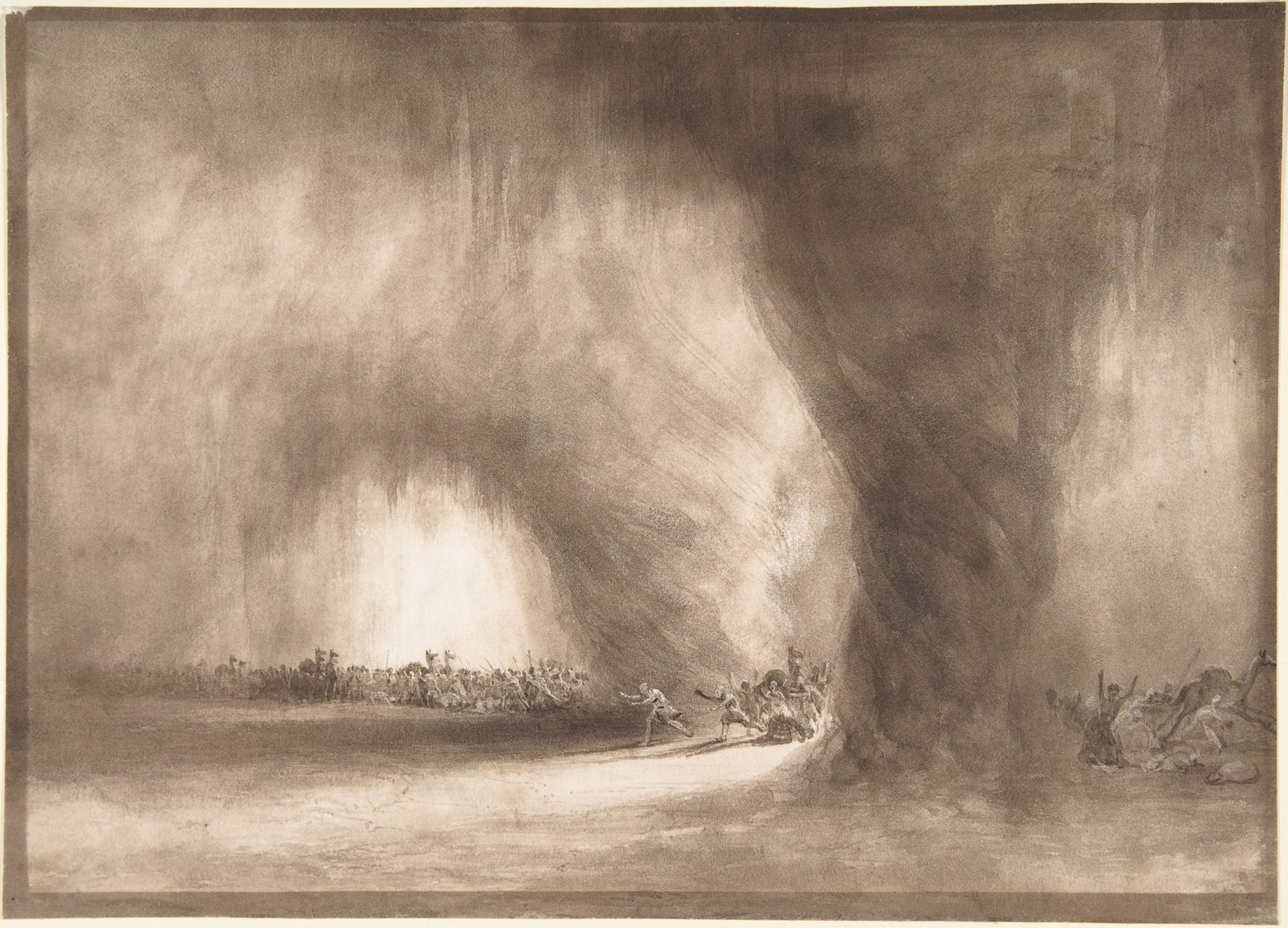
A Column of Oriental Travelers Scattered by a Dust Storm. William West, 1820-40. Wikimedia Commons. CC0.