
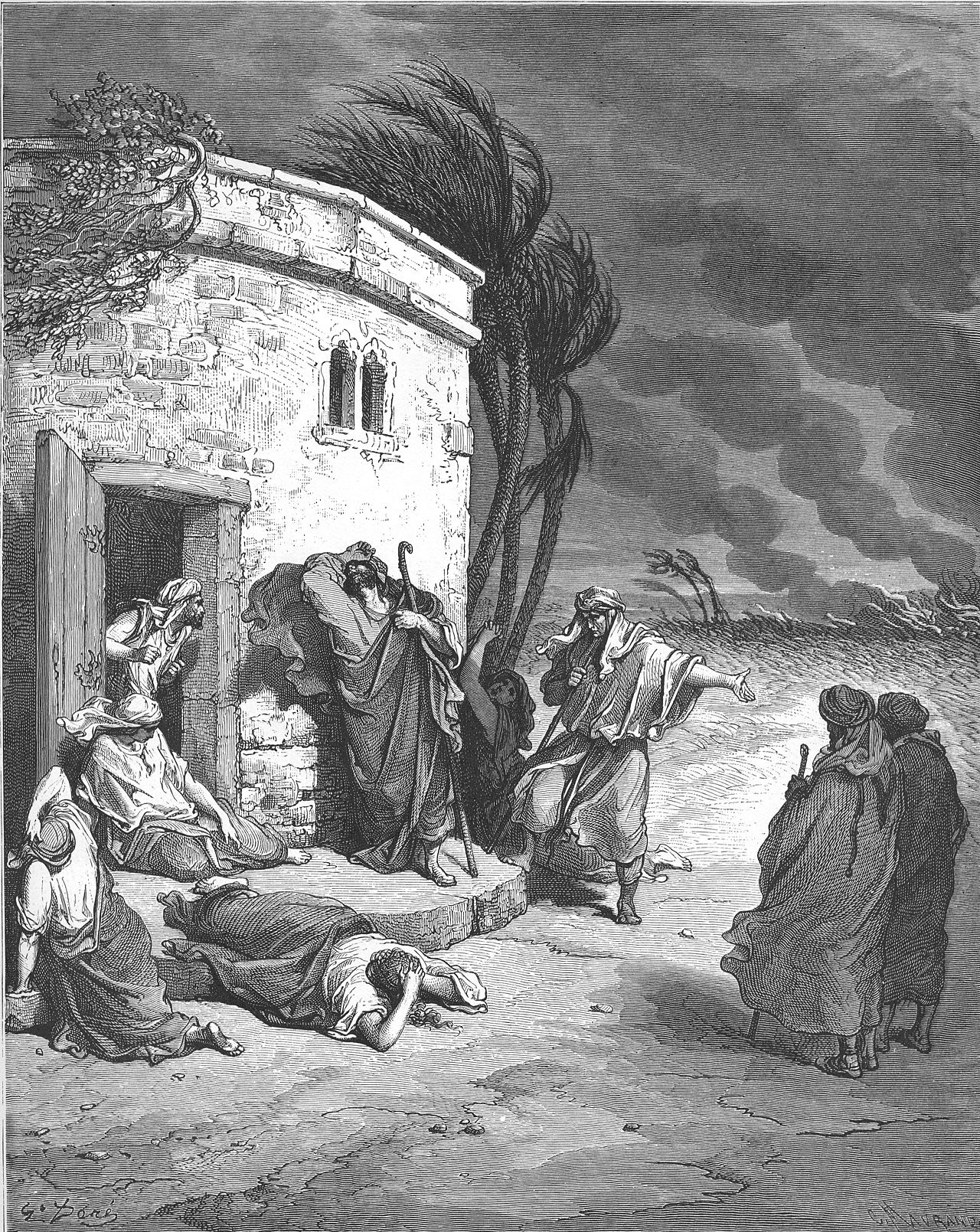
Jobchapter 10
22 verses · unknown · 10th century BC · Wisdom and poetry
You have granted me life and loving devotion, and Your care has preserved my spirit.
Introduction
unknown, Wisdom and poetry, Job Overview.
This chapter carries on Job's reply to Bildad, and now every word is spoken to God. Job speaks as a defendant who has been sentenced with no charge read. He also speaks as a creature to his maker, and he argues from the care that went into his own making. His hearers were herders who made cheese and potters who shaped clay, and he draws on both trades. Listen for the questions he puts to God and what each one assumes. The chapter ends on the same longing for rest that closed chapter 3.
Context
- Who
- Hearers who had asked God why and received nothing back
- What
- Job's complaint to God, asking for the charge against him, appealing to God's care in forming him, and pleading for a little relief before death.
- Where
- The ash heap outside Job's town, with the speech addressed wholly to God.
- When
- The continuation of Job's reply to Bildad in the first round of speeches.
- Why
- To hold God to His own workmanship and to press Job's claim of innocence before the one who made him.
Historical context
Job's language here is formal legal language turned on its head. He asks God not to condemn him but to 'show me wherefore thou contendest with me', the request of a defendant for the charge sheet. In an ancient trial at the town gate, the accuser stated the case and the accused answered it; Job's whole grievance is that he has been sentenced with no charge read.
Show the rest of the historical context, 3 more paragraphs
The picture of his own making is craft work. Thine hands have made me and fashioned me, the verb is a potter's word, and the same image appears wherever the ancient world imagined a god forming a human out of clay. He then switches to the dairy: poured out as milk and curdled like cheese, clothed with skin and flesh, knit together with bones and sinews. Milk left to separate and set was one of the most familiar processes in a herding household, and it is being used to describe a body forming in the womb.
'Thou huntest me as a fierce lion' brings in the other great image of that world, the royal lion hunt, where the animal is driven and cornered by beaters. Job casts himself as the quarry and God as the hunter who keeps renewing his witnesses against him.
The chapter ends where chapter 3 ended, asking for a little light before he goes to the land of darkness and the shadow of death, where the light is as darkness. That is the ancient picture of the grave, not annihilation, but a dim, silent, orderless place from which no one returns.
Significance
Job's argument to God is essentially: you made me carefully, on purpose, and you know I am not guilty, so what is this? He is holding God to God's own workmanship.
Show the rest of the significance, 1 more paragraph
Hearers were watching a man refuse two easy exits at once. He will not say God is unreal, and he will not say he himself is guilty. Holding both is what nearly tears him apart, and it is why the book calls him right at the end.
This chapter in Jewish lifeWhat this chapter is in Jewish life and reading.
What is done
The site's table assigns no reading to this chapter. Its probe of src/lib/hebraic/readings.ts printed parashot total 0 and haftarah uses total 0 for Job, with no festival reading.
The corpus ties the chapter to the study of the Torah portions at two verses. Under the twenty-second it carries Midrash Tanchuma at Bo 2:1 and 2:2, Ki Tavo 4:1 and Ki Tisa 33:4, with Midrash Tanchuma Buber, Bo 2:1. Under the twelfth it carries Midrash Tanchuma, Bamidbar 21:1 and Midrash Tanchuma Buber, Bamidbar 26:1. From the Talmud it carries Bava Batra 16a:12 under the seventh verse, Niddah 25a:26 under the tenth, Sukkah 21b:5 under the eleventh and Sanhedrin 91b:6 under the twelfth.
How it is read
Malbim is quoted here from Malbim's Job, translated by Jeremy I. Pfeffer (Ktav, 2003), which Sefaria reports as CC-BY. His notes on the second and the sixth verses carry the same words. In his reading Job renews one contention. It is that God "must have immutable foreknowledge of everything" by virtue of His perfection. On that view man has no free choice and should not be held responsible for what he does (Malbim on Job 10:2:1 and 10:6:1).
Rashi is quoted from The Judaica Press complete Tanach with Rashi, translated by A. J. Rosenberg, which Sefaria reports as CC-BY. He reads Job's soul as quarrelling with the fact that he is alive, and he takes the word from a verse in Ezekiel (Rashi on Job 10:1:1). Job's speech he reads as his trouble, which he cannot forget or restrain (Rashi on Job 10:1:2). The third verse he reads as a question put to God. Is it good to oppress the righteous man and rob him of his righteousness while shining on the council of the wicked, "to show them a friendly countenance?" (Rashi on Job 10:3:1).
The making of a man draws close glosses. Rashi takes the word for shaping from a mold, and he sets beside it a ruling in Tractate Shabbath on straightening an infant's limbs (Rashi on Job 10:8:1). The pouring like milk concerns the drop from which Job was born (Rashi on Job 10:10:1). The providence of the twelfth verse is "The providence of Your watch, for You appointed watchers for me" (Rashi on Job 10:12:1). God hid these things in His heart as though He did not remember them (Rashi on Job 10:13:1).
Then Job's complaint. If he sinned, God "laid Your eyes on me so as not to ignore [my sins] nor to forbear retaliation" (Rashi on Job 10:14:1). God hunts him and spreads a net for him as though he were as mighty as a lion (Rashi on Job 10:16:1). Job asks God to withdraw while he is still alive, so that he may rest before his time to die (Rashi on Job 10:20:1 and 10:21:1).
The corpus carries three further notes on this chapter without an English text, each marked linked because Sefaria holds no English version of the ref. They stand cited and unquoted at Metzudat David on Job 10:2:1, 10:4:1 and 10:11:1.
What the rabbis say
The corpus carries forty rabbinic locators on this chapter and the text of none, so each is cited here by ref alone. On the second verse it holds Midrash Lekach Tov, Numbers 12:9:1, Midrash Tehillim 26:2, Sifrei Bamidbar 104:1, Tractate Semachot 8:12 and Yalkut Shimoni on Torah 739:9. On the third it holds Pesikta Rabbati 24:1 and Vayikra Rabbah 23:12. On the seventh it holds Bava Batra 16a:12 and Ein Yaakov (Glick Edition), Bava Batra 1:36. On the eighth it holds Midrash Tehillim 119:20 and Otzar Midrashim, Midrash on Psalms, Addendum to Psalm 118 27. On the ninth it holds Yalkut Shimoni on Torah 547:4.
The tenth verse, the pouring like milk, draws eight. The corpus holds Bereshit Rabbah 14:5, Vayikra Rabbah 14:9, Niddah 25a:26 and Ein Yaakov, Niddah 3:4. With them stand Midrash Aggadah, Leviticus 12:2:4, Midrash Lekach Tov, Leviticus 12:2:2, Midrash Sekhel Tov, Bereshit 19:35:12 and Otzar Midrashim, Midrash on the Ten Commandments 1:34. On the eleventh it holds Midrash Sekhel Tov, Bereshit 18:8:1, Midrash Tehillim 143:1 and Sukkah 21b:5.
The twelfth verse draws nine. The corpus holds Bamidbar Rabbah 4:4, Bereshit Rabbah 34:10, Vayikra Rabbah 14:3 and Pesikta Rabbati 42:1. With them stand Sanhedrin 91b:6, Ein Yaakov, Sanhedrin 11:8 and Ein Yaakov (Glick Edition), Sanhedrin 11:11, and the two Bamidbar passages of the Tanchuma named above.
The twenty-second verse draws eight. The corpus holds Aggadat Bereshit 61:1, Ein Yaakov (Glick Edition), Sotah 9:20 and Ein Yaakov, Sotah 9:22, with the five Tanchuma passages named above. What each of them teaches is a saying of the rabbis, and is reported as theirs wherever this site quotes one. The quotations wait on a fetch that carries the text.
Sources: Malbim, Malbim on Job 10:2:1 and 10:6:1, Malbim's Job, trans. Jeremy I. Pfeffer, Ktav, 2003, reported CC-BY; Rashi, Rashi on Job 10:1:1 to 10:22:1, The Judaica Press complete Tanach with Rashi, translated by A. J. Rosenberg, reported CC-BY; Metzudat David, Metzudat David on Job 10:2:1, 10:4:1 and 10:11:1, cited by ref because the corpus carries no English text; The Sefaria corpus, scripts/data/sources/sefaria/job/10.json, the 40 Talmud and Midrash locators of this chapter; The site's own files, src/lib/hebraic/readings.ts, printing no portion, no Haftarah and no festival reading for this book.
The heads below are this chapter's scenes. The numbered points under each are its verses.
Job: Thy Hands Have Fashioned Me: Wilt Thou Destroy Me?
Job 10:1-2
"I loathe my own life" turns lament into a legal petition, the demand of a defendant: "Let me know why You prosecute me". The verb prosecute is the language of a lawsuit, with God cast as the party Job must answer without ever hearing the indictment.
Job 10:1
“My soul is weary of my life - compare the note at Job 7:16. The margin here is, Or,” cut off while I live.” The meaning in the margin is in accordance with the interpretation of Schultens. The Chaldee also renders it in a similar way: אתגזרת נפשי - my soul is cut off. But the more correct interpretation is that in our common version; and the sense is, that his soul, that is, that he himself was disgusted with life. It was a weary burden, and he wished to die.”
Let me know why You prosecute me: Job asks God to name the charge before He will condemn him. Barnes reads the plea as a protest against being held wicked with no reason shown. Wesley adds that when God contends with a man there is always a reason.
Job 10:2
“I will say unto God, Do not condemn me; shew me wherefore Thou so judgest me. Whereas he declares himself a sinner 'in the bitterness of his soul,' what else does he say to God, but that he may not be condemned, in that the bitterness of his present penance does away with the pains of ensuing wrath? Now God judgeth man in this life in two ways, seeing that either by present ills He is already beginning to bring upon him the torments to come, or else by present scourges He does away with the torments to come.”
Gregory the Dialogist · written before 604 · Morals on the Book of Job, Book IXpatristic
Job 10:3-4
Does it please You to oppress me: Job asks whether it pleases God "to oppress me, to reject the work of Your hands and favor the schemes of the wicked". "Do You have eyes of flesh" presses the point further, asking whether God's judgment of him is as shortsighted as a human accuser's would be.
Do You have eyes of flesh?: Eyes of flesh see only the surface. Jamieson, Fausset and Brown hear Job asking whether God sees him with the same uncharitable eyes as his friends, who read his affliction as proof. Wesley answers that darkness hides nothing from the eyes of God.
Job 10:4
“Hast thou eyes of flesh? - Eyes like man. Dost thou look upon man with the same disposition to discern faults; the same uncharitableness and inclination to construe everything in the severest manner possible, which characterizes man? Possibly Job may have reference here to the harsh judgment of his friends, and means to ask whether it could be possible for God to evince the same feelings in judging of him which they had done.”
Job 10:5-7
Are Your days like those of a mortal: l" asks whether God investigates him the way a mortal judge must. Job closes on a claim he never withdraws, "though You know that I am not guilty," beside "there is no deliverance from Your hand".
Job 10:5
“Are thy days as the days of man - Does thy life pass on like that of man? Dost thou expect soon to die, that thou dost pursue me in this manner, searching out my sins, and afflicting me as if there were no time to lose? The idea is, that God seemed to press this matter as if he were soon to cease to exist, and as if there were no time to spare in accomplishing it.”
search out my sin—: Job pictures God searching his days for a hidden sin. Aquinas compares the search to a court that seeks iniquity by torture, with each affliction serving as a question. Clarke hears Job asking why God should search so closely into one mortal.
Job 10:6
“He continues, "That you should interrogate me about my evildoing and examine my sin," to investigate through tribulations if I have sinned in my work or am evil in my thought, like men investigate criminal guilt using torture.”
Thomas Aquinas · written before 1274 · Commentary on Jobpatristic
though You know that I am not guilty: Here is the knot of Job's complaint. God already knows his innocence, yet the search goes on. Barnes notes that Job claims freedom from the hypocrisy his friends charge him with, and never claims to be sinless, as Job 9:20 shows.
Job 10:7
“Thou knowest that I am not wicked - That is, that I am not a hypocrite, or an impenitent sinner. Job did not claim perfection (see the note at Job 9:20), but he maintained through all this argument that he was not a wicked man, in the sense in which his friends regarded him as such, and for the truth of this he could boldly appeal to God. The margin is, “It is upon thy knowledge.” This is a literal translation of the Hebrew, but the sense is well expressed in the text.”
Job 10:8-12
Your hands shaped me and altogether formed me: "Your hands shaped me" opens an argument from workmanship to care. "Your care has preserved my spirit" turns toward tenderness, the Hebrew carrying the sense of watchful, sustaining care. A potter who shaped the vessel so closely has no reason to smash it, and Job puts that question to God.
Job 10:8
“Thine hands have made me and fashioned me, altogether round about: and dost Thou thus suddenly cast me down? As if He said to Him in humility; 'Whereas that which I have done being submitted to a just examination is not meet for the propitiating of Thee, consider in Thy mercy lest that should perish which is Thy doing.' By which same words too the wicked doctrine of Manichaeus is destroyed, who feigning that there are two Principles, strives to maintain that the spirit was made by God, but the flesh by Satan.”
Gregory the Dialogist · written before 604 · Morals on the Book of Job, Book IXpatristic
1 more voice on this verse
Job 10:8
“Thine hands have made me - Thou art well acquainted with human nature, for thou art its author. And fashioned me together round about - All my powers and faculties have been planned and executed by thyself. It is thou who hast refined the materials out of which I have been formed, and modified them into that excellent symmetry and order in which they are now found; so that the union and harmony of the different parts, (יחד yachad), and their arrangement and completion, (סביב sabib), proclaim equally thy wisdom, skill, power, and goodness.”
Adam Clarke · Commentary on the Bible (1810-1826)evangelical
You molded me like clay: Barnes hears an echo of Genesis 2:7, where God formed man from the dust. Matthew Henry notes that the saints have prayed the same way at Isaiah 64:8, where God is the potter. The potter who shaped the vessel is asked why he would grind it back to dust.
Job 10:9
"Thou hast made me, as the clay, by an act of sovereignty; and wilt thou by a like act of sovereignty unmake me again? If so, I must submit." 3. "Wilt thou destroy the work of thy own hands?" It is a plea the saints have often used in prayer, We are the clay and thou our potter, Isa. lxiv.
Matthew Henry · Commentary on the Whole Bible (1707-1721)puritan
curdle me like cheese?: Milk poured out and curdled like cheese pictures the body formed in the womb. Clarke and Gregory read it of conception, the seed thickening into flesh, and Jamieson, Fausset and Brown set it beside Psalm 139:15-16. Job credits his own shaping to the hands of God.
Job 10:10
“In the organization of the body from its rude commencements, the original liquid gradually assumes a more solid consistency, like milk curdling into cheese (Ps 139:15, 16). Science reveals that the chyle circulated by the lacteal vessels is the supply to every organ.”
Jamieson, Fausset & Brown · Commentary Critical and Explanatory on the Whole Bible (1871)reformed
1 more voice on this verse
Job 10:10
“Hast thou not poured me out as milk - After all that some learned men have said on this subject, in order to confine the images here to simple nutrition, I am satisfied that generation is the true notion. Respicit ad fetus in matris utero primam formationem, quum in embryonem ex utriusque parentis semine coalescit - Ex semine liquido, lac quodammodo referente, me formasti - In interpretando, inquit Hieronymus, omnino his accedo qui de genitali semine accipiunt, quod ipsa tanquam natura emulget, ac dein concrescere in utero ad coalescere jubet. I make no apology for leaving this untranslated.”
Adam Clarke · Commentary on the Bible (1810-1826)evangelical
knit me together with bones and sinews: In Matthew Henry's picture, skin and flesh clothe the body, and bones and sinews are its armour. Barnes reads the verse as the child formed in the womb. Every part of Job came from the hands of God.
Job 10:11
“Thou hast clothed me with skin and flesh - This refers, undoubtedly, to the formation of man in his foetal existence, and is designed to denote that the whole organization of the human frame was to be traced to God. Grotius remarks that this is the order in which the infant is formed - that the skin appears first, then the flesh, then the harder parts of the frame. On this subject, the reader may consult Dunglison’s Physiology, vol. ii. p. 340ff. And hast fenced me - Margin, Hedged. Literally, Hast covered me. The sense is plain.”
1 more voice on this verse
Job 10:11
“Here [Job] foreshadows the incarnation of the divine Word through the assumption of human nature. These words, in fact, appear to be addressed to the Father, as if they were said by the person [the Son] of the Lord.”
Ephrem the Syrian · written before 373 · Commentary on Job 10:11-12patristic
Your care has preserved my spirit: Verse 12 moves from the flesh to the life God granted and preserved. Wesley reads care as God's daily watch over a life open to danger, and Gregory adds that gifts are kept only by the Giver's care. Job remembers this loving devotion while God seems to destroy him.
Job 10:12
“Thou hast granted me life and favorer - Thou hast brought me from my mother’s womb; given me an actual existence among men; by thy favor or mercy thou hast provided me with the means of life; and thy visitation - thy continual providential care, has preserved me in life - has given me the air I breathe, and furnished me with those powers which enable me to respire it as an agent and preserver of life.”
Adam Clarke · Commentary on the Bible (1810-1826)evangelical
1 more voice on this verse
Job 10:12
“IT is well, sometimes, to sit down and take a grateful review of all that God has done for us, and with us, from our first day until now. We must not be like hogs under the oak, that eat the acorns but never thank the tree, or the Lord who made it grow. We must not receive the dew and yet never think of the Heaven from which it comes. To be ungrateful is to be unmanly—to be ungrateful to God is to commit high treason against the majesty of His goodness.”
Charles Spurgeon · written before 1892 · The Metropolitan Tabernacle Pulpit, Sermon No. 2314: “Three Blessings of the Heavenly Charter” (lightly modernized text, CCEL edition)Particular Baptist
Job: Let Me Alone, That I May Take Comfort a Little
Job 10:13-14
Yet You concealed these things in Your heart: t" accuses God of hiding a settled purpose. "If I sinned, You would take note, and would not acquit me of my iniquity" extends the charge. The frame of chapters 1 and 2 shows the complaint true in a sense Job cannot see.
Job 10:13
“And these things hast thou hid in thine heart - This may either refer to the arrangements by which God had made him, or to the calamities which he had brought upon him. Most expositors suppose that the latter is intended. Such is the opinion of Rosenmuller, Good, Noyes, and Scott. According to this the idea is, that God had purposed in his heart to bring these calamities upon him. They were a part of his counsel and design. To hide in the heart, or to lay up in the heart, is a phrase expressive of a secret purpose.”
If I sinned, You would take note: Job states what he believes God concealed in His heart in verse 13. Clarke reads it this way: nothing is hidden from God, and He will not acquit a man He knows to be guilty. Job feels watched for every sin.
Job 10:14
“If I sin - The object of this verse and the following is, evidently, to say that he was wholly perplexed. He did not know how to act. He could not understand the reason of the divine dealings, and he was wholly unable to explain them, and hence, he did not know how to act in a proper manner. It is expressive of a state of mind where the individual wishes to think and feel right, but where he finds so much to perplex him, that he does not know what to do.”
3 more voices on this verse
Job 10:14
“If I have sinned, and Thou sparedst me at the hour, wherefore dost Thou not let me be clean from mine iniquity? The Lord 'spareth sin at the hour,' when the moment that we yield tears, He does away with the guilt of sin.”
Gregory the Dialogist · written before 604 · Morals on the Book of Job, Book IXpatristic
Job 10:14
“Conscience, thy deputy, will be sure to upbraid me with it, and to tell me that this gripe, this twitch of pain, is to punish me for that." If God should thus mark iniquities, we should be undone; but we must acknowledge the contrary, that, though we sin, God does not deal in extremity with us.”
Matthew Henry · Commentary on the Whole Bible (1707-1721)puritan
Job 10:14
“If I sin - From thee nothing can be hidden; if I sin, thou takest account of the transgression, and canst not hold me for innocent when thou knowest I am guilty.”
Adam Clarke · Commentary on the Bible (1810-1826)evangelical
Job 10:15-17
If I am guilty, woe to me!: " and "even if I am righteous, I cannot lift my head" state the trap closing on Job. "You would hunt me like a lion" pictures relentless pursuit. "Hardships assault me in wave after wave" pictures a besieging army sent in successive companies.
Job 10:15
“If I be wicked, woe unto me; and if I be righteous, yet will I not lift up my head: I am full of affliction and misery. Yea, the wicked man has 'woe,' and the righteous man 'affliction,' in that both everlasting damnation follows the lost sinner, and each one of the Elect is purified by the pains of temporary affliction. The wicked man lifts up his head, yet when so lifted up he cannot escape the woe that pursues him.”
Gregory the Dialogist · written before 604 · Morals on the Book of Job, Book IXpatristic
1 more voice on this verse
Job 10:15
“If I be wicked, woe unto me - The meaning of this in this connection is, “I am full of perplexity and sorrow. Whether I am wicked or righteous, I find no comfort. Whatever is my character, my efforts to be happy are unavailing, and my mind is full of anguish. Woe follows if I have been guilty of sin; and if I am not a sinful man, I am equally incapable of enjoyment. In every way I am doomed to wretchedness.” And if I be righteous, yet will I not lift up my head.”
You would hunt me like a lion: Barnes reads the Hebrew verb, which means to lift up, of Job's head raised in confidence. Should Job rise at all, God stalks him like a lion. Matthew Henry notes that the sense of God's anger made these troubles taste so bitter.
Job 10:16
“For it increaseth - Probably this refers to the affliction mentioned above, which is increased in proportion to its duration. Every day made his escape from such a load of evils less and less probable. Thou huntest me as a fierce lion - As the hunters attack the king of beasts in the forest, so my friends attack me. They assail me on every side. Thou showest thyself marvelous - Thy designs, thy ways, thy works, are all incomprehensible to me; thou dost both confound and overpower me.”
Adam Clarke · Commentary on the Bible (1810-1826)evangelical
1 more voice on this verse
Job 10:16
“God was not only strange to him, but showed himself marvellous upon him, by bringing him into uncommon troubles and so making him prodigy, a wonder unto many. All wondered that God would inflict and that Job could bear so much. That which made his afflictions most grievous was that he felt God's indignation in them; it was this that made them taste so bitter and lie so heavy.”
Matthew Henry · Commentary on the Whole Bible (1707-1721)puritan
You produce new witnesses against me: Clarke observes that almost every term in this complaint belongs to a court of law. Barnes takes the witnesses as Job's new hardships, which his friends read as God's own witness that he was wicked. The last line pictures wave after wave of troops.
Job 10:17
“Thou renewest Thy witnesses against me, and multipliest Thy wrath: and pains war in me. HISTORICAL INTERPRETATION For 'God's witnesses' are they, who bear witness by the practice of holy works, what are the rewards of Truth that shall overtake the Elect. Hence too those, whom we see to have suffered for the sake of the Truth, we style in the Greek tongue, 'Martyrs,' i.e. witnesses. And the Lord says by John in the Angel's voice, Even in those days, wherein Antipas was my faithful witness, who was slain among you.”
Gregory the Dialogist · written before 604 · Morals on the Book of Job, Book IXpatristic
1 more voice on this verse
Job 10:17
“Thou renewest thy witnesses against me - Margin, “that is, plagues.” The Hebrew is, “thy witnesses” - עדיך ‛ēdeykā. So the Vulgate. The Septuagint is, “renewing against me my examination,” τὴν ἐξέτασίν μου tēn ecetasin mou. Rabbi Levi supposes that the plague of the leprosy is intended. But the true meaning seems to be, that God sent upon him calamities which were regarded by his friends as “proofs” or “witnesses” that he was wicked, the public and solemn attestation of God, as they supposed, to the truth that he was eminently a bad man.”
Job 10:18-19
Why then did You bring me from the womb?: " returns to the death wish, now aimed at God where chapter 3 cursed the day itself. "Oh, that I had died, and no eye had seen me" carries the wish back before birth.
carried from the womb to the grave: Job returns to the wish of Job 3:16, the stillborn child who never sees the light. Clarke reads it as a life ended, as though it had never been, and Gill likens it to a birth buried and forgotten. Job wishes his life had never come to be.
Job 10:19
“Wherefore then hast Thou brought me forth out of the womb. Oh that I had been consumed, and no eye had seen me. Which same sentiment he had already uttered in his first speech, saying, Why died I not from the womb? and whilst he subjoins that which he adds here, I should have been as though I had not been, I should have been carried from the womb to the grave; he adds in other words, but no other sense, saying, Or as a hidden untimely birth I had not been, as infants which never saw light.”
Gregory the Dialogist · written before 604 · Morals on the Book of Job, Book IXpatristic
Job 10:20-22
Are my days not few?: "Withdraw from me, that I may have a little comfort" asks a small mercy before an end Job assumes is near and final. He pictures "a land of utter darkness, of deep shadow and disorder, where even the light is like darkness," death as he understands it.
Barnes finds here an early picture of the grave as a land of total darkness. Clarke notes how the gloomy, broken terms suit a place so little known. Matthew Henry adds that the grave holds no work, no praise and no light.
Job 10:21
“Before I go - from where “I shall not return.” To the grave, to the land of shades, to “That undiscovered country, from whose bourne No traveler returns.” To the land of darkness - This passage is important as furnishing an illustration of what was early understood about the regions of the dead. The essential idea here is that it was a land of darkness, of total and absolute night. This idea Job presents in a great variety of forms and phrases.”
1 more voice on this verse
Job 10:21
“Secondly, That there is no light there. In the grave there is thick darkness, darkness that cannot be felt indeed, yet cannot but be feared by those that enjoy the light of life. In the grave there is no knowledge, no comfort, no joy, no praising God, no working out our salvation, and therefore no light.”
Matthew Henry · Commentary on the Whole Bible (1707-1721)puritan
Jamieson, Fausset and Brown count three Hebrew words for darkness in verses 21 and 22, each deeper than the last. Barnes traces the second to a root meaning to cover, as with wings. In that land even the light is gloom and disorder.
Job 10:22
“Where the light is as darkness - A palpable obscure: it is space and place, and has only such light or capability of distinction as renders “darkness visible.” The following words of Sophocles convey the same idea: Ιω σκοτος εμοι φαος; “Thou darkness be my light.””
Adam Clarke · Commentary on the Bible (1810-1826)evangelical
1 more voice on this verse
Job 10:22
“Three Hebrew words are used for darkness; in Job 10:21 (1) the common word "darkness"; here (2) "a land of gloom" (from a Hebrew root, "to cover up"); (3) as "thick darkness" or blackness (from a root, expressing sunset). "Where the light thereof is like blackness." Its only sunshine is thick darkness.”
Jamieson, Fausset & Brown · Commentary Critical and Explanatory on the Whole Bible (1871)reformed
Keep studying
Sources for this chapter
The summary
Jamieson, Fausset & Brown, Commentary Critical and Explanatory; John Wesley, Notes on the Old Testament and Matthew Henry, Complete Commentary.
The exposition
A. B. Davidson, The Book of Job, Cambridge Bible; Adam Clarke, Commentary on the Bible; Albert Barnes; Franz Delitzsch, Biblical Commentary on the Book of Job; Gregory the Dialogist, Morals on the Book of Job; Jamieson, Fausset & Brown, Commentary Critical and Explanatory on the Whole Bible; John Gill, Exposition of the Old Testament; John Wesley, Explanatory Notes upon the Old Testament; Matthew Henry, Commentary on the Whole Bible and Thomas Aquinas, Commentary on Job.