
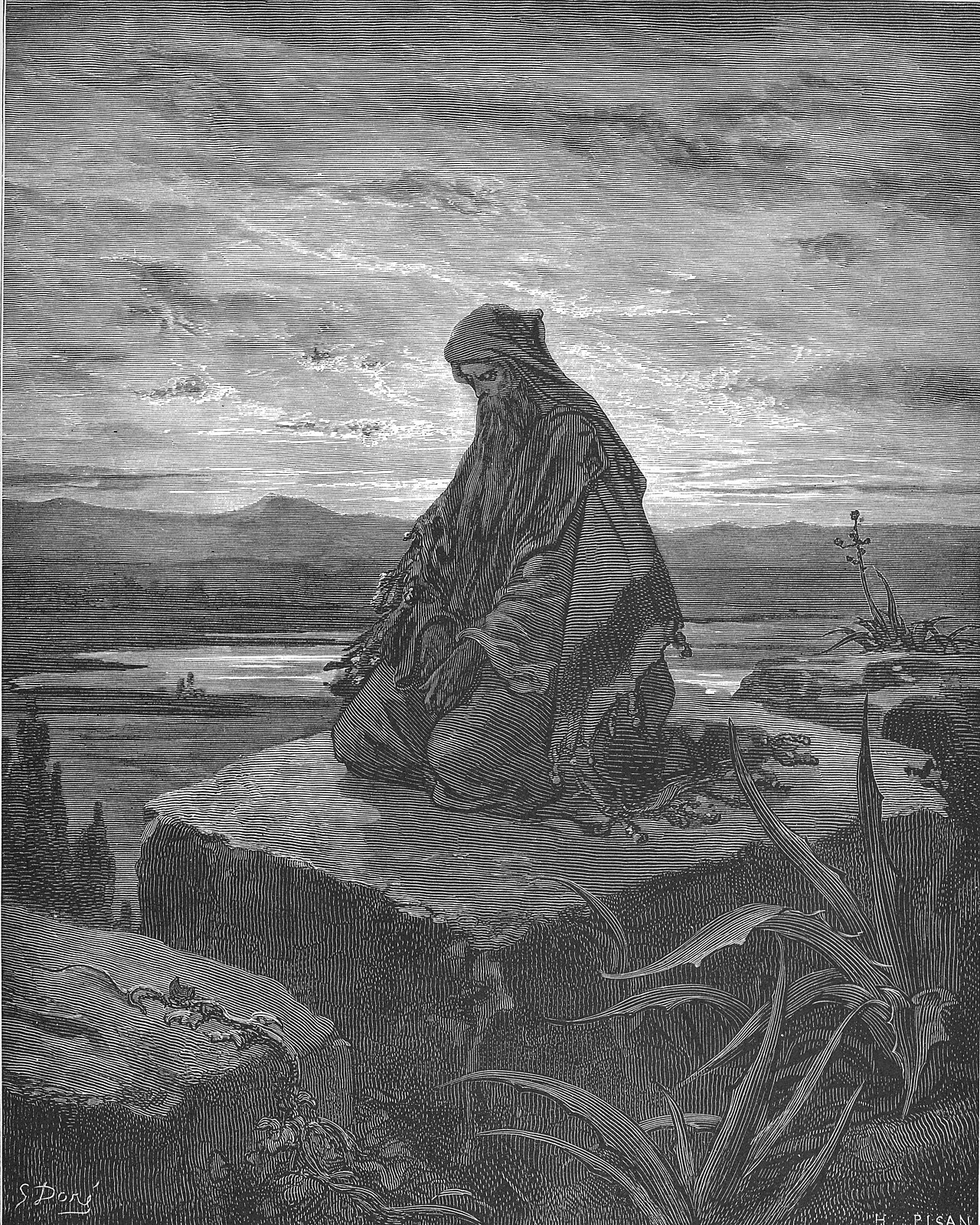
Isaiahchapter 38
22 verses · Isaiah · 8th century BC · The Prophets
I will make the sun’s shadow that falls on the stairway of Ahaz go back ten steps.’” So the sunlight went back the ten steps it had descended.
Introduction
Isaiah, The Prophets, Isaiah Overview.
This chapter tells of King Hezekiah's illness and recovery, and in time it comes before the siege of chapters 36 and 37. The account also stands in 2 Kings 20, and Isaiah alone keeps the poem Hezekiah wrote afterwards. The king had no heir, and the Assyrian threat was growing. The chapter sets a prophet's word, a sign read from a shadow on a stairway and a simple remedy side by side. Listen for how Hezekiah speaks of death from inside it, and for what he says the living can do.
Context
- Who
- A people whose king had no heir and whose enemy was on the way
- What
- Hezekiah's mortal illness, his prayer, the promise of fifteen more years with the sign of the shadow, and the psalm he wrote after he recovered.
- Where
- The king's sickroom in the palace in Jerusalem, with the stairway of Ahaz outside.
- When
- About 703 BC, before Sennacherib's invasion, since the fifteen added years run to Hezekiah's death about 686 BC.
- Why
- To show that God hears prayer and sees tears, and to record the thanks of a man brought back from the edge of death.
Historical context
The illness is described with a physical detail: a boil, treated with a lump of pressed figs laid on it. Fig poultices were standard medicine across the ancient Near East for drawing an inflamed sore, and prescriptions using them survive in Egyptian and Mesopotamian medical texts. The prophet who announces the healing is also the one who calls for the plaster, the miracle and the medicine sit in the same paragraph without embarrassment.
Show the rest of the historical context, 4 more paragraphs
The sign involves the steps of Ahaz. The Hebrew word means steps or degrees, not a dial in the Greek sense, and the likeliest thing being described is a staircase built so that a shadow moved down it through the day, marking the hours, a stair clock. Ahaz, who had brought in a foreign altar design from Damascus, is a plausible builder of an imported timekeeping device.
The order of the chapters matters. Hezekiah is given fifteen more years, and his death falls about 686 BC, so this sickness belongs around 703 BC, before the invasion of chapters 36 and 37, not after. Isaiah has arranged the four narrative chapters by theme rather than by date, ending with the Babylonian envoys so the book can pivot toward Babylon.
Hezekiah's written psalm afterwards uses two crafts. My life is cut off like a weaver cutting the cloth from the loom, the finished web severed from the beam, the work simply over. And my dwelling is taken down and carried away like a shepherd's tent, folded up at dawn and moved. He also describes his own sounds in illness: chattering like a swift, moaning like a dove, eyes worn out with looking upward.
The last request is telling: he asks for the sign so he can go up to the house of the LORD, and the psalm ends with singing to stringed instruments there all the days of our life. Recovery meant getting back into the temple.
Significance
Israel's Scriptures said little about what happens after death, and this psalm says so honestly: the grave cannot praise you, death cannot celebrate you, those who go down to the pit cannot hope for your truth. The living, the living, he shall praise you.
Show the rest of the significance, 1 more paragraph
For the first hearers, that was the shape of hope, not detailed, but definite. God took a man off his deathbed because a father tells his children the truth.
This chapter in Jewish lifeWhat this chapter is in Jewish life and reading.
What is done
No part of this chapter is read aloud in the synagogue. The site's own table in src/lib/hebraic/readings.ts printed parashot 0 and haftarah uses 0 for Isaiah 38, and no festival reading for the book. The table records Isaiah only as a source of Haftarot, and none of the Haftarot it records reaches this chapter.
The chapter is met instead in the study of the weekly portions, and the corpus names the doors. Under the eighth verse it carries Midrash Tanchuma, Vaera 3:1. Under the eleventh verse it carries Midrash Tanchuma Buber, Chukat 39:1 and Midrash Tanchuma, Chukat 16:1. Under the eighteenth verse it carries Midrash Tanchuma Buber, Vayechi 8:1. Each of those locators is named for the Torah portion whose study it belongs to.
How it is read
Rashi is quoted here from The Judaica Press complete Tanach with Rashi, translated by A. J. Rosenberg, which Sefaria reports as CC-BY, and Ibn Ezra from the Commentary of Ibn Ezra on Isaiah translated by M. Friedlander in 1873, which Sefaria reports as public domain. Rashi dates Hezekiah's illness by the fall of Sennacherib. He fell ill three days before it. The third day, when he went up to the house of the Lord, "was the day of Sennacherib's downfall, and it was the first festive day of Passover" (Rashi on Isaiah 38:1:1). The sentence of death he reads through Berachoth 10b: Hezekiah would die in this world and have no life in the world to come, because he had not married (Rashi on Isaiah 38:1:2).
The sign of the shadow going back ten steps answers the question 2 Kings 20:8 gives in Hezekiah's mouth (Rashi on Isaiah 38:7:1). The writing that follows is a thanksgiving, which Jonathan renders "A writing of thanksgiving for the miracle performed for Hezekiah" (Rashi on Isaiah 38:9:1). Rashi adds a reason for the king's despair: "until that day, no sick person had recovered" (Rashi on Isaiah 38:10:1).
At the seventeenth verse Rashi gives the reading of the Sages and then his own. The Sages hear bitterness in the good news, because Hezekiah's healing rested on the merit of David and so taught him that he was a sinner. Rashi's plain reading is that the promise of rescue came while he was near death, and he could not rejoice in it (Rashi on Isaiah 38:17:1). The living thank God at the nineteenth verse, living one to living One (Rashi on Isaiah 38:19:1). The cake of figs is a pressed cake (Rashi on Isaiah 38:21:1). The sign he asks for at the end is the sign that he will go up to the house of the Lord (Rashi on Isaiah 38:22:1).
The corpus carries three further notes on this chapter without an English text, each marked linked because Sefaria holds no English version of the ref. They stand cited and unquoted at Malbim on Isaiah 38:2:1 and 38:3:1 and at Metzudat David on Isaiah 38:5:1.
What the rabbis say
The corpus carries forty rabbinic locators on this chapter and the text of none, so each is cited by ref here and none is quoted or paraphrased. On the first verse it holds Berakhot 10a:27, Bereshit Rabbah 61:4 and Bereshit Rabbati, Parashat Miketz 55. On the second verse it holds Aggadat Bereshit 11:2, Aggadat Bereshit 9:3 and Berakhot 10b:2. On the third verse it holds Berakhot 10b:4 and Midrash Sekhel Tov, Bereshit 21:17:1. On the fifth verse it holds Devarim Rabbah 1:13, Ein Yaakov (Glick Edition), Yevamot 4:2 and Kohelet Rabbah 3:2:3. On the eighth verse it holds Ein Yaakov (Glick Edition), Sanhedrin 11:37, Midrash Tanchuma, Vaera 3:1 and Sanhedrin 96a:11.
On the ninth verse it holds Bereshit Rabbah 65:9, Otzar Midrashim, Midrash Shelosha v'Arba'ah 1:5 and Yalkut Shimoni on Torah 105:2. On the tenth verse it holds Pesikta Rabbati 24:1. On the eleventh verse it holds Bamidbar Rabbah 19:18, Midrash Tanchuma Buber, Chukat 39:1 and Midrash Tanchuma, Chukat 16:1. On the twelfth verse it holds Ein Yaakov (Glick Edition), Nedarim 4:9, Ein Yaakov, Nedarim 4:11 and Midrash Tehillim 26:2. On the fourteenth verse it holds Berakhot 56b:14, Midrash Lekach Tov, Exodus 12:27:2 and Midrash Tehillim 119:30.
On the sixteenth verse it holds Berakhot 55a:9 and Berakhot 57b:14. On the seventeenth verse it holds Berakhot 10b:13 and Ein Yaakov (Glick Edition), Berakhot 1:53. On the eighteenth verse it holds Aggadat Bereshit 82:1 and Midrash Tanchuma Buber, Vayechi 8:1. On the nineteenth verse it holds Midrash Lekach Tov, Genesis 2:6:7 and Midrash Tannaim on Deuteronomy 17:6:11. On the twentieth verse it holds Aggadat Bereshit 60:1 and Eikhah Rabbah 1:23.
On the twenty-first verse it holds Mekhilta DeRabbi Shimon Ben Yochai 15:25 and Mekhilta DeRabbi Yishmael, Tractate Vayassa 1:17. On the twenty-second verse it holds Midrash Lekach Tov, Exodus 3:12:3. What each of them teaches is a saying of the rabbis, and it is reported as theirs wherever this site quotes one. The quotations wait on a fetch that carries the text.
Sources: Rashi, Rashi on Isaiah 38:1:1 to 38:22:1, The Judaica Press complete Tanach with Rashi, translated by A. J. Rosenberg, reported CC-BY; Ibn Ezra, Ibn Ezra on Isaiah 38:20:1 to 38:20:1, Commentary of Ibn Ezra on Isaiah, translated by M. Friedlander, 1873, reported public domain; Malbim, Malbim on Isaiah 38:2:1 and 38:3:1, cited by ref because the corpus carries no English text; Metzudat David, Metzudat David on Isaiah 38:5:1, cited by ref because the corpus carries no English text; The Sefaria corpus, scripts/data/sources/sefaria/isaiah/38.json, the 40 Talmud and Midrash locators of this chapter; The site's own files, src/lib/hebraic/readings.ts, printing no portion, no Haftarah and no festival reading for this chapter, and src/data/bible/chapter-verse-counts.json for the verse count.
The heads below are this chapter's scenes. The numbered points under each are its verses.
Set Thine House in Order: the Shadow Goes Back Ten Steps
Isaiah 38:1-3
Isaiah brings a sentence with no condition attached: Put your house in order, for you are about to die. Hezekiah turned his face to the wall and prayed, pleading how I have walked before You faithfully. Hezekiah wept bitterly, and the text records his weeping without a word of rebuke.
Isaiah 38:1
“In those days - That is, his sickness commenced about the period in which the army of Sennacherib was destroyed. It has been made a question whether the sickness of Hezekiah was before or after the invasion of Sennacherib. The most natural interpretation certainly is, that it occurred after that invasion, and probably at no distant period. The only objection to this view is the statement in Isa 38:6, that God would deliver him out of the hand of the king of Assyria, which has been understood by many as implying that he was then threatened with the invasion.”
Hezekiah turned his face to the wall: Jerome gives two readings of the wall. Hezekiah could not go to the temple, so he turned toward the temple wall beside the palace, or to the wall of his own heart. Both readings send his prayer to the LORD alone.
Isaiah 38:2
“Then Hezekiah turned his face toward the wall - The furniture of an eastern divan or chamber, either for the reception of company or for private use, consists chiefly of carpets spread on the floor in the middle; and of sofas, or couches ranged on one or more sides of the room, on a part raised somewhat above the floor. On these they repose themselves in the day, and sleep at night. It is to be observed that the corner of the room is the place of honor.”
Adam Clarke · Commentary on the Bible (1810-1826)evangelical
And Hezekiah wept bitterly: Jamieson, Fausset and Brown give the reason Hezekiah wept bitterly from Jewish history: the king was childless and would leave the throne without an heir. The promise of a son for David hung on this sick man. The LORD saw those tears.
Isaiah 38:3
“And said, Remember now, O Lord, I beseech thee - The object which Hezekiah desired was evidently that his life might be spared, and that he might not be suddenly cut off. He therefore makes mention of the former course of his life, not with ostentation, or as a ground of his acceptance or justification, but as a reason why his limb should not be cut off. He had not lived as many of the kings of Israel had done. He had not been a patron of idolatry. He had promoted an extensive and thorough reformation among the people.”
1 more voice on this verse
Isaiah 38:3
“The letter of the Old Testament legal righteousness was, however, a standard very much below the spirit of the law as unfolded by Christ (Mt 5:20-48; 2Co 3:6, 14, 17). wept sore--JOSEPHUS says, the reason why he wept so sorely was that being childless, he was leaving the kingdom without a successor.”
Jamieson, Fausset & Brown · Commentary Critical and Explanatory on the Whole Bible (1871)reformed
Isaiah 38:4-6
the word of the LORD came to Isaiah: The sentence is reversed before Isaiah has left the palace, and the answer comes from the LORD, the God of your father David. The years are counted, I will add fifteen years. The same word joins the king's life to the city's safety, I will deliver you and this city.
Isaiah 38:4
“Then came the word of the Lord - In the parallel place in 2Ki 20:4, it is said, ‘And it came to pass, afore Isaiah was gone out into the middle court, that the word of the Lord came unto him.’ That is, the message of God name to Isaiah before he had left Hezekiah; or as soon as he had offered his prayer. This circumstance is omitted by Isaiah on the revision of his narrative which we have before us. But there is no contradiction.”
I have seen your tears: answers verse 3, and Jamieson, Fausset and Brown set it beside Psalm 56:8, where God keeps tears in his bottle. They set the fifteen years beside Genesis 5:27, where even the longest life is counted in days. The LORD numbers both.
Isaiah 38:5
“When Hezekiah, king of Judah, was still sick and weeping, there came an angel, and said to him: "I have seen thy tears, and I have heard thy voice. Behold, I add unto thy time fifteen years. And this shall be a sign to thee from the Lord: Behold, I turn back the shadow of the degrees of the house of thy father, by which the sun has gone down, the ten degrees by which the shadow has gone down," so that day be a day of thirty-two hours.”
Hippolytus of Rome · written before 235 · Hippolytus Exegetical Fragmentspatristic
2 more voices on this verse
Isaiah 38:5
“God of David thy father--God remembers the covenant with the father to the children (Ex 20:5; Ps 89:28, 29). tears-- (Ps 56:8). days . . . years--Man's years, however many, are but as so many days (Ge 5:27).”
Jamieson, Fausset & Brown · Commentary Critical and Explanatory on the Whole Bible (1871)reformed
Isaiah 38:5
“The God of David thy father - David is mentioned here, probably, because Hezekiah had a strong resemblance to him 2Ki 18:3, and because a long and happy reign had been granted to David; and also because the promise had been made to David that there should not fail a man to sit on his throne (see the note at Isa 37:35).”
I will defend this city: Jamieson, Fausset and Brown read the promise as assurance that Hezekiah had nothing more to fear from Assyria, whose army had fallen in chapter 37. The parallel at Second Kings 20:6 adds that the LORD defends the city for his own sake and for David. King and city stand together.
Isaiah 38:6
“I will defend this city - The other copy, 2Ki 20:6, adds:” for mine own sake, and for the sake of David my servant;” and the sentence seems somewhat abrupt without it.”
Adam Clarke · Commentary on the Bible (1810-1826)evangelical
1 more voice on this verse
Isaiah 38:6
“In 2Ki 20:8, after this verse comes the statement which is put at the end, in order not to interrupt God's message (Isa 38:21, 22) by Isaiah (Isa 38:5-8). will deliver--The city was already delivered, but here assurance is given, that Hezekiah shall have no more to fear from the Assyrians.”
Jamieson, Fausset & Brown · Commentary Critical and Explanatory on the Whole Bible (1871)reformed
Isaiah 38:7-8
a sign to you from the LORD: The sign is the sun's shadow on the stairway of Ahaz. The stairway bears the name of the king whose reign gave Judah its darkest years, and it becomes the stage for a reversal. The text records the result plainly, the sunlight went back the ten steps it had descended.
Isaiah 38:7
“And this shall be a sign unto thee - That is, a sign, or proof that God would do what he had promised, and that Hezekiah would recover and be permitted to go again to the temple of the Lord Isa 38:22; 2Ki 20:8. On the meaning of the word ‘sign,’ see Isa 7:11, note; Isa 7:14, note; compare the note at Isa 37:30. The promise was, that he should be permitted to go to the temple in three days 2Ki 20:5.”
Cyril of Jerusalem sets this sign beside the darkness at the cross, for the sun turned back for Hezekiah and was eclipsed for Christ. The stairway of Ahaz marked the hours by the shadow on its steps. Daylight ran backward for a dying king.
Isaiah 38:8
“He was one, from his connection with Tiglath-pileser, likely to have done so (2Ki 16:7, 10). "Shadow of the degrees" means the shadow made on the degrees. JOSEPHUS thinks these degrees were steps ascending to the palace of Ahaz; the time of day was indicated by the number of steps reached by the shadow.”
Jamieson, Fausset & Brown · Commentary Critical and Explanatory on the Whole Bible (1871)reformed
2 more voices on this verse
Isaiah 38:8
“For Hezekiah's sake the sun turned back, but for Christ the sun was eclipsed. The sun did not simply retrace its path for Christ but was completely eclipsed. This shows the difference between Hezekiah and Jesus. The former's prayer resulted in the canceling of God's decree. But does not Jesus forgive sins? Repent, shut your door, and pray to be forgiven. Pray that Christ may remove you from the burning flames, for confession has power even to quench fire, power even to tame lions.”
Cyril of Jerusalem · written before 386 · Catechetical Lecture 2:15patristic
Isaiah 38:8
“Which is gone down “By which the sun is gone down” - For בשמש bashshemesh, the Septuagint, Syriac, and Chaldee read השמש, hashshemesh. - Houbigant. In the history of this miracle in the book of Kings, (2Ki 20:9-11), there is no mention at all made of the sun, but only of the going backward of the shadow: which might be effected by a supernatural refraction. The first ὁ ἡλιος, the sun, in this verse is omitted in the Septuagint, MS. Pachom.”
Adam Clarke · Commentary on the Bible (1810-1826)evangelical
Hezekiah's Writing: Like a Swallow I Chattered
Isaiah 38:9-10
a writing by Hezekiah king of Judah: The heading marks a shift from narrative to the king's own composition. In the prime of my life I must go through the gates of Sheol. The gates of Sheol and the remainder of my years are the words of a man who had begun counting himself among the dead.
Isaiah 38:9
“The prayer and thanksgiving song of Hezekiah is only given here, not in the parallel passages of Second Kings and Second Chronicles. Isa 38:9 is the heading or inscription.”
Jamieson, Fausset & Brown · Commentary Critical and Explanatory on the Whole Bible (1871)reformed
Jamieson, Fausset and Brown take the prime of life as its quiet days, the tranquil reign Hezekiah now looked forward to. The remainder of my years are the years he had counted on. The gates of Sheol close on them.
Isaiah 38:10
“I said, in the cutting off of my days,.... When he was told that he should die, and he believed he should; this he calls a "cutting off" in allusion to the weaver's web, Isa 38:12 and a cutting off "his days", he being now in the prime of his age, about thirty nine or forty years of age, and not arrived to the common period of life, and to which, according to his constitution, and the course of nature, he might have attained.”
1 more voice on this verse
Isaiah 38:10
“Rather, "in the tranquillity of my days," that is, that period of life when I might now look forward to a tranquil reign [MAURER]. The Hebrew is so translated (Isa 62:6, 7). go to--rather, "go into," as in Isa 46:2 [MAURER]. residue of my years--those which I had calculated on.”
Jamieson, Fausset & Brown · Commentary Critical and Explanatory on the Whole Bible (1871)reformed
Isaiah 38:11-12
the land of the living: The despair widens to the loss of worship: I will never again see the LORD. The images that follow come from ordinary trades, a life rolled up like a weaver. Barnes notes that cloth cut from the loom was the ancient figure for a life ended before its natural close.
Isaiah 38:11
“I shall not see the Lord - In the original, the Hebrew which is rendered ‘Lord,’ is not Yahweh, but יה יה yâhh yâhh. On the meaning of it, see the note at Isa 12:2 (compare the note at Isa 7:14). The repetition of the name here denotes emphasis or intensity of feeling - the deep desire which he had to see Yahweh in the land of the living, and the intense sorrow of his heart at the idea of being cut off from that privilege.”
1 more voice on this verse
Isaiah 38:11
“He shall no more see (that is, serve) the Lord in the land of the living, the land of conflict between his kingdom and the kingdom of Satan, this seat of war.”
Matthew Henry · Commentary on the Whole Bible (1707-1721)puritan
Adam Clarke reads the shepherd tent as a dwelling removed to another place, and he asks whether it hints at belief in a future state. A tent picked up still has an owner. Hezekiah pictures his life rolled up and carried elsewhere.
Isaiah 38:12
“He plainly expects to exist, and not cease to be in another state; as the shepherd still lives, after he has struck his tent and removed elsewhere. I have cut off--He attributes to himself that which is God's will with respect to him; because he declares that will. So Jeremiah is said to "root out" kingdoms, because he declares God's purpose of doing so (Jer 1:10).”
Jamieson, Fausset & Brown · Commentary Critical and Explanatory on the Whole Bible (1871)reformed
1 more voice on this verse
Isaiah 38:12
“Mine age - is removed from me as a shepherd’s tent - רעי roi is put for רעה roeh, say the rabbis (Sal. Den Melec on the place); but much more probably is written imperfectly for רעים roim, shepherds. See note on Isa 5:1. I shall be removed from this state to another, as a shepherd removes his tent from one place to another for the sake of his flock. Is not this a strong intimation of his belief in a future state?”
Adam Clarke · Commentary on the Bible (1810-1826)evangelical
Isaiah 38:13-14
Like a lion He breaks all my bones: The sickness becomes a predator: Like a lion He breaks all my bones. The refrain from day until night You make an end of me repeats the clock the king watched. My eyes grow weak as I look upward, the posture of a man with no arguments left.
Isaiah 38:13
“I reckoned - There has been considerable variety in interpreting this expression. The Septuagint renders it, ‘I was given up in the morning as to a lion.’ The Vulgate renders it, ‘I hoped until morning;’ and in his commentary, Jerome says it means, that as Job in his trouble and anguish Isa 7:4 sustained himself at night expecting the day, and in the daytime waiting for the night, expecting a change for the better, so Hezekiah waited during the night expecting relief in the morning.”
1 more voice on this verse
Isaiah 38:13
“The Hebrew, in Ps 131:2, is rendered, "I quieted." Or else, "I made myself like a lion (namely, in roaring, through pain), He was so breaking my bones!" Poets often compare great groaning to a lion's roaring, so, Isa 38:14, he compares his groans to the sounds of other animals (Ps 22:1) [MAURER].”
Jamieson, Fausset & Brown · Commentary Critical and Explanatory on the Whole Bible (1871)reformed
I chirp like a swallow or crane: John Gill hears two sounds, the loud cry of the crane when pain was sharp and the weak chirp of the swallow when strength failed. The moan of the dove is the grief between them. Oppressed and weak, Hezekiah asks the Lord to be his security.
Isaiah 38:14
“Like a crane, or a swallow, so did I chatter,.... Rather, "like a crane and a swallow", like both; sometimes loud and clamorous, like a crane (o), when the pain was very acute and grievous; and sometimes very low, through weakness of body, like the twittering of a swallow; or the moan he made under his affliction was like the mournful voices of these birds at certain times.”
1 more voice on this verse
Isaiah 38:14
“Like - a swallow “Like the swallow” - כסיס kesis; so read two MSS., Theodot., and Hieron. Mine eyes fail - For דלו dallu the Septuagint read כלו calu, εξελιπον. Compare Psa 69:4; Psa 119:82, Psa 119:123; Lam 2:11; Lam 4:17, in the Hebrew and in the Septuagint. O Lord “O Lord” - For יהוה Jehovah, thirty MSS. and eight editions read אדני Adonai.”
Adam Clarke · Commentary on the Bible (1810-1826)evangelical
Isaiah 38:15-16
I will walk slowly all my years: The turn comes without transition: He Himself has done this, the God who sent the sentence now credited with the recovery. The king resolves: I will walk slowly all my years. The next verse names the bitterness as part of what taught him, by such things men live.
Isaiah 38:15
“What shall I say? - This language seems to denote surprise and gratitude at unexpected deliverance. It is the language of a heart that is overflowing, and that wants words to express its deep emotions. In the previous verse he had described his pain, anguish, and despair. In this he records the sudden and surprising deliverance which God had granted; which was so great that no words could express his sense of it.”
by such things men live: Jamieson, Fausset and Brown note that let me live is an imperative in Hebrew, a prayer added to the thanks for health restored. Men live by the gifts of God, as Deuteronomy 8:3 says of every word from his mouth. The king asks to keep living by them.
Isaiah 38:16
“All "men live by these" benefits (Ps 104:27-30), "and in all these is the life of my spirit," that is, I also live by them (De 8:3). and (wilt) make me to live--The Hebrew is imperative, "make me to live." In this view he adds a prayer to the confident hope founded on his comparative convalescence, which he expressed, "Thou wilt recover me" [MAURER].”
Jamieson, Fausset & Brown · Commentary Critical and Explanatory on the Whole Bible (1871)reformed
1 more voice on this verse
Isaiah 38:16
“By these things men live “For this cause shall it be declared” - Περι αυτης γαρ ανηγγελη σοι, και εξηγειρας μου την πνοην, Sept. They read in their copies עליה יחוו לך ותחיי רוחי not very different from the present text, from which all the ancient Versions vary. They entirely omit two words, ולכל בהן ulecol bahen; as to which there is some variation in the MSS. One MS. has ובכל ubechol, and in all; two others וכל vechol, and all, and ten MSS. have בהם bahem, in them, in the masculine gender.”
Adam Clarke · Commentary on the Bible (1810-1826)evangelical
cast all my sins behind Your back: The anguish is renamed as care: Your love has delivered me from the pit of oblivion. The line You have cast all my sins behind Your back puts guilt out of sight. The verse joins rescue from the pit and forgiveness, and Micah 7:19 uses the same picture.
Isaiah 38:17
HEZEKIAH HERE SPEAKS POSITIVELY on a matter concerning which he had not the remotest shadow of n doubt. He kind trusted his God, he had cast himself upon the merit of the promised Messiah, and as the result of that faith, assurance had been granted to him, and he now sings with unfaltering tongue, "Thou," even thou, O God, Most High and Most Just, "thou hast cast all my sins," great and innumerable though they be, thou hast east them all "behind thy back."
1 more voice on this verse
Isaiah 38:17
“Behold, for peace - That is, instead of the health, happiness, and prosperity which I had enjoyed, and which I hope still to enjoy. I had great bitterness - Hebrew, ‘Bitterness to me, bitterness;’ an emphatic expression, denoting intense sorrow. But thou hast in love to my soul - Margin, ‘Loved my soul from the pit.’ The word which occurs here (חשׁקת châshaqtâ) denotes properly to join or fasten together; then to be attached to anyone; to be united tenderly; to embrace. Here it means that God had loved him, and had thus delivered his soul from death.”
Isaiah 38:18-19
For Sheol cannot thank You: The writing states its view of the dead plainly: Sheol cannot thank You, and those who descend to the Pit cannot hope for Your faithfulness. Against that silence stands the line, The living, only the living, can thank You. Praise belongs to the living and is handed down.
Isaiah 38:18
“For the grave cannot praise thee - The Hebrew word here is sheol. It is put by metonymy here for those who are in the grave, that is, for the dead. The word ‘praise’ here refers evidently to the public and solemn celebration of the goodness of God. It is clear, I think, that Hezekiah had a belief in a future state, or that he expected to dwell with ‘the inhabitants of the land of silence’ Isa 38:11 when he died. But he did not regard that state as one adapted to the celebration of the public praises of God.”
1 more voice on this verse
Isaiah 38:18
“Their probation is at an end. They can no longer exercise faith and hope in regard to Thy faithfulness to Thy promises, which are limited to the present state. For "hope" ceases (even in the case of the godly) when sight begins (Ro 8:24, 25); the ungodly have "no hope" (1Th 4:13).”
Jamieson, Fausset & Brown · Commentary Critical and Explanatory on the Whole Bible (1871)reformed
fathers will tell their children: carried a personal hope for Hezekiah. Jamieson, Fausset and Brown read his wish to live until he had a son, an heir to receive the memory of the faithfulness of God. His praise looks to the next generation.
Isaiah 38:19
“The living, the living - An emphatic or intensive form of expression, as in Isa 38:11, Isa 38:17. Nothing would express his idea but a repetition of the word, as if the heart was full of it. The father to the children - One generation of the living to another. The father shall have so deep a sense of the goodness of God that he shall desire to make it known to his children, and to perpetuate the memory of it in the earth.”
1 more voice on this verse
Isaiah 38:19
“He probably, also, hints at his own desire to live until he should have a child, the successor to his throne, to whom he might make known and so perpetuate the memory of God's truth. truth--faithfulness to His promises; especially in Hezekiah's case, His promise of hearing prayer.”
Jamieson, Fausset & Brown · Commentary Critical and Explanatory on the Whole Bible (1871)reformed
The LORD will save me: The writing closes on song: The LORD will save me, and we will play songs on stringed instruments in the house of the LORD. The praise is set in the temple. The verse turns the whole writing from complaint into song, closing the arc from the pit to praise.
Isaiah 38:20
"Jehovah was for my salvation," that is, saved me (compare Isa 12:2). we--I and my people. in the house of the Lord--This song was designed, as many of the other Psalms, as a form to be used in public worship at stated times, perhaps on every anniversary of his recovery; hence "all the days of our life." lump of figs--a round cake of figs pressed into a mass (1Sa 25:18).
Jamieson, Fausset & Brown · Commentary Critical and Explanatory on the Whole Bible (1871)reformed
1 more voice on this verse
Isaiah 38:20
At no time should one freely praise God more than when one has passed through afflictions. Nor again should one at any time give thanks more than when he finds rest from toil and temptations. As Hezekiah, when the Assyrians perished, praised the Lord and gave thanks, saying, "The Lord is my salvation, and I will not cease to bless you with harp all the days of my life, before the house of the Lord."
Athanasius of Alexandria · written before 373 · Letter 10.3patristic
A Cake of Figs and a Sign for the House of the LORD
Isaiah 38:21-22
The narrative resumes with the ordinary remedy Isaiah prescribed: Prepare a lump of pressed figs and apply it to the boil, and he will recover. Hezekiah's question, What will be the sign that I will go up to the house of the LORD, is answered in verses 7 and 8.
Isaiah 38:21
“For Isaiah had said,.... Before the above writing was made, which ends in the preceding verse; for this and the following are added by Isaiah, or some other person, taken out of 2Ki 20:7. The Septuagint version adds, "to Hezekiah"; but the speech seems rather directed to some of his servants, or those that were about him: let them take a lump of figs, and lay it for a plaster upon the boil, and he shall recover; which was done, and he did accordingly recover. Aben Ezra, Jarchi, and.”
1 more voice on this verse
Isaiah 38:21
“We must not put physicians, or physic, in the place of God, but make use of them in subordination to God and to his providence; help thyself and God will help thee. That the chief end we should aim at, in desiring life and health, is that we may glorify God, and do good, and improve ourselves in knowledge, and grace, and meetness for heaven.”
Matthew Henry · Commentary on the Whole Bible (1707-1721)puritan
Matthew Henry notes that Hezekiah took it for granted that a restored king would go up to the temple with thank offerings. The house of the LORD was his first goal. Jesus later found the healed man of John 5 in the temple.
Isaiah 38:22
“Hezekiah also had said - What evidence or proof have I that I shall be restored, and permitted to go to the temple? The miracle on the sun-dial was performed in answer to this request, and as a demonstration that he should yet be permitted to visit the temple of God (see the note at Isa 38:7).”
Keep studying
Places1
Sources for this chapter
The summary
Jamieson, Fausset & Brown, Commentary Critical and Explanatory; John Calvin, Commentaries; John Wesley, Notes on the Old Testament and Matthew Henry, Complete Commentary.
The exposition
Adam Clarke, Commentary on the Bible; Albert Barnes, Notes on the Book of Isaiah; Cyril of Jerusalem, Catechetical Lecture 2:15; Franz Delitzsch, Biblical Commentary on the Prophecies of Isaiah; Jamieson, Fausset & Brown, Commentary Critical and Explanatory on the Whole Bible; Jerome, Commentary on Isaiah; John Gill and Matthew Henry, Commentary on the Whole Bible.