
Ezekielchapter 6
14 verses · Ezekiel · 593 to 571 BC · The Prophets
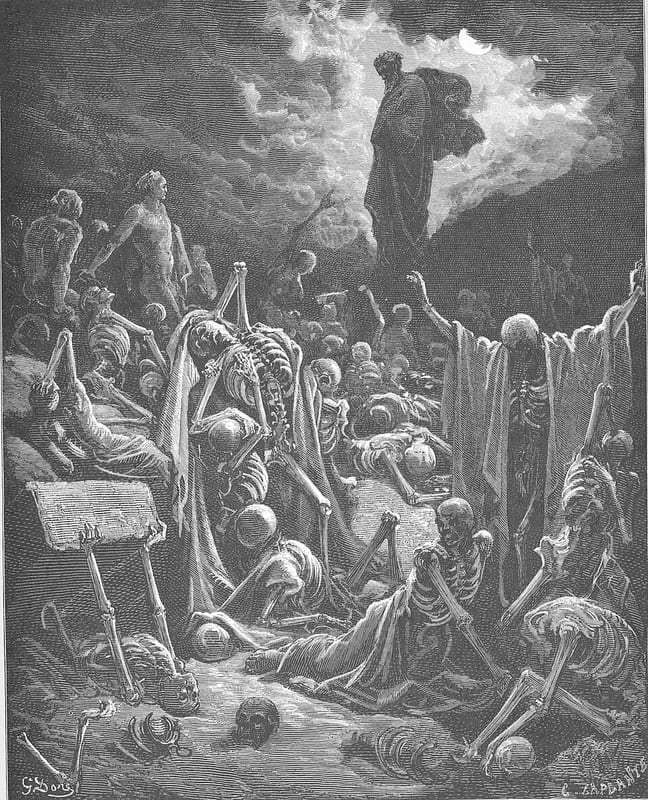
Your altars will be demolished and your incense altars will be smashed; and I will cast down your slain before your idols.
Introduction
Ezekiel, The Prophets, Ezekiel Overview.
Ezekiel spoke this from exile in Babylonia, but he was told to turn his face toward the hills of home. His hearers had worshipped at the local hilltop shrines all their lives and saw no harm in it. The chapter is an oracle addressed to the land itself, its mountains, ravines and valleys. Listen for the refrain that closes section after section and tells what all of it is for. Notice too the small group who survive, and what they come to feel when they remember.
Context
- Who
- Exiles who had worshipped at those hilltop shrines all their lives and saw nothing wrong with it
- What
- An oracle against the mountains of Israel and their high places, with the promise of a remnant who will remember the LORD among the nations.
- Where
- Spoken at Tel Abib toward the hill country of Judah, its ridges, ravines and valleys.
- When
- About 593 to 592 BC, before the fall of Jerusalem.
- Why
- To show that the hill shrines would be destroyed with their worshippers, so that the people would know that He is the LORD.
Historical context
A high place was a real installation, not a vague idea. Excavators have uncovered them at Dan, Arad, Megiddo and elsewhere: a raised platform, a stone altar for burnt offerings, standing stones, sometimes a small roofed room, set on a ridge or under a spreading tree. Ordinary Israelites used them for generations; they were the local parish church, and the fact that they were local is exactly what made them hard to give up.
Show the rest of the historical context, 3 more paragraphs
The furniture of these shrines gets named. Incense stands, small pillar-like altars for burning aromatic gum, have been found by the dozen. Standing stones marked a god's presence. A carved wooden pole represented Asherah, the mother goddess of Canaanite religion. Josiah had smashed all of this a generation earlier; within twenty years it was back.
Ravines and watercourses matter to the geography of the threat. The Judean hill country is cut by steep wadis, and a fugitive's instinct is to go down into them. God says the dead will lie there too, in front of the very altars where they burned their offerings, with their bones scattered around the incense stands.
Behind the wording is an old and blunt idea: a shrine was defiled by human bones. Josiah had cleared the high places by burning bones on their altars. Now the bones will be those of the worshippers themselves.
Significance
Refugees comfort themselves with the land. The exiles could picture home, the terraces, the olive trees, the familiar shrine on the ridge above the village. This oracle goes straight to that picture and empties it.
Show the rest of the significance, 1 more paragraph
But it is not only destruction. A refrain runs through the chapter: then they will know that I am the LORD. And a remnant survives to remember, among the nations, and to feel loathing for what they had done. Judgment is aimed at recognition, not extinction.
This chapter in Jewish lifeWhat this chapter is in Jewish life and reading.
What is done
The site's table of synagogue readings ties no weekly portion and no Haftarah to this chapter. Probed for this lane, src/lib/hebraic/readings.ts printed parashot 0 and haftarah uses 0 for Ezekiel 6, and no festival reading for the book. The table holds the Haftarah of each weekly portion and the six books read whole on a feast or a fast. Across chapters 1 to 24 of Ezekiel the same probe found a Haftarah only in chapters 20 and 22.
The corpus ties one custom to this chapter. Rashi reads the stamping of the foot in the eleventh verse as the flattening of the mud, "and this is a custom of a mourner" (Rashi on Ezekiel 6:11:1).
How it is read
Rashi is the main commentator on this chapter in the corpus. He is quoted here from The Judaica Press complete Tanach with Rashi, translated by A. J. Rosenberg, which Sefaria reports as CC-BY. The translation is modern, so every quotation from it is fifty words or fewer.
The chapter turns against the mountains of Israel and their high places. Rashi names the sun images of the fourth verse as idols "made on the roofs [dedicated] to the sun" (Rashi on Ezekiel 6:4:1).
The survivors in exile will remember God's kindness, "that I had compassion on them when they committed iniquities before Me in their land" (Rashi on Ezekiel 6:9:1). Rashi reads the broken heart of the ninth verse as God yielding to a people who turned away. "I begged of them, through My prophets, to return to Me" (Rashi on Ezekiel 6:9:2).
The stamping and the cry of the eleventh verse are acts of grief. The cry is "A cry of grief and woe" (Rashi on Ezekiel 6:11:2). The one besieged in the twelfth verse is the man "who is gathered into the city when they besiege it" (Rashi on Ezekiel 6:12:1).
The corpus carries 12 notes on this chapter without an English text, marked linked. Metzudat David's notes stand at 6:2:1, 6:4:1, 6:5:1, 6:7:1, 6:8:1 and 6:10:1. Radak's notes stand at 6:2:1, 6:5:1, 6:6:1, 6:7:1, 6:8:1 and 6:10:1. Each stands cited and unquoted, because Sefaria holds no English version of the ref.
What the rabbis say
The corpus carries 7 rabbinic locators on the verses of this chapter, 3 filed under the Talmud and 4 under the Midrash. It carries the text of none, so each is cited by ref here and never quoted or paraphrased. The verse numbers are the Hebrew ones the corpus prints.
On verse 3 it holds Yalkut Shimoni on Torah 288:2. On verse 9 it holds Shir HaShirim Rabbah 7:8:1. On verse 11 it holds Bereshit Rabbati, Parashat Bereshit 11 and Tractate Semachot 3:3. On verse 12 it holds Avot DeRabbi Natan, Recension B 11:9 and Avot DeRabbi Natan, Recension B 1:12. On verse 13 it holds Yalkut Shimoni on Torah 51:1.
What each of them teaches is a saying of the rabbis, and is reported as theirs wherever this site quotes one. The quotations wait on a fetch that carries the text.
Sources: Rashi, Rashi on Ezekiel 6:4:1 to 6:12:1, The Judaica Press complete Tanach with Rashi, translated by A. J. Rosenberg, reported CC-BY; Metzudat David, Metzudat David on Ezekiel 6:2:1 to 6:10:1, cited by ref only: Sefaria holds no English version of the ref; Radak, Radak on Ezekiel 6:2:1 to 6:10:1, cited by ref only: Sefaria holds no English version of the ref; The Sefaria corpus, scripts/data/sources/sefaria/ezekiel/6.json, the 7 Talmud and Midrash locators on the verses of this chapter; The site's own files, src/lib/hebraic/readings.ts, probed for Ezekiel 6: parashot 0, haftarah uses 0, no festival reading for the book.
The heads below are this chapter's scenes. The numbered points under each are its verses.
A word against the mountains and their high places
Ezekiel 6:1-3
the word of the LORD came: The word is spoken to the land itself: “O mountains of Israel, hear the word of the Lord GOD!” It reaches “the mountains and hills,” “the ravines and valleys,” with a sword against them. Gill compares Deuteronomy 32:1, where Moses calls on the heavens and the earth to hear.
Ezekiel 6:1
“And the word of the Lord came unto me, saying. That is, the word of prophecy from the Lord, as the Targum: this, according to Junius, was delivered out by the prophet on a sabbath day, the twenty first of the fifth month, and in the sixth year of King Jehoiachin's captivity; and so was more than a year after the vision at Chebar, Eze 1:1.”
1 more voice on this verseWhat preachers and commentators have said about this verse, in their own words.
Ezekiel 6:1
“The former prophecies concerned the city of Jerusalem and the inhabitants of Judaea. The present is addressed to the whole land and people of Israel, which is to be included in a like judgment, The ground of the judgment is “idolatry,” and the whole rests on Deut. 12. The prophecy is against the “mountains” of Israel, because the mountains and valleys were the seats of idol-worship. It is also the proclamation of the final judgment of Israel. It is the picture of the future judgment of the world.”
set your face against the mountains of Israel: Ezekiel is told to set his face against the mountains of Israel and to prophesy against them. Jamieson, Fausset and Brown compare the prophet who spoke to Jeroboam's altar in 1 Kings 13:2. The hills held Israel's high places.
Ezekiel 6:2
“Set thy face toward the mountains of Israel - This is a new prophecy, and was most probably given after the four hundred and thirty days of his lying on his left and right side were accomplished. By Israel here, Judea is simply meant; not the ten tribes, who had long before been carried into captivity. Ezekiel uses this term in reference to the Jews only. The mountains may be addressed here particularly, because it was on them the chief scenes of idolatry were exhibited.”
Adam Clarke · Commentary on the Bible (1810-1826)evangelical
to the ravines and valleys: The word reaches every part of the land, mountains and hills, ravines and valleys. Albert Barnes notes that the ravines, like the hills, were favored sites for idol worship, as in 2 Kings 23:10. The sword will destroy the high places.
Ezekiel 6:3
“Rivers - Or, “ravines,” which were, like the mountains, favorite seats of idol-rites 2Ki 23:10.”
Ezekiel 6:4-7
Your altars will be demolished: The Lord will “lay the corpses of the Israelites before their idols,” as Leviticus 26:30 warned. Clarke notes that the cities and high places fall together: “the cities will be laid waste.” The unit ends with the chapter’s first “you will know that I am the LORD.”
Ezekiel 6:4
“Images - See the margin and margin reference, and the Eze 8:16 note. Idols - The Phoenicians were in the habit of setting up “heaps” or “pillars” of stone in honor of their gods, which renders the use of the word more appropriate.”
1 more voice on this verse
Ezekiel 6:4
“Your images shall be broken - Literally, your sun images; representations of the sun, which they worshipped. See the margin.”
Adam Clarke · Commentary on the Bible (1810-1826)evangelical
lay the corpses of the Israelites before their idols: The dead will lie before the idols they served. Matthew Henry reads the sin in the punishment itself: corpses laid before idols show why these people died. Bones scattered around the altars defile them, as Josiah did to the altars of Bethel in 2 Kings 23:14 to 16.
Ezekiel 6:5
“And I will lay the dead carcasses of the children of Israel before their idols,.... Which is repeated for the confirmation of it: and I will scatter your bones round about your altars: which were reckoned a pollution of them; see 2Ki 23:14.”
2 more voices on this verse
Ezekiel 6:5
“Will scatter your bones round about your altars - This was literally fulfilled by the Chaldeans. According to Baruch, 2:24, 25, they opened the sepulchres of the principal people, and threw the bones about on every side.”
Adam Clarke · Commentary on the Bible (1810-1826)evangelical
Ezekiel 6:5
“Sennacherib was slain by his sons when he was worshipping in the house of his god. (4.) The sin might be read in this circumstance of the punishment; the slain men are cast before the idols, to show that therefore they are slain, because they worshipped those idols; see Jer. viii.”
Matthew Henry · Commentary on the Whole Bible (1707-1721)puritan
the cities will be laid waste: Wherever the people live, the cities and high places will fall together. Altars, idols and incense altars will be smashed and cut down. Matthew Henry comments that the Lord would lay town and country in ruins before He would leave the idol altars standing.
Ezekiel 6:6
“Rather than their idolatrous altars shall be left standing, both town and country shall be laid in ruins. Sin is a desolating thing; therefore stand in awe and sin not.”
Matthew Henry · Commentary on the Whole Bible (1707-1721)puritan
The slain will fall among you: The dead will fall among the living. Albert Barnes reads the verse as a sequence: when the slain fall, then at last the people will know that He is the LORD. The same phrase returns through the chapter.
Ezekiel 6:7
“The force of the words is, “When the slain shall fall in the midst of you, then at last ye shall know that I am the Lord.” So in Eze 6:10 where the knowledge implies a recognition of the merciful intent of Yahweh’s dispensations, and therefore, a hope of restoration.”
A remnant left to remember among the nations
Ezekiel 6:8-10
Yet I will leave a remnant: The Lord leaves “a remnant,” some who “escape the sword.” In exile “your survivors will remember Me,” and “they will loathe themselves for the evil they have done.” The recognition formula returns with an added clause: “I did not declare in vain that I would bring this calamity upon them.”
In exile the survivors will remember the Lord and see how their adulterous hearts grieved Him. They will loathe themselves for their evil. Adam Clarke sees this in the end of idol worship among the Jews after the captivity in Babylon.
Ezekiel 6:9
“I am broken ... - Translate: “because” I have broken “their whorish heart, which hath departed from me,” and their eyes etc. Since Ezekiel is addressing the Church of God through Israel, we are to note here that the general principle of the divine administration is laid down. Sin leads to judgment, judgment to repentance, repentance to forgiveness, forgiveness to reconciliation, reconciliation to a knowledge of communion with God.”
1 more voice on this verse
Ezekiel 6:9
“They are reprieved, and escape the sword, that they may have time to return to God. Note, God's patience both leaves room for repentance and is an encouragement to sinners to repent. Where God designs grace to repent he allows space to repent; yet many who have the space want the grace, many who escape the sword do not forsake the sin, as it is promised that these shall do.”
Matthew Henry · Commentary on the Whole Bible (1707-1721)puritan
I did not declare in vain: The survivors will know that the LORD did not speak in vain. The calamity came as He had said. John Gill reads calamity here as the harm of punishment, the captivity and scattering, which answers their sin.
Ezekiel 6:10
“And they shall know that I am the Lord,.... As in Eze 6:7; and that I have not said in vain; either within himself, in his own purposes and decrees; so the Targum, "I have not in vain decreed in my word;'' or by the mouth of the prophets: that I would do this evil unto them; in carrying them captive, and dispersing them in other lands; for this is not the evil of sin, but the evil of punishment, or of affliction.”
Clap, stamp, and watch the land go desolate
Ezekiel 6:11-13
Clap your hands, stomp your feet: Ezekiel is to “Clap your hands, stomp your feet, and cry out.” The judgments are set by distance: “He who is far off will die by the plague, he who is near will fall by the sword.” They will know the LORD when their slain lie among their idols.
Ezekiel 6:11
“Two things the prophet must thus lament:-- 1. Alas! for all the evil abominations of the house of Israel. Note, The sins of sinners are the sorrows of God's faithful servants, especially the evil abominations of the house of Israel, whose sins are more abominable and have more evil in them than the sins of others.”
Matthew Henry · Commentary on the Whole Bible (1707-1721)puritan
2 more voices on this verse
Ezekiel 6:11
“The gleam of hope is but transitory. Darkness again gathers round, for as yet the prophet is predicting judgment. Eze 6:11 Smite ... stamp - Well-known modes of expressing grief. Eze 6:13 Sweet savor - Compare Gen 8:21. Words, applied to the smell of sacrifices accepted by God, applied here to idol-sacrifices in irony. Eze 6:14 Toward Diblath - Or, “Diblathaim,” the “Diblathan” of the Moabite stone, one of the double cities of Moab (see Eze 25:9) to the east of which lay the great desert of Arabia. Some read: “unto Riblah” Jer 52:9 and take the margin rendering.”
Ezekiel 6:11
“High places - The places of your idolatrous worship. Cast down - Before the altars of your idols, which you fly to for refuge. And - Thus the idols were upbraided with their inability to help their worshippers, and the idolaters, with the folly of trusting in them.”
John Wesley · Explanatory Notes upon the Old Testament (1765)evangelical
He who is far off will die by the plague: No one escapes by distance or by staying put. The one far off dies by plague, the one near falls by the sword, and the one left in the besieged city dies by famine. Jerome reads the far off as those who fled the siege into the desert.
Ezekiel 6:12
“He that is far off--namely, from the foe; those who in a distant exile fear no evil. he that remaineth--he that is left in the city; not carried away into captivity, nor having escaped into the country. Distinct from "he that is near," namely, those outside the city who are within reach of "the sword" of the foe, and so fall by it; not by "famine," as those left in the city.”
Jamieson, Fausset & Brown · Commentary Critical and Explanatory on the Whole Bible (1871)reformed
when their slain lie among their idols: Their slain will lie around their altars and under every green tree. Matthew Henry notes that they will read their sin in their punishment. The hills of their incense will hold their dead.
stretch out My hand against them: The Lord will stretch out His hand to make the land “a desolate waste, from the wilderness to Diblah.” Clarke notes that some manuscripts read Riblah for Diblah, the two names differing by one letter. The chapter closes on its fourth “Then they will know that I am the LORD.”
Ezekiel 6:14
“So will I stretch out mine hand upon them,.... Not unto them, in a way of mercy; but upon, or against them, in a way of judgment.”
2 more voices on this verse
Ezekiel 6:14
“Diblath--another form of Diblathaim, a city in Moab (Nu 33:46; Jer 48:22), near which, east and south of the Dead Sea, was the wilderness of Arabia-Deserta.”
Jamieson, Fausset & Brown · Commentary Critical and Explanatory on the Whole Bible (1871)reformed
Ezekiel 6:14
“It is called Diblathaim ( Num. xxxiii. 22 ), that great and terrible wilderness which is described, Deut. viii. 15 , wherein were fiery serpents and scorpions.”
Matthew Henry · Commentary on the Whole Bible (1707-1721)puritan
Keep studying
Sources for this chapter
The summary
Jamieson, Fausset & Brown, Commentary Critical and Explanatory; John Calvin, Commentaries; John Wesley, Notes on the Old Testament and Matthew Henry, Complete Commentary.
The exposition
Adam Clarke, Commentary on the Bible; Albert Barnes, Notes, Explanatory and Practical, on the Old and New Testaments (1832-1869); Carl Friedrich Keil, Biblical Commentary on the Prophecies of Ezekiel; Jamieson, Fausset & Brown, Commentary Critical and Explanatory on the Whole Bible; Jerome, Commentary on Ezekiel; John Gill; John Wesley, Explanatory Notes upon the Old Testament and Matthew Henry, Commentary on the Whole Bible.