
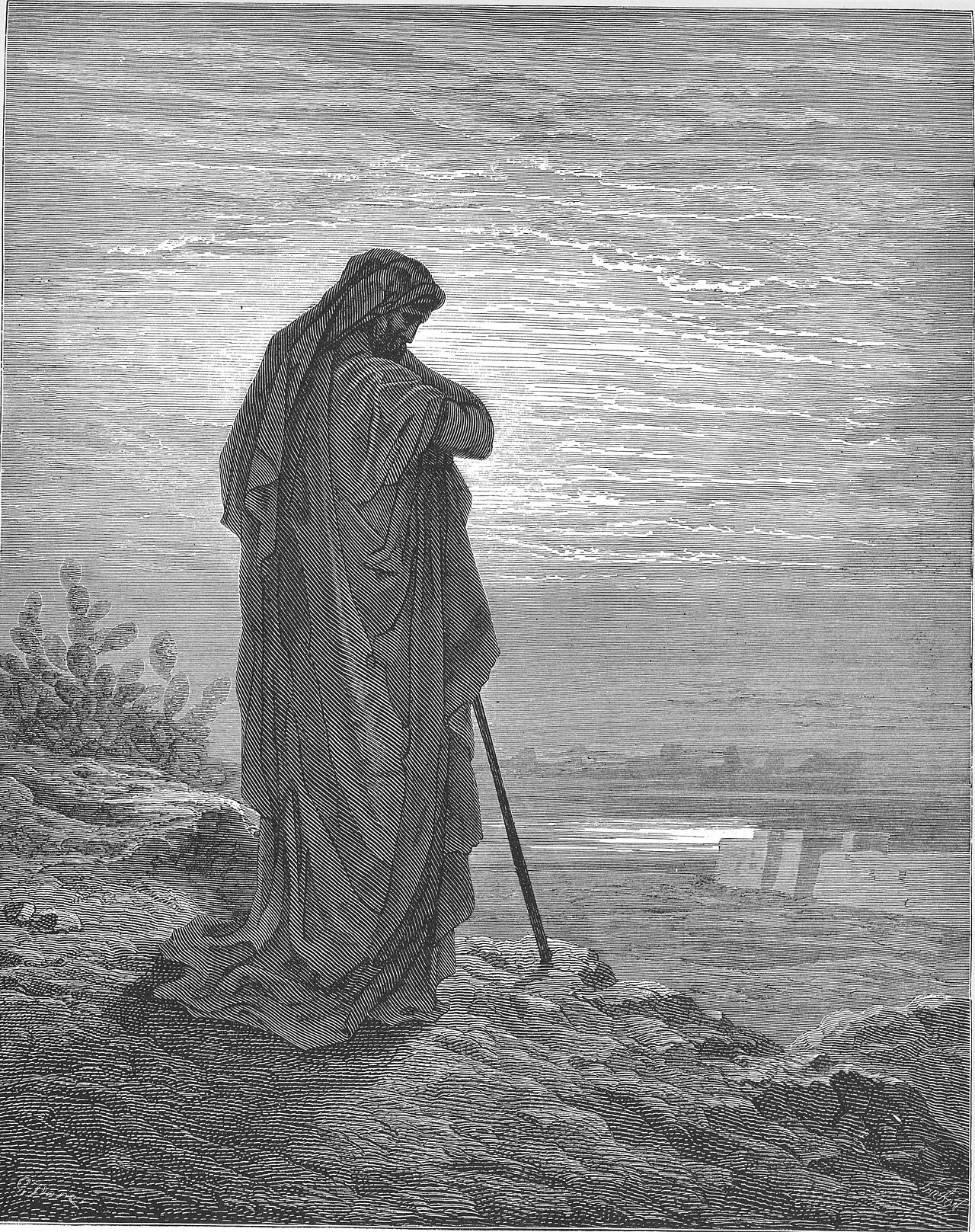
Amoschapter 6
14 verses · Amos · about 760 BC · The Twelve
“Do horses gallop on the cliffs? Does one plow the sea with oxen? But you have turned justice into poison and the fruit of righteousness into wormwood—
Introduction
Amos, The Twelve, Amos Overview.
This chapter carries the second woe in the middle of the book, spoken to the leaders of both kingdoms. Its hearers were the governing class of Samaria, and Zion is named alongside them. They had recently won towns in Jeroboam's wars and believed their borders were secure. The chapter describes their banquets closely, down to the furniture, the food and the music. Listen for the one thing these men failed to feel. Notice the fallen cities the chapter asks them to compare themselves with, and the two towns they were boasting about.
Context
- Who
- The men who were at that banquet
- What
- A woe on the complacent leaders of Zion and Samaria, a picture of their feasting, and a warning of exile and invasion.
- Where
- Samaria and Zion, with Calneh, Hamath and Gath named as examples, and Lo-debar and Karnaim as recent conquests.
- When
- About 760 BC, in the reign of Jeroboam II of Israel; the book gives no exact year.
- Why
- To expose a ruling class that enjoyed its wealth and felt nothing for the ruin of its people.
Historical context
The feast described here has a name in the wider culture. Texts from Ugarit and later Semitic sources describe the marzeah, an elite drinking society that met for lavish banquets, sometimes in connection with the dead, with its own membership, property, and reputation for excess. The word Amos uses for the revelry of those who stretch themselves out is that term.
Show the rest of the historical context, 3 more paragraphs
Every luxury named is a specific extravagance. Beds inlaid with ivory match the carved ivories excavated at Samaria. Lambs from the flock and calves from the stall means eating the young breeding stock and the specially fattened animals rather than what a household would normally eat. Drinking wine from bowls means the large basins used for ritual sprinkling, not cups, deliberately absurd quantities.
The finest oils were an expensive import used for anointing at feasts, and the idle songs strummed to the harp are dismissed as amateur composing in the manner of David, the comparison is meant to sting, since David's songs were worship and these were background music.
The two towns named at the end are a bitter pun. Lo-debar means roughly nothing at all, and Karnaim means horns, the standard image for strength. Israel had recently taken both in Jeroboam's wars, so the boast becomes: we took Nothing by our own strength, and captured Horns by our own horns.
Significance
The verdict is compressed into one phrase: they are not grieved over the ruin of Joseph. The sin is not the food or the music. It is a governing class that could enjoy all of it while the nation came apart, and feel nothing.
Show the rest of the significance, 1 more paragraph
Amos points them to Calneh, Hamath, and Gath, cities that had already fallen, and asks whether Israel is better than those kingdoms. Hearers who believed their borders were the widest in living memory were being asked to visit some ruins.
This chapter in Jewish lifeWhat this chapter is in Jewish life and reading.
What is done
No part of this chapter is read in the synagogue. Probed for this lane, the site's table in src/lib/hebraic/readings.ts printed parashot 0 and no Haftarah use for Amos 6, and no festival reading for the book. The same probe printed 54 weekly portions and 6 festival readings in the table as a whole. Amos is heard in the synagogue twice in the year, and neither reading reaches this chapter. The table records Amos 2:6 to 3:8 as the Haftarah of Vayeshev and Amos 9:7 to 9:15 as the Ashkenazi Haftarah of Kedoshim.
The chapter is met in two portions of the Torah. Under the first verse the corpus carries Midrash Tanchuma, Shmini 5:1 and Midrash Tanchuma Buber, Shmini 8:1, with Vayikra Rabbah 5:3. Shmini is the portion the table records as Leviticus 9:1 to 11:47. Under the sixth verse, the drinking of wine from bowls, it carries Midrash Tannaim on Deuteronomy 32:13:12 and Midrash Lekach Tov, Deuteronomy 32:14:1. Those are notes on the song of Moses in Ha'azinu, Deuteronomy 32:1 to 32:52.
How it is read
Rashi is the one commentator on this chapter whose English the corpus carries, quoted here from The Judaica Press complete Tanach with Rashi, translated by A. J. Rosenberg, which Sefaria reports as CC-BY. The translation is modern, so every quotation from it is fifty words or fewer.
Rashi reads the chapter as a people that chose to be like the nations. Israel was first among them, "You were called the most praiseworthy of the nations" (Rashi on Amos 6:1:1). Then "They chose the ordinances of the nations and came to be included among them" (Rashi on Amos 6:1:2). The call to go over to Calneh, which he names as Babylon, answers the choice. "Why have you rejected My Torah to cleave to the ordinances of the nations?" (Rashi on Amos 6:2:1). The prophet sends them to look and see whether the great nations are better.
Three verses carry two readings each in Rashi's own notes. On the third verse he gives first a reading of the exile under Esau. "This is the midrash of Rabbi Simon of blessed memory", he writes, and a bracketed note in the translation finds it also in Leviticus Rabbah 5:3. He then gives a second, in which they despise the prophecy of evil days (Rashi on Amos 6:3:2). On the beds of ivory he gives the plain sense of men sprawled on couches. He then adds, "Our Sages, however, explained that they would exchange wives with one another", from Shabbat 62b (Rashi on Amos 6:4:1). On the bowls of wine he reports the Sages in Shabbat 62b and a second view of a long vessel with two mouths (Rashi on Amos 6:6:1).
The music of the fifth verse he sets against the Temple's own. He takes the word for the strumming with Menahem in his Machbereth, "and I approve of his view" (Rashi on Amos 6:5:1). "They thought their musical instruments were like the musical instruments of your servant David, which were meant for the sake of Heaven, but these were for enjoyment" (Rashi on Amos 6:5:2). The finest oils are "The best of the oils, which is balsamum" (Rashi on Amos 6:6:2). The banquet of the seventh verse he finds in the Sifre on Numbers 25:1, where the same word names the feasts at Shittim (Rashi on Amos 6:7:1).
The pride of Jacob that God abhors in the eighth verse is the Temple, after Targum Jonathan and Ezekiel 24:21. "For the Temple is called the pride of their strength" (Rashi on Amos 6:8:2). The horses on the rock of the twelfth verse ask "will they maintain their running when they change the order of the world?" (Rashi on Amos 6:12:1). The thing of naught they rejoice in is their wealth, "Over their greatness and their wealth, which is nought, since it will not endure" (Rashi on Amos 6:13:1).
The corpus carries two further notes on this chapter without an English text, each marked linked because Sefaria holds no English version of the ref. They stand cited and unquoted at Ibn Ezra on Amos 6:7:1 and at Rashi on Amos 6:9:2.
What the rabbis say
The corpus carries forty rabbinic locators on this chapter, seven it files under Talmud and thirty-three under Midrash, and the text of none, so each is cited by ref here rather than quoted. On the first verse it holds Bamidbar Rabbah 10:3, Midrash Tanchuma Buber, Shmini 8:1, Midrash Tanchuma, Shmini 5:1 and Vayikra Rabbah 5:3. On the third verse it holds Kohelet Rabbah 12:7:1. On the fourth verse it holds Bamidbar Rabbah 9:7, Ein Yaakov (Glick Edition), Pesakhim 3:2, Ein Yaakov, Kiddushin 4:9, Ein Yaakov, Pesakhim 3:2, Ein Yaakov, Shabbat 6:7 and Kiddushin 71b:6. It also holds Midrash Tannaim on Deuteronomy 32:13:10.
On the sixth verse it holds Bamidbar Rabbah 13:1, Bamidbar Rabbah 13:16, Bamidbar Rabbah 13:20, Bereshit Rabbah 36:4, Midrash Lekach Tov, Deuteronomy 32:14:1 and Midrash Tanchuma Buber, Noach 21:5. It also holds Midrash Tannaim on Deuteronomy 32:13:12. On the seventh verse it holds Ein Yaakov (Glick Edition), Ketubot 6:9, Ein Yaakov, Ketubbot 6:9, Ketubot 69b:3, Kiddushin 71b:7, Moed Katan 28b:26 and Shabbat 62b:11. On the eighth verse it holds Midrash Tanchuma Buber, Noach 17:1. On the tenth verse it holds Eikhah Rabbah 1:23, Ein Yaakov, Sanhedrin 7:15 and Introductions to Tanaitic Literature, Introduction to Mishnah and Tosefta, The Mishnayot of the Disciples of Rabbi Akiva 208. It also holds Otzar Midrashim, Midrash Temurah 1:29, Sanhedrin 64a:1 and Sifra, Bechukotai, Chapter 6 4.
On the eleventh verse it holds Kohelet Rabbah 10:18:1, Shir HaShirim Rabbah 4:14:1 and Vayikra Rabbah 19:4. On the twelfth verse it holds Devarim Rabbah 3:7. On the thirteenth verse it holds Midrash Lekach Tov, Deuteronomy 32:27:1, Midrash Tannaim on Deuteronomy 32:27:8 and Sifrei Devarim 322:8. On the fourteenth verse it holds Otzar Midrashim, Midrash Gadol u'Gedolah 30. What each of them teaches is a saying of the rabbis, and it is reported as theirs wherever this site quotes one. The quotations wait on a fetch that carries the text.
Sources: Rashi, Rashi on Amos 6:1:1 to 6:14:1, The Judaica Press complete Tanach with Rashi, translated by A. J. Rosenberg, reported CC-BY; Ibn Ezra, Ibn Ezra on Amos 6:7:1, cited by ref because the corpus carries no English text; Rashi (the notes without English), Rashi on Amos 6:9:2, cited by ref because the corpus carries no English text; The Sefaria corpus, scripts/data/sources/sefaria/amos/6.json, the 40 Talmud and Midrash locators of this chapter; The site's own files, src/lib/hebraic/readings.ts, probed for this chapter and printing parashot 0 and no Haftarah use, with festivalReadingForBook(amos) null.
The heads below are this chapter's scenes. The numbered points under each are its verses.
Woe to those at ease in Zion, first to go into exile
Amos 6:1-3
at ease in Zion: The woe names both capitals at once, "those at ease in Zion and those secure on Mount Samaria," two kingdoms sharing one complacency. They "dismiss the day of calamity and bring near a reign of violence," putting judgment off in the mind while inviting violence in practice.
Amos 6:1
“The house of Israel came to them, that is, was divided into those kingdoms, of which Zion and Samaria were the mother cities. Those that were at ease were the princes and rulers, the great men, that were chief of the nations, chief of those two kingdoms, and to whom, having their residence in Zion and Samaria, the whole house of Israel applied for judgment.”
Matthew Henry · Commentary on the Whole Bible (1707-1721)puritan
1 more voice on this verseWhat preachers and commentators have said about this verse, in their own words.
Amos 6:1
“At ease - That neither fear nor believe the threatened judgments of God. In Zion - That is put for the kingdom of the two tribes, and principally the inhabitants of Jerusalem. Samaria - Woe to them also who rely upon the strength, wealth, and policy of the kingdom of Samaria or Israel.”
John Wesley · Explanatory Notes upon the Old Testament (1765)evangelical
Cross over to Calneh and see: Amos sends the leaders to look at cities already subdued. John Gill places Calneh in Shinar, and Adam Clarke reports the view of Calmet that it was Ctesiphon on the Tigris. Clarke places Hamath on the Orontes, and Jamieson, Fausset and Brown note that Uzziah subdued Gath (2 Chronicles 26:6).
Amos 6:2
“Pass ye unto Calneh - This is, says Calmet, the Ctesiphon on the river Tigris. Hamath - The same as Emesa. Hamath was a city on the Orontes, in Syria. Gath - A well-known town, and head of one of the five seignories of the Philistines. Be they better - You have no more reason to expect exemption from the consequences of your sins than they had. They have been punished; so shall you. Why then will ye trust in their gods, that could not save their own cities?”
Adam Clarke · Commentary on the Bible (1810-1826)evangelical
2 more voices on this verse
Amos 6:2
“Pass ye unto Calneh, and see,.... What is become of that city, which was in the land of Shinar, an ancient city, as early as the days of Nimrod, and built by him, and was with others the beginning of his kingdom, Gen 10:10; it belonged to Babylon, and is by Jarchi here interpreted by it, being put for Babel, as he supposes.”
Amos 6:2
“Also by Assyria subsequently (2Ki 18:34). Gath--subjugated by Uzziah (2Ch 26:6). be they better--no. Their so recent subjugation renders it needless for Me to tell you they are not.”
Jamieson, Fausset & Brown · Commentary Critical and Explanatory on the Whole Bible (1871)reformed
You dismiss the day of calamity: Albert Barnes reads dismiss as pushing the day away with aversion: they could set it at a distance in their minds. The day of calamity is the Day of the Lord of 5:18. John Wesley reads the reign of violence as the judgment seat, made a seat of violence.
Amos 6:3
“Ye - That flatter yourselves the day of darkness foretold, is far off. The seat - The judgment seat which should relieve the oppressed, is made a seat of violence.”
John Wesley · Explanatory Notes upon the Old Testament (1765)evangelical
Amos 6:4-6
beds inlaid with ivory: The list of luxury piles up, "beds inlaid with ivory," songs improvised "like David," and "the finest oils" for anointing. David made music for worship, and these make it for appetite. The list closes on the true charge: "you fail to grieve over the ruin of Joseph."
Amos 6:4
“That lie upon beds of ivory,.... That were made of it, or inlaid with it, or covered with it, as the Targum; nor was it improbable that these were made wholly of ivory, for such beds we read of: Timaeus says (r), the Agrigentines had beds entirely made of ivory; and Horace (s) also speaks of such beds: and if any credit can be given to the Targums of Jonathan and Jerusalem on Gen 50:1. Joseph made his father Jacob to lie on a bed of ivory.”
2 more voices on this verse
Amos 6:4
“That lie upon beds of ivory - The word הוי hoi, wo, is understood at the beginning of each of the first, third, fourth, fifth, and sixth verses. The beds mentioned here may be either sofas to recline on at table, or beds to sleep on; and these among the ancients were ornamented with ivory inlaid. They were called lectos eburatos by Plautus, lectos eburnos by Horace, “ivory beds.” Probably those ornamented with shells, or mother-of-pearl, may be intended. Several works of this kind may be still seen in Palestine and other places.”
Adam Clarke · Commentary on the Bible (1810-1826)evangelical
Amos 6:4
“They had no concern at all for the interests of the church of God, and of the nation, that were sinking and going to decay: They are not grieved for the affliction of Joseph; the church of God, including both the kingdoms of Judah and Israel (which are called Joseph, Ps. lxxx. 1 ), was in distress, invaded, insulted, and broken in upon.”
Matthew Henry · Commentary on the Whole Bible (1707-1721)puritan
improvise songs on the harp like David: Jamieson, Fausset and Brown read the verse as the rich citing David to defend their love of music. He made music in peace and for the praise of God, while they played for pleasure as ruin drew near. Albert Barnes notes that Amos alone uses the verb.
Amos 6:5
“That chant to the voice of the lyre - Accompanying “the voice of the lyre” with the human voice; giving vocal expression and utterance to what the instrumental music spoke without words. The word, which Amos alone uses in this one place, describes probably a hurried flow of unmeaning, unconsidered words, in which the rhythm of words and music was everything, the sense, nothing; much like most glees.”
1 more voice on this verse
Amos 6:5
“They defend their luxurious passion for music by his example: forgetting that he pursued this study when at peace and free from danger, and that for the praise of God; but they pursue for their own self-gratification, and that when God is angry and ruin is imminent.”
Jamieson, Fausset & Brown · Commentary Critical and Explanatory on the Whole Bible (1871)reformed
You drink wine by the bowlful: John Gill reads the bowls as large vessels, so the guests could drink freely to drunkenness, and recalls Ephraim's drunkards at Isaiah 28:1. Adam Clarke suggests that the cost of the vessels, more than the quantity drunk, may be the fault named. The charge closes on the ruin of Joseph.
Amos 6:6
“That drink wine in bowls,.... Not in small cups or glasses, but in large bowls, that they might drink freely, even to drunkenness; hence we read of the drunkards of Ephraim, or the ten tribes, Isa 28:1; or "drink in bowls of wine"; which is much to the: same sense.”
1 more voice on this verse
Amos 6:6
“That drink wine in bowls - Perhaps the costliness of the drinking vessels, more than the quantity drank, is that which is here reprehended by the prophet. Drinking vessels of the most costly materials, and of the most exquisite workmanship, are still in use; and as to precious ointments and perfumes among the Jews, we have a proof that the contents of one small box was worth three hundred denarii, at least seven pounds ten shillings sterling. See the case in the Gospel, Joh 12:5 (note), and the note there.”
Adam Clarke · Commentary on the Bible (1810-1826)evangelical
Amos 6:7-8
as the first of the captives: They "will now go into exile as the first of the captives," and their feasting ends. "The Lord GOD has sworn by Himself," and "I abhor Jacob’s pride and detest his citadels" turns the nation's pride into what God hates. These are the stone houses already condemned at 5:11.
Amos 6:7
“Therefore now (that is, shortly) shall they go captive with the first (at the head) of those who go captive - They had sought eminence; they should have it. Jerome: “Ye who are first in riches, shall, the first, endure the yoke of captivity, as it is in Ezekiel, ‘begin from My sanctuary’ Eze 9:6, that is, from the destruction of the Temple which is holy.”
1 more voice on this verse
Amos 6:7
“How strongly this burden is bound on, not to be shaken off by their presumption and security; for it is bound by the Lord the God of hosts, by his mighty, his almighty, hand, which none can resist; it is bound with an oath, which puts the sentence past revocation: The Lord God has sworn, and he will not repent, and, since he could swear by no greater, he has sworn by himself.”
Matthew Henry · Commentary on the Whole Bible (1707-1721)puritan
The Lord abhors the pride of Jacob
Albert Barnes notes that the Hebrew reads by His soul, and cites Jerome that God speaks here after the way of human feeling. Jamieson, Fausset and Brown read the pride of Jacob as the sanctuary, of no weight against punishment, and the citadels as storehouses of robbery.
Amos 6:8
“The Lord God - He who alone is and who alone hath power, “hath sworn by Himself,” literally, “by His soul;” as our “self” comes from the same root as “soul.” Jerome: “So God saith in Isaiah, “Your new moons and your appointed feasts My soul hateth” Isa 1:14; not that God hath a soul, but that He speaks after the way of human feelings.”
1 more voice on this verse
Amos 6:8
“The sanctuary which was the great glory of the covenant-people [VATABLUS], (Eze 24:21). The priesthood, and kingdom, and dignity, conferred on them by God. These, saith God, are of no account in My eyes towards averting punishment [CALVIN]. hate his palaces--as being the storehouses of "robbery" (Am 3:10, 15).”
Jamieson, Fausset & Brown · Commentary Critical and Explanatory on the Whole Bible (1871)reformed
Amos 6:9-11
ten men left in one house: The scene shrinks to a single house, where even "ten men left in one house" will die. The relative is told to keep silent, for "the name of the LORD must not be invoked," in dread that naming God might bring judgment.
who is to burn the bodies: Adam Clarke cites Bishop Newcome, who reads the scene as famine and plague during the siege of Samaria. The bodies are burned and carried out with no funeral rites. Clarke reads the call for silence as the lone survivor keeping quiet, lest the little food he has be plundered.
Amos 6:10
“A man’s uncle shall take him up - Bp. Newcome says, this obscure verse seems to describe the effects of famine and pestilence during the siege of Samaria. The carcass shall be burnt, and the bones removed with no ceremony of funeral rites, and without the assistance of the nearest kinsman. Solitude shall reign in the house; and if one is left, he must be silent, (see Amo 8:3), and retired, lest he be plundered of his scanty provision!”
Adam Clarke · Commentary on the Bible (1810-1826)evangelical
Matthew Henry reads the great and small houses as the palace and the cottage, neither above nor beneath the justice of God. Albert Barnes cites Jerome that what the Lord commands His servants to do He is seen to do Himself.
Amos 6:11
“The Lord commandeth and He will smite - Jerome: “If He commandeth, how doth He smite? If He smiteth, how doth He command? In that thing which He “commands” and enjoins His ministers, He Himself is seen to “smite.” In Egypt the Lord declares that He killed the first-born, who, we read, were slain by “the destroyer” Exo 12:23. The “breaches” denote probably the larger, “the cleft” the smaller ruin. The greater pile was the more greatly destroyed.”
1 more voice on this verse
Amos 6:11
“The princes' palaces are not above the rebuke of divine justice, nor the poor men's cottages beneath it; neither shall escape. When sin has marked them for ruin God will find ways to bring it about. It is by order from him that breaches are made.”
Matthew Henry · Commentary on the Whole Bible (1707-1721)puritan
Justice turned to poison, and boasting in Lo-debar
Amos 6:12-14
Horses cannot gallop on cliffs and oxen cannot plow the sea, yet Israel has "turned justice into poison and the fruit of righteousness into wormwood." The boast of taking Karnaim "by our own strength" treats a minor victory as lasting security, and Karnaim means horns, the Hebrew figure for strength.
Amos 6:12
“In turning "judgment (justice) into gall (poison), and . . . righteousness into hemlock" (or wormwood, bitter and noxious), ye act as perversely as if one were to make "horses run upon the rock" or to "plough with oxen there" [MAURER]. As horses and oxen are useless on a rock, so ye are incapable of fulfilling justice [GROTIUS].”
Jamieson, Fausset & Brown · Commentary Critical and Explanatory on the Whole Bible (1871)reformed
1 more voice on this verse
Amos 6:12
“Shall horses run upon the rock - First, they could not do it, because they were unshod; for the shoeing of horses with iron was not then known. Secondly, If they did run on the rock, it would be useless to their owner, and hurtful to themselves. Thirdly, And it would be as useless to plough on the rock with oxen; for there it would be impossible to sow with any advantage. Fourthly, Just as useless and injurious would it be to put gall in the place of judgment, and hemlock in the place of righteousness.”
Adam Clarke · Commentary on the Bible (1810-1826)evangelical
Where the Berean text names Lo-debar, Albert Barnes reads a thing of nought, the power and empire they thought they held. Matthew Henry notes the boast may have been the language of their hearts more than of their lips. Jerome turns the verse against those lifted up by pride.
Amos 6:13
“But those who trust in their own strength rejoice in a thing of nought, and so they will find. Probably they did not say this with their lips, totidem verbis--in so many words, but it was the language of their hearts and of their actions, both which God understands.”
Matthew Henry · Commentary on the Whole Bible (1707-1721)puritan
2 more voices on this verse
Amos 6:13
“Who rejoice - (Literally, “the rejoicers!” Amos, as is his wont, speaks of them with contempt and wonder at their folly, “the rejoicers!” much as we say, the cowards! the renegades!) “in a thing of nought,” literally, “a non-thing,” (“no-whit, nought”) not merely in a thing valueless, but in a “non-thing,” that has no existence at all, as nothing has any substantial existence out of God. This “non-thing” was their power, strength, empire, which they thought they had, but which was soon to shrivel away as a scroll.”
Amos 6:13
“Whence also we say that the holy men are just and that they are made pleasing to God after their sins not only through their merits but through the mercy of him to whom every creature is subject and stands in need of his mercy. Let heretics hear, who are lifted up by pride and say, "We have taken unto us horns by our own strength." Let them listen to what Moab heard said to him: "We have heard the pride of Moab, he is exceedingly proud.”
Jerome · written before 420 · Against the Pelagians 2:29patristic
I will raise up a nation against you: Adam Clarke names the nation as Assyria under Pul, Tiglath-pileser and Shalmaneser. The oppression reaches from Lebo-hamath in the north to the brook in the south, which Clarke takes for the Besor near Gaza. Matthew Henry notes that the whole nation shared the sin and so shares the calamity.
Amos 6:14
“I will raise up against you a nation - The Assyrians under Pul, Tiglath-pileser, and Shalmaneser, who subdued the Israelites at various times, and at last carried them away captive in the days of Hosea, the last king of Israel in Samaria. From the entering in of Hamath (on the north) unto the river of the wilderness - Besor, which empties itself into the sea, not far from Gaza, and was in the southern part of the tribe of Simeon.”
Adam Clarke · Commentary on the Bible (1810-1826)evangelical
1 more voice on this verse
Amos 6:14
“The whole nation has shared in the iniquity, and therefore must expect to share in the calamity. Note, When men are in any way instruments of affliction to us we must see God raising them up against us, for they are in his hand--the rod, the sword, in his hand.”
Matthew Henry · Commentary on the Whole Bible (1707-1721)puritan
Keep studying
Sources for this chapter
The summary
Jamieson, Fausset & Brown, Commentary Critical and Explanatory; John Calvin, Commentaries; John Wesley, Notes on the Old Testament and Matthew Henry, Complete Commentary.
The exposition
Adam Clarke, Commentary on the Bible; Albert Barnes; Carl Friedrich Keil, The Twelve Minor Prophets; Edward Bouverie Pusey, The Minor Prophets: A Commentary; Jamieson, Fausset & Brown, Commentary Critical and Explanatory on the Whole Bible; Jerome, AGAINST THE PELAGIANS 2:29; John Gill; John Wesley, Explanatory Notes upon the Old Testament and Matthew Henry, Commentary on the Whole Bible.