
1 Chronicleschapter 25
31 verses · Ezra, by tradition · 450 to 400 BC · History
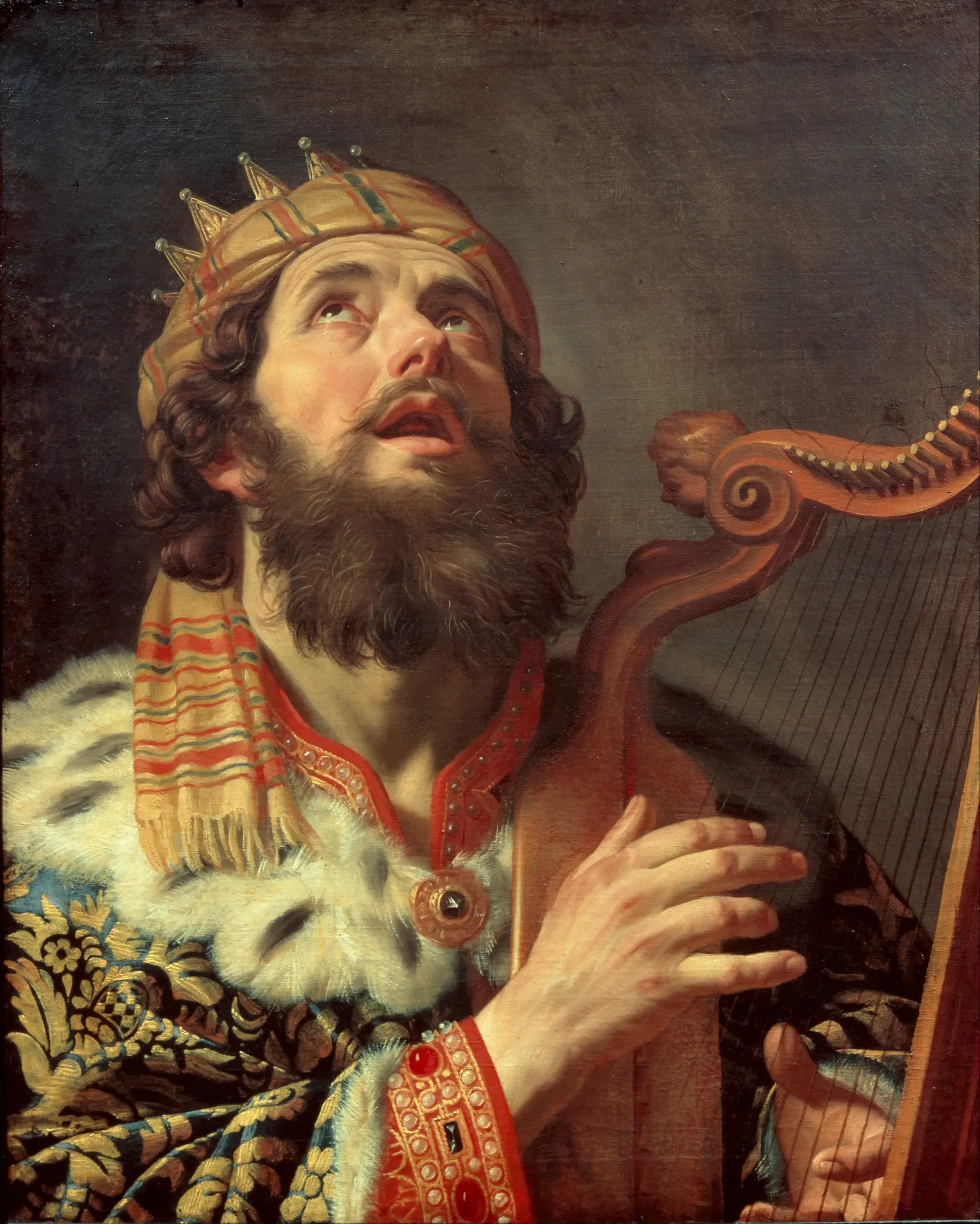
Additionally, David and the commanders of the army set apart some of the sons of Asaph, Heman, and Jeduthun to prophesy with the accompaniment of lyres, harps, and cymbals. The following is the list of the men who performed this service:
Introduction
Ezra, by tradition, History, 1 Chronicles Overview.
This chapter was written for the trained choirs and instrumentalists of the second temple, and it tells them how their service was first ordered. The names Asaph, Heman and Jeduthun head the families here, and the first hearers met two of those names in the headings of their own psalms. The musicians are organised in the same way as the priests of the chapter before. The first hearers knew the lyre, the harp and the cymbals, and they sang to them. Listen for the verb the chapter uses for what these musicians did. Then notice who draws lots beside whom.
Context
- Who
- The trained choirs and instrumentalists of the second temple
- What
- A register of the temple musicians from the families of Asaph, Heman and Jeduthun, set in twenty-four divisions of twelve by lot.
- Where
- The sanctuary courts in Jerusalem, where the singers' turns were assigned.
- When
- The last year of David's reign, about 970 BC, a date held as approximate.
- Why
- To found a rostered ministry of music and to give the singers a place in the service beside the priests.
Historical context
The chapter is David's again, working with three Levitical houses, Asaph, Heman and Jeduthun. Heman is called the king's seer, a title Chronicles elsewhere gives to Gad the prophet.
Show the rest of the historical context, 5 more paragraphs
The place and the time are those of the chapters around it, the sanctuary courts in Jerusalem in the last year of the reign, about 970 BC.
The occasion is the founding of a rostered ministry of music. The musicians are organised exactly as the priests were, twenty-four courses of twelve trained singers, 288 in all, with the wider body of Levites in training behind them. Lots were cast for the order, young and old alike, teacher as well as pupil, so a master took his turn in the rotation with his own apprentices.
A first hearer would have caught the verb the chapter uses and a reader today needs it pointed out. The three houses are set apart to prophesy with lyres, harps and cymbals, and the same verb returns of Jeduthun's sons at verse 3. Music in this house was treated as a form of speaking for God, and the men who did it were understood to stand in the prophetic line.
The instruments are the three that recur through the Psalms, the lyre, the larger harp and cymbals to mark the beat, with the priests' trumpets sounding as the offering went up.
One curiosity is worth naming rather than smoothing over. The last nine names in Heman's son list read, strung together in Hebrew, almost like a sentence of prayer. Many scholars hold that a fragment of a psalm has been preserved as a list of names, and others take them as names built from the ordinary vocabulary of Hebrew prayer.
Significance
The community's hymnbook carried the names of Asaph, Heman and Ethan in its headings. This chapter told them those men headed a rostered ministry that was still running in their own day.
Show the rest of the significance, 1 more paragraph
It also raised the standing of the choir. In a temple where the priesthood held the highest honours, the singers were set apart by the same lot, in the same public assembly, for work the text describes as prophecy.
This chapter in Jewish lifeWhat this chapter is in Jewish life and reading.
What is done
1 Chronicles carries no weekly portion and no Haftarah, and no part of it is read in the synagogue service on any Sabbath of the year. In the Hebrew Bible Chronicles stands among the Writings, and the Haftarah is drawn from the Prophets, so the yearly cycle passes this book over entirely. This site's own table of synagogue readings records the same absence. It holds no portion, no Haftarah use and no festival reading for any of the twenty-nine chapters of the book.
One line of this chapter did reach the synagogue service, by way of a poem rather than a reading, and Rashi points to it. The third verse names six sons of Jeduthun and then lists five. Rashi's answer is that the sixth, Shimei, was still in his mother's womb, and that his father saw by the holy spirit that he too would head a watch. This is the Shimei who appears later in the chapter as the tenth lot. Rashi then quotes the liturgical poet who set the same reading into verse. The line stands in the Kedushah of Yozer for the portion of Shekalim, "Inscribed from the womb to be counted in the watch of the Sanctuary" (Rashi on I Chronicles 25:3:1). A Christian reader should notice what this shows about how the classical material travelled. A difficulty in a list of names produced a rabbinic reading, and the reading was put into a poem that a congregation sang on a set Sabbath of the year.
Rashi also describes how these singers' rota was worked and how it was joined to the priests'. The lots of the eighth verse were cast watch against watch. He insists on what the verse says about who is bound by them. The small and the great, the trained master and the pupil, all stood equal under the lot, so that whoever drew first went first. He then sets the two rotas side by side, the first Levitical watch serving with the priestly watch of Jehoiarib and the second with that of Jedaiah (Rashi on I Chronicles 25:8:2).
How it is read
The corpus carries seventeen kept notes of Rashi for this chapter in The Judaica Press complete Tanach with Rashi, translated by A. J. Rosenberg, under CC-BY.
The chapter's own claim is that the musicians prophesied, and Rashi takes it at its word. At the first verse he explains that when these men played their instruments they would prophesy. He brings the case of Elisha calling for a musician before the hand of the LORD came upon him (Rashi on I Chronicles 25:1:3). At the third verse he says what was played. It was the songs beginning with the call to give thanks and the songs beginning with Hallelujah, and the prophesying went with them (Rashi on I Chronicles 25:3:3). At the fifth he reads the horn to be lifted up as the horn of prophecy, since Heman prophesied for the king (Rashi on I Chronicles 25:5:1). Two short notes open the chapter, the separation being for the service of song, and the choice falling on the sons of Asaph out of all the Levites (Rashi on I Chronicles 25:1:1 and 25:1:2).
Heman's fourteen sons and three daughters draw a note about what a gift is. Rashi argues that without God's giving it would have been impossible for one man to have so many children and all of them fit to head watches. He sets two other cases beside it where the text says that God gave, the conception of Ruth and the sight of the whole land granted to Moses (Rashi on I Chronicles 25:5:2). The reading turns a genealogical total into an argument about providence.
The rest of the notes are the work of a careful reader of lists. Rashi settles that Romamti Ezer is one name and not two (Rashi on I Chronicles 25:4:1). He glosses the phrase that places the sons beside their father (Rashi on I Chronicles 25:3:2). He explains the word for a trained man as the proper word for skill in song, citing the chief of the Levites in song earlier in the book (Rashi on I Chronicles 25:7:1). He reads the phrase about a watch against a watch by the same doubling he found in the tabernacle's moves (Rashi on I Chronicles 25:8:1). Then he walks through the first lots one by one, naming which son of Asaph or of Jeduthun each was and in what order of birth. The reader can watch the lot moving from one house to the other (Rashi on I Chronicles 25:9:1, 25:9:2, 25:10:1, 25:11:1 and 25:12:1).
Metzudat David, Malbim and Radak comment on this chapter as well. The corpus carries their refs with the reason that Sefaria holds no English version of them, so they stand here cited and unquoted. Metzudat David comments at I Chronicles 25:2:1, 25:4:1, 25:6:1 and 25:7:1. Malbim comments at I Chronicles 25:2:1 and 25:4:1. Radak comments at I Chronicles 25:2:1.
What the rabbis say
The corpus carries seventeen rabbinic locators for this chapter and the text of none, so each is cited and linked here rather than quoted. Eight of the seventeen stand on the fifth verse, where Heman is called the king's seer in the words of God. They are Bamidbar Rabbah 18:8, Eikhah Rabbah 2:6, and Midrash Shmuel 2:5 and 4:3. The rest are Midrash Tanchuma, Korach 5:1, Midrash Tanchuma Buber, Korach 12:1, Midrash Tehillim 75:5, and Yalkut Shimoni on Torah 750:25.
Two stand on the first verse, where the sons of Asaph, Heman and Jeduthun are set apart to prophesy with harps, lyres and cymbals. They are Shir HaShirim Rabbah 4:4:1 and Introductions to Amoraic Literature, Part II (Notes and Interpretations for Chapters of the Talmud), Baba Batra, Chapter I 451. Two stand on the seventeenth verse, the tenth lot that fell to Shimei: Bereshit Rabbah 39:11 and 94:9.
The rest are single locators. Kohelet Rabbah 7:19:4 stands on the second verse, Midrash Shmuel 32:3 on the third, and Midrash Lekach Tov, Numbers 4:23:1 on the tenth. Introductions to Tanaitic Literature, Introduction to Halakhic Midrashim, Halakhic Midrash 21 stands on the eighth. Arakhin 13b:8 is carried across the seventh to the ninth verses together, where the number of the trained singers is given and the first lot is cast. What each of them teaches is a saying of the rabbis, and is reported as theirs wherever this site quotes one. The quotations wait on a fetch that carries the text.
Sources: Rashi, Rashi on I Chronicles 25:1:1 to 25:12:1, seventeen kept notes in The Judaica Press complete Tanach with Rashi, translated by A. J. Rosenberg, CC-BY; Metzudat David, Metzudat David on I Chronicles 25:2:1, 25:4:1, 25:6:1 and 25:7:1, cited by ref because the corpus carries no English text; Malbim, Malbim on I Chronicles 25:2:1 and 25:4:1, cited by ref because the corpus carries no English text; Radak, Radak on I Chronicles 25:2:1, cited by ref because the corpus carries no English text; The Sefaria corpus, scripts/data/sources/sefaria/1-chronicles/25.json, the 17 Talmud and Midrash locators of this chapter; This site's table of synagogue readings, src/lib/hebraic/readings.ts, which records no portion, no Haftarah use and no festival reading for 1 Chronicles.
The heads below are this chapter's scenes. The numbered points under each are its verses.
Prophesying with harps, psalteries, and cymbals
1 Chronicles 25:1-3
the commanders of the army set apart: David and the army commanders set apart three families, Asaph, Heman and Jeduthun, “to prophesy with the accompaniment of lyres, harps, and cymbals”. The verb is the one the book uses of the prophets. Clarke notes the Targum reads the verb as prophesying by the Holy Spirit.
1 Chronicles 25:1
“David and the captains of the host - The chiefs of those who formed the several orders: not military captains. Should prophesy - Should accompany their musical instruments with prayer and singing.”
Adam Clarke · Commentary on the Bible (1810-1826)evangelical
1 more voice on this verseWhat preachers and commentators have said about this verse, in their own words.
1 Chronicles 25:1
“Not but that it is the greatest liberty and pleasure to be employed in praising God: what is heaven but that? But it intimates that it is our duty to make a business of it, and stir up all that is within us to it; and that, in our present state of corruption and infirmity, it will not be done as it should be done without labour and struggle.”
Matthew Henry · Commentary on the Whole Bible (1707-1721)puritan
From the sons of Asaph: Asaph's four sons open the roll: Zaccur, Joseph, Nethaniah and Asarelah. Adam Clarke notes that the Targum reads prophesied here as prophecy by the Holy Spirit. Matthew Henry held that Asaph, Heman and Jeduthun were trained under Samuel in the schools of the prophets and now served as masters.
1 Chronicles 25:2
“Which prophesied - Sung hymns and prayed. But the Targum understands this of prophesying in the proper sense of the term; and therefore says, “Who prophesied by the Holy Spirit.” Jarchi is of the same opinion and quotes the case of Elisha, 2Ki 3:15; While the minstrel played, the hand of the Lord [i.e., the spirit of prophecy] was upon him.”
Adam Clarke · Commentary on the Bible (1810-1826)evangelical
1 more voice on this verse
1 Chronicles 25:2
“It is probable that Heman, Asaph, and Jeduthun, were bred up under Samuel, and had their education in the schools of the prophets which he was the founder and president of; then they were pupils, now they came to be masters.”
Matthew Henry · Commentary on the Whole Bible (1707-1721)puritan
From the sons of Jeduthun: Jeduthun's six sons served under their father. Adam Clarke's text named only five, so he counted Jeduthun himself as the sixth; the Berean list names Shimei in that place. Matthew Henry held that these three fathers were once pupils of Samuel and were now masters.
1 Chronicles 25:3
“The sons of Jeduthun - six - That is, six with their father, otherwise, there are but five. Hence it is said, they were under the hands of their father Jeduthun, who prophesied with a harp, etc.”
Adam Clarke · Commentary on the Bible (1810-1826)evangelical
1 Chronicles 25:4-6
Bukkiah, Mattaniah, Uzziel, Shebuel: Heman is called “the king’s seer”, a title Chronicles also gives to Gad, so the man holds the office the book gives its prophets. His fourteen sons and three daughters are folded whole into the service. One king's order binds all three houses into a single service.
1 Chronicles 25:4
“Of Heman: the sons of Heman,.... The third chief singer: Bukkiah, Mattaniah, Uzziel; the same with Azareel, 1Ch 25:18. Shebuel; called Shubael, 1Ch 25:20. and Jerimoth, Hananiah, Hanani, Eliathah, Giddalti, and Romamtiezer, Joshbekashah, Mallothi, Hothir, and Mahazioth; in all fourteen, to whom came the sixth, ninth, eleventh, fifteenth, sixteenth, eighteenth, twentieth, twenty second, twenty fourth, seventeenth, nineteenth, twentieth, and twenty third lots, 1Ch 25:13.”
Heman the king’s seer: Heman bears the title seer, which Jamieson, Fausset and Brown note Chronicles also gives to Gad and to Jeduthun. God gave him fourteen sons and three daughters. Albert Barnes read the promise to exalt him as God raising Heman's dignity through that large family.
1 Chronicles 25:5
To lift up the horn - Some take this literally, and consider that Heman and his sons played on the born in the musical services; but there is no other evidence that the horn was so employed. Perhaps the most probable explanation is that it has been transferred from the next clause, where (as here) it followed the word “God,” with the sense that “God, to exalt Heman’s horn (or, increase his dignity), gave him fourteen sons and three daughters.”
1 more voice on this verse
1 Chronicles 25:5
“Heman the king's seer--The title of "seer" or "prophet of David" is also given to Gad (1Ch 21:9), and to Jeduthun (2Ch 29:14, 15), in the words (Margin, "matters") of God. to lift up the horn--that is, to blow loudly in the worship of God; or perhaps it means nothing more than that he presided over the wind instruments, as Jeduthun over the harp.”
Jamieson, Fausset & Brown · Commentary Critical and Explanatory on the Whole Bible (1871)reformed
the music of the house: All three families made music with cymbals, harps and lyres at the house of God, each son under his own father. Asaph, Jeduthun and Heman in turn answered to the king.
they numbered 288: Two hundred eighty eight singers stood cunning enough to lead, a figure Gill and Barnes both derive from twenty four courses of twelve. The Levites' service in song is counted with the same precision Chronicles gives every other office in the house, a trained and numbered charge.
1 Chronicles 25:7
“With their brethren - i. e., “with others of the tribe of Levi.” Each son of Asaph, Jeduthun, and Heman, was at the head of a band of twelve skilled musicians, consisting partly of his own sons, partly of Levites belonging to other families 1 Chr. 25:9-31. The 24 band-leaders, together with their bands, formed a body of 288 persons (24 x 12 =288) Besides these, we hear of there being above 3,700 singers, who were probably divided, like the trained musicians, into 24 courses, which must have contained about 155 each 1Ch 23:5.”
young and old alike, teacher as well as pupil: The lot falls on “young and old alike, teacher as well as pupil”. Seniority and skill alike yield to the same casting that already set the priestly courses in chapter twenty four. Barnes notes the lot ranked the courses of Asaph, Jeduthun and Heman, with Asaph's four courses given precedence.
1 Chronicles 25:8
“As well the small as the great - Compare 1Ch 24:31. The lot was not applied indiscriminately to all the 24 courses, but was only used to settle which course of Asaph, which of Jeduthun, and which of Heman, should on each occasion be taken. Asaph was given the precedence over his brethren, and his four courses were assigned the first, and then each alternate place. Jeduthun took rank next, and received alternate places, first with Asaph, and then with Heman, until his courses were exhausted.”
1 more voice on this verse
1 Chronicles 25:8
“In the first catalogue given in this chapter the courses are classed according to their employment as musicians. In the second, they are arranged in the order of their service.”
Jamieson, Fausset & Brown · Commentary Critical and Explanatory on the Whole Bible (1871)reformed
The twenty-four lots of the temple singers
1 Chronicles 25:9-31
which was for Asaph, fell to Joseph: Every name in the roll stood in the family lists of verses 2 to 4, and the roster fixes the order the lot gave them. Gill and Keil flag two names as variant spellings, Shubael of verse 20 for Shebuel of verse 4 and Azarel of verse 18 for Uzziel.
1 Chronicles 25:9
“For Asaph to Joseph - His first-born. The second to Gedaliah - The first-born of Jeduthun.”
Adam Clarke · Commentary on the Bible (1810-1826)evangelical
the third to Zaccur: Zaccur, first of Asaph's sons in verse 2, drew the third lot. Asaph's four sons drew the first, third, fifth and seventh lots, and each lot sent out a company of 12 men from one family.
1 Chronicles 25:10
“The third to Zaccur - The first-born of Asaph.”
Adam Clarke · Commentary on the Bible (1810-1826)evangelical
the fourth to Izri: Izri drew the fourth lot, with 12 of his sons and brothers. The name matches Zeri, listed among the sons of Jeduthun in verse 3. The houses of Asaph and Jeduthun alternate through the first five lots.
1 Chronicles 25:11
“The fourth to Izri - The second son of Jeduthun.”
Adam Clarke · Commentary on the Bible (1810-1826)evangelical
the fifth to Nethaniah: Nethaniah, a son of Asaph from verse 2, drew the fifth lot. The houses of Asaph and Jeduthun alternate through the first five lots, and Heman's house first enters at the sixth. Each lot sent out 12 men.
1 Chronicles 25:12
“The fifth to Nethaniah - The third son of Asaph. Thus we find the lot did not run in any particular kind of order.”
Adam Clarke · Commentary on the Bible (1810-1826)evangelical
the sixth to Bukkiah: Bukkiah, first of Heman's fourteen sons in verse 4, drew the sixth lot. He is the first of Heman's house in the roll. Heman's sons hold fourteen of the lots, one lot for each son.
the seventh to Jesarelah: Jesarelah drew the seventh lot, the last of the four that fell to Asaph's sons. The name matches Asarelah, a son of Asaph in verse 2. After this lot every lot fell to the houses of Jeduthun and Heman.
1 Chronicles 25:14
“Jesharelah - Supposed to be the same with Uzziel, son of Heman.”
Adam Clarke · Commentary on the Bible (1810-1826)evangelical
the eighth to Jeshaiah: Jeshaiah, a son of Jeduthun named in verse 3, drew the eighth lot. He led 12 of his sons and brothers. Jeduthun's six sons drew the second, fourth, eighth, tenth, twelfth and fourteenth lots.
the ninth to Mattaniah: Mattaniah, second of Heman's sons in verse 4, drew the ninth lot. From the eighth lot to the fourteenth, the lot alternates between the house of Jeduthun and the house of Heman. His company numbered 12.
the tenth to Shimei: Shimei drew the tenth lot for the house of Jeduthun. He is the sixth son in the Berean list of verse 3, the name Adam Clarke's text lacked when he counted Jeduthun to make six. His company held 12 men.
the eleventh to Azarel: Azarel drew the eleventh lot for the house of Heman. The name matches Uzziel, the third of Heman's sons in verse 4. His sons and brothers made a company of 12, the same size as every other company.
the twelfth to Hashabiah: Hashabiah, a son of Jeduthun from verse 3, drew the twelfth lot. That lot marks the halfway point of the roll. Twelve lots of 12 men each gave 144 singers, half of the 288 counted in verse 7.
the thirteenth to Shubael: Shubael drew the thirteenth lot for the house of Heman. The name matches Shebuel, the fourth son of Heman in verse 4. Like every company in the roll, his held 12 men from his sons and brothers.
the fourteenth to Mattithiah: Mattithiah, the last of Jeduthun's sons in verse 3, drew the fourteenth lot. With it all six of Jeduthun's sons had drawn. Every lot after this one fell to the house of Heman.
the fifteenth to Jeremoth: Jeremoth drew the fifteenth lot, and the name matches Jerimoth, fifth of Heman's sons in verse 4. From this lot to the last, all ten lots fell to Heman's sons. Each led 12 men.
the sixteenth to Hananiah: Hananiah, the sixth son of Heman in verse 4, drew the sixteenth lot. He was one of the fourteen sons Albert Barnes reads as God's gift to exalt Heman in verse 5. His company held 12 men.
the seventeenth to Joshbekashah: Joshbekashah drew the seventeenth lot. He is the eleventh name among Heman's sons in verse 4. Heman, called the king's seer in verse 5, gave the roll more companies than Asaph and Jeduthun together.
the eighteenth to Hanani: Hanani drew the eighteenth lot, two lots after Hananiah. The two stand side by side in verse 4, Hananiah sixth and Hanani seventh among the sons of Heman. Hanani's company numbered 12 men.
the nineteenth to Mallothi: Mallothi, the twelfth of Heman's sons in verse 4, drew the nineteenth lot. He led 12 of his sons and brothers. With this lot, 228 of the 288 singers of verse 7 had their places.
the twentieth to Eliathah: Eliathah drew the twentieth lot. He is the eighth son of Heman in verse 4, and the lot set him twelve places lower than that list. Verse 8 says the lot fell on young and old alike, teacher as well as pupil.
the twenty-first to Hothir: Hothir, the thirteenth son of Heman in verse 4, drew the twenty-first lot and led 12 of his sons and brothers. Three lots remained after his. All three also fell to sons of Heman.
the twenty-second to Giddalti: Giddalti drew the twenty-second lot. He is the ninth son of Heman in verse 4, one of the fourteen sons verse 5 counts as God's gift to exalt Heman. His company numbered 12.
the twenty-third to Mahazioth: Mahazioth, the last name among Heman's sons in verse 4, drew the twenty-third lot. His 12 sons and brothers made the next to last company. With his lot, 276 of the 288 singers of verse 7 had their places.
the twenty-fourth to Romamti-ezer: Romamti-ezer, a son of Heman named in verse 4, drew the twenty-fourth and last lot. Adam Clarke notes that both parts of the name belong to one man. The twenty-four companies of 12 make the 288 singers of verse 7.
1 Chronicles 25:31
“Romamti-ezer - Both these names belong to the same person. He is mentioned also 1Ch 25:4. With this immense parade of noise and show, (David’s own invention), Christianity has nothing to do.”
Adam Clarke · Commentary on the Bible (1810-1826)evangelical
How this psalm is built
The form: Administrative list, the Levitical musicians set apart to prophesy with instruments and ordered by lot, as Clarke classes it.
The patterns in this chapter
| Device | What it does | Where to see it |
|---|---|---|
| To prophesy with harps | The chapter uses one verb for the singers' work and it is the verb of the prophets, naba at Strong's h5012, which the book page carries as a keynote of 1 Chronicles. It stands at verse 1 of the three houses together, at verse 2 of Asaph and at verse 3 of Jeduthun. The chapter therefore states its own doctrine rather than leaving a reader to infer it.Adam Clarke, Commentary on the Bible, 1832, on 1 Chronicles 25:1. | 1 Chronicles 25:1, 1 Chronicles 25:2, 1 Chronicles 25:3 |
| Twelve in all, twenty-four times | Verses 9 to 31 close every course with the same total. The phrase twelve in all stands twenty-four times, counted in the Berean text in the store, once for each turn. The repetition is how the chapter says that no course was larger or smaller than another, and 24 multiplied by 12 gives the 288 of verse 7.John Gill, Exposition of the Old Testament, 1748 to 1763, on 1 Chronicles 25:7. | 1 Chronicles 25:9, 1 Chronicles 25:19, 1 Chronicles 25:31 |
| Young and old alike, teacher as well as pupil | Verse 8 pairs two opposites in one line and binds both to the same draw. Seniority is set beside youth and the teacher beside the pupil, and the lot covers all four. The line states the chapter's method in a single sentence before the roster works it out.Matthew Henry, Commentary on the Whole Bible, 1710, on 1 Chronicles 25:8. | 1 Chronicles 25:8 |
| The three houses, named and then drawn | Verses 2 to 4 list the sons of Asaph, Jeduthun and Heman by name, and verses 9 to 31 draw those same names in the order the lot gave them. Every name in the roll already stood in the family lists. John Gill and C. F. Keil both flag two names carried under a variant spelling, Shubael at verse 20 for Shebuel at verse 4 and Azarel at verse 18 for Uzziel at verse 4, a difference the roster never explains.C. F. Keil and Franz Delitzsch, Biblical Commentary on the Books of Chronicles, 1872, on 1 Chronicles 25:9. | 1 Chronicles 25:2, 1 Chronicles 25:4, 1 Chronicles 25:9, 1 Chronicles 25:18, 1 Chronicles 25:20 |
The structure of the number
12 more paragraphs on the patterns
The 288 of verse 7 is twenty-four courses of twelve, and John Gill and Albert Barnes both derive the figure that way. The same twenty-four stands over the priests in chapter 24, so the singers were set on the structure already given to the priesthood. Twelve is the number of the tribes, and the text states the totals without drawing that comparison itself.
The historical value
The three names in this chapter are the names in the Psalter's own headings. Asaph stands over Psalms 50 and 73 to 83, the sons of Korah over a further group, and Heman and Ethan over Psalms 88 and 89. The chapter is therefore the administrative record behind a body of psalms a reader already meets by name.
The dossier on this book sets the courses of 1 Chronicles 23 to 26 against the Babylonian temple prebend records of the sixth to fifth centuries BC. In the Eanna archive at Uruk and the Ebabbar archive at Sippar, sanctuary staffs were organised by family into rotating shares, covering singers, gatekeepers, bakers and the rest of the working orders. Its verdict is that these courses look like what a working temple actually required, and that the parallel settles nothing about when the chapters were written down.
The debated concept
What the chapter means by prophesying with instruments is read two ways in the commentary tradition. Adam Clarke notes that the Targum reads the verb as prophesying by the Holy Spirit, and cites Elisha calling for a minstrel at 2 Kings 3:15 before the hand of the LORD came upon him. Others read the verb in this chapter as the ordinary leading of praise under appointment, since the content of what the singers sang is the Psalter rather than new oracles. The page states both readings and gives no verdict.
Albert Barnes adds a reading of the lot at verse 8. On his account the draw did not choose among all 288 singers individually, but ranked which course of Asaph, Jeduthun or Heman served in a given turn, with Asaph's courses given the first place.
The divine connection
Heman carries the title the king's seer at verse 5, which Chronicles elsewhere gives to Gad. The man who leads the sacred music therefore stands in the same office the book gives its prophets, and the chapter says so before it gives a single name of a course.
Verse 5 also records that God gave Heman fourteen sons and three daughters through the promises of God to exalt him. The text states the gift and the purpose together, and the household that follows is the visible result.
The New Testament and the later church
The chapter is not quoted in the New Testament. Its subject carries forward in the teaching that the church sings psalms, hymns and spiritual songs at Ephesians 5:19 and Colossians 3:16, where singing is named as instruction as well as praise. The link is one of subject rather than of citation, and the page states it that way.
Keep studying
Studies1
Sources for this chapter
The summary
Jamieson, Fausset & Brown, Commentary Critical and Explanatory; John Wesley, Notes on the Old Testament and Matthew Henry, Complete Commentary.
The form and classifications
Adam Clarke, Commentary on the Bible, 1832, on 1 Chronicles 25:1; Albert Barnes, Notes, Explanatory and Practical, on the Old and New Testaments, 1832 to 1869, on 1 Chronicles 25:7; John Gill, Exposition of the Old Testament, 1748 to 1763, on 1 Chronicles 25:1 and The dossier's ancient Near Eastern section on this book, src/components/book/dossier-content/1-chronicles.ts, the Eanna and Ebabbar entry.
The exposition
Adam Clarke, Commentary on the Bible; Albert Barnes; Jamieson Fausset and Brown, Commentary Critical and Explanatory on the Whole Bible; Jamieson, Fausset & Brown, Commentary Critical and Explanatory on the Whole Bible; John Gill, Exposition of the Old Testament; Keil, The Books of the Chronicles and Matthew Henry, Commentary on the Whole Bible.