
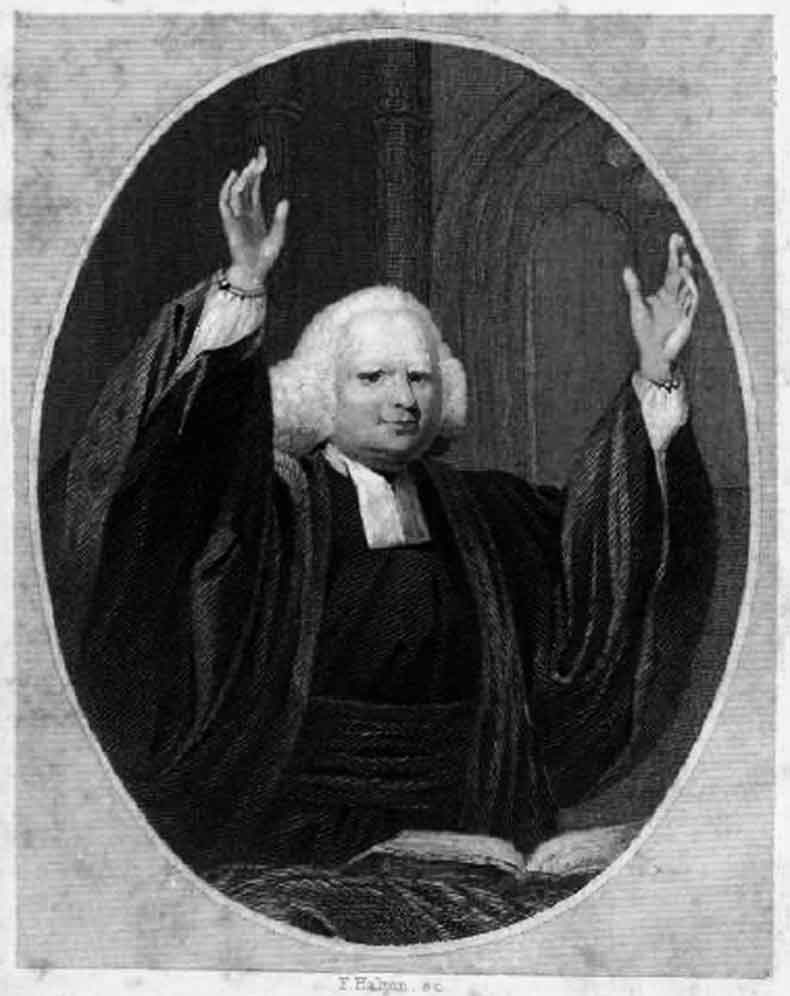
F. Halpin, George Whitefield preaching, 1857. Public domain.
Romans 8:32 and Romans 9:21 · Debate · Featured Study
The Free Grace Quarrel
Wesley and Whitefield divided over election and stayed friends until Whitefield died.
On 24 December 1740, at his orphan house in Georgia, Whitefield wrote that Jonah went to Nineveh with no more reluctance than he felt in writing against Wesley.
He who did not spare His own Son but gave Him up for us all, how will He not also, along with Him, freely give us all things?
- The question
- Does God choose some for salvation by an unconditional decree, or is His grace free for all who will receive it?
- The texts
- Romans 8:32, Romans 9:21, 2 Peter 3:9, Numbers 23:10
Summary
John Wesley preached against predestination at Bristol and printed the sermon. George Whitefield answered him from America. Then the Methodists of England split between those who held that Christ died for the chosen and those who held that he died for all.
- Wesley held that the grace of God is free for every person.
- The quarrel reached a single society, which went two ways.
- Wesley preached Whitefield's funeral sermon in London.
The Texts Both Men Read
Wesley's text and the passages he closed on, and the potter of Romans 9.
Wesley preached on Romans 8:32 and closed his sermon on a run of texts that offer grace to all. Whitefield printed beside his answer a hymn by Isaac Watts on the potter and the clay of Romans 9.
Wesley's sermon
Although God overlooked the ignorance of earlier times, He now commands all people everywhere to repent.
Wesley cited Paul's call to all people everywhere near the close of the sermon.
Acts 17:30BSB
Now if any of you lacks wisdom, he should ask God, who gives generously to all without finding fault, and it will be given to him.
Wesley set James beside Paul as a witness that God gives to all.
James 1:5BSB
The Lord is not slow in keeping His promise as some understand slowness, but is patient with you, not wanting anyone to perish but everyone to come to repentance.
Wesley cited this verse among the apostles' witnesses near the sermon's close.
2 Peter 3:9BSB
Whitefield's answer
Does not the potter have the right to make from the same lump of clay one vessel for special occasions and another for common use?
Watts's hymn printed with Whitefield's letter turns on the potter's right over the clay.
Romans 9:21BSB
Romans 9:21
The Two Readings Side by Side
Four questions, each answered from Wesley's sermon and Whitefield's letter.
The two men differed on election and on the lot, and agreed on what they preached everywhere.
| The question | Wesley | Whitefield |
|---|---|---|
| What is the grace of God? | Free in all to whom it is given and free for all, depending on no power or merit in the one who receives it. | God may choose some to life while others die and remain just and gracious, as the hymn by Watts printed with his letter says. |
| What does an unconditional decree do to preaching? | It makes all preaching vain, since the elect will be saved without it and the rest cannot be saved with it. | He could not preach the gospel without speaking of election, he wrote at sea in February 1741. |
| Was the sermon rightly published? | Wesley wrote in his preface that he was bound to declare this truth to all the world. | Whitefield said Wesley drew a lot, which answered “preach and print,” and asked whether that tempted the Lord. |
| What did each man preach everywhere? | The new birth and justification by faith, Wesley said in 1770, and he had never heard Whitefield preach the decree in his chapels. | The same two doctrines, by Wesley's account of 1770, which the Gospel Magazine disputed in favour of absolute predestination. |
Each Reading in Its Own Words, and the Site's Tradition
Wesley and Whitefield argued their readings in print, followed by the site's tradition.
Wesley argued that every name for the doctrine, election, preterition, predestination or reprobation, came in the end to one sense. One part of mankind would be saved by an irresistible decree and the rest damned.
Against that he set the decree he found in Moses and the prophets, that the soul which chooses life shall live and the soul which chooses death shall die.
Whitefield answered that Wesley had taken the question to God by lot without first asking whether election was a doctrine of the gospel.
He printed with his letter the Church of England's articles on original sin, free will, and predestination and election.
Charles Wesley's hymn on universal redemption, printed with the sermon, gave the Wesleyan reading in verse, and Whitefield took particular offence at it.
MannaFest stands in the Wesleyan-Pentecostal tradition, which descends from Wesley's side of this quarrel and holds that God's grace is offered to every person.
From Bristol to the Parting of 1741
A sermon and a hymn book divided the friends, and a society split at Kingswood.
Wesley's sermon was printed at Bristol by S. and F. Farley soon after Whitefield had sailed for America.
Wesley sent a copy to Commissary Garden at Charleston, where Whitefield met with it, as Wesley's early biographer John Whitehead records.
From Boston the next September Whitefield wrote that the sermon “has set the nation a disputing.”
At Kingswood near Bristol, on 6 March 1741, Wesley called the society to choose between him and John Cennick. Fifty-two members left with Cennick and upwards of ninety stayed with Wesley.
Whitefield landed at Falmouth five days later, on 11 March, and found his London congregations shrunk from twenty thousand to two or three hundred on weekdays.
His answer was printed in London by W. Strahan for T. Cooper, in thirty-one pages.
On 25 March he wrote that he was now constrained to separate publicly from the Wesleys, whom he still loved as his own soul.
Who made the division, in Wesley's later account3 paragraphs
Nearly forty years on, Wesley wrote that Whitefield himself had made the division by preaching against the brothers by name.
He held that a difference of doctrine need not have made a difference of affection, and that the two could have held particular and general redemption to their lives' end.
Tyerman, Whitefield's biographer, judged in 1876 that John Cennick had more influence with Whitefield than was good for him.
The funeral sermon of 17703 paragraphs
Whitefield died at Newburyport in Massachusetts on 30 September 1770, and his executors asked Wesley to preach his funeral sermon.
Wesley preached it on 18 November 1770 at the chapel in Tottenham Court Road and at the Tabernacle near Moorfields, on Numbers 23:10.
He preached for Whitefield again at the Tabernacle in Greenwich on 23 November and at Deptford on 2 January 1771.
In Their Own Words
George Whitefield (1714 to 1770)
A Letter to the Rev. Mr. John Wesley, in Answer to his Sermon, entitled Free Grace, the opening paragraph, as printed in Tyerman, volume 1, page 469
Whitefield wrote with the reluctance of Jonah.
“God only knows what unspeakable sorrow of heart I have felt on your account, since I left England last. Whether it be my infirmity or not, I frankly confess, that, Jonah could not have gone with more reluctance to Nineveh, than I now take pen in hand to write against you.”
Calvinistic Methodist
About this saying1 paragraph
These are the first lines of the letter Whitefield dated at Bethesda in Georgia on 24 December 1740.
John Wesley (1703 to 1791)
Free Grace. A Sermon Preach'd at Bristol, page 5, the second paragraph
Wesley opened the sermon on grace free in all and free for all.
“The Grace or Love of God, whence cometh our Salvation, is Free in all, and Free for all.”
Evangelical
About this saying1 paragraph
Wesley set these words at the head of the sermon in 1739, under the text of Romans 8:32.
John Wesley
A Sermon on the Death of the Rev. Mr. George Whitefield (1770), the application, as printed in Tyerman, volume 2, pages 618 to 619
Wesley summed up Whitefield's preaching in two words.
“May they not be summed up, as it were, in two words, The new birth, and justification by faith?”
Evangelical
About this saying1 paragraph
Wesley closed the funeral sermon of 1770 by naming the doctrines Whitefield delivered.
Where the Readings Are Contested
Wesley named the two sorts of Methodists that the quarrel left.
The quarrel left two Methodisms in England, one holding particular redemption and one general redemption.
Books to Read Next
Free Grace. A Sermon Preach'd at Bristol
John Wesley · 1739
The sermon that began the quarrel, in its first printing.
Free at the Internet ArchiveThe Life of the Rev. George Whitefield, volume 1
Luke Tyerman · 1876
Whitefield's letters and his answer to Wesley, as Tyerman printed them in 1876.
Free at the Internet ArchiveOne Gospel and Two Connexions
The two men parted over the decree. Wesley's funeral sermon named the two doctrines they had always shared.
Sources
Scripture is the Berean Standard Bible.
- The Holy Bible, Berean Standard Bible (read 2026)
- John Wesley, Free Grace. A Sermon Preach'd at Bristol (Bristol: S. and F. Farley, 1739)
- Luke Tyerman, The Life of the Rev. George Whitefield, volume 1 (London: Hodder and Stoughton, 1876), pages 414 and 463 to 472.
- The same biography, volume 2, at pages 599 and 614 to 619.
Keep Studying
People and groups2
Doctrines1