
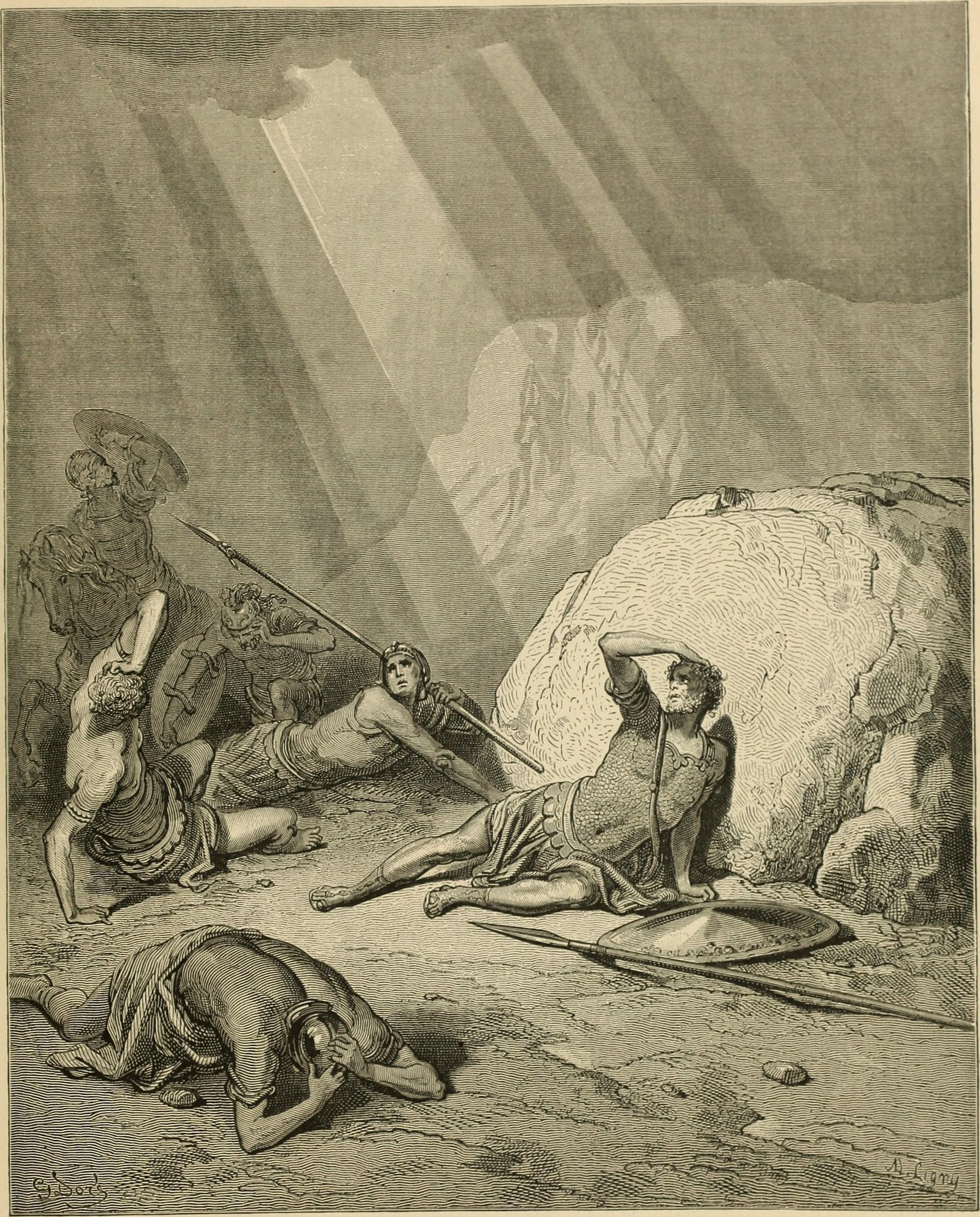
Gustave Doré, The Conversion of Saul, printed 1891, public domain
Acts 8 and 11 · Subject · Featured Study
The Scattered Church
Persecution has driven Christians from their homes from Acts 8 to the twentieth century, and churches have often risen where the scattered settled.
The persecution that began with Stephen's death drove the believers out of Jerusalem, and Luke records that they preached the word wherever they went.
Those who had been scattered preached the word wherever they went.
- Book
- Acts
- Hold in memory
- Acts 8:4, Acts 11:26
Summary
Acts 8 sets out the pattern. Pressure drove believers from home, and they carried the gospel to the places where they settled.
- After Stephen's death all but the apostles were scattered through Judea and Samaria.
- Some reached Antioch and spoke to the Greeks, and the disciples were first called Christians there.
- French Protestants fled the Revocation of 1685 and planted churches in London.
- Moravian exiles built Herrnhut and sent missionaries to St. Thomas ten years later.
The Verses of the Scattering
Luke tells the scattering in Acts 8, follows it to Antioch in Acts 11, and Jesus had spoken of it before.
The scattering, Acts 8
And Saul was there, giving approval to Stephen’s death. On that day a great persecution broke out against the church in Jerusalem, and all except the apostles were scattered throughout Judea and Samaria.
Luke dates the great persecution to the day of Stephen's death and names the places the believers fled to.
Acts 8:1BSB
Philip went down to a city in Samaria and proclaimed the Christ to them.
Philip is the first of the scattered whom Luke follows by name, to a city of Samaria.
Acts 8:5BSB
The road to Antioch, Acts 11
Meanwhile those scattered by the persecution that began with Stephen traveled as far as Phoenicia, Cyprus, and Antioch, speaking the message only to Jews. But some of them, men from Cyprus and Cyrene, went to Antioch and began speaking to the Greeks as well, proclaiming the good news about the Lord Jesus. The hand of the Lord was with them, and a great number of people believed and turned to the Lord.
Luke returns to the people of Acts 8 and follows them north to the city where the first church of Jews and Gentiles stood.
and when he found him, he brought him back to Antioch. So for a full year they met together with the church and taught large numbers of people. The disciples were first called Christians at Antioch.
The church the scattered began at Antioch is the place where the name Christian was first used.
Acts 11:26BSB
The word before it
When they persecute you in one town, flee to the next. Truly I tell you, you will not reach all the towns of Israel before the Son of Man comes.
Jesus gave this instruction for times of persecution when He sent out the Twelve.
But you will receive power when the Holy Spirit comes upon you, and you will be My witnesses in Jerusalem, and in all Judea and Samaria, and to the ends of the earth.”
The witness in Judea and Samaria that Jesus named before His ascension is reached in Acts 8 through the scattering.
Acts 1:8BSB
Acts 11:19 to 21, Acts 11:26, Matthew 10:23, Acts 1:8
Four Scatterings
The dated steps run from Jerusalem after Stephen to China after 1949.
Four times in this record pressure drove believers out, and each time churches stood in the places they reached.
- The persecution after Stephen scatters the church of JerusalemThe day of Stephen's deathActs 8:1
- The scattered reach Antioch and speak to the GreeksBefore Barnabas is sent to AntiochActs 11:19 to 22Acts 11:19 to 21
- The Act of Revocation in France22 October 1685Smiles, The Huguenots (1867), pages 182 to 183
- The first Moravian exiles reach Berthelsdorf8 June 1722Hutton, A History of the Moravian Church (1909), Book Two, chapter II
- Dober and Nitschmann set out for St. Thomas21 August 1732Hutton (1909), Book Two, chapter VI
- The Three-Self Manifesto in ChinaJuly 1950MannaFest, The Chinese House Churches, from the United Front Work Department's history
A timeline of the four scatterings, each row naming the record that fixes its date.
The era of the apostles holds the wider story of the church from Pentecost to the death of the last apostle.
From Jerusalem to Antioch
The persecution that killed Stephen sent the believers into Samaria and then north along the coast to Antioch.
Luke writes that the apostles stayed in Jerusalem while the rest of the church fled. Saul went from house to house and put men and women in prison.
Wesley notes on Acts 8:1 that the word all cannot mean the whole church. If it did, he says, no one would have been left for the apostles to teach or for Saul to persecute.
In Acts 11 Luke returns to the same people. Some spoke only to Jews in Phoenicia, Cyprus and Antioch. Others, men of Cyprus and Cyrene, spoke to the Greeks at Antioch, and a great number believed.
Three Later Scatterings
The Huguenots, the Moravian exiles and the Chinese Christians of the last century were driven out or underground.
Samuel Smiles sets out the terms of the Revocation of the Edict of Nantes. The act banished every Protestant pastor from France within fifteen days and set the galleys for life on any man caught trying to leave.
Smiles counts thirty-five French churches in London and its suburbs about the beginning of the eighteenth century, eleven of them in Spitalfields.
J. E. Hutton tells how Christian David, a carpenter, asked Count Zinzendorf for a refuge for persecuted Protestants of Moravia. On 27 May 1722 a small band met at Jacob Neisser's house at Sehlen and crossed the mountains, leaving their goods behind.
They reached Zinzendorf's estate at Berthelsdorf on 8 June 1722. On 17 June Christian David struck his axe into a tree for the first house of Herrnhut.
Ten years later Leonard Dober and David Nitschmann set out from Herrnhut on foot for Copenhagen, on their way to the slaves of St. Thomas.
In China the scattering came after the missionaries left and the churches were pressed to join the Three-Self Patriotic Movement. MannaFest's page on the Chinese house churches sets out the party's own counts from Document 19 of 1982. The document counted about 700,000 Protestants at liberation and about 3 million in 1982, and it stated no method.
In Their Own Words
John Chrysostom (died 407)
Homily on Acts 18
Chrysostom said the scattering made the discipleship greater.
“‘The persecution,’ say you, ‘gained strength.’ True, but at that very time to men possessed before by a hostile power it brought deliverance. For it planted the miracles like a stronghold, in the heart of the enemy's country. Not even the death of Stephen quenched their rage, nay, increased it rather: it scattered wide the teachers, so that the greater became the discipleship.”
on Acts 8:1Patristic
About this saying1 paragraph
Chrysostom takes up the persecution of Acts 8:1 in his eighteenth homily on Acts; he died in 407.
Christian David (1690 to 1751)
as reported in J. E. Hutton, A History of the Moravian Church, Book Two, chapter III
Christian David took a psalm as he felled the first tree.
“Yea, the sparrow hath found a house, and the swallow a nest for herself.”
Moravian Brethren
About this saying1 paragraph
Hutton records the words Christian David spoke in 1722 at the site of Herrnhut.
Samuel Smiles (1812 to 1904)
The Huguenots: Their Settlements, Churches, and Industries in England and Ireland, chapter VIII, page 205
Smiles said the number of the Huguenot exiles can never be known.
“It can never be known, with anything approaching to accuracy, how many persons fled from France in the great exodus.”
Protestant
About this saying1 paragraph
Smiles wrote this in 1867, after setting out the estimates of Vauban and Sismondi.
Does Pressure Always Spread the Church?
Chrysostom read the scattering as growth, and the record also holds churches that pressure nearly ended.
Chrysostom, on Acts 8:1, holds that the persecution planted the gospel in the enemy's country and made the discipleship greater.
Hutton's own history gives the other side. After the Day of Blood at Prague on 21 June 1621 the old Unity of the Brethren was crushed in Bohemia and Moravia. Its last ministers went into exile with Comenius.
Comenius prayed that God would keep a Hidden Seed in the old home. Hutton says that remnant held the faith in secret for a hundred years.
Smiles gives two estimates of the Huguenot flight. Vauban put France's loss at a hundred thousand inhabitants, and Sismondi at three or four hundred thousand emigrants.
Books to Read Next
The Huguenots: Their Settlements, Churches, and Industries in England and Ireland
Samuel Smiles · 1867
Smiles sets out the Revocation's terms and counts the French churches of London.
Free scan of the 1867 editionA History of the Moravian Church
J. E. Hutton · 1909
Hutton tells the flight from Moravia, the building of Herrnhut and the first missionaries.
Free at Project GutenbergWhat the Scattered Carried
The believers who fled Jerusalem carried the word to Antioch, where the first church of Jews and Greeks together was named Christian. Later exiles carried it to London, to Herrnhut and from Herrnhut across the sea.
Sources
Scripture is the Berean Standard Bible.
- The Holy Bible, Berean Standard Bible (read 2026)
- Samuel Smiles, The Huguenots: Their Settlements, Churches, and Industries in England and Ireland (London: John Murray, 1867), chapters VII, VIII and XV, pages 182 to 185, 205 and 340.
- J. E. Hutton, A History of the Moravian Church, second edition, revised and enlarged (1909), Book One, chapters XV and XVI, and Book Two, chapters II, III and VI.
Keep Studying
People and groups2
Subjects5
Go further2
Church history5
Trials of life1