
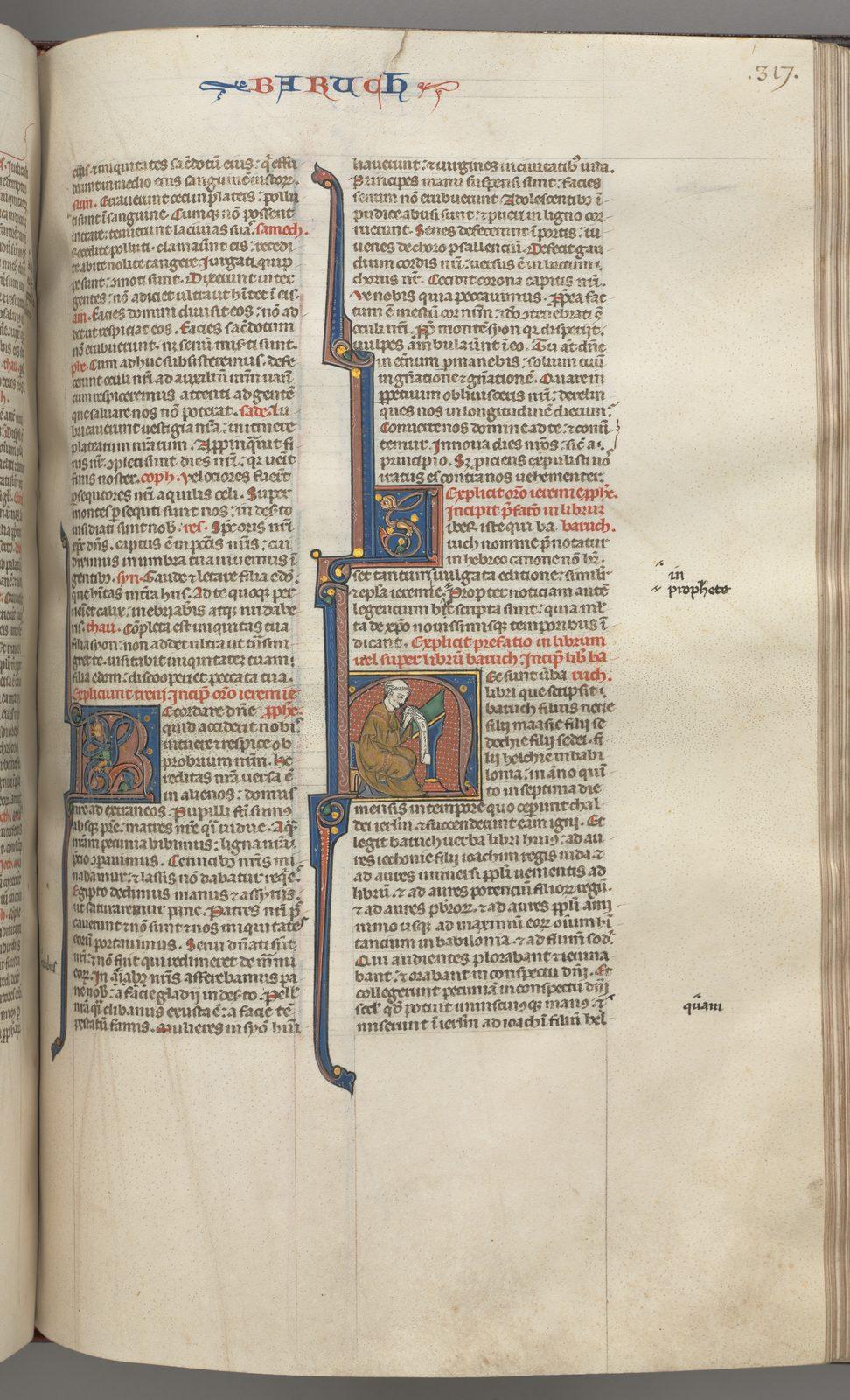
Southern France, Toulouse, 1275 to 1300. CC0.
Baruch 1 to 6 · Book · Apocrypha, a study resource beside the canon
Baruch
Baruch is a book of the Apocrypha in six chapters and 213 verses, written in the name of Jeremiah's scribe.
The book opens with Baruch reading a book aloud to the exiles in Babylon.
To You, O Lord, belongs righteousness, but this day we are covered with shame—the men of Judah, the people of Jerusalem, and all Israel near and far, in all the countries to which You have driven us because of our unfaithfulness to You.
To You, O Lord, belongs righteousness, but this day we are covered with shame—the men of Judah, the people of Jerusalem, and all Israel near and far, in all the countries to which You have driven us because of our unfaithfulness to You.
- Date
- A.D. 74 to about 78, by Whitehouse's dating of its parts (proposed)
- Occasion
- The book presents itself as words Baruch wrote in Babylon and read to the exiles, to be sent to Jerusalem for confession.
- Edition
- Baruch in the King James Version Apocrypha, 1769 text (eBible.org); the Berean Standard Bible for the canon
Summary
Baruch is a book of the Apocrypha. Jerome, the Council of Trent and the Church of England each gave it a different standing.
- The King James Bible prints the Letter of Jeremiah as its sixth chapter.
- Whitehouse dated its parts after the temple fell in A.D. 70.
- Augustine quoted its third chapter as words of Jeremiah.
The Book of Baruch
The first fourteen verses tell how the book was read in Babylon and sent to Jerusalem.
Baruch reads "in the hearing of Jechonias the son of Joachim king of Juda" (Baruch 1:3). He reads to "all them that dwelt at Babylon by the river Sud" (Baruch 1:4).
The people "wept, fasted, and prayed before the Lord" (Baruch 1:5). They gathered money and sent it to Jerusalem with the book (Baruch 1:6 to 7). The book was to be read in the house of the Lord on the feasts (Baruch 1:14).
The Book at a Glance
The six chapters fall into five parts by their opening words.
Prose in the first three chapters gives way to poetry, and a letter against idols closes the book.
- The frameBaruch 1:1 to 14, opening with "And these are the words of the book".
- The confessionBaruch 1:15 to 3:8, a confession of the people's sins.
- The poem on wisdomBaruch 3:9 to 4:4, opening with "Hear, Israel, the commandments of life".
- The consolationBaruch 4:5 to 5:9, opening with "Be of good cheer, my people".
- The Letter of JeremiahBaruch 6, seventy-three verses, opening with "A copy of an epistle, which Jeremy sent".
Each part with its verses and its opening words in the King James text.
Baruch beside the Canon
Whitehouse traced the book's borrowings from Daniel, Jeremiah, Deuteronomy, Proverbs, Job, Isaiah and Sirach.
Whitehouse noted the repeated use of whole clauses of Daniel 9:7 to 19 in Baruch 1:15 to 2:17.
Whitehouse found that the poem on wisdom borrows from Proverbs, Job, the later chapters of Isaiah and Sirach 24. He found the consolation based very largely on the later chapters of Isaiah.
Where the Book Came From
Whitehouse dated each part of the book, and the Catholic Encyclopedia sets the letter apart.
In R. H. Charles's Apocrypha and Pseudepigrapha of the Old Testament (1913), O. C. Whitehouse found three documents from different hands. They are a prose document in Baruch 1:1 to 3:8 and a poem of the Wisdom kind in Baruch 3:9 to 4:4. The third is a document of exhortation and comfort in Baruch 4:5 to 5:9.
He held that the first two had a Hebrew original and that the third was written in Greek. Charles, the editor, added a note that the Greek of Baruch 5 is a translation from the Hebrew.
Whitehouse dated the first document to A.D. 74, the fifth year after the temple was destroyed. He set the first two in the circle of Johanan ben Zaccai. For the third he wrote that A.D. 78 might be a not improbable date.
Francis Gigot, in the Catholic Encyclopedia (1907), wrote that the sixth chapter does not belong to the book proper.
Who Receives the Book
Five witnesses each did something different with the book.
Greek fathers read Baruch with Jeremiah, Jerome set it aside, Trent counts it in, and Article VI names it among the other books.
| Who | What they do with the book |
|---|---|
| Greek fathers of the fourth century, Athanasius and Cyril of Jerusalem among them | treat Baruch as an appendix to Jeremiah, though they set other books of the Apocrypha apart |
| John Chrysostom | quotes passages of Baruch as words of the prophet Jeremiah |
| Jerome | separates Baruch and the Letter of Jeremiah from the book of Jeremiah as outside the canon, because the Hebrews neither read it nor have it |
| The Council of Trent | recognizes it as part of the Old Testament among the deuterocanonical books |
| The Church of England's Article VI | names Baruch the Prophet among the other books the Church reads, but not to establish any doctrine |
The Voices
Augustine knew that some readers gave Baruch 3:35 to 37 to the secretary and not to Jeremiah.
In The City of God, book 18, chapter 33, he quotes the lines among the prophecies of Jeremiah. He adds: "Some attribute this testimony not to Jeremiah, but to his secretary, who was called Baruch; but it is more commonly ascribed to Jeremiah."
Books to Read Next
Three works give the book, its critical notes and its place in the church.
Baruch, King James Version Apocrypha
The King James translators, the standardized text · 1769
It gives all six chapters, the Letter of Jeremiah among them.
Read it in the readerThe Apocrypha and Pseudepigrapha of the Old Testament, vol. I
R. H. Charles, ed.; 1 Baruch by O. C. Whitehouse · 1913
Whitehouse sets out the book's three documents, their languages, their dates and the book's reception.
Read it free at archive.orgBaruch, in The Catholic Encyclopedia
Francis Gigot · 1907
It gives the book's contents, its canonicity and the Letter of Jeremiah.
Read it free at New AdventThe Letter against Idols
The last chapter says the idols of Babylon cannot save themselves.
Of Babylon's gods it says: "Yet cannot these gods save themselves from rust and moth, though they be covered with purple raiment" (Baruch 6:12).
Its last verse calls the just man who has no idols the better man, for he will be far from reproach (Baruch 6:73).
Sources
Scripture is the Berean Standard Bible.
- Baruch, King James Version Apocrypha, 1769 text (eBible.org USFX edition), public domain.
- O. C. Whitehouse, 1 Baruch, in R. H. Charles (ed.), The Apocrypha and Pseudepigrapha of the Old Testament, vol. I, Oxford, 1913, pp. 569 to 595; public domain.
- Francis Gigot, Baruch, The Catholic Encyclopedia, vol. 2, 1907; public domain.
- The Church of England, Articles of Religion, Article VI, in the Book of Common Prayer of 1863.
- Augustine, The City of God, book 18, chapter 33, tr. Marcus Dods, Nicene and Post-Nicene Fathers, first series, vol. 2; public domain.