
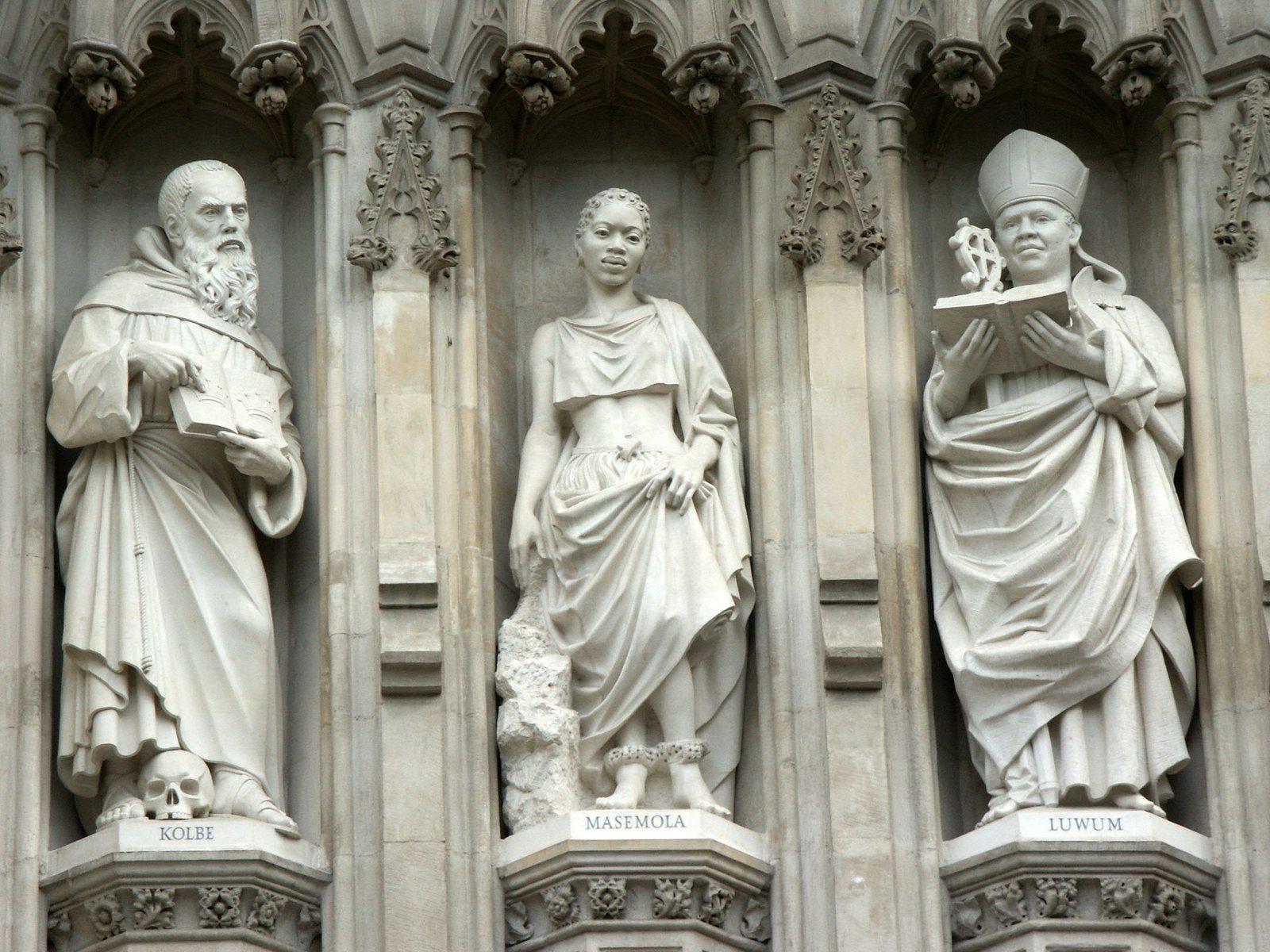
Jean-Christophe Benoist, the statues of Maximilian Kolbe, Manche Masemola and Janani Luwum on the west front of Westminster Abbey, photograph, CC BY 2.5
Uganda, to 1977 · Person · Featured Study
Janani Luwum
He led the Anglican province of Uganda from 1974 until his death in custody.
- Born
- In Acholi, northern Uganda; year not recorded (proposed)
- Died
- 16 or 17 February 1977, in the hands of Idi Amin's security forces (probable)
- Family
- wife: Mary Luwum
- Places
- Mucwini, Buwalasi, Kampala
Amin's radio reported a road crash, and the Abbey's record calls it murder.
Truly, truly, I tell you, unless a kernel of wheat falls to the ground and dies, it remains only a seed; but if it dies, it bears much fruit.
Summary
Janani Luwum was a schoolteacher in Acholi. He came to faith in the East African Revival in 1948. He became a bishop in 1969 and archbishop five years later. By then Idi Amin ruled Uganda. The bishops sent Amin a letter against the killings by his security forces. Within a week Luwum was dead.
- An American cable of 17 February gives the radio's account and the bishops' letter.
- Mary Luwum, his widow, was 92 when Uganda named the day for him.
- Westminster Abbey heads its page on him with the words "I am prepared to die in the army of Jesus".
The Verses of His Stand
Jesus told His disciples whom to fear, and the apostles told their council whom to obey.
The Abbey writes that Luwum warned the church against conforming to "the powers of darkness" and pleaded for the victims of Amin's rule. The question of this life is what a church leader says to a government that kills its own people, and what it costs him.
Do not be afraid of those who kill the body but cannot kill the soul. Instead, fear the One who can destroy both soul and body in hell.Jesus gave this word to the Twelve as He sent them out.
But Peter and the other apostles replied, “We must obey God rather than men.This was the answer given at Jerusalem when the high priest forbade their preaching.
The Life in Order
The church years stand on the Abbey's account, and the last weeks on an American telegram.
Eight years passed from his consecration as a bishop to his death.
- January 1948ConversionThe Abbey
- January 1949BuwalasiThe Abbey
- December 1955DeaconThe Abbey
- 1966Provincial officeThe Abbey
- January 1969BishopThe Abbey
- 1974ArchbishopThe Abbey
- February 1977Search, letter and deathThe telegram; the Abbey
- March 1977Memorial at the AbbeyThe Abbey
Each step of the life stands with its witness.
February 1977, March 1977
From Acholi to Kampala
A village teacher became the head of his church in the years of Amin's rule.
He was a young schoolteacher in Acholi when the East African Revival reached his village, and he was converted on 6 January 1948. He began to preach at once, against drink and tobacco, and the local authorities held that he was disturbing the peace.
In January 1949 he left his wife Mary and a young daughter to study at Buwalasi in eastern Uganda, and he came back a catechist. He trained for ordination from 1953, studied twice in England, and became principal of Buwalasi. In 1966 he became Provincial Secretary of the Church of Uganda, Rwanda, Burundi and Boga-Zaire.
At his consecration as bishop of Northern Uganda in January 1969, the prime minister Milton Obote and the army's chief of staff Idi Amin were in the congregation. Two years later Amin took power by a coup. The Abbey records that he ruled by intimidation, violence and corruption, with the Acholi and Langi peoples among his chief victims, and that he expelled the Asians of Uganda in 1972.
Luwum was elected archbishop in 1974. Amin cultivated him, and Luwum sought to soften the effects of the rule and to plead for its victims. The Anglican and Catholic churches came to act together, and then the Muslims of Uganda joined them.
On 5 February, in the last weeks of his life, security forces searched his house at gunpoint and accused him of a plot against Amin. On 16 February he was brought to a meeting that Amin attended to condemn the plot, with two ministers of the government, Erenayo Oryema and Charles Oboth-Ofumbi. The three were taken away, and Kampala radio and the Abbey give two accounts of their deaths.
The Abbey writes that the church leaders were called to Kampala and then sent away one by one. It says that Luwum turned to Bishop Festo Kivengere and said, "They are going to kill me", and then, "I am not afraid". The Abbey gives no earlier source for the words.
His body was buried near St Paul's Church at Mucwini. Tanzanian forces ended Amin's rule in 1979, and Amin fled abroad.
Read The East African Revival, the movement that converted him
The Bishops' Letter
An American telegram gives the letter's date and a line of its text.
The United States embassy at Nairobi cabled Washington on 17 February. It reported that eighteen bishops had signed a forceful letter dated 10 February against the atrocities of Amin's security forces. The embassy took this from the Nairobi Standard and a British diplomat.
The cable gives one line of the letter. It says the guns of those forces were in effect "pointed at every Christian . . . and have been increasingly used against the Ugandan to take away his life and property". The Abbey says Luwum delivered a protest to Amin on 12 February.
The cable judged that the killing of the archbishop and two ministers who were "said to be strong Christians" might unite opposition to Amin. On 23 February President Carter told a press conference, "In Uganda, the actions there have disgusted the entire civilized world".
In Their Own Words
Two of his sayings from February 1977 stand beside a word of Festo Kivengere on his death, all as Simonetta Carr quotes them in 2021.
Janani Luwum (1922 to 1977)
Simonetta Carr, "Janani Luwum: A Ugandan Martyr", Place for Truth, 8 June 2021, the raid on his house, quoting Festo Kivengere and Dorothy Smoker, I Love Idi Amin (Old Tappan: Fleming H. Revell), page 47, in note 1; the book was not opened
This is our work
“We pray for the president. We pray for the security officers, whatever they do. We preach the gospel and pray for others. This is our work, not keeping arms!”
Anglican
About this saying1 paragraph
He gave this answer to the security officers who searched his house by night in February 1977, by Festo Kivengere's account.
Janani Luwum
Simonetta Carr, "Janani Luwum: A Ugandan Martyr", Place for Truth, 8 June 2021, Ready to Die, quoting Margaret Ford, Janani, the Making of a Martyr (Marshall, Morgan and Scott, 1978), page 75, in note 2; the book was not opened
My conscience is clear
“I face daily being picked up by the soldiers. While the opportunity is there, I preach the gospel with all my might and my conscience is clear before God that I have not sided with the present government, which is utterly self-seeking.”
Anglican
About this saying1 paragraph
He told a critic this in February 1977, after the bishops' letter, in the words of Margaret Ford's life of him of 1978.
Festo Kivengere (1919 to 1988)
Simonetta Carr, "Janani Luwum: A Ugandan Martyr", Place for Truth, 8 June 2021, A Message of Forgiveness, quoting Festo Kivengere and Dorothy Smoker, I Love Idi Amin (Old Tappan: Fleming H. Revell), page 62, in note 4; the book was not opened
Praying for their murderers
“Many have died praying for their murderers, as did Janani Luwum, with compassion for those who were trapped in the confusion of killing. They reached out for heaven, and saw the glory of the angels’ welcome, and let others see it too.”
Anglican
About this saying1 paragraph
Festo Kivengere, who escaped from Uganda after his death, wrote this of him in I Love Idi Amin, the book he published in 1977.
The People Around Him
The witnesses name his wife, a fellow bishop, the two rulers and the two ministers who died with him.
The men who died beside him were members of Amin's own government.
| Person | Tie to Luwum | The witness |
|---|---|---|
| Mary Luwum | His wife, left at home while he studied in 1949. | The Abbey |
| Festo Kivengere | The bishop to whom, by the Abbey, he spoke of his coming death. | The Abbey |
| Milton Obote | Named in the alleged plot of 1977. | The telegram |
| Idi Amin | Ruler of Uganda from 1971. | The Abbey; the telegram |
| Erenayo Oryema | Minister of Lands, reported dead with him. | The telegram |
| Charles Oboth-Ofumbi | Minister of Internal Affairs, reported dead with him. | The telegram |
The Places of His Life
His life ran from a village in Acholi to the capital, and he was buried at Mucwini in the north.
His places ran from the north of Uganda to London.
| Place | What the witnesses say | The witness |
|---|---|---|
| Mucwini | His grave. | The Abbey |
| Buwalasi | The theological college where he studied and later served as principal. | The Abbey |
| Kampala | The capital, where the leaders were summoned in February 1977. | The telegram; the Abbey |
| London | Site of the statue unveiled in 1998. | The Abbey |
What His Death Did
Westminster Abbey mourned him within weeks, and Uganda now keeps a day in his name.
Westminster Abbey held a memorial service for him on 30 March. In 1998 it set his statue, by Corin Johnson, among ten martyrs of the twentieth century over its west door.
Uganda's Daily Monitor reported in February 2015 that President Museveni had declared 16 February a public holiday in his honour. The day the holiday keeps is the day Kampala radio gave for his death.
How the Key Verse Was Taught
Ignatius and John Chrysostom read the grain of wheat that dies.
Ignatius of Antioch (died 108)
The Epistle to the Romans, chapter 4
Ignatius of Antioch, on his way to the beasts at Rome, used the figure of wheat for his own death.
“I am the wheat of God, and let me be ground by the teeth of the wild beasts, that I may be found the pure bread of Christ.”
Early Church
John Chrysostom (died 407)
Catena Aurea by Aquinas
John Chrysostom read the verse of the death of Christ and the calling of the Gentiles.
“(Hom. lxvi. 2) He illustrates His discourse by an example from nature. A grain of corn produces fruit, after it has died. How much more then must the Son of God? The Gentiles were to be called after the Jews had finally offended; i. e. after His crucifixion. Now then that the Gentiles of their own accord offered their faith, He saw that His crucifixion could not be far off.”
on John 12:24Patristic
What the Witnesses Leave Open
The day and the manner of his death and the date of the protest are each given two ways.
How he diedKampala radio, by the American telegram; Westminster Abbey
Kampala radio said the three men died in a car accident while trying to escape from custody, and the American embassy cabled that account as the radio's report. The Abbey writes that he was taken away and murdered.
The day of his deathKampala radio; Westminster Abbey
The radio put the accident on 16 February 1977. The Abbey gives 17 February as the day of his death.
The date of the protestThe American telegram; Westminster Abbey
The letter in the telegram bears the earlier date and the Abbey's protest the later, two days apart, and the two may mark the writing and the delivery.
Books to Read Next
Foreign Relations of the United States, 1977 to 1980, volume 17, part 2
Louise P. Woodroofe, editor, United States Government Publishing Office · 2018
Its document 137 is the Nairobi telegram of 17 February.
Read the telegram free at the Office of the HistorianJanani: The Making of a Modern Martyr
Margaret Ford · 1978
The Abbey names this life of him for further reading.
In print: find it wherever books are sold.
What Janani Luwum Left
He left the protest he carried to Amin and a grave at Mucwini. His wife told in 2015 how they had first met in a church there.
Sources
Scripture is the Berean Standard Bible.
- The Holy Bible, Berean Standard Bible (read 2026)
- Foreign Relations of the United States, 1977 to 1980, volume XVII, part 2, document 137, telegram from the Embassy in Kenya to the Department of State, Nairobi, 17 February 1977, with its note on President Carter's press conference of 23 February.
- Westminster Abbey, "Janani Luwum", the Abbey's commemoration page.
- Daily Monitor (Kampala), the report of 16 February 2015 on the day named for Janani Luwum, photographs by Cissy Makumbi.
- Simonetta Carr, "Janani Luwum: A Ugandan Martyr", Place for Truth, 8 June 2021, which quotes Festo Kivengere and Dorothy Smoker, I Love Idi Amin (Fleming H. Revell), pages 47 and 62, and Margaret Ford, Janani, the Making of a Martyr (Marshall, Morgan and Scott, 1978), page 75 (the Abbey gives Ford's title as Janani: The Making of a Modern Martyr, the form the books section uses); neither book was opened.
- Tim Stafford, "Costly Love, Radical Forgiveness", Christian History, issue 94 (Christianity Today, 2007), for the year of I Love Idi Amin, 1977.
- Ignatius of Antioch, The Epistle to the Romans, chapter 4.
- John Chrysostom, Homily 66 on John, in the Catena Aurea of Thomas Aquinas, on John 12:24.
Keep Studying
Studies1