
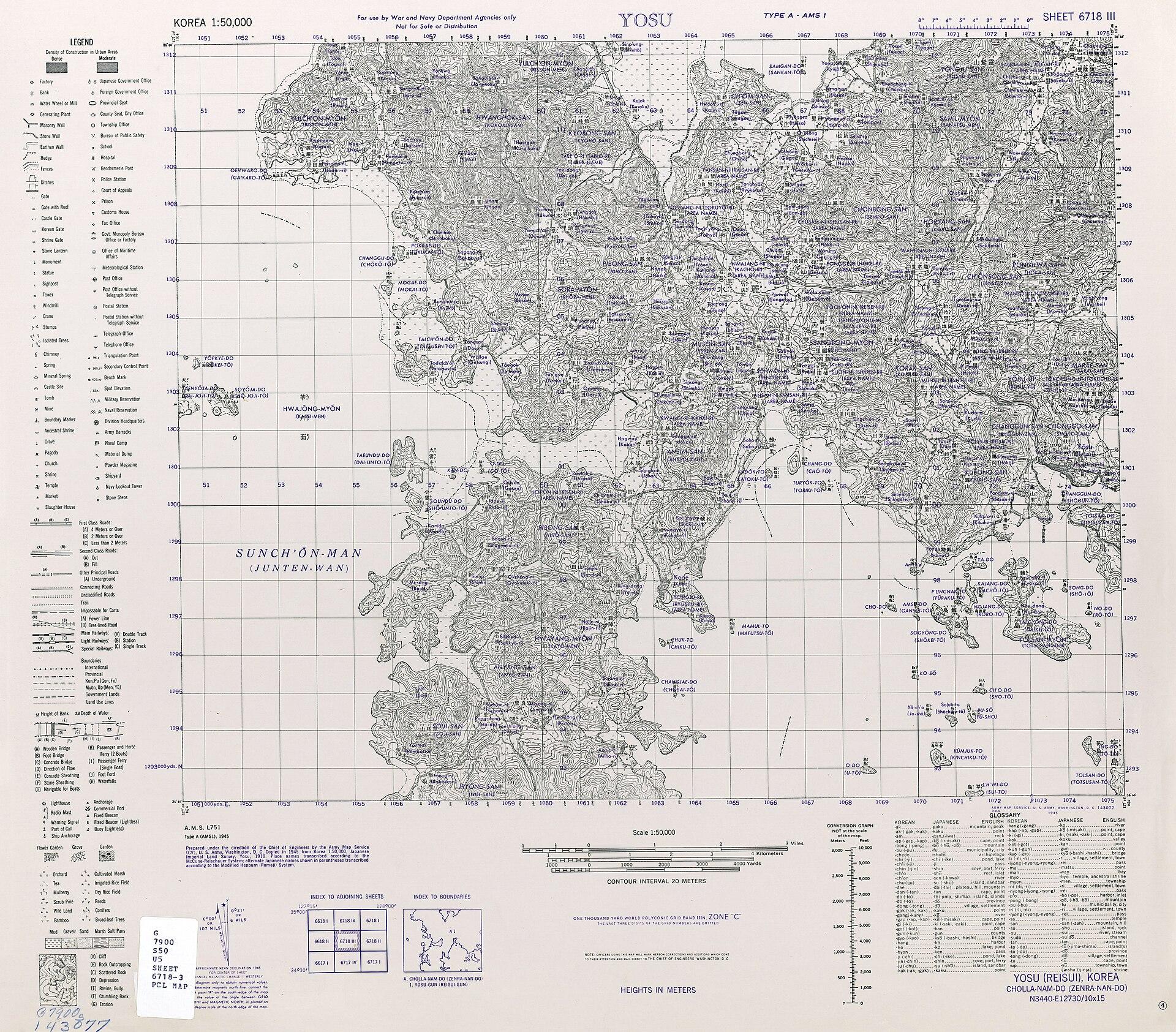
United States Army Map Service, Yosu, Sheet 6718 III, 1945. Public domain.
Korea, 1902 to 1950 · Person · Featured Study
Son Yang-won
He pastored lepers in the south of Korea, spent the Pacific War in prison and died in the Korean War.
He pleaded for the life of one of the students who had killed his boys, and then made him his son.
But I tell you, love your enemies and pray for those who persecute you,
- Born
- 7 July 1902, at Haman in South Gyeongsang
- Died
- 28 September 1950, at Mipyeong near Yeosu (probable)
- Family
- father: Son Jong-il; wife: Jeong Yang-sun; son: Dong-in; son: Dong-sin
- Places
- Haman, Busan, Yeosu, Suncheon
Summary
Son Yang-won was a Korean Presbyterian pastor who grew up in a devout Christian home. He spent the years from 1940 to 1945 in prison for refusing the Shinto shrine. Later he adopted one of those condemned for the deaths of two of his sons. In the Korean War communist forces shot him.
- His pen name was Sandol, and as a child he was called Son Yeon-jun.
- Classes he taught from the magazine Seongseo Joseon cost him his post at the Busan leper church.
- He married Jeong Yang-sun in 1924, and they had four sons and three daughters.
The Command He Kept
The prayer of Jesus on the cross and Paul's word on evil stand beside his forgiveness.
The Encyclopedia of Korean Culture calls him the pastor who forgave the leftist youth who killed his sons and made him his son. The question of this life is how one man carried the command to love an enemy through the war years of Korea.
Then Jesus said, “Father, forgive them, for they do not know what they are doing.” And they divided up His garments by casting lots.Jesus prayed for those who crucified Him, and Son pleaded for one who had joined in killing his sons.
Do not be overcome by evil, but overcome evil with good.He answered the killing of his sons by giving one of the killers a home.
The Life in Order
The dates stand on Son Seung-ho's entry of 2023 in the Encyclopedia of Korean Culture.
The years of the leper colony, the prison and the war all fall after 1938.
- 7 July 1902BirthThe encyclopedia
- 1915Trouble at schoolThe encyclopedia
- 1921Study in JapanThe encyclopedia
- 1926Bible instituteThe encyclopedia
- 1938Seminary finished; AeyangwonThe encyclopedia
- 1940 to August 1945PrisonThe encyclopedia
- 1946OrdinationThe encyclopedia
- October 1948Two sons killedThe encyclopedia
- 1949The flag questionThe encyclopedia
- September 1950ArrestThe encyclopedia
- 28 September 1950DeathThe encyclopedia
Each step of the life stands with its witness.
1946, October 1948, 1949, September 1950, 28 September 1950
From Haman to Mipyeong
He studied in Korea and in Japan before he settled near Yeosu.
He was born at Haman in South Gyeongsang, the eldest son of Son Jong-il, and came to faith with his father in 1909. In 1915 his school at Chilwon expelled him for refusing to bow toward the emperor's palace. It took him back after the missionary Macrae protested.
His father was jailed at Masan for joining the independence rising of 1919, and the son left his school in Seoul. In 1921 he went to Japan and finished a night course at the Sugamo middle school. There the preacher Nakada Juji moved him deeply, and Uchimura Kanzo also influenced him.
From 1926 he studied at the Gyeongnam Bible Institute, where Ju Gi-cheol was his teacher. He preached at Sangaewon, the church of the Busan leper hospital. He also travelled as an evangelist to churches near Ulsan and Yangsan.
After the Pyongyang seminary he went in 1938 to Aeyangwon, the leper colony near Yeosu, and served its church. The police arrested him in 1940 for refusing the shrine, and he came out of prison at the liberation of 1945. He went back to Aeyangwon and was ordained in 1946.
In October 1948 leftist students killed his sons Dong-in and Dong-sin. When one of the young men who had joined in the killing was about to be executed, he worked to save him and adopted him.
When the war came in 1950, those around him urged him to flee, and he stayed with the patients. Communist forces arrested him in September. On the night of the 28th, as they took him toward Suncheon, they shot him at Mipyeong.
The Rising of October 1948
His sons died in a revolt of soldiers and students in the south of Korea.
The encyclopedia calls the rising a revolt by part of the 14th Regiment at Yeosu, which refused an order to put down the Jeju uprising. It began on 19 October 1948 and spread to Suncheon.
In Their Own Words
Five of his sayings come through Soo Kwang Lee's article of 2014, which quotes in English Korean books by him and about him.
Son Yang-won (1902 to 1950)
Soo Kwang Lee, "Son, Yang-Won (1902-1950)", Journal of Korean American Ministries & Theology 6 (2014), Twelve Influential Early Korean Preachers, the Nine Thanks, quoting KIATS, ed., Son Yang-Won: Essential Writings (2009), pages 194 to 195, in note 2; that book was not opened
The first of nine thanks
“I thank the Lord for producing sons of martyrdom from the blood of a sinner like me.”
Korean Presbyterian
About this saying1 paragraph
He wrote a list of nine thanks after his sons were killed in the Yeosu uprising of October 1948, and this is the first.
Son Yang-won
Soo Kwang Lee, "Son, Yang-Won (1902-1950)", Journal of Korean American Ministries & Theology 6 (2014), Twelve Influential Early Korean Preachers, the seventh of the Nine Thanks, quoting KIATS, ed., Son Yang-Won: Essential Writings (2009), pages 194 to 195, in note 2; that book was not opened
An enemy as a son
“I thank the Lord for giving me a loving heart with which to lead my enemy to repentance and embrace him as my son.”
Korean Presbyterian
About this saying1 paragraph
In the seventh of the same thanks of 1948 he wrote of the young man he took as his son.
Son Yang-won
Soo Kwang Lee, "Son, Yang-Won (1902-1950)", Journal of Korean American Ministries & Theology 6 (2014), Twelve Influential Early Korean Preachers, his answer on the shrine, quoting Son Dong-Hee, In-Prison Ministry of Rev. Son, Yang-Won, the Martyr of Love, pages 184 to 185, in note 10; that book was not opened
Two gods
“Therefore, the government's policy forces Christians to commit the sin of serving two gods, which Christians regard as unrighteous.”
Korean Presbyterian
About this saying1 paragraph
The records of his case after his arrest in 1940 give this answer, when he was asked what complaint he had against Japan.
Son Yang-won
Soo Kwang Lee, "Son, Yang-Won (1902-1950)", Journal of Korean American Ministries & Theology 6 (2014), Twelve Influential Early Korean Preachers, a letter from prison, quoting Son Dong-Hee, In-Prison Ministry of Rev. Son, Yang-Won, the Martyr of Love, pages 40 to 41, in note 11; that book was not opened
A letter from prison
“please ask Dong-In not to bow, for we can never bow to the Shinto shrine. We cannot do this, for this is against the Second Commandment.”
Korean Presbyterian
About this saying1 paragraph
In a letter home from his cell after 1940 he wrote of Dong-in and the bow at school.
Son Yang-won
Soo Kwang Lee, "Son, Yang-Won (1902-1950)", Journal of Korean American Ministries & Theology 6 (2014), Twelve Influential Early Korean Preachers, Oh Martha's account, quoting Chong-Soon Cha, Aeyangwon and Martyr of Love: Son Yang-Won (2008), page 196, in note 14; that book was not opened
In the war
“Let's all die as martyrs. Let's die.”
Korean Presbyterian
About this saying1 paragraph
After the war began in June 1950 he asked Oh Martha, wife of the pastor of Jangcheon Church, to come to Aeyangwon with these words, as she told it.
The People Around Him
The encyclopedia names his family, his teachers and the men who shaped his faith.
His teachers ran from a missionary at Chilwon to a pastor who died in prison.
| Person | Tie to Son | The witness |
|---|---|---|
| Son Jong-il | His father. | The encyclopedia |
| Macrae | The missionary whose protest won his return to school. | The encyclopedia |
| Nakada Juji | The preacher who moved him in Japan. | The encyclopedia |
| Ju Gi-cheol | His teacher at the Bible institute. | The encyclopedia |
| Kim Gyo-sin | One of the publishers of Seongseo Joseon, the magazine Son taught from. | The encyclopedia |
| Jeong Yang-sun | His wife from 1924. | The encyclopedia |
| Dong-in and Dong-sin | His sons, killed in 1948. | The encyclopedia |
The Places of His Life
He served the churches of two leper colonies, at Busan and at Yeosu.
He spent his last twelve years near Yeosu.
| Place | What the witnesses say | The witness |
|---|---|---|
| Haman | His birthplace, where a memorial hall stands since 2015. | The encyclopedia |
| Japan | Where he studied from 1921. | The encyclopedia |
| Busan | His first charge as a preacher. | The encyclopedia |
| Pyongyang | The seminary he finished in 1938. | The encyclopedia |
| Yeosu | Aeyangwon, where a memorial hall to him stands since 1993. | The encyclopedia |
| Mipyeong | The place of his death, on the road to Suncheon. | The encyclopedia |
What He Did With an Enemy
He saved one of his sons' killers, refused the bow to the flag and stayed with his patients.
The encyclopedia says he lived out love, reconciliation and forgiveness in a striking way, and that the Korean church widely honours him for it. After his death he gained the name The Atom Bomb of Love. It is the title of a life of him that was translated into English and German and made into a film.
In 1949 he called the bow to the national flag of the new Republic idolatry, as he had refused the bow at the shrine.
How the Key Verse Was Taught
Jerome and John Wesley read the command to love enemies and pray for persecutors.
Jerome (died 420)
Catena Aurea by Aquinas
Jerome answered those who held the command impossible.
“Many measuring the commandments of God by their own weakness, not by the strength of the saints, hold these commands for impossible, and say that it is virtue enough not to hate our enemies; but to love them is a command beyond human nature to obey. But it must be understood that Christ enjoins not impossibilities but perfection. Such was the temper of David towards Saul and Absalom; the Martyr Stephen also prayed for his enemies while they stoned him, and Paul wished himself anathema for the sake of his persecutors. (Rom. 9:3.)”
on Matthew 5:44Patristic
John Wesley (1703 to 1791)
Journal, 24 May 1738, section 15, Curnock, Standard Edition, volume I, page 476
John Wesley wrote in his journal of praying for those who had used him spitefully.
“I began to pray with all my might for those who had in a more especial manner despitefully used me and persecuted me.”
Evangelical
What the Witnesses Leave Open
The day of his arrest and the book that named him are each left partly open.
The day of his arrestSon Seung-ho in the Encyclopedia of Korean Culture; the memorial hall's listing
Son Seung-ho's entry of 2023 says communists arrested him in September 1950 and gives no day. The listing of the Son Yang-won Martyrdom Memorial Hall gives 13 September, and both give the 28th for his death at Mipyeong.
The book that named himSon Seung-ho in the Encyclopedia of Korean Culture
The encyclopedia names neither the author of The Atom Bomb of Love nor the year of its first edition.
Books to Read Next
Encyclopedia of Korean Culture, the entry on Son Yang-won
Son Seung-ho · 2023
The entry gives each step of his life and lists the Korean studies of it.
Read the entry free, in KoreanWhat Son Yang-won Left
He left a son by adoption and a church among the lepers of Yeosu. Memorial societies keep his name, and halls to him stand at Yeosu and at Haman.
Sources
Scripture is the Berean Standard Bible.
- The Holy Bible, Berean Standard Bible (read 2026)
- Son Seung-ho, "Son Yang-won" (손양원), Encyclopedia of Korean Culture, written 2023, revised 17 September 2025.
- Kim Seung-tae's entry "Ju Gi-cheol" (주기철) in the same encyclopedia, revised 2 December 2024.
- K-Trip Tips, "손양원목사 순교기념관" (the Son Yang-won Martyrdom Memorial Hall), the hall's listing.
- Soo Kwang Lee, "Son, Yang-Won (1902-1950)", Journal of Korean American Ministries & Theology 6 (2014), Twelve Influential Early Korean Preachers, Korean American Ministries at Columbia Theological Seminary. The article quotes in English the books named in its notes 2, 10, 11 and 14, none of them opened, and names no translator. Its bibliography gives Son Dong-Hee, In-Prison Ministry of Rev. Son Yang-Won, the Martyr of Love (Seoul: Voice Publication, 2000), and KIATS, ed., Son Yang-Won: Essential Writing (Seoul: The KIATS Press, 2009)
- Jerome, on Matthew 5:44, in the Catena Aurea of Thomas Aquinas.
- John Wesley, Journal, 24 May 1738, Curnock's Standard Edition, volume 1, page 476.
Keep Studying
People and groups2
Values1
Trials of life1