
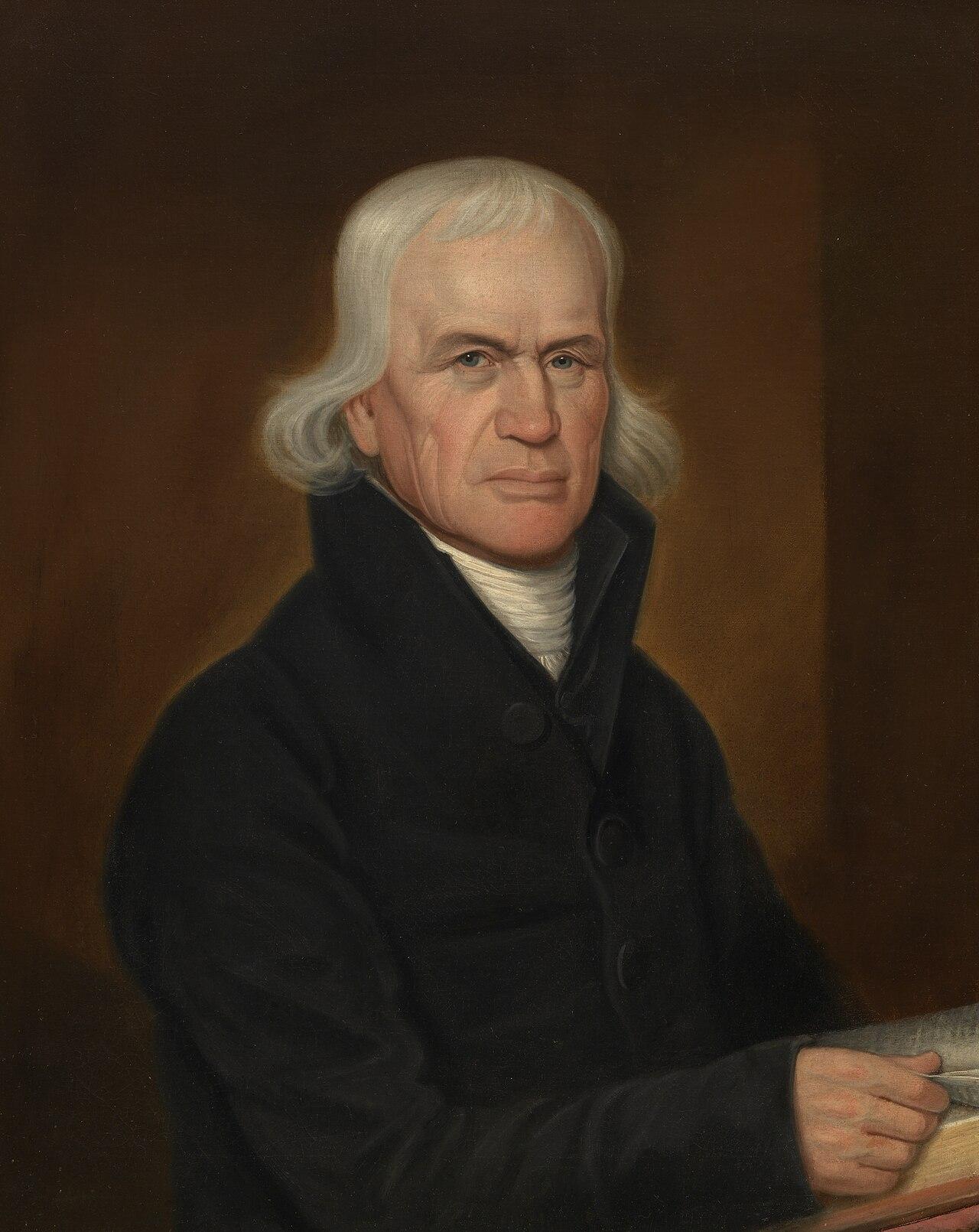
John Paradise, Francis Asbury, 1813. Public domain.
England and America, 1745 to 1816 · Person · Featured Study
Francis Asbury
One of Wesley's preachers, he crossed to America and led its Methodists as general superintendent until his death.
Told in 1777 that two fellow preachers had left the continent, he wrote in his journal, "So we are left alone."
Preach the word; be prepared in season and out of season; reprove, rebuke, and encourage with every form of patient instruction.
- Born
- 20 or 21 August 1745, near Birmingham, by his own account (probable)
- Died
- a Sunday in March 1816, in Spotsylvania, Virginia
- Family
- father: Joseph Asbury; mother: Elizabeth Asbury
- Places
- Handsworth, Bristol, Philadelphia, Delaware, Baltimore
Summary
Asbury was born near Birmingham. As a young man he offered himself to Wesley for America, and he landed at Philadelphia. He stayed on through the war. Then the preachers at Baltimore chose him and Thomas Coke to lead a new church. He kept to the roads until his last illness and died in Virginia in March 1816.
- His Journal, printed in three volumes in 1852, is the main witness to his life.
- His Journal gives his own count of the miles he rode.
- Wesley objected to his title of bishop in 1788.
The Verses of His Calling
No verse names him, and Paul's words to Timothy and the Corinthians fit the work he gave his life to.
No verse of Scripture names Asbury, who was born in 1745. Paul charged Timothy to preach the word in season and out of season, and he wrote to the Corinthians of his daily care for all the churches.
The question of this life is how one English preacher held a scattered church together across a new country. His Journal answers it day by day, and the sources leave his birthday, his title and the day of his death open to question.
And He died for all, that those who live should no longer live for themselves, but for Him who died for them and was raised again.Asbury wrote at sea that he was going to America to live to God.
Apart from these external trials, I face daily the pressure of my concern for all the churches.Asbury carried the same care for the churches across a continent.
The Life in Order
Almost every step stands on his own Journal.
Forty-five years of the life were spent in America.
- August 1745Birth in the parish of HandsworthJournal, volume 2, page 157
- August 1771Accepted by Wesley for AmericaJournal, volume 1, page 11
- September 1771The voyage from near BristolJournal, volume 1, page 12
- October 1771Arrival at PhiladelphiaJournal, volume 1
- 1777News that Rankin and Rodda had goneJournal, volume 1, the year 1777
- March 1778Retreat to DelawareJournal, volume 1, page 272
- December 1784Election and ordination at BaltimoreJournal, volume 1, page 486
- September 1788Wesley's letter against the title of bishopWesley's Letters, ed. Telford
- July 1794Bethel opened in PhiladelphiaAllen's narrative, page 18
- August 1803What he would leave a successorJournal, volume 3, pages 123 to 124
- March 1816Death in Spotsylvania, VirginiaJournal, volume 3, pages 473 to 474
Each step of the life stands with its witness.
December 1784, September 1788, July 1794, August 1803, March 1816
From Handsworth to the American Roads
A young preacher sailed for America and stayed there for the rest of his life.
Asbury wrote in 1792 that he was born near Hamstead Bridge, in the parish of Handsworth, about four miles from Birmingham. He gave the day as the 20th or 21st of August 1745. His father Joseph worked as a farmer and gardener for the two richest families of the parish, and his only sister died in infancy. At about thirteen and a half he chose to learn a trade, and he worked at it some six and a half years.
At the conference that began at Bristol on 7 August 1771 he offered himself for America, and Wesley accepted him. He came back to Bristol with no money, and friends gave him clothes and ten pounds. He sailed on 4 September and landed at Philadelphia on 27 October 1771.
In 1777, in the war between Britain and the colonies, Asbury learned that Rankin and Rodda had left the continent. From 10 March 1778 he refused the state oath of Maryland as a non-juror, and he withdrew to Delaware, where clergy were not asked to swear.
In November 1784 Thomas Coke brought Wesley's plan for an American church with superintendents, elders and deacons. Asbury answered that he would take the office only if the preachers chose him. The conference met at Baltimore in December, and it elected Coke and Asbury superintendents. Asbury was ordained deacon and elder before he was made superintendent.
He travelled the circuits for the rest of his life, preaching in chapels, barns and houses. In 1803 he wrote that he would leave a successor five thousand miles a year, the care of more than a hundred thousand souls and four hundred preachers to station. In March 1816, too weak to go on, he stopped at the house of George Arnold in Spotsylvania, Virginia, and he died there on a Sunday. He was buried in Arnold's ground, and his body was later moved to Baltimore by order of the General Conference.
In Their Own Words
He speaks here in four entries of his Journal, from the voyage out to the roads of his later years.
Francis Asbury (1745 to 1816)
Journal, volume 1 (1852), page 12
Whither am I going?
“Whither am I going? To the New World. What to do? To gain honour? No, if I know my own heart. To get money? No: I am going to live to God, and to bring others so to do.”
Methodist
About this saying1 paragraph
He wrote this at sea on 12 September 1771, eight days out from Bristol.
Francis Asbury
The Journal of the Rev. Francis Asbury, volume 1, April 1778, page 272
A non-juror
“From March 10, 1778, on conscientious principles I was a non-juror, and could not preach in the State of Maryland; and therefore withdrew to the Delaware State, where the clergy were not required to take the State-oath”
Methodist
About this saying1 paragraph
He set down in April 1778 why he had left Maryland.
Francis Asbury
The Journal of the Rev. Francis Asbury, volume 1, November 1784, page 484
If the preachers choose me
“My answer then was, if the preachers unanimously choose me, I shall not act in the capacity I have hitherto done by Mr. Wesley's appointment.”
Methodist
About this saying1 paragraph
He recorded his answer to Wesley's plan in November 1784, a month before the conference at Baltimore.
Francis Asbury
The Journal of the Rev. Francis Asbury, volume 3, 9 August 1803, pages 123 to 124
Who wants this legacy?
“I have little to leave, except a journey of five thousand miles a year, the care of more than a hundred thousand souls, and the arrangement of about four hundred preachers yearly”
Methodist
About this saying1 paragraph
He wrote this on Tuesday 9 August 1803, ill on the road near Mount Braddock.
The People Around Him
The Journal, the letters and Allen's narrative name those who sent him, served with him and parted from him.
Wesley sent him, and the American preachers chose him.
| Person | Tie to Asbury | The witness |
|---|---|---|
| John Wesley | He accepted Asbury for America in 1771 and wrote to him in 1788. | Journal, volume 1; Wesley's Letters, ed. Telford |
| Thomas Rankin | Asbury heard his last sermon in 1777, and Rankin then left the continent. | Journal, volume 1 |
| Thomas Coke | He came from Wesley in 1784 and shared the superintendency with Asbury. | Journal, volume 1 |
| Harry Hosier | Asbury planned in 1780 to take him on the road, and he preached after Asbury in 1781. | Journal, volume 1, June 1780 and May 1781 |
| Richard Allen | The preacher who built Bethel in Philadelphia. | Allen, Life (1833) |
| George Arnold | The host of his last days. | Journal, volume 3 |
Asbury asked Allen in 1785 to travel with him, on terms Allen would not accept, and in July 1794 he preached at the opening of Allen's church.
The Places of His Life
His life ran from the English Midlands to the roads of the young American states.
The record of his life moves with him from place to place.
| Place | What the witnesses say | The witness |
|---|---|---|
| Handsworth | His birthplace, in the English Midlands. | Journal, volume 2 |
| Bristol | He sailed for America from near the city. | Journal, volume 1 |
| Philadelphia | He landed there in 1771 and opened Bethel there in 1794. | Journal, volume 1; Allen's narrative |
| Delaware | His refuge during the war. | Journal, volume 1 |
| Baltimore | The conference met there in December 1784, and his body was later laid there. | Journal, volumes 1 and 3 |
| Spotsylvania | The county in Virginia where his travels ended. | Journal, volume 3 |
The Figures Behind the Legend
His own counts of miles, souls and preachers stand in the Journal, and some later figures do not.
Asbury's own figure for his travel is the yearly count in his Journal. A lifetime total of about 270,000 miles is often given. It does not appear in the third volume of his Journal, in Strickland's life of 1858, in Lednum's history of 1859 or in Stevens's history of 1864.
The account of his death printed with the Journal says he gave about fifty-five years to the ministry, forty-five of them in North America. It says he served thirty of those years as general superintendent.
How the Key Verse Was Taught
Matthew Henry and John Wesley read Paul's charge to preach in season and out of season.
Matthew Henry (1662 to 1714)
Commentary on the Whole Bible
Matthew Henry tied the charge to Paul's coming departure.
“The reason of his concern in this case, Why must Timothy now be instant in season, &c., in a particular manner? Because the church was likely to be deprived of the apostle's labours, for his departure was at hand,”
on 2 Timothy 4:1 to 5Puritan
John Wesley (1703 to 1791)
Explanatory Notes upon the New Testament
John Wesley read the charge as a call to make an occasion where none is given.
“Not only when a fair occasion is given: even when there is none, one must be made.”
on 2 Timothy 4:2Evangelical
What the Sources Leave Open
Wesley and Asbury differed on his title, and the account of his death gives a date that does not match its day of the week.
The title of bishopJohn Wesley (1788); Francis Asbury (1784)
Wesley wrote to him from London on 20 September 1788, "How can you, how dare you suffer yourself to be called Bishop". He wrote that he would never consent to be called bishop himself.
Asbury had written in 1784 that he would act only if the preachers chose him, and the conference elected him. The Journal calls him superintendent, and the account of his death calls the office general superintendent.
The day of his deathJournal, volume 3 (1852); the calendar of 1816
The account printed with the Journal says he died on the Sabbath, "the 21st day of March", 1816. The 21st of March 1816 was a Thursday and the 31st was a Sunday, so the day of the week points to the 31st.
His birthdayFrancis Asbury (1792)
Asbury himself hedged the day, "according to the best of my after-knowledge". No other witness to the day was opened.
Books to Read Next
The Journal of the Rev. Francis Asbury, volume 1
Francis Asbury · 1852
This volume covers his record from the voyage to America to the conference at Baltimore.
Read volume 1 free at the Internet ArchiveThe Journal of the Rev. Francis Asbury, volume 3
Francis Asbury · 1852
The last volume holds the account of his death.
Read volume 3 free at the Internet ArchiveThe Life, Experience, and Gospel Labours of the Rt. Rev. Richard Allen
Richard Allen · 1833
Allen's narrative is the second witness, beside the Journal, to Asbury's dealings with him.
Read Allen free at Documenting the American SouthWhat Asbury Left
Asbury left his Journal and a church whose preachers he had stationed year by year for thirty years.
Sources
Scripture is the Berean Standard Bible.
- The Holy Bible, Berean Standard Bible (read 2026)
- Francis Asbury, The Journal of the Rev. Francis Asbury, volume 1 (New York: Lane and Scott, 1852)
- Francis Asbury, The Journal of the Rev. Francis Asbury, volume 2 (New York: Lane and Scott, 1852), July 1792.
- Francis Asbury, The Journal of the Rev. Francis Asbury, volume 3 (New York: Lane and Scott, 1852), with the account of his death.
- John Wesley, letter to Francis Asbury, London, 20 September 1788, in The Letters of the Rev. John Wesley, ed. John Telford, Standard Edition (1931)
- Richard Allen, The Life, Experience, and Gospel Labours of the Rt. Rev. Richard Allen (Philadelphia: Martin and Boden, 1833)
- Matthew Henry, Commentary on the Whole Bible (1710), on 2 Timothy 4:2.
- John Wesley, Explanatory Notes upon the New Testament (1755), on 2 Timothy 4:2.
Keep Studying
Read it3