
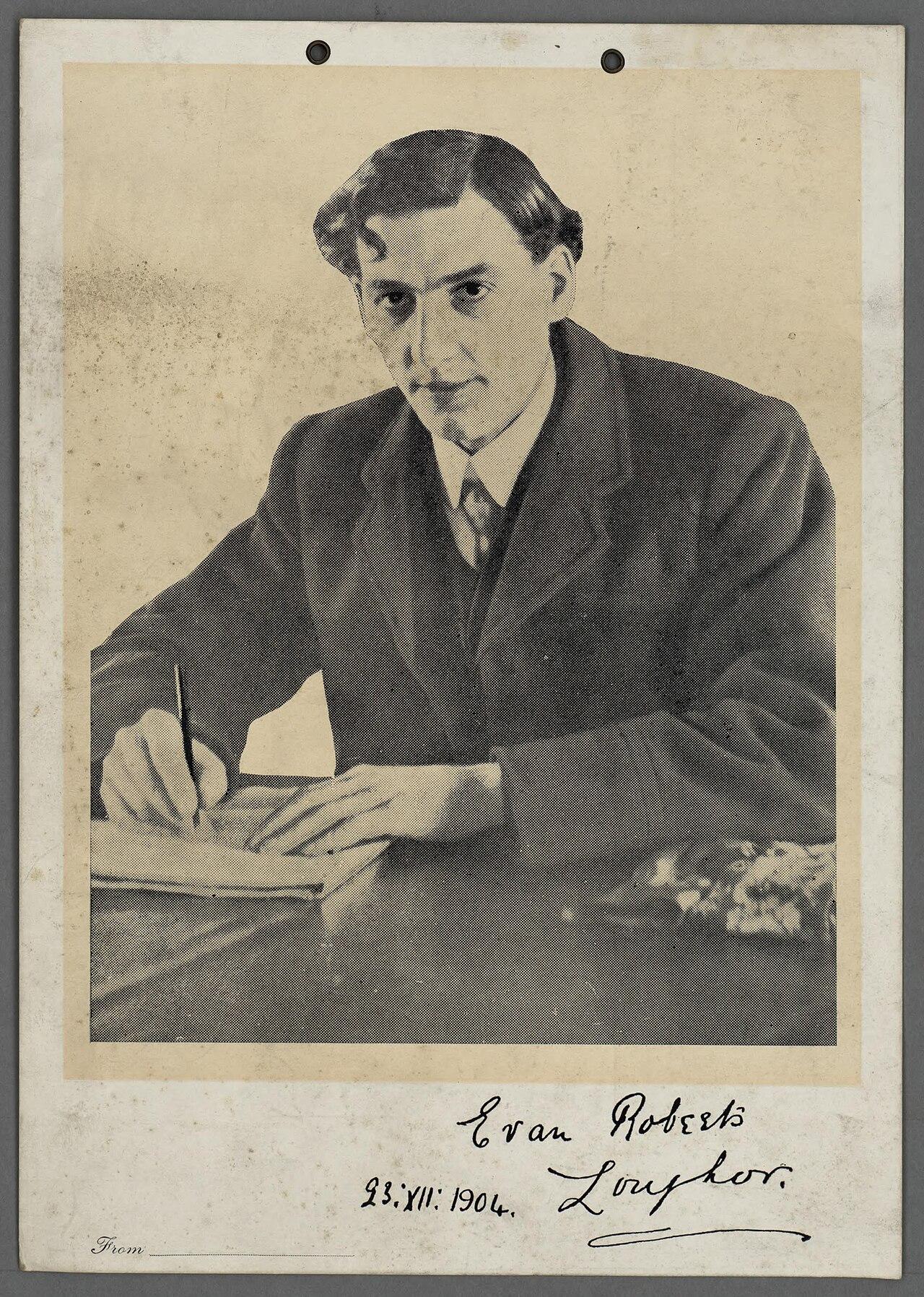
Evan Roberts, Loughor, 1904. Public domain.
Loughor, 1878 to 1951 · Person · Featured Study
Evan Roberts
He worked in the pit and the smithy at Loughor and led the revival meetings that spread from there.
Seventeen people stayed behind for his first meeting at Moriah, and two years later he was resting in Leicester.
But God proves His love for us in this: While we were still sinners, Christ died for us.
But God proves His love for us in this: While we were still sinners, Christ died for us.
- Born
- 8 June 1878, at Island House, Loughor
- Died
- 29 January 1951, at Rhiwbina, Cardiff
- Family
- father: Henry Roberts; mother: Hannah Roberts
- Places
- Loughor, Newcastle Emlyn, Blaenannerch, Leicester, Cardiff
Summary
Roberts was born at Loughor and worked in the colliery there from about the age of twelve. He left the pit for the smithy and then went to school at Newcastle Emlyn to prepare for the ministry. After a meeting at Blaenannerch he went home to Loughor, and the meetings he began there grew into the revival. Worn out within two years, he withdrew from public life, and he died at Cardiff in 1951.
- D. M. Phillips's life of him prints his letters and his own accounts.
- W. T. Stead heard him at Mardy and printed what Roberts told him.
- Phillips and the Dictionary give different counts of the years he prayed for a revival.
The Verses of His Preaching
No verse names him, and the verses he and his hearers turned to stand behind his story.
No verse of Scripture names Roberts, who was born in 1878. His own account of Blaenannerch speaks of God commending His love, which is the word of Romans 5:8. He told Stead that the movement was of God and that he would not dare to direct it.
The question of this life is how a young collier and smith became the voice of a revival and then left public view. Phillips's life of 1906 tells the first part from his letters, and the later years stand on a few lines of the Dictionary of Welsh Biography.
So he said to me, “This is the word of the LORD to Zerubbabel: Not by might nor by power, but by My Spirit, says the LORD of Hosts.The word to Zerubbabel puts the work in the hands of the Spirit.
So if you who are evil know how to give good gifts to your children, how much more will your Father in heaven give the Holy Spirit to those who ask Him!”Roberts's prayer for the Spirit leans on this promise.
The Life in Order
The dated steps run from his birth at Loughor to his death at Cardiff.
The public years of the life were fewer than two.
- 8 June 1878He was born at Island House, LoughorPhillips; Dictionary of Welsh Biography
- About the age of twelveHe went to work in the colliery with his father, and then as a door-boyPhillips (1906)
- January 1897The explosion in the pitPhillips (1906)
- September 1902From the pit to the smithyPhillips; Dictionary of Welsh Biography
- End of 1903First sermons at MoriahDictionary of Welsh Biography
- September 1904He entered the school at Newcastle EmlynDictionary of Welsh Biography
- September 1904The meeting at BlaenannerchPhillips (1906)
- October 1904The mission at Loughor openedPhillips (1906)
- December 1904W. T. Stead heard him at MardyStead (1905)
- 1906Worn out, he was cared for by Jessie Penn-Lewis at LeicesterDictionary of Welsh Biography
- 1925 to 1930Occasional meetings in WalesDictionary of Welsh Biography
- January 1951Death at CardiffDictionary of Welsh Biography
Each step of the life stands with its witness.
September 1904, October 1904, December 1904, 1906, 1925 to 1930, January 1951
From the Pit to Moriah and Back to Quiet
A young collier prayed for years, preached for a season and lived his last decades out of view.
Roberts was born on 8 June 1878 at Island House, Loughor, the son of Henry and Hannah Roberts. When he was about eleven and a half, his father broke his leg in the Mountain Colliery, and Evan went down to help him. At about twelve he became a door-boy in the pit, and his first pay was five shillings.
He kept his Bible with him in the colliery. On 8 January 1897 an explosion went through the pit while he was away, and the Bible was found scorched with its leaves scattered, and he gathered the leaves together. In September 1902 he left the pit and began to learn the trade of a blacksmith.
At the end of 1903 he began to preach at Moriah, and the Presbyterian Church of Wales accepted him as a candidate for the ministry. At the end of September 1904 he went to John Phillips's school at Newcastle Emlyn. On Thursday 29 September, at a meeting at Blaenannerch, he remembered Seth Joshua praying "bend us", and he cried out, "Bend me".
He went home to Loughor before the end of October to hold a mission. On Monday 31 October 1904, after the prayer meeting at Moriah, sixteen adults and one girl stayed for his meeting, and after two hours they all stood to confess Christ. The meetings spread through South Wales over the following months, and the page on the revival tells that story.
By 1906 he was worn out and physically weak. Jessie Penn-Lewis cared for him at her home in Leicester, and he lived for a short time in London. In Leicester he published a booklet in Welsh in 1912. He took part now and then in meetings in Wales between 1925 and 1930. He died at Rhiwbina, Cardiff, on 29 January 1951 and was buried in the family grave at Moriah, Loughor.
In Their Own Words
He speaks here of the meeting at Blaenannerch, a prayer in a letter from Loughor and his answer to Stead.
Evan Roberts (1878 to 1951)
His account in D. M. Phillips's life of him (London), the Revival Library's text, the meeting at Blaenannerch
Bent
“It was God commending His love that bent me, and I not seeing anything in Him to commend. After I was bent, a wave of peace filled my bosom.”
Welsh revival
About this saying1 paragraph
He told of the morning at Blaenannerch in the account Phillips printed in 1906.
Evan Roberts
Letter to Elsie Phillips from Island House, Loughor, in D. M. Phillips, Evan Roberts, the Great Welsh Revivalist and His Work, the letter headed Island House, Loughor
Send the Spirit now
“Send the Spirit now for Jesus Christ's sake.”
Welsh revival
About this saying1 paragraph
He wrote this to Elsie Phillips from Island House, Loughor, in his first weeks of meetings in 1904, as the first of four rising petitions.
Evan Roberts
His words to W. T. Stead, in W. T. Stead, The Welsh Revival, the chapter on Evan Roberts
Of God
“The movement is not of me, it is of God. I would not dare to try to direct it.”
Welsh revival
About this saying1 paragraph
He told W. T. Stead this, and Stead printed it in The Welsh Revival in 1905.
The People Around Him
The sources name the people who shaped him, heard him and kept him.
Seth Joshua's prayer moved him, and Jessie Penn-Lewis gave him a home.
| Person | Tie to Roberts | The witness |
|---|---|---|
| Henry Roberts | His father, who worked in the same pit. | Phillips (1906) |
| Seth Joshua | Roberts remembered his closing prayer at Blaenannerch for the words "bend us". | Phillips (1906); Joshua's diary in Morgan (1909) |
| Sydney Evans | His friend at Newcastle Emlyn, to whom he spoke of a hundred thousand converts. | Phillips (1906) |
| W. T. Stead | He heard Roberts at Mardy and printed his interview. | Stead (1905) |
| Elsie Phillips | He wrote to her from Island House with the prayer for the Spirit. | Phillips (1906) |
| Jessie Penn-Lewis | The writer who took him into her home and published with him. | Dictionary of Welsh Biography |
The women who sang and prayed in his meetings have a page of their own.
The Places of His Life
His life began at Loughor and ended at Cardiff, with a long stay in England between.
The record of his life centres on Loughor.
| Place | What the witnesses say | The witness |
|---|---|---|
| Loughor | He was born at Island House, worked in its colliery and held his first meetings at Moriah. | Dictionary of Welsh Biography; Phillips |
| Newcastle Emlyn | The school where he prepared for the ministry. | Dictionary of Welsh Biography |
| Blaenannerch | The meeting where he cried out. | Phillips (1906) |
| Leicester | His home in the years after the revival. | Dictionary of Welsh Biography |
| Rhiwbina, Cardiff | The place of his last years and his death. | Dictionary of Welsh Biography |
The Long Quiet
He lived forty-five more years after the revival, most of them out of public view.
The Dictionary of Welsh Biography says the stresses of the revival months proved too much for him and that he retired from public view. In 1912 Jessie Penn-Lewis published War on the Saints, its title page naming him as her collaborator. The book calls the revival in Wales "a true work of God" and warns of what followed it.
Historians differ on what Penn-Lewis did to his ministry, and the page on the revival sets out both sides. He was buried at Moriah, where his first meeting had been held, and a monument to him was unveiled in front of the chapel in 1953.
How the Key Verse Was Taught
John Wesley and Adam Clarke read the word that God commends His love.
John Wesley (1703 to 1791)
Explanatory Notes upon the New Testament
John Wesley read the verb as God recommending His love to those far from Him.
“So far from being good, that we were not even just.”
on Romans 5:8Evangelical
Adam Clarke (1762 to 1832)
Commentary on the Bible
Adam Clarke read it as God setting His mercy in the most open light.
“God hath set this act of infinite mercy in the most conspicuous light, so as to recommend it to the notice and admiration of all.”
on Romans 5:8Evangelical
What the Sources Leave Open
Phillips and the Dictionary disagree on his years of prayer, and his later life is thinly recorded.
How long he prayed for a revivalD. M. Phillips (1906); Gomer Morgan Roberts, Dictionary of Welsh Biography
Phillips wrote that he had prayed between ten and eleven years expressly for a revival before it came. Gomer Morgan Roberts wrote that he confessed to having prayed for thirteen years. Phillips also counts thirteen years from his church membership to the revival, as a time of preparation.
The years after 1906Gomer Morgan Roberts, Dictionary of Welsh Biography
Its account of those years runs to a few sentences, and it names Leicester, London, Porthcawl and Rhiwbina.
Books to Read Next
Evan Roberts, the Great Welsh Revivalist and His Work
D. M. Phillips · 1906
Phillips prints his letters and his own account of the revival months.
Read Phillips free at the Internet ArchiveThe Welsh Revival
W. T. Stead · 1905
Stead reports what he saw at Mardy and what Roberts told him.
Read Stead free at the Internet ArchiveWhat Roberts Left
Roberts left letters, poems and hymns, and a selection of them stands in Phillips's life of him. A collection of his hymns was published at Aberdare in 1905.
Sources
Scripture is the Berean Standard Bible.
- The Holy Bible, Berean Standard Bible (read 2026)
- D. M. Phillips, Evan Roberts, the Great Welsh Revivalist and His Work (London: Marshall Brothers, preface dated 24 July 1906), the Revival Library text of an undated copy.
- Gomer Morgan Roberts, ROBERTS, EVAN JOHN (1878 to 1951), Dictionary of Welsh Biography.
- W. T. Stead, The Welsh Revival (Boston: Pilgrim Press, 1905)
- Seth Joshua's diary for 29 September 1904, as printed in J. Vyrnwy Morgan, The Welsh Religious Revival 1904-5 (1909)
- Jessie Penn-Lewis, War on the Saints, in collaboration with Evan Roberts (first edition 1912; the seventh edition read)
- The Welsh Revival page, its fold Did Jessie Penn-Lewis end it?, which cites William K. Kay (2009) and Sarah Prendergast (2018)
- John Wesley, Explanatory Notes upon the New Testament (1755), on Romans 5:8.
- Adam Clarke, Commentary on the Bible (1832), on Romans 5:8.
Keep Studying
People and groups3
Go further1