
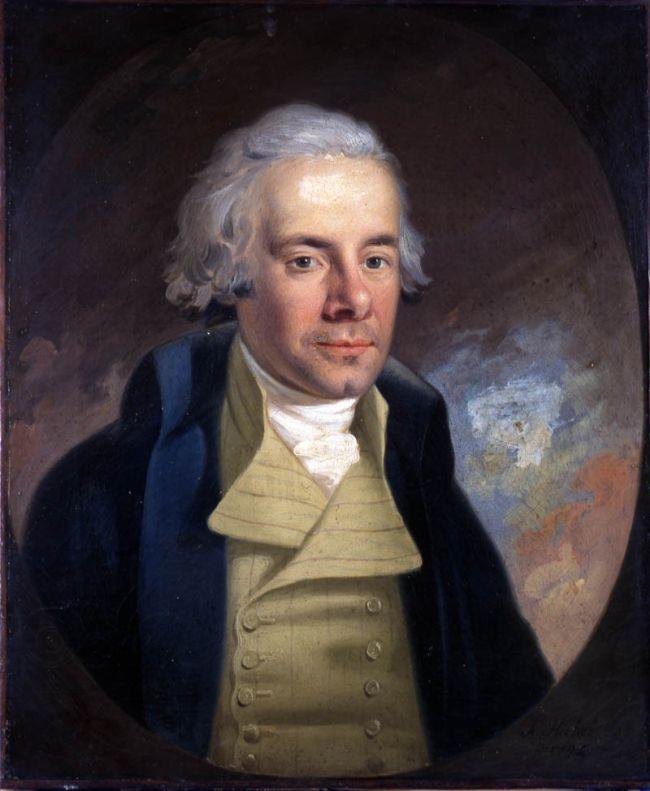
Anton Hickel, William Wilberforce, 1794. Public domain.
Hull and Westminster, 1759 to 1833 · Person · Featured Study
William Wilberforce
He sat in the House of Commons for Hull and then for Yorkshire, and he led the cause against the slave trade there.
Elected to Parliament at twenty-one, he wrote seven years later that God had set before him two great objects.
He has shown you, O man, what is good. And what does the LORD require of you but to act justly, to love mercy, and to walk humbly with your God?
- Born
- 24 August 1759, at Hull
- Died
- 29 July 1833, in London
- Family
- father: Robert Wilberforce; mother: Elizabeth Bird
- Places
- Hull, Yorkshire, Clapham, Westminster
Summary
Wilberforce was born at Hull and won its seat in the Commons in 1780. The road home from Nice with Isaac Milner turned him to the Scriptures, and John Newton counselled him in the months after. He then led the cause against the British slave trade, which Parliament abolished in 1807. He died in London soon after the Commons voted for the bill to end slavery in the colonies.
- His book of 1797 called the higher and middle classes of his country back to the doctrines of the faith.
- In the last days of his life John Wesley wrote to urge him on against the trade.
- His sons' Life and the printed speech of 1789 differ on the day of his first motion against the trade.
The Verses Behind the Cause
No verse names him, and both sides of the slave trade debate argued from Scripture.
No verse of Scripture names Wilberforce, who was born in 1759.
The question of this life is how a member of Parliament turned his faith into public work. His journal, his book and his sons' Life of him answer it in his own words, and they leave a few dates in doubt.
Whoever kidnaps another man must be put to death, whether he sells him or the man is found in his possession.The law of Moses set death as the penalty for stealing and selling a man.
for the sexually immoral, for homosexuals, for slave traders and liars and perjurers, and for anyone else who is averse to sound teachingPaul lists slave traders among those the law is laid down for.
The Life in Order
Each step stands on his journal, his letters or his sons' Life of him.
Fifty years passed between his first election and the bill against slavery.
- 1759Birth at HullLife, volume 1, chapter 1
- 1780Member for HullLife, volume 1, pages 15 to 16
- 1784Member for YorkshireLife, volume 1, page 63
- 1784 to 1785Travels from Nice with Isaac MilnerLife, volume 1, pages 76 to 77
- December 1785A visit to John NewtonHis journal, in the Life, volume 1, pages 96 to 97
- October 1787The trade and the reform of manners named as his aimsHis journal, in the Life, volume 1, page 149
- February 1791A letter from John WesleyLife, volume 1, page 297
- 1792A home with Henry ThorntonLife, volume 1, the year 1792
- 1797A Practical View was printedThe title page
- 25 March 1807The bill abolishing the trade received the royal assentLife, volume 3, page 302; Clarkson (1808)
- July 1833He died in LondonLife, volume 5, page 373
Each step of the life stands with its witness.
February 1791, 1792, 1797, 25 March 1807, July 1833
From Hull to Westminster Abbey
A young member of Parliament turned to the Scriptures and gave his seat to two causes.
Wilberforce was born at Hull on 24 August 1759, the only son of Robert Wilberforce and his wife Elizabeth. The election at Hull in 1780 came soon after his twenty-first birthday, and he polled 1,126 votes, as many as his two opponents together. His sons record that it cost him between eight and nine thousand pounds. In 1784 he was elected for the county of York.
In the winter of 1784 to 1785 he travelled from Nice with Isaac Milner and carried Doddridge's Rise and Progress of Religion. Milner called it "one of the best books ever written", and they read it together. Wilberforce then resolved to examine the Scriptures for himself.
On Sunday 4 December 1785 he took a letter to John Newton at his church in the City. When they met that week, Newton encouraged him and told him he had long hoped God would bring him to Him. Wilberforce wrote that he came away "more humbled, and looking more devoutly up to God".
A committee for the abolition of the trade first met on 22 May 1787, with Granville Sharp in the chair, and Wilberforce became its leader in the Commons. That October he wrote in his journal of the two objects he believed God had set before him. His motions failed in 1791 and in later years, and the trade was abolished in 1807.
In 1792 he agreed to share Henry Thornton's house at Battersea Rise on Clapham Common. In 1797 he published A Practical View, a long appeal to Christians of the middle and higher classes. Its title page names him member of Parliament for the county of York.
In July 1833 the Commons gave a second reading to the bill to abolish slavery. Wilberforce heard the news in London and thanked God that he had lived to see England ready to pay twenty millions sterling for it. He died at three in the morning of Monday 29 July. Members of both Houses asked that he be buried in Westminster Abbey, and he was buried there.
Read Wilberforce and the Slave Trade, the campaign year by year
In Their Own Words
He speaks here in a line of his journal, a sentence of his book and his words on the news of the bill against slavery.
William Wilberforce (1759 to 1833)
His journal, Sunday 28 October 1787, in The Life of William Wilberforce, volume 1, page 149
Two great objects
“God Almighty has set before me two great objects, the suppression of the slave trade and the reformation of manners.”
Anglican evangelical
About this saying1 paragraph
He wrote this in his journal on Sunday 28 October 1787, and his sons printed it in 1838.
William Wilberforce
A Practical View of the Prevailing Religious System of Professed Christians, chapter 4, section 6
The grand radical defect
“But the grand radical defect in the practical system of these nominal Christians, is their forgetfulness of all the peculiar doctrines of the Religion which they profess”
Anglican evangelical
About this saying1 paragraph
In A Practical View, printed in 1797, he named three doctrines that nominal Christians forgot: the corruption of human nature, the atonement and the work of the Holy Spirit.
William Wilberforce
His words in July 1833, in The Life of William Wilberforce, volume 5, page 370
Twenty millions sterling
“that I should have lived to witness a day in which England is willing to give twenty millions sterling for the Abolition of Slavery.”
Anglican evangelical
About this saying1 paragraph
He began with "Thank God" when he heard of the second reading in July 1833, and his sons printed his words in 1838.
The People Around Him
His sons' Life and the letters name the friends who turned him and worked with him.
Two men turned him to the faith and others shared the cause.
| Person | Tie to Wilberforce | The witness |
|---|---|---|
| Isaac Milner | He travelled with Wilberforce and read Doddridge with him. | Life, volume 1 |
| John Newton | He received Wilberforce's letter and encouraged him in December 1785. | Life, volume 1 |
| Granville Sharp | He presided over the twelve who formed the first committee. | Life, volume 1, the year 1787 |
| Thomas Clarkson | He gathered the evidence, and the committee worked with Wilberforce as its head in Parliament. | Clarkson, History (1808), volume 1, chapter 10 |
| Henry Thornton | His house at Battersea Rise was Wilberforce's home as well. | Life, volume 1 |
| John Wesley | His letter urged Wilberforce on against the trade. | Life, volume 1 |
Wesley sent this charge on 24 February 1791, and the page of the Life that prints it is headed Wesley's Last Words.
“Go on in the name of God, and in the power of His might, till even American slavery, the vilest that ever saw the sun, shall vanish away before it.”
John Wesley · Letter to William Wilberforce, 24 February 1791, in The Life of William Wilberforce, volume 1, page 297Evangelical
The Places of His Life
His life ran from the port of Hull to the House of Commons and the Abbey beside it.
The record of his life centres on Westminster.
| Place | What the witnesses say | The witness |
|---|---|---|
| Hull | He was born there in 1759 and won its seat in 1780. | Life, volume 1 |
| York | He was elected and chaired at the castle for the county in 1784. | Life, volume 1 |
| Nice | His turn to the Scriptures began on the road from there. | Life, volume 1 |
| Clapham Common | He made his home there from 1792. | Life, volume 1 |
| Westminster | He sat in the Commons there, and he was buried in the Abbey in 1833. | Life, volume 5 |
What He Asked of Christians
His book called for real Christianity in private life, and his journal set public work beside it.
The full title of his book sets the prevailing religion of professed Christians against real Christianity. Its first pages say he had long wished to write to his countrymen on religion and that his public duties had kept him from it.
His two objects joined the end of the trade to the reformation of manners. His sons say that he now counted his gifts of speech and his influence with Pitt as talents lent to him by God, for which he must give account.
How the Key Verse Was Taught
Matthew Henry and John Wesley read the Lord's requirement in Micah 6:8.
Matthew Henry (1662 to 1714)
Commentary on the Whole Bible
Matthew Henry set justice before mercy in reading the verse.
“We must love mercy; we must delight in it, as our God does, must be glad of an opportunity to do good, and do it cheerfully. Justice is put before mercy, for we must not give that in alms which is wrongfully got, or with which our debts should be paid.”
on Micah 6:8Puritan
John Wesley (1703 to 1791)
Explanatory Notes upon the Old Testament
John Wesley read the verse as a call to mercy toward all and fellowship with God.
“Keep up a constant fellowship with God, by humble, holy faith.”
on Micah 6:8Evangelical
What the Sources Leave Open
The sources differ on three dates: his first motion, his visit to Newton and his funeral.
The day of the first motionThe sons' Life (1838); the printed speech (1789)
His sons' Life reads "At length on the 12th of May the question came before the House". The speech as printed in 1789 is dated on its title page Wednesday 13 May 1789.
The day he called on NewtonThe sons' Life (1838); his journal
The Life says the meeting was named for the Wednesday after Sunday 4 December 1785, which was the 7th. The note under it cites his journal for the 6th, so the sources leave the day open.
The day of his funeralThe sons' Life (1838); the calendar of 1833
The Life says the funeral reached Westminster Abbey on Saturday the 5th of August. The 5th of August 1833 fell on a Monday, and the Saturday of that week was the 3rd, so either the day or the date is wrong in the print.
Books to Read Next
The Life of William Wilberforce
Robert Isaac and Samuel Wilberforce · 1838
His sons print his journal and letters across five volumes.
Read volume 1 free at the Internet ArchiveA Practical View of the Prevailing Religious System of Professed Christians
William Wilberforce · 1797
His own book sets out the faith he held.
Read the book free at Project GutenbergThe History of the Abolition of the African Slave-Trade
Thomas Clarkson · 1808
Clarkson tells the committee's work from the inside.
Read volume 1 free at Project GutenbergWhat Wilberforce Left
Wilberforce left a book on the faith and an act of Parliament against the trade. He lived to hear of the second reading of the bill against slavery.
Sources
Scripture is the Berean Standard Bible.
- The Holy Bible, Berean Standard Bible (read 2026)
- Robert Isaac and Samuel Wilberforce, The Life of William Wilberforce, volume 1 (London: John Murray, 1838)
- Robert Isaac and Samuel Wilberforce, The Life of William Wilberforce, volume 3 (London: John Murray, 1838), pages 298 and 302.
- Robert Isaac and Samuel Wilberforce, The Life of William Wilberforce, volume 5 (London: John Murray, 1838)
- William Wilberforce, A Practical View of the Prevailing Religious System of Professed Christians (Dublin: Robert Dapper for B. Dugdale, 1797)
- John Wesley, letter to William Wilberforce, Balam, 24 February 1791, in The Letters of the Rev. John Wesley, ed. John Telford, Standard Edition (1931), with the editor's note.
- The Speech of William Wilberforce on the Question of the Abolition of the Slave Trade (London: Logographic Press, 1789), the title page.
- Thomas Clarkson, The History of the Rise, Progress, and Accomplishment of the Abolition of the African Slave-Trade by the British Parliament (1808), volume 1, chapter 10, and volume 2, chapter 10.
- Matthew Henry, Commentary on the Whole Bible (1710), on Micah 6:8.
- John Wesley, Explanatory Notes upon the Old Testament (1765), on Micah 6:8.
Keep Studying
Studies4
People and groups5
Values1