
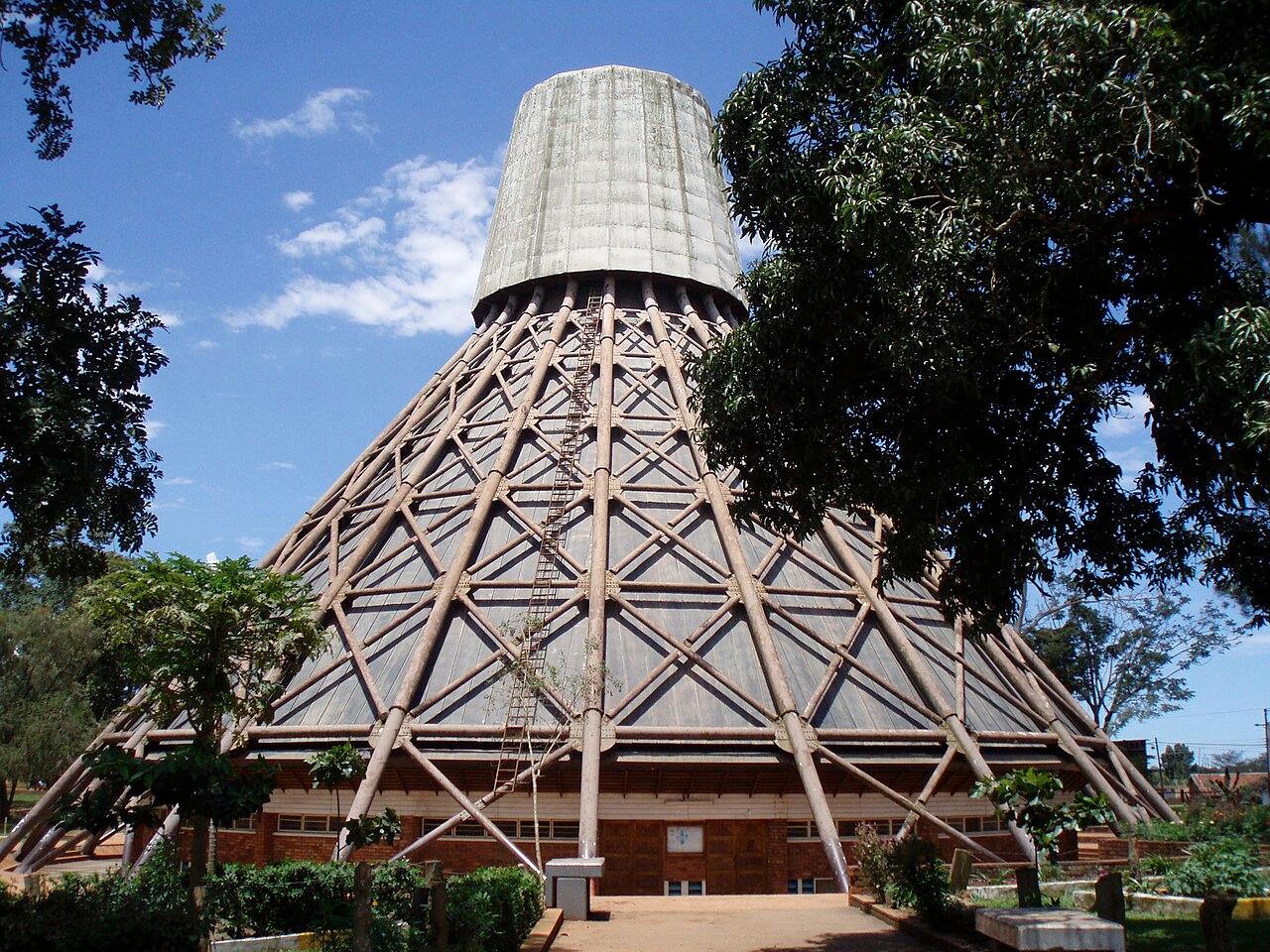
Isabelle Prondzynski, Namugongo Martyrs' Shrine, 2007. CC BY 2.0.
Buganda, under Kabaka Mwanga · Person · Featured Study
The Uganda Martyrs
Pages and chiefs of the court of Buganda, Anglican and Catholic, were put to death under Kabaka Mwanga.
- Died
- From January 1885 to June 1886 (probable)
- Places
- Mengo, Munyonyo, Kampala, Namugongo
The chief executioner offered his own son his freedom at the pyre, and the boy asked to die for Christ.
Do not be afraid of those who kill the body but cannot kill the soul. Instead, fear the One who can destroy both soul and body in hell.
Summary
Two missions, one English and one French, taught at the court of Buganda. The king, Mwanga, turned on the readers of both. His men first burned three young converts of the English mission. A year and a half later they killed dozens more. Many of the king's own pages died together on one fire at Namugongo.
- Robert Ashe and Alexander Mackay of the Anglican mission wrote down the deaths within weeks.
- Pope Benedict XV beatified twenty-two of the Catholic dead in 1920.
- The witnesses agree that the outbreak began with a page who refused the king's will, and they weigh the cause differently.
The Verses of Their Stand
Jesus told the Twelve whom to fear, and Hebrews names those of whom the world was not worthy.
No verse of Scripture names these Christians, and two passages stand behind their witnesses' words. Walsh records that one page answered from the unlit pyre that the executioners could kill the body and not the soul. Ashe, telling of the fire, borrowed the words of Hebrews for the dead.
The question of these deaths is what the Anglican and Catholic witnesses of the time saw, how far their records of the persecution agree, and where the two churches' accounts part.
The world was not worthy of them. They wandered in deserts and mountains, and hid in caves and holes in the ground.Ashe applies this verse to the Christians who died on the pyre.
The Persecution in Order
The Anglican letters carry the first deaths, and the Catholic record carries the fire at Namugongo.
Seventeen months passed from the first deaths to the great fire.
- 30 January 1885The first deathsMackay, page 257
- November 1885Joseph Mukasa beheadedWalsh, pages 9 and 28
- May 1886A page refuses the kingAshe, page 218
- Late MayArrests and killingsAshe, pages 218 to 226
- 29 MayMackay's pleaAshe, page 224
- 3 June 1886The fire at NamugongoWalsh, page 19
- 6 June 1920Beatification at RomeWalsh, page 31
Each step stands with its witness and page.
From the Court to Namugongo
The king turned on the readers of two missions, and the readers would not hide.
Mackay wrote from Msalala in June 1885, "Our first martyrs have won the martyr's crown". He wrote that three Christian lads had been mutilated and burned alive, accused of no crime but learning from the missionaries.
Later that year Mwanga ordered the death of the head of his pages, a Christian, for telling him it was wrong to kill Bishop Hannington. Walsh names him as Joseph Mukasa Balikuddembe, a Catholic of twenty-six, who forgave the king and was beheaded at Mengo, and his body was burned.
The next May a baptized page named Matia, who held the office of Sabagabo, refused the demand of a chief to whom the king had handed him. Ashe calls it "this splendid act of disobedience", and it set off the arrests. Mwanga speared one youth, whom the executioners then killed, and struck Apolo Kagwa, who answered that he was a reader, and Kagwa lived.
Ashe wrote that the leading Christians would not run or hide, "lest they should give colour to this suspicion" of disloyalty. Walukaga, a blacksmith of the Anglican church council, let his household escape and stood firm, and he was taken. Munyaga was seized while he was teaching, and he was cut in pieces and burned.
The condemned pages were marched from the court toward Namugongo, about forty miles away, with a halt at Kampala. Walsh tells that Charles Lwanga, their leader, was held apart and burned slowly. The rest were bound in cane mats and laid on one great pyre. Three boys were spared because the king had ordered it.
Ashe called the burning of Walukaga and some thirty others "the crowning act in the cruel tragedy". He called them "this company of saints" and set them beside the faithful of Hebrews 11.
Two Missions at One Court
The Anglican missionaries wrote letters and a diary, and the Catholic record came from the beatification process.
Ashe and Mackay of the Church Missionary Society lived at the capital through the persecution. Ashe kept a diary, and Mackay's letters home were printed by his sister in 1890. Ashe wrote that the storm broke on "the Christian readers of both denominations, Protestant and Roman Catholic".
Father Lourdel of the White Fathers went to the Katikiro, the king's chief minister, and begged him not to kill his own children. Ashe reports the answer, "as many as you teach we shall kill". Mackay went to the king at Munyonyo on 29 May, and the king promised to spare the prisoners and did not keep his word.
Walsh's account draws on the record of the beatification and quotes the witnesses who deposed in it, among them Father Lourdel. He names twenty-two beatified martyrs in two groups, nine who died by various torments and thirteen pages burned together.
In Their Own Words
Six sayings, each as a witness of the time or the Catholic record reports it.
Joseph Mukasa Balikuddembe (died 1885)
The Bl. Negro Martyrs of Uganda, as Charles J. Walsh reports him, chapter 7, page 28
A Christian has no fear of death
“What, do you think that I, who am dying for my religion, would seek to escape? A Christian who gives up his life for God has no fear of death.”
Catholic
About this saying1 paragraph
Joseph Mukasa said this to the executioners who came to chain him in November 1885, and Walsh gives the words on page 28.
Mbaga Tuzinde (died 1886)
The Bl. Negro Martyrs of Uganda, as Charles J. Walsh reports him, chapter 6, page 21
I desire to die for Christ
“The king has commanded you to kill me. Put me to death. I desire to die for Christ.”
Catholic
About this saying1 paragraph
Mbaga Tuzinde said this to his father, the chief executioner Mukajjanga, at Namugongo on 3 June 1886, as Walsh reports it on page 21.
Bruno Serunkuma (died 1886)
The Bl. Negro Martyrs of Uganda, as Charles J. Walsh reports him, chapter 6, page 21
Our souls you cannot kill
“You may kill our bodies; our souls you cannot kill. They will enter into Paradise.”
Catholic
About this saying1 paragraph
Bruno Serunkuma called this from the unlit pyre at Namugongo on 3 June 1886 when the executioners mocked the pages' God, in Walsh's account on page 21.
Charles Lwanga (died 1886)
The Bl. Negro Martyrs of Uganda, as Charles J. Walsh reports him, chapter 6, page 22
Look to yourself
“Unhappy man, you know not what you are saying. Look to yourself lest it come to pass that the God whom you now insult, one day cast you into the true fire which never dies.”
Catholic
About this saying1 paragraph
Charles Lwanga answered his executioner Senkole with these words as he burned on 3 June 1886, and Walsh prints the reply on page 22.
Apolo Kagwa
Two Kings of Uganda, as Robert P. Ashe reports him, chapter 18, page 219
I read, my Lord
“I read, my Lord,”
Anglican
About this saying1 paragraph
Apolo Kagwa gave this answer when Mwanga asked him in May 1886 whether he was a reader, as Ashe translates it on page 219.
Samweli Kiwobe
Two Kings of Uganda, as Robert P. Ashe reports him, chapter 18, page 227
I shall confess
“I shall confess, my friend.”
Anglican
About this saying1 paragraph
Kiwobe, a boy who asked Ashe for baptism after his teacher Munyaga was killed in 1886, gave this answer when asked whether he would deny that he was a reader, on page 227.
The People Around Them
The witnesses name the king, his officers, the missionaries and the leaders among the dead.
The leaders among the dead served the king himself.
| Person | Tie to the martyrs | The witness |
|---|---|---|
| Mwanga | The Kabaka who ordered the deaths. | Ashe; Mackay; Walsh |
| Mukajjanga | In charge of the burning; Mbaga Tuzinde was his child. | Walsh, pages 19 to 21 |
| Joseph Mukasa | The head of the pages, the first to die. | Walsh, page 28 |
| Charles Lwanga | Leader of the pages burned at Namugongo. | Walsh, pages 9 and 22 |
| Walukaga | Taken in the arrests and counted by Ashe among the dead. | Ashe, pages 225 and 228 |
| Alexander Mackay | Anglican missionary who pleaded with the king. | Ashe, pages 220 and 224 |
| Robert Ashe | Anglican missionary who kept a diary of the arrests. | Ashe, page 217 |
| Father Lourdel | Catholic priest who pleaded with the Katikiro. | Ashe, page 223 |
Robert Ashe, Father Lourdel
The Places of the Persecution
The arrests ran from the king's capital to Munyonyo, and the march ended at Namugongo.
The pages walked about forty miles to their deaths.
| Place | What the witnesses say | The witness |
|---|---|---|
| Mengo | The capital, where Joseph Mukasa was beheaded. | Walsh, page 28; Ashe, page 221 |
| Munyonyo | Where the king was staying during the arrests. | Ashe, page 224 |
| Kampala | The stop for the night on the road to the place of execution. | Walsh, page 16 |
| Namugongo | The great fire burned here. | Walsh, pages 16 and 19 |
| Rome | St Peter's, where they were beatified. | Walsh, page 31 |
What Their Deaths Did
The witnesses saw the church grow under the persecution, and some of the survivors rose to rule.
Ashe wrote that the Christians' confidence in their cause "so puzzled the rulers" and made them "such a power in the country". Amid the killings a boy named Kiwobe asked him for baptism, and Ashe and Mackay baptized him there and then.
Some who survived the spear and the knife rose to office. Ashe records that Nyonyintono, a Catholic reader who was mutilated by the king's order, later became Katikiro. Apolo Kagwa rose to the chieftainship of Mukwenda. Walsh records that Denis Kamiuka, one of the three pages left alive at the pyre, held high office in what he called "the now nearly Christian kingdom of Uganda".
How the Key Verse Was Taught
Boniface and John Wesley read the word about those who kill the body.
Boniface (675 to 754)
words reported in Willibald, The Life of Saint Boniface, chapter 8, chapter 8, to the priests and deacons
Boniface spoke the verse to the priests and deacons beside him as the raiders came on in Frisia, as Willibald reports in his Life.
“Men and brethren, be of stout heart, and fear not them who kill the body, since they are not able to slay the soul, which continues without end”
English Benedictine
John Wesley (1703 to 1791)
Explanatory Notes upon the New Testament, on Matthew 10:28
John Wesley noted that the verse bids those who love God still to fear Him.
“It is remarkable, that our Lord commands those who love God, still to fear him, even on this account, under this notion.”
Evangelical
What the Witnesses Leave Open
The witnesses differ on how many died, why the king struck and where Ashe's pyre stood.
How many diedMackay; Ashe; Walsh
Mackay wrote within the month that about a dozen were hacked to pieces the first day and "over thirty were thus slain". Walsh gives about one hundred and thirty victims in all and twenty-two whose deaths the Catholic process could prove. The two numbers measure different things, the first weeks and the whole persecution.
Why the king struckWalsh; Mackay; Ashe
Walsh calls the pages' refusal of the king's vice "the true cause" and holds them martyrs of the faith and of chastity. Mackay names the same refusal as the origin and quotes the king, "These Christians are disobedient, and learn rebellion from the white man". Ashe writes that the Christians were suspected of "disloyalty and sedition". All three name the page's refusal as the spark, and they weigh the king's fear of the foreigners differently.
Where Ashe's pyre stoodAshe; Walsh
Ashe names no place for the burning of Walukaga. Walsh names Namugongo and the morning of 3 June for the thirteen pages. The page sets the two accounts side by side and leaves the place of Ashe's pyre as Ashe left it.
Books to Read Next
Two Kings of Uganda
Robert P. Ashe · 1889
Its chapter 18 gives the persecution as an eyewitness saw it.
Read Ashe free at the Internet ArchiveA. M. Mackay, Pioneer Missionary of the Church Missionary Society to Uganda
J. W. Harrison, his sister · 1890
It gathers what Mackay wrote from the lake during the persecution.
Read the letters free at the Internet ArchiveThe Bl. Negro Martyrs of Uganda
Charles J. Walsh · 1920
It tells the Catholic martyrs' story from the record of their beatification.
Read Walsh free at the Internet ArchiveWhat the Uganda Martyrs Left
They left a shrine at Namugongo and the records of two missions whose converts died in the same weeks. Mackay appealed to Christian England for "the scattered remnant" of the church.
Sources
Scripture is the Berean Standard Bible.
- The Holy Bible, Berean Standard Bible (read 2026)
- Robert P. Ashe, Two Kings of Uganda, or Life by the Shores of Victoria Nyanza (London: Sampson Low, 1889), chapter 18, pages 215 to 229.
- J. W. Harrison, A. M. Mackay, Pioneer Missionary of the Church Missionary Society to Uganda (London: Hodder and Stoughton, 1890), the letters of 6 June 1885 to 28 June 1886, pages 256 to 294.
- Charles J. Walsh, The Bl. Negro Martyrs of Uganda (Techny, Illinois: Mission Press, 1920), 35 pages.
- Willibald, The Life of Saint Boniface, chapter 8.
- John Wesley, Explanatory Notes upon the New Testament, on Matthew 10:28.
Keep Studying
Studies1
Church history4
Trials of life1