
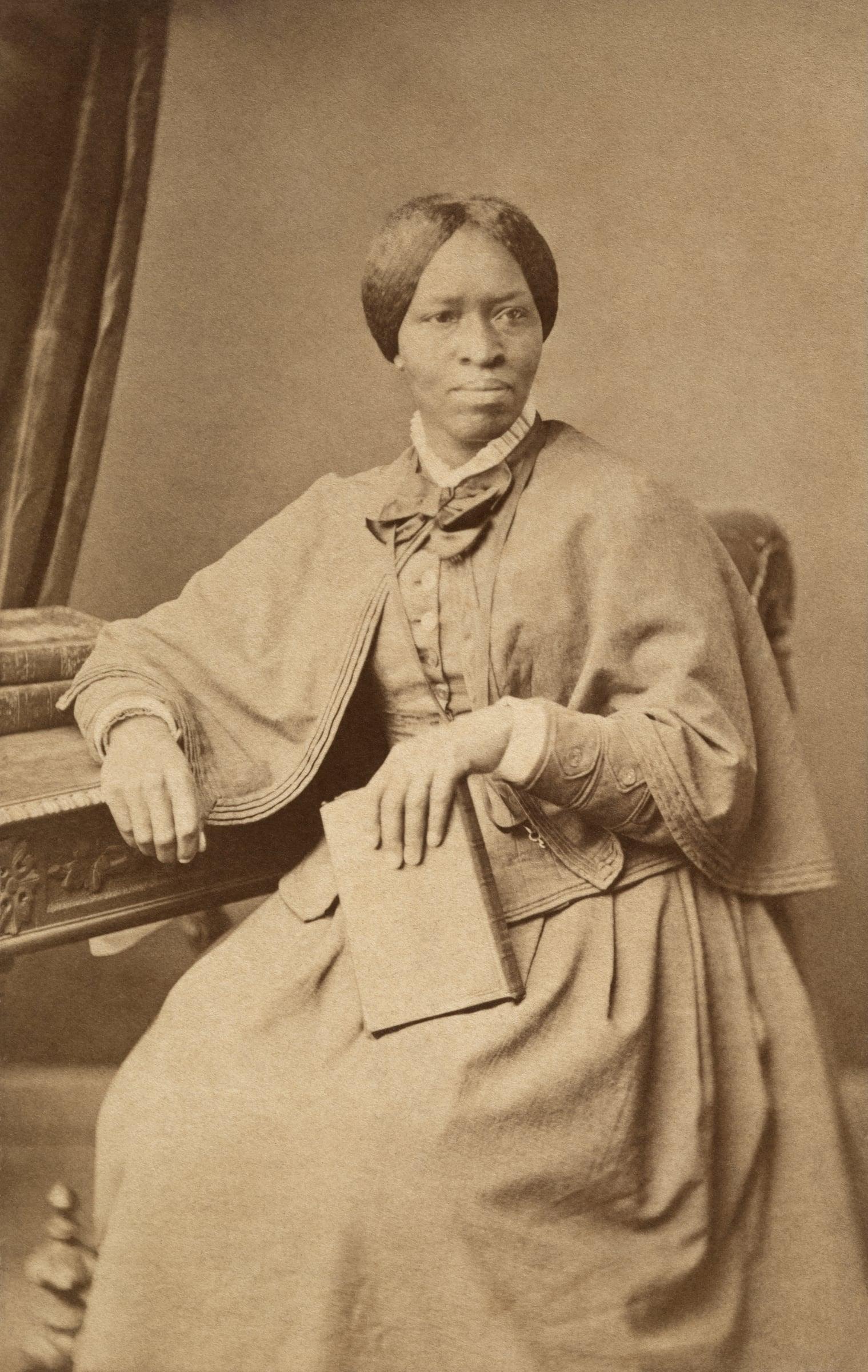
T. B. Latchmore, Amanda Berry Smith, about 1885. Public domain.
America, Britain, India and Liberia, 1870 to 1890 · Person · Featured Study
Amanda Berry Smith
Her Autobiography of 1893 tells how a freed slave became a Holiness evangelist on four continents.
Her father bought her family out of slavery, and she wrote that she had been bought and set free a second time.
To them God has chosen to make known among the Gentiles the glorious riches of this mystery, which is Christ in you, the hope of glory.
To them God has chosen to make known among the Gentiles the glorious riches of this mystery, which is Christ in you, the hope of glory.
- Born
- 23 January 1837, at Long Green, Maryland
- Died
- 24 February 1915
- Family
- father: Samuel Berry; husband: James Smith; daughter: Mazie
- Places
- Long Green, New York, Keswick, Bombay, Calcutta, Monrovia
Summary
Amanda Berry was born a slave at Long Green, Maryland, in 1837. Her father later purchased the family's freedom. In 1868, at Green Street Church in New York, she received the blessing the Holiness movement preached. From 1870 she preached at camp meetings and in churches. From 1878 she worked in Britain, India and Liberia. She told her life in her Autobiography of 1893.
- She was the only coloured person at Green Street on the morning of her blessing.
- James Thoburn said he learned more as a preacher from her than from any other one person.
- She sought no ordination, and she wrote that the thought had never entered her mind.
God in You
Her account of her blessing stands beside Colossians 1, and her family's freedom beside Galatians 3.
No verse of Scripture names her. At Green Street Church the words "God in you" rang through her, and Paul names the mystery of the gospel as Christ in the believer.
The question of this life is how a woman born enslaved came to preach abroad, and her own book is the main witness to it.
There is neither Jew nor Greek, slave nor free, male nor female, for you are all one in Christ Jesus.Born a slave, she lived to preach in four lands as a free woman.
The Life in Order
Her Autobiography dates the life to her return from Africa, and a museum record gives her death.
Her own book dates every step but the last.
- 23 January 1837Her birthAutobiography
- Her early childhoodRelease from slaveryAutobiography
- 17 March 1856She was convertedAutobiography
- September 1868The blessing at Green Street Church, New YorkAutobiography
- November 1869Her husband James Smith died at New UtrechtAutobiography
- October 1870She left home to preachAutobiography
- July 1878She sailed for EnglandAutobiography
- August 1879She left Keswick after the conventionAutobiography
- November 1879She reached BombayAutobiography
- 18 January 1882She landed at Monrovia, LiberiaAutobiography
- After twelve years abroadShe came home to New York by LiverpoolAutobiography
- 1893Her Autobiography was published at ChicagoThe title page
- 24 February 1915She diedThe National Portrait Gallery's record
Each step of the life stands with its witness.
July 1878, August 1879, November 1879, 18 January 1882, After twelve years abroad, 1893, 24 February 1915
From Long Green to Liberia
She tells her own life, and James Thoburn's introduction adds the years in India.
Amanda Berry's father was Samuel Berry and her mother Mariam Matthews. Their masters held adjoining farms.
Her father worked in the harvest fields till one and two in the morning to buy his own liberty and then the freedom of his wife and five children. The family later moved to Pennsylvania, where she went to school.
She married, and she was converted in 1856. Her husband James Smith, a deacon of the African Methodist Episcopal Church, died in 1869, and she remained a widow.
She had long sought the blessing the Holiness preachers taught. Then a voice told her, she writes, "On Sunday morning go to Green Street Church and hear John Inskip", and there she received it.
She was the only coloured person in the church. She held back a shout because, she says, Satan told her that if she made a noise they would put her out.
In October 1870 she left her paid work "at God's command" and began to preach. Her chapters run from camp meetings in Maine and Vermont to churches in Brooklyn and Philadelphia.
She sailed for England in 1878 meaning to stay three months, and she was away more than twelve years. She spoke at Keswick and Perth, then went to India, where Thoburn says she "assisted us for some time in Calcutta".
From 1882 she spent eight years in Liberia and along the West African coast. She held temperance meetings, worked beside Bishop Taylor and took a boy named Bob to raise and teach.
A Woman Preacher in Her Church
She tells how the delegates spoke of her before the General Conference at Nashville.
The African Methodist Episcopal Church held a General Conference at Nashville, she writes, in "May, '70, or '71". It was the first the church had held south of the Mason and Dixon line.
She had no money and no prominence, she says, except as a woman preacher, "which was to be dreaded by the majority".
When she asked a delegate what the trip would cost, he turned away, and another asked what she wanted to go for. The reply came, "Woman preacher; they want to be ordained."
In Their Own Words
Her book speaks of her freedom, her blessing and her call.
Amanda Smith (1837 to 1915)
An Autobiography: The Story of the Lord's Dealings with Mrs. Amanda Smith, the Colored Evangelist, chapter 1
A right to shout
“I often say to people that I have a right to shout more than some folks; I have been bought twice, and set free twice, and so I feel I have a good right to shout. Hallelujah!”
Methodist Holiness evangelist
About this saying1 paragraph
She wrote this of her family's freedom in the first chapter of her Autobiography of 1893.
Amanda Smith
An Autobiography: The Story of the Lord's Dealings with Mrs. Amanda Smith, the Colored Evangelist, chapter 7, page 76
Two ways at once
“And somehow I seemed to sink down out of sight of myself, and then rise; it was all in a moment. I seemed to go two ways at once, down and up. Just then such a wave came over me, and such a welling up in my heart, and these words rang through me like a bell: ‘God in you, God in you,’”
Methodist Holiness evangelist
About this saying1 paragraph
She wrote this of the moment at Green Street Church, as Inskip preached in September 1868.
Amanda Smith
An Autobiography: The Story of the Lord's Dealings with Mrs. Amanda Smith, the Colored Evangelist, chapter 15, page 200
My ordination from Him
“He knew that the thought of ordination had never once entered my mind, for I had received my ordination from Him”
Methodist Holiness evangelist
About this saying1 paragraph
She wrote this in 1893 of the delegates' words about women who wanted to be ordained.
The People Around Her
Her book names her family, the preacher of her blessing and the missionaries she worked beside.
Most of her circle is known from her own book.
| Person | Tie to her | The witness |
|---|---|---|
| Samuel Berry | Her father, a free man before his family. | Autobiography |
| Mariam Matthews | Her mother. | Autobiography |
| Frances | Her sister, whose freedom she bought. | Autobiography |
| James Smith | Her husband, once a choir leader at Bethel Church. | Autobiography |
| Mazie | Her daughter, whose conversion and schooling she records. | Autobiography |
| John S. Inskip | His sermon was the one she heard when the blessing came. | Autobiography |
| James M. Thoburn | He worked with her in India and wrote the introduction to her book. | Autobiography, introduction |
| Bishop Taylor | A bishop whose work in Africa she records beside her own. | Autobiography |
| Bob | An African boy she took to raise and taught to read. | Autobiography |
James M. Thoburn, Bishop Taylor, Bob
Thoburn told an American audience of young preachers what he owed her.
“I had learned more that had been of actual value to me as a preacher of Christian truth from Amanda Smith than from any other one person I had ever met.”
James M. Thoburn · Introduction to An Autobiography: The Story of the Lord's Dealings with Mrs. Amanda Smith, pages viii to ixMethodist Episcopal missionary in India
The Places of Her Life
Her life runs from a Maryland farm to New York, Britain, India and the West African coast.
Her years abroad took her round the world.
| Place | What the witnesses say | The witness |
|---|---|---|
| Long Green | She was born there into slavery. | Autobiography |
| Pennsylvania | Her girlhood home after Maryland. | Autobiography |
| New York | She received the blessing at Green Street Church. | Autobiography |
| Nashville | The AME General Conference met there. | Autobiography |
| Keswick | She was at the convention in 1879. | Autobiography |
| Calcutta | She assisted Thoburn's mission there. | Thoburn's introduction |
| Monrovia | She landed there and began her work in Liberia. | Autobiography |
| Chicago | Her Autobiography was published there. | The title page |
Monrovia, Chicago
Full Salvation
She taught the blessing she received in the terms of the Holiness movement.
She calls the blessing "full salvation" and says that without proper teaching she had wandered in doubts and fears for twelve years.
One chapter is headed "About Seeking Sanctification by Works", and others tell of faith healing and of obedience.
How the Key Verse Was Taught
Matthew Henry in 1710 and William Arthur in 1860 read the verse.
Matthew Henry (1662 to 1714)
Commentary on the Whole Bible
Matthew Henry, in 1710, set Christ in the believer as the ground of hope.
“This mystery, thus made known, is Christ in you (or among you) the hope of glory. Observe, Christ is the hope of glory. The ground of our hope is Christ in the word, or the gospel revelation, declaring the nature and methods of obtaining it.”
on Colossians 1:27Puritan
William Arthur
his account of Coleraine, as printed in William Gibson, The Year of Grace, Gibson, pp. 68 to 69
William Arthur, in his account of the revival at Coleraine printed in 1860, wrote of young converts who felt what the verse means.
“Strange words, in cold times! Natural words, when upon the simple and the young the Spirit is poured out, and they feel what is meant by ‘Christ in you the hope of glory,’ and utter it in the first terms that come!”
Revival witness
What the Witnesses Leave Open
Readers differ on whether the blessing she taught comes in a moment, and her book leaves one year unsettled.
Does the blessing come in a moment?Her Autobiography; the Free Methodist Church; the Westminster Assembly
She says the change came "all in a moment". The Free Methodist article of 1860 says entire sanctification is "wrought instantaneously upon the consecrated, believing soul".
The Westminster Confession holds that sanctification is "yet imperfect in this life, there abiding still some remnants of corruption in every part".
The year of the Nashville conferenceHer Autobiography
Her chapter on the Nashville conference also dates an earlier event "October, 1870, or 1871", and her book settles neither year.
Books to Read Next
An Autobiography: The Story of the Lord's Dealings with Mrs. Amanda Smith, the Colored Evangelist
Amanda Smith, with an introduction by James M. Thoburn · 1893
She told her own life from Long Green to her return from Africa.
Read the Autobiography free at the Internet ArchiveWhat She Left
She left her Autobiography, the one full witness to her life, in her own words.
Sources
Scripture is the Berean Standard Bible.
- The Holy Bible, Berean Standard Bible (read 2026)
- Amanda Smith, An Autobiography: The Story of the Lord's Dealings with Mrs. Amanda Smith, the Colored Evangelist, with an introduction by James M. Thoburn (Chicago: Meyer and Brother, 1893)
- National Portrait Gallery, Smithsonian Institution, the record of NPG.2008.12, Amanda Berry Smith by T. B. Latchmore.
- Matthew Henry, Commentary on the Whole Bible (1710), on Colossians 1:27.
- William Arthur, his account of Coleraine, in William Gibson, The Year of Grace (1860), pages 68 to 69, on Colossians 1:27.