
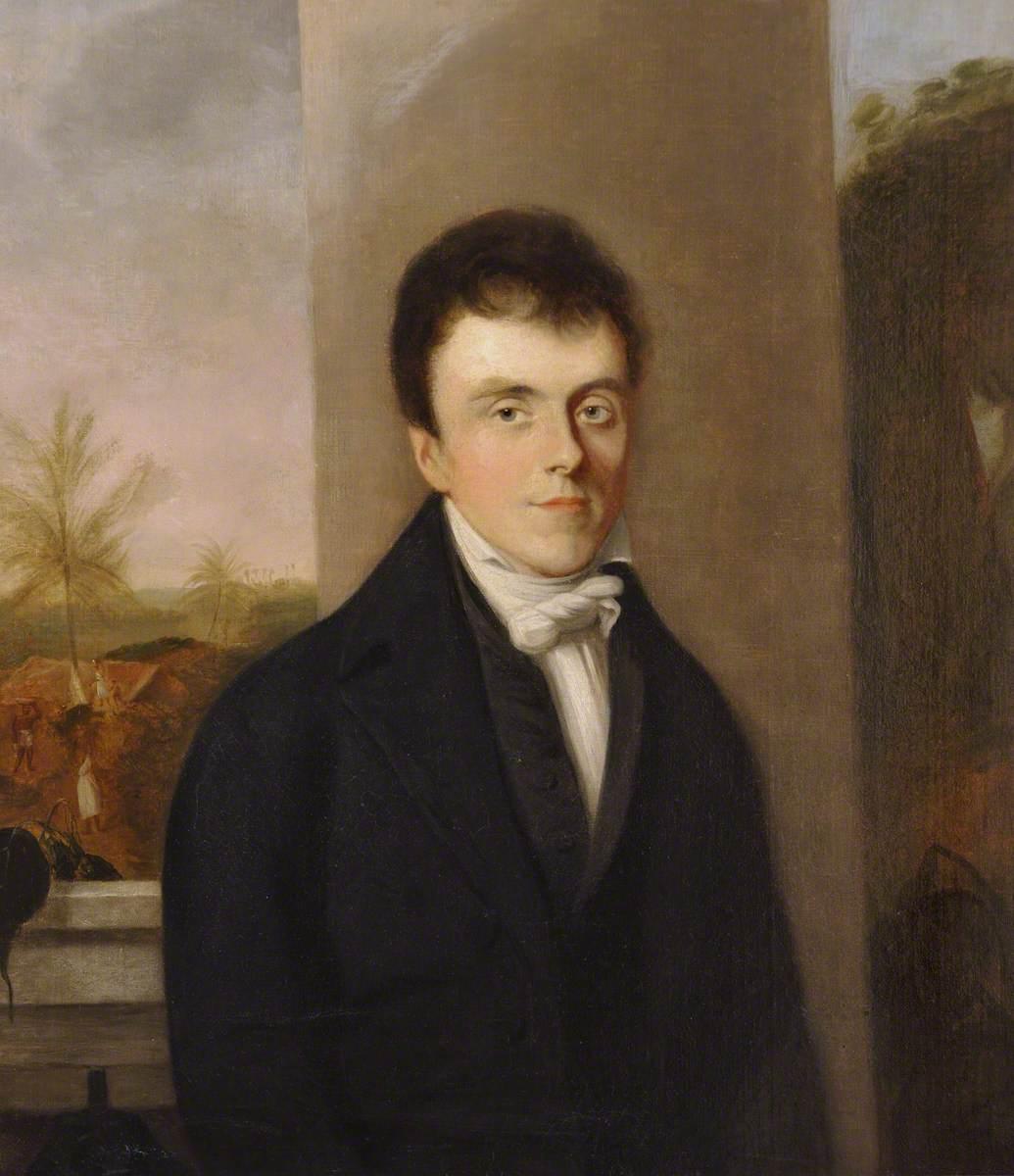
Henry Martyn, 1781 to 1812. Public domain.
India and Persia, 1806 to 1812 · Person · Featured Study
Henry Martyn
He was a Cambridge mathematician whose journals tell his years in India and Persia.
On his first full day in Calcutta his journal asked that he might burn out for God.
For to me, to live is Christ, and to die is gain.
- Born
- 18 February 1781, at Truro in Cornwall
- Died
- 16 October 1812, at Tokat
- Places
- Truro, Cambridge, Calcutta, Dinapore, Cawnpore, Shiraz, Tabriz, Tokat
Summary
Henry Martyn came first in mathematics at Cambridge in 1801. He became the curate of Charles Simeon. He sailed to Bengal as a chaplain of the East India Company and reached Calcutta in May 1806. He put the New Testament into Hindustani in India and into Persian at Shiraz. He died at Tokat on the road from Persia, aged thirty-one.
- His journals, printed in 1837, are the main witness to his inner life.
- He finished both of his New Testaments before he turned thirty-one.
- An Italian doctor at Tokat could not say whether plague or the hard travelling killed him.
The Verse on His Memoir
Sargent's memoir set Revelation 2:3 under its title, and Philippians 1:21 speaks of a life spent for Christ.
No verse of Scripture names Martyn. The Boston edition of John Sargent's memoir prints Revelation 2:3 on its title page.
The question of this life is how a Cambridge mathematician came to die in Asia Minor at thirty-one, and what his own journals say of the road there.
Without growing weary, you have persevered and endured many things for the sake of My name.Sargent chose this word to the church at Ephesus for the title page of his life of Martyn.
The Life in Order
His journal dates the Indian and Persian years day by day.
Most of the dated record falls in his last six years.
- 18 February 1781He was born at Truro in CornwallSargent (1819)
- January 1801He came out Senior Wrangler at CambridgeSmith (1892)
- After his ordinationA curacy in CambridgeSargent (1819)
- 1805 to 1806The voyage to India, by South America and South AfricaSmith (1892)
- 16 May 1806Landing in BengalJournals, volume 1
- October 1807A letter came from Lydia Grenfell refusing to come outJournals, volume 2
- 1807 to 1810Chaplain at Dinapore, then at CawnporeSmith (1892)
- 1810He completed the Hindustani New TestamentSmith (1892)
- June 1811Arrival at ShirazSmith (1892)
- 24 February 1812He corrected the last page of the Persian New TestamentSmith (1892)
- 2 September 1812He left Tabriz for ConstantinopleSmith (1892)
- 6 October 1812The journal endsJournals, volume 2
- 16 October 1812He died at TokatJournals, volume 2; Simeon's letter, in Smith
Each step of the life stands with its witness.
1807 to 1810, 1810, June 1811, 24 February 1812, 2 September 1812, 6 October 1812, 16 October 1812
From Truro to Tokat
Sargent and Smith tell the life, and the journals give his own account of it.
Martyn went up from Truro to St John's College, Cambridge. Not yet twenty, he came out Senior Wrangler and first Smith's Prizeman.
He sat under the preaching of Charles Simeon at Holy Trinity Church and became Simeon's curate there, with the village parish of Lolworth. His journal records an afternoon spent reading David Brainerd's journal.
The voyage to Bengal ran nine months by South America and South Africa. At Calcutta he went ashore at daylight and found William Carey, with whom he breakfasted and joined in worship.
As chaplain at Dinapore and then Cawnpore he read and translated with munshis, his language teachers. Mirza Fitrut worked with him on the Hindustani.
In 1811 he left India by Bombay for Persia and landed at Bushire. At Shiraz he held disputations with Shi'a teachers, Sufis and Jews while the translation went on.
From Tabriz he set out for Constantinople with fever on him, under a Tartar guide whom a later witness charged with brutal treatment. He died at Tokat in Asia Minor.
The Two New Testaments
He finished the Hindustani in India and the Persian at Shiraz.
Smith says the Hindustani New Testament was made "for Mohammedans", that is, for Muslims. It was passing through the Serampore press when the fire of March 1812 destroyed all the sheets but the first thirteen chapters of Matthew.
Martyn began the Persian translation within a week of reaching Shiraz, with Mirza Sayyid Ali as his helper. He corrected the last page the following February.
For three more months he stayed at Shiraz while copies were made. In the garden of Jaffir Ali Khan he read the Old Testament histories to a company of inquirers "at their request".
Two copies were written out in fine Persian hand for the Shah and for the heir, Prince Abbas Mirza. He left Shiraz that May to present them himself, by way of the British ambassador, Sir Gore Ouseley.
In Their Own Words
His journal speaks at Calcutta, at Lydia's refusal and in the last week of his life.
Henry Martyn (1781 to 1812)
Journals and Letters of the Rev. Henry Martyn, edited by Samuel Wilberforce, volume 1, the entry of May 17, 1806
Pressed in spirit
“I feel pressed in spirit to do something for God. Every body is diligent, but I am idle; all employed in their proper work, but I tossed in uncertainty; I want nothing but grace; I want to be perfectly holy, and to save myself and those that hear me. I have hitherto lived to little purpose, more like a clod than a servant of God; now let me burn out for God.”
Anglican chaplain and missionary in India and Persia
About this saying1 paragraph
He wrote this at Calcutta on 17 May 1806, the day after he came ashore.
Henry Martyn
Journals and Letters of the Rev. Henry Martyn, edited by Samuel Wilberforce, volume 2, the entry of October 24, 1807
An unhappy day
“An unhappy day; received at last a letter from Lydia, in which she refuses to come because her mother will not consent to it.”
Anglican chaplain and missionary in India and Persia
About this saying1 paragraph
He wrote this in India on 24 October 1807, when Lydia Grenfell's answer reached him.
Henry Martyn
Journals and Letters of the Rev. Henry Martyn, edited by Samuel Wilberforce, volume 2, the entry of October 6, 1812
I sat in the orchard
“I sat in the orchard, and thought with sweet comfort and peace, of my God; in solitude my company, my friend, and comforter. Oh! when shall time give place to eternity? when shall appear that new heaven and new earth wherein dwelleth righteousness?”
Anglican chaplain and missionary in India and Persia
About this saying1 paragraph
He wrote this on 6 October 1812, held up on the road for want of horses. It is the last entry of his journal.
The People Around Him
The journals and the lives name his teacher, the woman he hoped would join him and his helpers.
His circle ran from Cambridge to Calcutta and Shiraz.
| Person | Tie to Martyn | The witness |
|---|---|---|
| Charles Simeon | His preaching drew Martyn, who became his curate. | Sargent (1819) |
| David Brainerd | Martyn read his journal and named him in his own. | Sargent (1819) |
| Lydia Grenfell | She refused by letter to come out to him, because her mother would not consent. | Journals, volume 2 |
| William Carey | Martyn found him on the morning he landed at Calcutta. | Journals, volume 1 |
| Mirza Fitrut | He translated with Martyn into Hindustani. | Smith (1892) |
| Mirza Sayyid Ali | He worked with Martyn on the Persian at Shiraz. | Smith (1892) |
| Sir Gore Ouseley | The British ambassador, through whom the Shah's copy was to go. | Smith (1892) |
| Hassan | He rode with Martyn in the last days on the road. | Journals, volume 2 |
Sir Gore Ouseley, Hassan
The Places of His Life
His life runs from Cornwall and Cambridge to Bengal, Persia and Asia Minor.
His last six years were spent in Asia.
| Place | What the witnesses say | The witness |
|---|---|---|
| Truro | He was born there. | Sargent (1819) |
| Cambridge | He studied at St John's and served as Simeon's curate. | Sargent (1819); Smith (1892) |
| Calcutta | He landed there and found Carey. | Journals, volume 1 |
| Dinapore | He served there as chaplain. | Smith (1892) |
| Cawnpore | He served there as chaplain. | Smith (1892) |
| Shiraz | He made the Persian New Testament there. | Smith (1892) |
| Tabriz | The British ambassador, Sir Gore Ouseley, was there. | Smith (1892) |
| Tokat | He died there and was buried among the Armenians. | Smith (1892) |
Tabriz, Tokat
The Mission to Muslims
George Smith named him the first modern missionary to the Muslims.
George Smith titled his life of 1892 "Henry Martyn, Saint and Scholar, First Modern Missionary to the Mohammedans". Mohammedans was the word of his day for Muslims.
The Hindustani version was made for Muslim readers, and the Persian was made in a Muslim land. At Shiraz he argued the faith with Muslim teachers in person.
How the Key Verse Was Taught
Ambrose of Milan and Albert Barnes read living as Christ and dying as gain.
Ambrose of Milan (died 397)
On the Decease of His Brother Satyrus, Book 2
Ambrose of Milan used the verse in the fourth century, mourning his brother Satyrus.
“We see, then, that this death is a gain and life a penalty, so that Paul says: ‘To me to live is Christ and to die is gain.’ What is Christ but the death of the body, the breath of life? And so let us die with Him, that we may live with Him.”
on Philippians 1:21Patristic
Albert Barnes (1798 to 1870)
Notes, Explanatory and Practical, on the Old and New Testaments (1832 to 1869)
Albert Barnes, in the nineteenth century, read in it the one purpose of Paul's soul.
“His aim was not honor, learning, gold, pleasure; it was, to glorify the Lord Jesus. This was the single purpose of his soul - a purpose to which he devoted himself with as much singleness and ardor as ever did a miser to the pursuit of gold, or a devotee of pleasure to amusement, or an aspirant for fame to ambition.”
on Philippians 1:21Evangelical
What the Witnesses Leave Open
Readers differ on what killed him and on the exact day.
What killed himan Italian doctor at Tokat, as a traveller reports him in Smith
A traveller whom Smith quotes met an Italian doctor at Erzurum who had been at Tokat when Martyn died. The doctor could not determine whether the plague or exhaustion from the Tartar's brutal treatment had killed him.
The day of his deaththe Journals; Isaac Morier, in Simeon's letter
The Journals close with the words that he entered on his rest at Tokat on the 16th of October. Simeon, writing in February 1813, passed on Isaac Morier's report from Constantinople, "October 16 (or thereabouts)".
Books to Read Next
Memoir of the Rev. Henry Martyn
John Sargent · 1819
Sargent wrote his life from Martyn's papers in 1819.
Read Sargent free at the Internet ArchiveJournals and Letters of the Rev. Henry Martyn
Samuel Wilberforce, editor · 1837
Wilberforce edited the journals from Cambridge to the last entry.
Read volume 1 free at the Internet ArchiveHenry Martyn, Saint and Scholar
George Smith · 1892
Smith added the Lydia Grenfell papers and the reports from Tokat.
Read Smith free at the Internet ArchiveWhat Martyn Left
Martyn left a New Testament in Hindustani and another in Persian, and the journals his friends printed after his death.
Sources
Scripture is the Berean Standard Bible.
- The Holy Bible, Berean Standard Bible (read 2026)
- John Sargent, Memoir of the Rev. Henry Martyn (London, 1819), and the Boston edition (1820), its title page.
- Journals and Letters of the Rev. Henry Martyn, edited by Samuel Wilberforce, volumes 1 and 2 (London, 1837)
- George Smith, Henry Martyn, Saint and Scholar, First Modern Missionary to the Mohammedans (London, 1892)
- Ambrose of Milan, On the Decease of His Brother Satyrus, book 2 (fourth century), on Philippians 1:21.
- Albert Barnes, Notes, Explanatory and Practical (1832 to 1869), on Philippians 1:21.
Keep Studying
People and groups7