
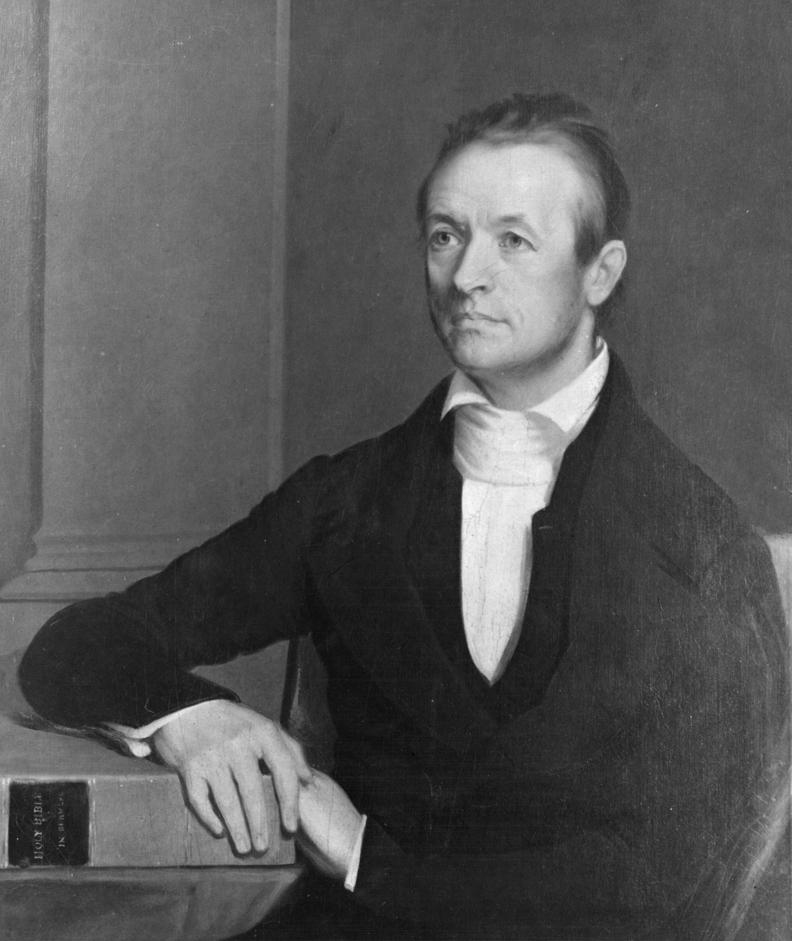
George Peter Alexander Healy, Adoniram Judson, 1846. Public domain.
Burma, 1813 to 1850 · Person · Featured Study
Adoniram and Ann Judson
They were American missionaries in Burma, she until her death and he for thirty-seven years.
Asked how bright the prospects were for the heathen, Judson answered, his son wrote, "As bright as the promises of God."
Those who sow in tears will reap with shouts of joy.
- Born
- Adoniram on 9 August 1788 at Malden; Ann on 22 December 1789 at Bradford
- Died
- Ann on 24 October 1826 at Amherst; Adoniram at sea on 12 April 1850
- Family
- daughter: Maria
- Places
- Malden, Bradford, Salem, Calcutta, Rangoon, Ava, Amherst
Summary
Adoniram Judson and Ann Hasseltine married in February 1812 and sailed for Asia that month. They reached Rangoon in 1813 and began the Baptist mission in Burma. Ann cared for her husband while he lay in prison at Ava. She died at Amherst in 1826. He finished the Burmese Bible in 1834 and died at sea in 1850.
- They sailed under the American Board and became Baptists at Calcutta on the way.
- Judson waited six years in Rangoon for his first Burman convert.
- The story of the pillow comes from Wayland's memoir of 1853. Ann's own letter does not tell it.
The Promise They Leaned On
Judson's letter of 1816 stands beside Hebrews 10, and his six years without a convert beside Psalm 126.
No verse of Scripture names the Judsons. In 1816 Judson told Luther Rice how to answer those who asked what the mission could hope for, and he grounded the answer in the faithfulness of God.
The question of these two lives is what their own papers keep of each. Ann's letters survive in Knowles's memoir of 1829, and Judson's journals and letters in Wayland's memoir of 1853.
Let us hold resolutely to the hope we profess, for He who promised is faithful.The verse names the faithfulness of the One who promised.
The Lives in Order
Their own letters and journals date nearly every step, as Wayland and Knowles print them.
The two lives ran together from the wedding to Amherst.
- 9 August 1788Adoniram Judson was born at Malden, MassachusettsWayland, volume 1
- 22 December 1789Ann Hasseltine was born at Bradford, MassachusettsKnowles
- 12 October 1808Judson entered the seminary at AndoverWayland, volume 1
- 1811Sailing to England, he was taken by a French privateer and held at BayonneKnowles
- 5 and 6 February 1812They married, and he was ordained at Salem the next dayWayland, volume 1, from the Panoplist
- 19 February 1812They sailed from Salem in the brig CaravanWayland, volume 1
- 6 September 1812They were baptized in the Baptist chapel at CalcuttaAnn's letter, in Wayland, volume 1
- 13 July 1813They reached RangoonWayland, volume 1
- 27 June 1819Judson baptized Moung NauJudson's journal, in Wayland, volume 1
- 8 June 1824Officers arrested Judson at AvaAnn's letter of 26 May 1826, in Knowles
- 24 October 1826Ann died at AmherstWayland, volume 1
- January 1834Judson finished the Burmese BibleHis postscript, in Wayland, volume 2
- 12 April 1850He died at sea and was buried in the ocean that dayWayland, volume 2
Each step of the two lives stands with its witness.
6 September 1812, 13 July 1813, 27 June 1819, 8 June 1824, 24 October 1826, January 1834, 12 April 1850
From Bradford to Amherst
Wayland tells his life from his papers, and Knowles prints her letters.
Judson entered Providence College, now Brown University, in his sixteenth year, and at the close he gave the valedictory address. A classmate whom Wayland names only as E. was a Deist. Judson became, Wayland says, "at least professedly, as great an unbeliever as his friend."
Judson was travelling when he spent a night at an inn beside a dying fellow lodger. In the morning the landlord told him the man was dead and named him as E. of Providence College. Judson went to Andover that autumn, first as a special student.
Ann Hasseltine grew up at Bradford and studied at its academy. Two years before the wedding she wrote to a friend that she expected to spend her days in heathen lands.
Judson was ordained at the Tabernacle in Salem with Samuel Newell, Samuel Nott, Gordon Hall and Luther Rice. A council of Congregational churches ordained them as missionaries to Asia.
On the voyage Judson studied the Greek word translated baptism and decided he had never been baptized. At Calcutta the couple asked the Baptists for baptism, and Rice followed some weeks later.
At Rangoon they lived first in the Baptist mission house of Felix Carey. In April 1819 Judson opened a zayat, a public shelter by the road, for teaching, and that June he baptized his first convert.
In the war between Burma and Great Britain, Judson was imprisoned at Ava with the other foreigners. The prisoners spent about seven months in the city prison, then were marched to a village prison outside it. Ann went back and forth to the prison "with little Maria in my arms", and she stayed six months at the second prison.
Ann died at Amherst while her husband was away, and the news reached him a month later.
Judson gave the rest of his life to the Burmese Bible and the churches. Ill in 1850, he sailed from Maulmain in a French bark for the Isle of France, and he died at sea.
Why They Became Baptists
Judson set out his reasons in a letter after the baptism at Calcutta.
Of the Greek word translated baptism, Judson wrote that "a very little search convinced me that its plain, appropriate meaning was immersion or dipping". He cited Professor Campbell of Scotland, "though he was no Baptist", for the same reading.
He drew the conclusion in his own terms: "I saw that, in a double sense, I was unbaptized." His letter answers the Pedobaptists, as he calls those who baptize infants.
Ann wrote that their friends at Serampore were "extremely surprised" at the request, since they had heard nothing of the couple's doubts.
In Their Own Words
Ann wrote before she sailed and after the war, and Judson wrote of the mission's hope and of the finished Bible.
Ann Hasseltine Judson (1789 to 1826)
letter of 8 September 1810, in Knowles's Memoir (1829)
I feel willing
“I feel willing, and expect, if nothing in providence prevents, to spend my days in this world in heathen lands.”
Baptist missionary
About this saying1 paragraph
Ann Hasseltine wrote this from Beverly to a friend on 8 September 1810, before her marriage.
Ann Hasseltine Judson
Letter to her brother, Rangoon, May 26, 1826, in James D. Knowles, Memoir of Mrs. Ann H. Judson, page 231
Where is the teacher?
“'Where is the teacher?' was the first inquiry. Mr. Judson presented himself. 'You are called by the King,' said the officer; a form of speech always used when about to arrest a criminal.”
Baptist missionary
About this saying1 paragraph
Ann gave the arrest at Ava in a letter to her brother from Rangoon, after the war, and Knowles printed it in 1829.
Adoniram Judson (1788 to 1850)
Letter to Luther Rice, 3 August 1816, in Edward Judson's life (1883), page 93
Tell them
“If they ask again, What prospect of ultimate success is there? tell them, As much as that there is an almighty and faithful God, who will perform His promises, and no more.”
Baptist
About this saying1 paragraph
Judson wrote this to Luther Rice on 3 August 1816, before any Burman had been baptized, and his son Edward printed the letter in 1883.
Adoniram Judson
Postscript of January 31, 1834, in Francis Wayland, A Memoir of the Life and Labors of the Rev. Adoniram Judson, volume 2, pages 75 to 76
The last leaf
“Thanks be to God, I can now say I have attained. I have knelt down before him, with the last leaf in my hand, and imploring his forgiveness for all the sins which have polluted my labors in this department, and his aid in future efforts to remove the errors and imperfections which necessarily cleave to the work, I have commended it to his mercy and grace; I have dedicated it to his glory.”
Baptist
About this saying1 paragraph
Judson added this postscript to a letter on 31 January 1834, the day he finished the Burmese Bible.
The People Around Them
The memoirs name their companions, their first convert and the friend who turned Judson back.
Most of the circle is known from Judson's own papers.
| Person | Tie to the Judsons | The witness |
|---|---|---|
| E. | A Deist friend at college, whose death at an inn turned Judson back. | Wayland, volume 1 |
| Luther Rice | Ordained with Judson at Salem, he was baptized at Calcutta weeks after them. | Ann, quoted by Wayland |
| Samuel Newell | Ordained with Judson, he and his wife sailed with them in the Caravan. | Wayland, volume 1 |
| Felix Carey | His mission house at Rangoon was their first home in Burma. | Wayland, volume 1 |
| Moung Nau | Judson baptized him as the first Burman convert. | Judson's own journal |
| Maria | Their infant daughter, whom Ann carried to the prison. | Ann, quoted by Wayland |
| Mr. Ranney | He sailed with Judson in 1850 and closed his eyes. | Wayland, volume 2 |
| Emily Judson | She outlived him and gave Wayland her memories of him. | Wayland's preface |
Mr. Ranney, Emily Judson
The Places of Their Lives
Their lives run from two Massachusetts towns to the river cities of Burma.
Most of their married years were spent in Burma.
| Place | What the witnesses say | The witness |
|---|---|---|
| Malden | Judson was born there. | Wayland, volume 1 |
| Bradford | Ann was born there and studied at its academy. | Knowles |
| Andover | Judson studied at the seminary there. | Wayland, volume 1 |
| Salem | He was ordained at the Tabernacle, and they embarked there. | Wayland, volume 1 |
| Calcutta | Their change of views ended there in baptism. | Her letter of 1812 |
| Rangoon | Their first home in Burma and the place of the first baptism. | Wayland, volume 1 |
| Ava | Officers arrested Judson there, and he lay in its prison. | Knowles |
| Oung-pen-la | The prisoners were marched there, and Ann stayed six months. | Knowles |
| Amherst | Ann died there. | Wayland, volume 1 |
Ava, Oung-pen-la, Amherst
How the Key Verse Was Taught
Basil of Caesarea and Matthew Henry read the sowing in tears.
Basil of Caesarea (died 379)
HOMILIES ON THE PSALMS 14:4
Basil of Caesarea, in his homilies on the Psalms of the fourth century, joined the verse to the blessing on those who weep.
“‘Blessed are they who weep, for they shall laugh.’ They, therefore, who spend the days of their life, which is already at its consummation and declining toward its setting, in weeping for their sins, these will be glad in that true morning that is approaching. ‘They that sow in tears shall reap in joy,’ of course, in the future.”
on Psalm 126:5Patristic
Matthew Henry (1662 to 1714)
Commentary on the Whole Bible
Matthew Henry, in 1710, named the kinds of tears that are themselves the seed.
“Nay, there are tears which are themselves the seed that we must sow, tears of sorrow for sin, our own and others, tears of sympathy with the afflicted church, and the tears of tenderness in prayer and under the word.”
on Psalm 126:5 to 6Puritan
What the Witnesses Leave Open
Readers differ on the pillow, on Judson's best-known saying and on a story of a coffin crate.
The manuscript in the pillowWayland, from Emily Judson; Ann Judson's letter
Wayland's memoir says the manuscript of the translation was sewn into a pillow "so mean in its appearance, and so hard and uncomfortable withal, that even the avarice of a Burman would not covet it".
Wayland took these reminiscences from Emily Judson, the widow, and printed them in 1853. Ann's letter of 1826, the witness nearest the prison, does not tell the story.
As bright as the promises of GodEdward Judson
Edward Judson wrote in 1883 that his father gave this answer "many years after" his first labours, and he gives no date or place. The form that begins "The future is" appears only later.
The coffin crateKnowles, Wayland and Edward Judson
A story often told says the Judsons packed their goods for Burma in a crate built like a coffin. Knowles, Wayland and Edward Judson do not tell it, and no earlier witness for it has been found.
Books to Read Next
A Memoir of the Life and Labors of the Rev. Adoniram Judson
Francis Wayland · 1853
Wayland printed Judson's journals and letters with Ann's letters from Burma.
Read volume 1 free at the Internet ArchiveMemoir of Mrs. Ann H. Judson
James D. Knowles · 1829
Knowles gave her life through her own letters and journals.
Read Knowles free at the Internet ArchiveThe Life of Adoniram Judson
Edward Judson · 1883
Edward Judson told his father's life with many of his letters.
Read Edward Judson free at the Internet ArchiveWhat the Judsons Left
They left the Burmese Bible and the letters that tell their years in Burma. Wayland ends the life at sea, where they lowered Judson "to his ocean grave without a prayer".
Sources
Scripture is the Berean Standard Bible.
- The Holy Bible, Berean Standard Bible (read 2026)
- Francis Wayland, A Memoir of the Life and Labors of the Rev. Adoniram Judson, volume 1 (Boston, 1853), with Judson's journals and letters and Ann Judson's letters.
- Francis Wayland, A Memoir of the Life and Labors of the Rev. Adoniram Judson, volume 2 (Boston, 1853)
- James D. Knowles, Memoir of Mrs. Ann H. Judson (Boston, 1829)
- Edward Judson, The Life of Adoniram Judson (New York, 1883)
- Basil of Caesarea, Homilies on the Psalms 14.4 (fourth century), on Psalm 126:5.
- Matthew Henry, Commentary on the Whole Bible (1710), on Psalm 126:5.
Keep Studying
People and groups9