
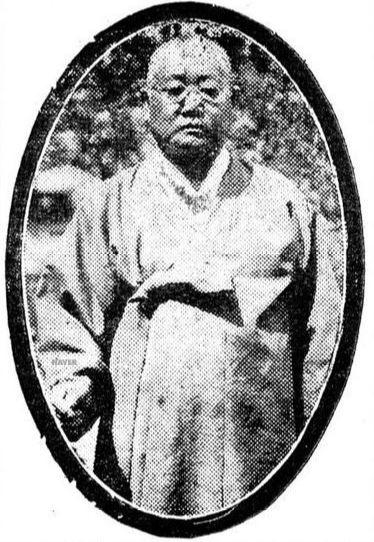
Gil Seon-ju, photographer unknown, 1935. Public domain.
Pyongyang, 1897 to 1935 · Person · Featured Study
Gil Seon-ju and the Dawn Prayer
Korean churches credit this Pyongyang preacher with their prayer meeting before dawn.
Blind in part, he was led through the streets of Seoul to take charge of its meetings.
Early in the morning, while it was still dark, Jesus got up and slipped out to a solitary place to pray.
Early in the morning, while it was still dark, Jesus got up and slipped out to a solitary place to pray.
- Born
- 1869, at Anju
- Died
- 1935, after collapsing at a Bible class
- Places
- Anju, Pyongyang, Seoul
Summary
Gil Seon-ju was born at Anju in 1869. He sought God as a Taoist and was baptized in 1897. He was the leading Korean preacher of the Pyongyang revival of 1907, and that year he was ordained one of the first seven Presbyterian ministers in Korea. He signed the declaration of independence of 1919 and died in 1935.
- The missionaries spelled his name Kil Sun Chu, and James Gale wrote it S. J. Keel.
- Malte Rhinow found prayer meetings at dawn in Korea from 1890, before the revival.
- His own letter from the weeks of the revival says it kept the Korean church from being great only in appearance.
The Hour Before Dawn
Jesus prays before daylight in Mark 1, and the psalmist pleads at daybreak in Psalm 5.
No verse of Scripture names Gil Seon-ju. Korean churches keep a prayer meeting before daybreak, saebyeok gido, and these two texts speak of prayer at that hour.
The question of this life is what the missionaries' papers and the Korean record say of Gil, and whether he began the dawn prayer he is remembered for.
In the morning, O LORD, You hear my voice; at daybreak I lay my plea before You and wait in expectation.The psalm makes the morning the time of a daily plea.
The Life in Order
The missionaries date his preaching, and the Korean encyclopedia dates the rest of the life.
The English witnesses see him only from 1907 to 1909.
- 1869He was born at AnjuThe Encyclopedia of Korean Culture
- Before his baptismYears in Taoist practiceGale (1909)
- Autumn 1896His own Christian prayer at dawnRhinow (2012), his table of contents
- 1897BaptismThe Encyclopedia of Korean Culture
- 1901Eldership in PyongyangThe Encyclopedia of Korean Culture
- January 1907He preached in the revival meetings at PyongyangGraham Lee, The Korea Mission Field (March 1907)
- Early 1907Meetings in the capitalThe Korea Mission Field (March 1907); Gale (1909)
- September 1907He was ordained with six others at the first presbyteryW. D. Reynolds, The Korea Mission Field (November 1907)
- About summer 1909A daily meeting before light in his own churchRhinow (2012), his table of contents
- 1 March 1919The independence movementThe Encyclopedia of Korean Culture
- After his releasePreaching toursThe Encyclopedia of Korean Culture
- 1935His deathThe Dong-a Ilbo (1935)
- 2009The Order of Merit for National FoundationThe Encyclopedia of Korean Culture
Each step of the life stands with its witness.
Early 1907, September 1907, About summer 1909, 1 March 1919, After his release, 1935, 2009
From Anju to the Pulpit
The missionaries' papers give the preacher, and the Korean encyclopedia gives the life.
Before he became a Christian he sought God by the Taoist way. Gale wrote of him, "Our dear brother, S. J. Keel, was once a Taoist."
He was baptized in 1897 at twenty-nine. In 1901 he became an elder of the Jangdaehyeon church, the Central Church of Pyongyang, where the revival would break six years later.
Gale writes that Keel "was once stone-blind, is partially blind still". Of the revival meetings, Graham Lee called him "our most gifted Korean preacher".
That year Seoul sent a delegation asking for him, and the mission's paper reported meetings he held in the churches there. In the autumn he was ordained with six other Koreans after a theological course of five years.
The Korean encyclopedia records that he was one of the signers of the 1919 declaration, served time in prison and then led revival meetings across the country. In 1935 the Dong-a Ilbo reported that he had collapsed during a Bible class and died.
The Dawn Prayer
The meeting he is remembered for began before the revival, and he made it the custom of his church.
Young-Hoon Lee counts early morning prayer meetings among the traditions the revival left in the Korean church.
Jonathan Goforth tells of Kil proposing that his people meet for prayer "every morning at half-past four". He sets it some years after Kil became pastor of the Central Church.
Malte Rhinow's table of contents dates the Jangdaehyeon dawn meetings of Park Chi-rok and Gil to about the summer of 1909.
The Encyclopedia of Korean Culture names dawn prayer and praying aloud as native forms of faith that appeared in the Wonsan movement of 1903 to 1906.
In Their Own Words
His letter to James Gale, written in the weeks of the revival, survives in Gale's English.
Gil Seon-ju (1869 to 1935)
His account of the Sunday meeting at Pyongyang, in James S. Gale, Korea in Transition, page 203
Some tried to confess, some tried to pray
“Oh you never experienced anything like it, the whole place was just whing with nothingness. Some tried to confess, some tried to pray. It would not do, and the meeting dispersed and went home.”
Korean Presbyterian
About this saying1 paragraph
Gale printed in 1909 what he said of the Sunday night meeting before the breaking at Pyongyang.
Gil Seon-ju
letter to James S. Gale, in James S. Gale, Korea in Transition (1909), pages 220 and 221
Great only in appearance
“If God had not manifested thus his Spirit, the Church of Korea would have been great only in appearance, but Satan would have ruled, and I fear few would have been saved.”
Korean Presbyterian
About this saying1 paragraph
He wrote to Gale, then in America, on the twenty-fifth day of the first moon of 1907.
Gil Seon-ju
Letter to James S. Gale, in James S. Gale, Korea in Transition, page 221
Poured out on you
“No power can tell of the blessing, nor can I write with pen all that God has done. My prayer is that the Spirit may be poured out on you as he has been manifested here.”
Korean Presbyterian
About this saying1 paragraph
The same letter of 1907 closes with a prayer for Gale himself.
The People Around Him
The record names the missionaries who wrote of him and the Koreans who served beside him.
Most of what the English record holds of him comes from four missionaries.
| Person | Tie to Gil | The witness |
|---|---|---|
| Graham Lee | The Pyongyang missionary who called him the most gifted Korean preacher. | Lee, in the mission's paper |
| W. B. Hunt | He saw Elder Kil rise at the after-meeting of the first breaking. | Hunt, in the mission's paper |
| James S. Gale | A missionary of Seoul, far away in America that winter. | Gale (1909) |
| W. D. Reynolds | He reported the ordination of the seven, Kil among them. | Reynolds's report |
| Suh Kyung Jo and Han Suk Chin | Fellow graduates of the first class. | Reynolds's report |
| Park Chi-rok | He led the Jangdaehyeon dawn meetings with Gil. | Rhinow (2012) |
| Jonathan Goforth | A missionary who wrote of the Korean revival in a booklet of 1943. | Goforth (1943) |
The Places of His Life
His life runs from Anju to Pyongyang and Seoul.
His work centred on one church in Pyongyang.
| Place | What the witnesses say | The witness |
|---|---|---|
| Anju | He was born there. | The Korean encyclopedia |
| Pyongyang | His congregation stood there. | The Korean encyclopedia; Goforth (1943) |
| Seoul | A delegation came from there asking for him in 1907. | Gale (1909) |
| Wonsan | An earlier revival began there. | The Korean encyclopedia |
How the Key Verse Was Taught
Origen, Matthew Henry and the Jamieson, Fausset and Brown commentary read Jesus at prayer before day.
Origen of Alexandria (died 253)
ON PRAYER 13.1
Origen, in his treatise On Prayer of the third century, drew from the verse a reason no disciple may neglect prayer.
“Jesus prayed and did not pray in vain, since he received what he asked for in prayer when he might have done so without prayer. If so, who among us would neglect to pray? Mark says that ‘in the morning, a great while before day, he rose and went out to a lonely place, and there he prayed.’ And Luke says, ‘He was praying in a certain place, and when he ceased, one of his disciples said to him, 'Lord, teach us to pray,' ‘ and elsewhere, ‘And all night he continued in prayer to God.’”
on Mark 1:35Patristic
Matthew Henry (1662 to 1714)
Commentary on the Whole Bible
Matthew Henry, in 1710, read the verse as an example of secret prayer.
“He prayed, prayed alone; to set us an example of secret prayer. Though as God he was prayed to, as man he prayed. Though he was glorifying God, and doing good, in his public work, yet he found time to be alone with his Father; and thus it became him to fulfil all righteousness.”
on Mark 1:35Puritan
Jamieson, Fausset & Brown (1802 to 1910)
Commentary Critical and Explanatory on the Whole Bible
The commentary of Jamieson, Fausset and Brown, in 1871, pictured Peter's house on that morning.
“When morning came, Peter, loath to break in upon the repose of his glorious Guest, would await His appearance beyond the usual hour; but at length, wondering at the stillness, and gently coming to see where the Lord lay, he finds it--like the sepulchre afterwards--empty! Speedily a party is made up to go in search of Him, Peter naturally leading the way.”
on Mark 1:35Reformed
What the Witnesses Leave Open
Readers differ on whether Gil began the dawn prayer or took up a practice older than his ministry.
Did Gil begin the dawn prayer?InSoo Kim; Malte Rhinow
InSoo Kim wrote in 1993 that the day-break prayer meeting "which was initiated by Kil was permanently established as an unique characteristic of the church".
Malte Rhinow wrote in 2012, "The author found 5 examples for early morning prayers before 1898, the earliest in September 1890". He judged that they did not start during the revival movement.
The two readings meet in Gil's own church, where he made the dawn meeting a fixed custom after the revival.
Books to Read Next
Korea in Transition
James S. Gale · 1909
Gale printed Gil's letter from the revival and wrote of his Taoist years and his blindness.
Read Gale free at the Internet ArchiveThe Korea Mission Field, volume 3
The missions in Korea · 1907
The mission's paper reported his preaching in March and his ordination in November.
Read the March issue free at the Internet ArchiveWhat Gil Left
Gil left a church that met to pray before light each morning, and a letter that judged the revival by what the Korean church would have been without it.
Sources
Scripture is the Berean Standard Bible.
- The Holy Bible, Berean Standard Bible (read 2026)
- The Korea Mission Field 3:3 (Seoul, March 1907): Graham Lee, "How the Spirit Came to Pyeng Yang"; W. B. Hunt, "Impressions of an Eye Witness"; "Recent Work of the Holy Spirit in Seoul".
- W. D. Reynolds, "The Presbytery of Korea", The Korea Mission Field 3:11 (November 1907)
- James S. Gale, Korea in Transition (New York: Young People's Missionary Movement, 1909), pages 82, 203 to 204 and 220 to 221.
- The Encyclopedia of Korean Culture (Academy of Korean Studies): 이장식, "길선주" (1995, revised 2024); 이덕주, "원산부흥운동" (2015, revised 2023)
- Malte Rhinow, "Research on the Beginnings of Early Morning Prayer in the Korean Protestant Church", Theology and Praxis 31 (2012), pages 183 to 225, the abstract and table of contents.
- InSoo Kim, dissertation (1993), page 192, as quoted in Bay (2007)
- Young-Hoon Lee, "Korean Pentecost: The Great Revival of 1907", Asian Journal of Pentecostal Studies 4:1 (2001), pages 73 to 83.
- Jonathan Goforth, When the Spirit's Fire Swept Korea (Grand Rapids: Zondervan, 1943)
- Origen, On Prayer 13.1 (third century), on Mark 1:35.
- Matthew Henry, Commentary on the Whole Bible (1710), on Mark 1:35.
- Robert Jamieson, A. R. Fausset and David Brown, Commentary Critical and Explanatory on the Whole Bible (1871), on Mark 1:35.