
Esther 6:14
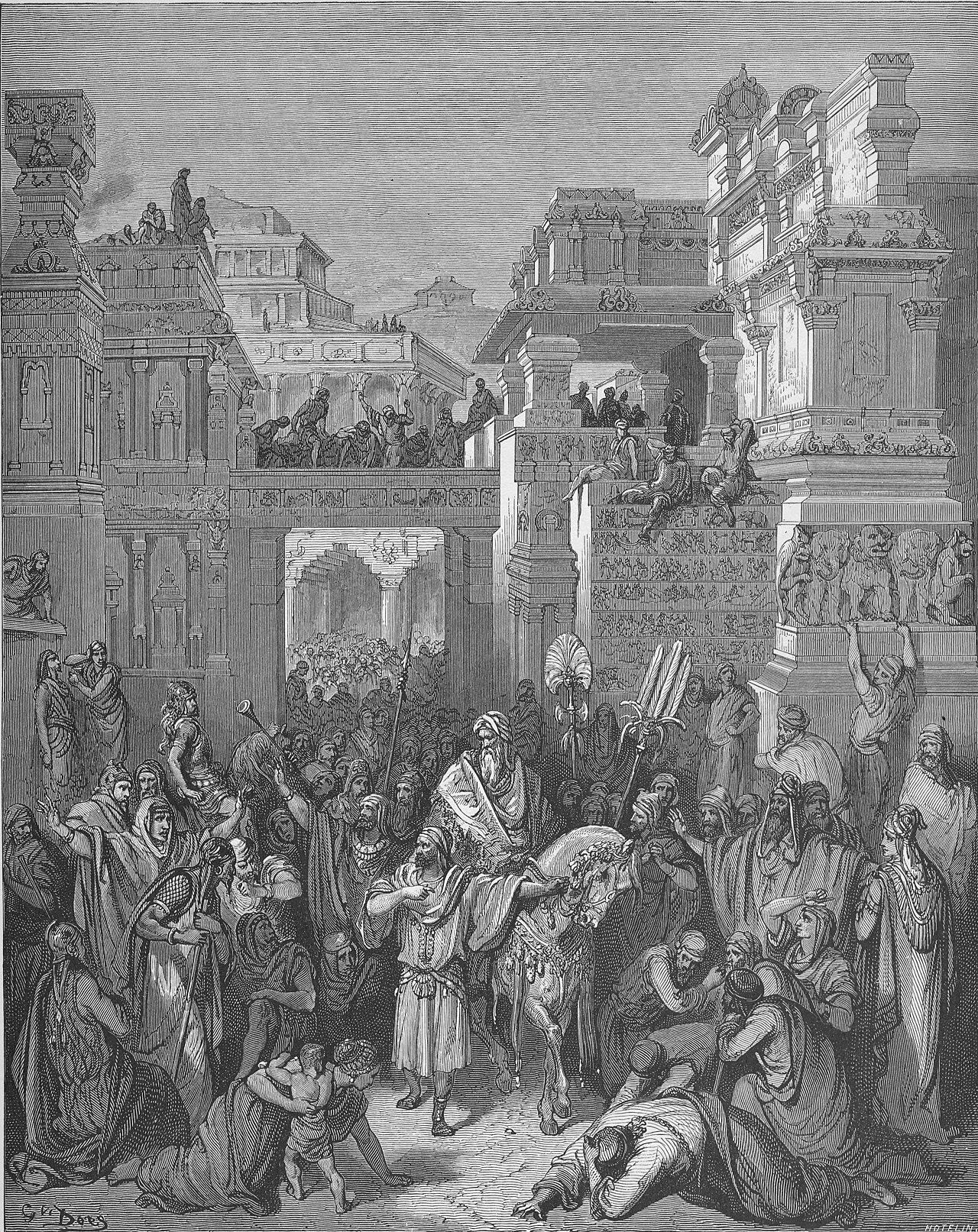
in Esther 6While they were still speaking with Haman, the king’s eunuchs arrived and rushed him to the banquet that Esther had prepared.
BSB
The same verse in ASV and KJV ▾
ASV
While they were yet talking with him, came the king’s chamberlains, and hasted to bring Haman unto the banquet that Esther had prepared.
KJV
And while they were yet talking with him, came the king’s chamberlains, and hasted to bring Haman unto the banquet that Esther had prepared.
⋯
This verse in Esther 6
Commentary
8 notes on this verseHasted to bring Haman - There was a dreadful banquet before him, of which he knew nothing: and he could have little appetite to enjoy that which he knew was prepared at the palace of Esther.
This site's exposition
If Mordecai be of the seed of the Jews
on Esther 6:13-14
Zeresh and the wise men read the day's events as an omen rather than an accident: if Mordecai be of the seed of the Jews, before whom thou hast begun to fall, thou shalt not prevail against him, but shalt surely fall before him. Pagan counselors state the book's hidden doctrine more plainly than the narrator ever does in his own voice. Commentators who trace Haman's line back to Agag read the seed language against the old war with Amalek, a connection the words themselves carry no further than the name.
The record, by era
The Medieval Church2 voices
Now, notice that Haman is now attending the second day just as he had come before when he was summoned; and yet once Esther lays out her request, he is condemned and goes off to his punishment. This explains the fact that in one place …
The second day of the banquet arrives to which Haman is invited like before. However, after Esther reveals her petition, he is condemned and brought to his place of execution. The gospel mentions this as a noonday meal in one passage and as an evening …
The Puritans and the Awakening3 voices
He thought it seasonable, in hopes it would revive his drooping spirits and save his sinking honour. But really it was seasonable because, his spirits being broken by this sore disappointment, he might the more easily be run down by Esther's complaint against him. The wisdom of God is seen in timing the means of his church's deliverance so as to manifest his own glory.
And while they were yet talking with him,.... About these things, and giving their opinion of the issue of them, upon the present appearance of them: came the king's chamberlains, and hasted to bring Haman unto the banquet that Esther had prepared; the time appointed for it being very near, or quite up, and Haman being backward and dilatory, having no stomach to go to it, and perhaps fearing worse things were coming upon him he should hear of there.
We read of no bodily indisposition he was under, that might break his sleep; but God, whose gift sleep is, withheld it from him. Those that are ever so much resolved to cast away care cannot always do it; they find it in their pillows when they neither expect nor welcome it.
1 more voice on this verse
The Nineteenth Century1 voice
A commentator
Jamieson, Fausset & Brown1802–1910
Commentary Critical and Explanatory on the Whole Bible (1871)
proposed
came the king's chamberlains, and hasted to bring Haman unto the banquet that Esther had prepared--Besides the invitation given to an entertainment, a message is always sent to the guests, immediately at the day and hour appointed, to announce that all things are ready.
quarantine:debris (2026-07-29) — starts-lowercase
How the passage was read
What the Jewish commentators add
On the verses either side of this one
Since you have begun to fall, etc. She said, “This nation has been compared to the stars and to the dust. When they descend, they descend to the dust, and when they ascend, they ascend up to the sky and the stars.” 6 Maseches Megillah 15a.
This section is reception history: how the passage was read and kept in the Jewish tradition. Where a reading parts from an essential of the Christian faith, the section says so at that point.
Texts and citation data: Sefaria; each excerpt follows its version’s licence. 5 further sources are cited on this chapter that carry no English text this site may quote or only restate the verse.
The words behind it
15 Hebrew wordsEvery Hebrew word of this verse in the order it stands, with what it means and the door to its own study. The last column counts the times a word stands in the whole Bible: the rarer the word, the more the places it appears belong together.
| Hebrew | Sound | Meaning | Word study | In the Bible |
|---|---|---|---|---|
| עוֹדָם֙ | odam | still they | H5750 → | 490 times |
| מְדַבְּרִ֣ים | medaberim | [were] speaking | H1696 → | 1141 times |
| עִמּ֔וֹ | imo | with him | H5973 → | 1050 times |
| וְסָרִיסֵ֥י | vesarisei | and [the] eunuchs of | H5631 → | 42 times |
| הַמֶּ֖לֶךְ | hamelekh | the king | H4428 → | 2525 times |
| הִגִּ֑יעוּ | higiu | they arrived | H5060 → | 150 times |
| וַיַּבְהִ֙לוּ֙ | vaiyavhilu | and they made haste | H926 → | 39 times |
| לְהָבִ֣יא | lehavi' | to bring | H935 → | 2568 times |
| אֶת־ | ʾet- | <obj.> | H853 → | 10935 times |
| הָמָ֔ן | haman | Haman | H2001 → | 54 times |
| אֶל־ | ʾel- | to | H413 → | 5510 times |
| הַמִּשְׁתֶּ֖ה | hamishteh | the feast | H4960 → | 46 times |
| אֲשֶׁר־ | ʾasher- | which | H834 → | 5497 times |
| עָשְׂתָ֥ה | ʾasetah | she had prepared | H6213 → | 2628 times |
| אֶסְתֵּֽר׃ | ʾester | Esther | H635 → | 55 times |
עוֹדָם֙still they
odamH5750 →490 times
מְדַבְּרִ֣ים[were] speaking
medaberimH1696 →1141 times
עִמּ֔וֹwith him
imoH5973 →1050 times
וְסָרִיסֵ֥יand [the] eunuchs of
vesariseiH5631 →42 times
הַמֶּ֖לֶךְthe king
hamelekhH4428 →2525 times
הִגִּ֑יעוּthey arrived
higiuH5060 →150 times
וַיַּבְהִ֙לוּ֙and they made haste
vaiyavhiluH926 →39 times
לְהָבִ֣יאto bring
lehavi'H935 →2568 times
אֶת־<obj.>
ʾet-H853 →10935 times
הָמָ֔ןHaman
hamanH2001 →54 times
אֶל־to
ʾel-H413 →5510 times
הַמִּשְׁתֶּ֖הthe feast
hamishtehH4960 →46 times
אֲשֶׁר־which
ʾasher-H834 →5497 times
עָשְׂתָ֥הshe had prepared
ʾasetahH6213 →2628 times
אֶסְתֵּֽר׃Esther
ʾesterH635 →55 times
A shaded row is a word that stands 400 times or fewer in the Bible.
The walk
8 stopsEach card is a verse this one points to, and under it the verses that one points to in turn. Where several paths arrive at the same place, that place is listed first: the text keeps returning to it.
Through
Esther 5:14His wife Zeresh and all his friends told him, “Have them build a gallows fifty cubits high, and ask the king in the morning to have Mordecai hanged on it. Then go to the…
it leads to
- Esther 6:4
“Who is in the court?” the king asked. Now Haman had just entered the outer court of the palace to ask the king to hang Mordecai on the gallows he had prepared for him.
- Psalms 37:32
Though the wicked lie in wait for the righteous, and seek to slay them,
- Esther 7:9–10
Then Harbonah, one of the eunuchs attending the king, said: “There is a gallows fifty cubits high at Haman’s house. He had it built for Mordecai, who gave the report that saved the king.”…
- Psalms 37:14
The wicked have drawn the sword and bent the bow to bring down the poor and needy, to slay those whose ways are upright.
- 1 Kings 21:7
But his wife Jezebel said to him, “Do you not reign over Israel? Get up, eat some food, and be cheerful, for I will get you the vineyard of Naboth the Jezreelite.”
- Esther 6:4
Through
Esther 5:8If I have found favor in the sight of the king, and if it pleases the king to grant my petition and fulfill my request, may the king and Haman come tomorrow to the…
it leads to
- Proverbs 16:9
A man’s heart plans his course, but the LORD determines his steps.
- Esther 7:3
Queen Esther replied, “If I have found favor in your sight, O king, and if it pleases the king, grant me my life as my petition, and the lives of my people as my…
- Esther 8:5
“If it pleases the king,” she said, “and if I have found favor in his sight, and the matter seems proper to the king, and I am pleasing in his sight, may an order…
- Proverbs 16:9
Where this verse is studied
On this page
Studies2
On this chapter
About Esther
Who and where
1 name in this verse with a page on the site.
This page draws on Adam Clarke, Commentary on the Bible; Jamieson, Fausset & Brown, Commentary Critical and Explanatory on the Whole Bible; John Gill, Exposition of the Old Testament (1748-1763); Keil, The Books of Ezra, Nehemiah, and Esther; Matthew Henry, Commentary on the Whole Bible; Rabanus Maurus, Commentary on Esther; Rabanus Maurus, EXPLANATION ON THE BOOK OF ESTHER 10 and W. F. Adeney, Ezra, Nehemiah and Esther (Expositor's Bible).