
Esther 6:12
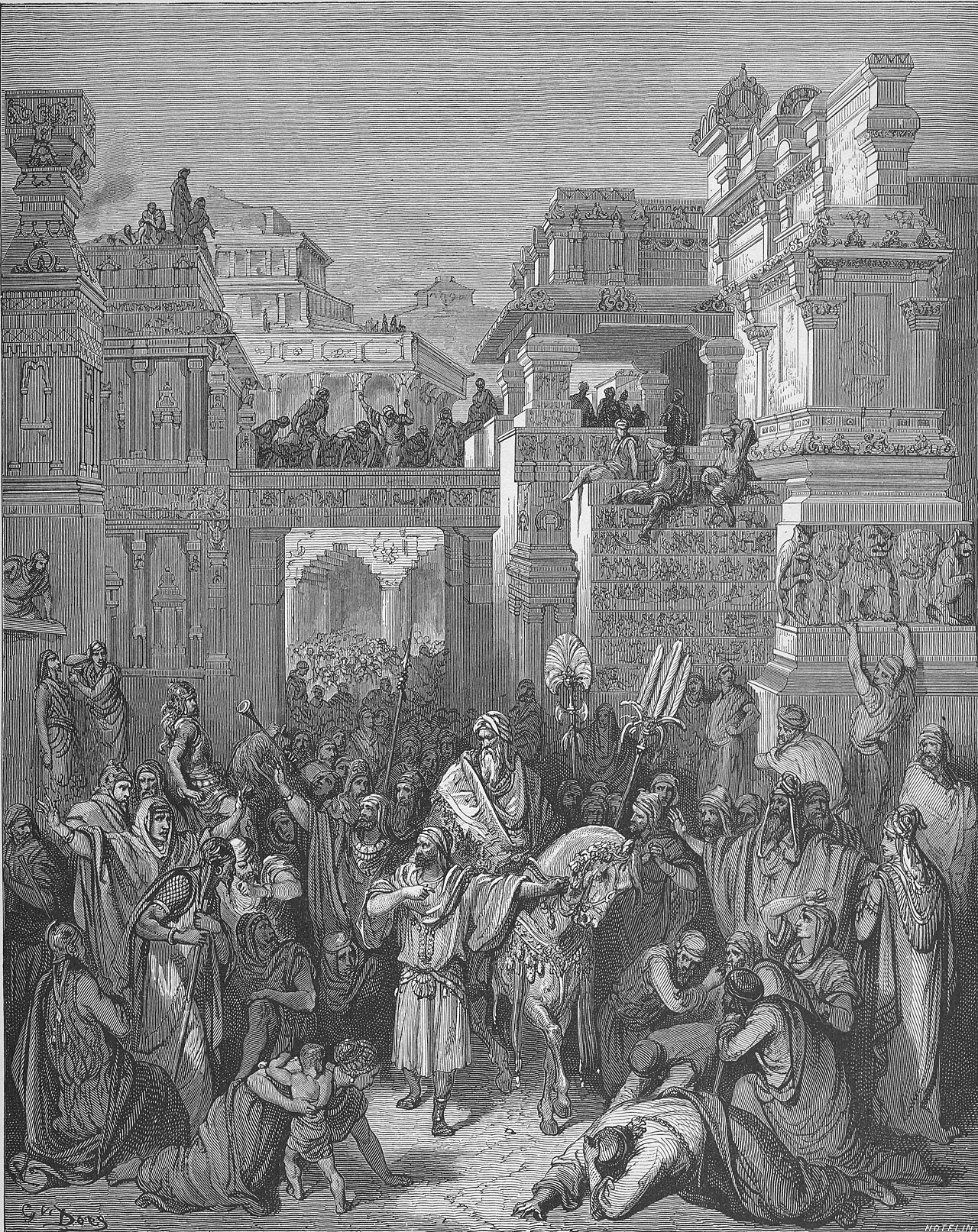
in Esther 6Then Mordecai returned to the king’s gate. But Haman rushed home, with his head covered in grief.
BSB
The same verse in ASV and KJV ▾
ASV
And Mordecai came again to the king’s gate. But Haman hasted to his house, mourning and having his head covered.
KJV
And Mordecai came again to the king’s gate. But Haman hasted to his house mourning, and having his head covered.
⋯
This verse in Esther 6
Commentary
9 notes on this verseMordecai came again to the king’s gate - He resumed his former humble state; while Haman, ashamed to look up, covered his face, and ran home to hide himself in his own house. Covering the head and face was a sign of shame and confusion, as well as of grief, among most people of the earth.
This site's exposition
Mordecai returned to the king’s gate
Mordecai returns to the king's gate, unmoved by the honor as he was unmoved by the insult that started chapter five. Haman hastens home mourning, his head covered, the sign of a man already in disgrace. The two men end the scene in the postures each began it, reversed.
The record, by era
The Medieval Church2 voices
This is the change caused by the right hand of the Highest: the one who had just boasted about his power and was arrogant towards everyone else becomes viler and weaker than anyone else. When Mary the mother of our Lord considered the greatness of …
This is the change in the right hand of the Most High, when someone who was only recently boasting that he had power over others, and was more arrogant than anyone, suddenly becomes more wretched than anyone else and weaker than all of them. It …
The Puritans and the Awakening3 voices
Gate - To his former place; shewing that as he was not overwhelmed by Haman's threats, so he was not puffed up with this honour. Cover'd - In token of his shame and grief for his unexpected disappointment, and for the great honour done to his abhorred adversary, by his own hands, and with his own public disgrace.
); he returned to his place and the duty of it immediately, and minded his business as closely as he had done before. Honour is well bestowed on those that are not made proud and idle by it, and will not think themselves above their business. How much Haman was cast down with his disappointment.
quarantine:debris (2026-07-29) — leading-punctuation+unbalanced-parens
And Mordecai came again to the king's gate,....
2 more voices on this verse
The Puritans and the Awakening1 voice
We read of no bodily indisposition he was under, that might break his sleep; but God, whose gift sleep is, withheld it from him. Those that are ever so much resolved to cast away care cannot always do it; they find it in their pillows when they neither expect nor welcome it.
The Nineteenth Century1 voice
A commentator
Albert Barnes1798–1870
Notes, Explanatory and Practical, on the Old and New Testaments (1832-1869)
proposed
It is quite consonant with Oriental notions that Mordecai, after receiving the extraordinary honors assigned him, should return to the palace and resume his former humble employment.
How the passage was read
What the Jewish commentators add
Mordechai then returned. To his sackcloth, and to his fasting. 4 Maseches Megillah 16a. This was the last day of Mordechai’s three day fast. (Sifsei Chachomim)
1 more on this passage, in their own words ▾
Since you have begun to fall, etc. She said, “This nation has been compared to the stars and to the dust. When they descend, they descend to the dust, and when they ascend, they ascend up to the sky and the stars.” 6 Maseches Megillah 15a.
This section is reception history: how the passage was read and kept in the Jewish tradition. Where a reading parts from an essential of the Christian faith, the section says so at that point.
Texts and citation data: Sefaria; each excerpt follows its version’s licence. 5 further sources are cited on this chapter that carry no English text this site may quote or only restate the verse.
The words behind it
12 Hebrew wordsEvery Hebrew word of this verse in the order it stands, with what it means and the door to its own study. The last column counts the times a word stands in the whole Bible: the rarer the word, the more the places it appears belong together.
| Hebrew | Sound | Meaning | Word study | In the Bible |
|---|---|---|---|---|
| וַיָּ֥שָׁב | vaiyashov | and he returned | H7725 → | 1056 times |
| מָרְדֳּכַ֖י | maredokhai | Mordecai | H4782 → | 60 times |
| אֶל־ | ʾel- | to | H413 → | 5510 times |
| שַׁ֣עַר | shaar | [the] gate of | H8179 → | 374 times |
| הַמֶּ֑לֶךְ | hamelekh | the king | H4428 → | 2525 times |
| וְהָמָן֙ | vehaman | and Haman | H2001 → | 54 times |
| נִדְחַ֣ף | nidchaf | he hurried himself | H1765 → | 4 times |
| אֶל־ | ʾel- | to | H413 → | 5510 times |
| בֵּית֔וֹ | beito | house his | H1004 → | 2046 times |
| אָבֵ֖ל | ʾavel | mourning | H57 → | |
| וַחֲפ֥וּי | vachafui | and covered of | H2645 → | |
| רֹֽאשׁ׃ | rosh | head | H7218 → | 599 times |
וַיָּ֥שָׁבand he returned
vaiyashovH7725 →1056 times
מָרְדֳּכַ֖יMordecai
maredokhaiH4782 →60 times
אֶל־to
ʾel-H413 →5510 times
שַׁ֣עַר[the] gate of
shaarH8179 →374 times
הַמֶּ֑לֶךְthe king
hamelekhH4428 →2525 times
וְהָמָן֙and Haman
vehamanH2001 →54 times
נִדְחַ֣ףhe hurried himself
nidchafH1765 →4 times
אֶל־to
ʾel-H413 →5510 times
בֵּית֔וֹhouse his
beitoH1004 →2046 times
אָבֵ֖לmourning
ʾavelH57 →
וַחֲפ֥וּיand covered of
vachafuiH2645 →
רֹֽאשׁ׃head
roshH7218 →599 times
A shaded row is a word that stands 400 times or fewer in the Bible.
The walk
8 stopsEach card is a verse this one points to, and under it the verses that one points to in turn. Where several paths arrive at the same place, that place is listed first: the text keeps returning to it.
Through
Job 20:5the triumph of the wicked has been brief and the joy of the godless momentary?
it leads to
- Psalms 37:35–36
I have seen a wicked, ruthless man flourishing like a well-rooted native tree,
- Job 18:5–6
Indeed, the lamp of the wicked is extinguished; the flame of his fire does not glow.
- Psalms 73:18–20
Surely You set them on slick ground; You cast them down into ruin.
- Psalms 37:35–36
Through
Esther 2:19When the virgins were assembled a second time, Mordecai was sitting at the king’s gate.
it leads to
- Esther 2:21
In those days, while Mordecai was sitting at the king’s gate, Bigthan and Teresh, two of the king’s eunuchs who guarded the entrance, grew angry and conspired to assassinate King Xerxes.
- Esther 2:3–4
and let the king appoint commissioners in each province of his kingdom to assemble all the beautiful young women into the harem at the citadel of Susa. Let them be placed under the care…
- Esther 2:21
Through
1 Kings 21:4So Ahab went to his palace, sullen and angry because Naboth the Jezreelite had told him, “I will not give you the inheritance of my fathers.” He lay down on his bed, turned his…
it leads to
- 1 Kings 20:43
Sullen and angry, the king of Israel went home to Samaria.
- 1 Kings 20:43
Through
2 Samuel 15:30But David continued up the Mount of Olives, weeping as he went up. His head was covered, and he was walking barefoot. And all the people with him covered their heads and went up,…
it leads to
- Luke 19:41
As Jesus approached Jerusalem and saw the city, He wept over it
- 2 Samuel 19:4
But the king covered his face and cried out at the top of his voice, “O my son Absalom! O Absalom, my son, my son!”
- Luke 19:41
Where this verse is studied
On this page
Studies2
On this chapter
About Esther
Who and where
1 name in this verse with a page on the site.
This page draws on 9 works. Open the list of works
This page draws on Adam Clarke, Commentary on the Bible; Albert Barnes, Notes, Explanatory and Practical, on the Old and New Testaments (1832-1869); John Gill, Exposition of the Old Testament; John Gill, Exposition of the Old Testament (1748-1763); John Wesley, Explanatory Notes upon the Old Testament; Keil, The Books of Ezra, Nehemiah, and Esther; Matthew Henry, Commentary on the Whole Bible; Rabanus Maurus, EXPLANATION ON THE BOOK OF ESTHER 9 and Rabanus Maurus, Commentary on Esther.