
Psalm 8
9 verses · Hymn of praise
O LORD, our Lord, how majestic is Your name in all the earth! You have set Your glory above the heavens.
Introduction
David, the Majestic Name, Book 1: The book of David, Poetry, Psalms Overview.
David wrote this as a hymn, and it is the first psalm in the book that praises God from its first line to its last. It was written by a man who had spent nights outdoors with flocks under a sky without city light. The psalm sets the smallness of a human being beside the place God has given him, and it holds both at once. Listen for the line that opens and closes it, and for the question at its centre. The New Testament reads that question of Jesus.
Context
- Who
- Israelites who worked outdoors and slept under the stars the psalm asks them to consider
- Where
- The open night sky over the Judean hills, with flocks and herds nearby
- When
- The reign of David. c. 1010 to 970 BC on the superscription, which Young's Literal Translation renders To the Overseer, On the Gittith, a Psalm of David
Historical context
The psalm depends on a sky that people in lit cities have stopped seeing. With no artificial light the Milky Way stands overhead as a bright band, and a shepherd on night watch had hours to look at it. The beholding of verse 3 describes what a man actually did through a night. The list of verses 7 and 8 runs from what a man herds, to what he cannot control, to what he cannot reach. The psalm claims the rule of Genesis 1 over all of it. The phrase at verse 5 reads in the Hebrew as a little lower than elohim, a word Israel used for God and also for other spirit beings. The old Greek version rendered it angels, which Hebrews 2:7 follows. The nations around Israel worshipped the sun, the moon and the planets by name, and this psalm calls them the work of God's fingers.
Significance
An Israelite heard two things at once that are hard to hold together, that he is small under that sky and that he has been crowned with glory and honor. The psalm opens and closes on the same line about the name of the LORD in all the earth, so everything it says about human dignity is said inside praise.
This chapter in Jewish lifeWhat this chapter is in Jewish life and reading.
How it is read
The word in the heading is read three ways in the corpus, and the third is the one a Christian reader should notice. Radak is quoted here from the Finch translation of 1919, which is public domain. He reports that the word names a kind of music. Some hold David composed the psalm in Gath, and others that he gave it to the sons of Obed Edom the Gittite (Radak on Psalms 8:1:1). Rashi, quoted from the Judaica Press Tanach with Rashi, records Menachem's reading of an instrument made in Gath. He then reports the reading of the Sages, who took the word from the winepress and applied it to Edom, "a nation that is destined to be trodden like a winepress". Rashi sets that reading aside in one line: "the contents of the psalm do not indicate it" (Rashi on Psalms 8:1:1).
The second and third verses are read as an argument about worth. Rashi holds that "the earthlings did not deserve that You should cause Your Shechinah to rest among them". It would be fitting for God's majesty to rest on the heavens instead (Rashi on Psalms 8:2:1 and 8:2:2). He then reads the babes of the third verse as the Levites and the priests, whose praise in the Temple is the strength the verse names (Rashi on Psalms 8:3:1). The purpose he gives that praise is to answer a taunt, from an enemy "who says, You are no better than the other nations" (Rashi on Psalms 8:3:3). The New Testament reads the same verse a different way, and has Jesus apply the babes and sucklings to the children shouting in the Temple, at Matthew 21:16.
The fourth verse is where the commentators open the sky. Radak notes that the psalm names the moon and the stars and leaves out the sun, and reports three answers. Some hold the psalm was uttered at night. Some hold that the day shows only the sun while the night shows a great host. Some hold that the earlier verse about glory over the heavens already hinted at the sun (Radak on Psalms 8:4:1). He reads the phrase about the work of God's fingers as an argument against the eternity of the world, because a work is made new. He also carries a piece of medieval cosmology in the name of Ibn Ezra. The fingers are ten because the spheres are ten, counting seven firmaments, the sphere of the Zodiac, the ninth sphere and the Throne of Glory (Radak on Psalms 8:5:1). Ibn Ezra's own comments on this chapter carry no English text in the corpus. He stands here cited and unquoted at Ibn Ezra on Psalms 8:1:1, 8:4:1, 8:5:1 and 8:10:1, with Metzudat David on Psalms 8:4:1.
The sixth verse is the heart of the chapter for both commentators, and for the New Testament. Radak reads the word the psalm uses of what man is a little lower than as the angels. His reason is that "the spirit of man is of the same quality as that of the angels", and that man's inferiority lies in the spirit being lodged in a body (Radak on Psalms 8:6:1). Rashi takes the same word as angels, and points to the power given to men in the record. Joshua stilled the sun, Moses split the sea, and Elijah raised the dead (Rashi on Psalms 8:6:1). The letter to the Hebrews takes the same verses and applies them to Jesus, at Hebrews 2:6 to 8, reading the lowering and the crowning of one man rather than of mankind. That is the parting, and it turns on whether the psalm describes the race or announces a person. The site sets both readings in front of the reader at this verse.
Radak closes the psalm on man's rule. The dominion reaches the creatures under him, and by understanding it reaches the spheres above him (Radak on Psalms 8:7:1). He reads the paths of the sea as ships, made by man's own devices (Radak on Psalms 8:9:2). His last note is a summary of the argument: man "is small and of no account in comparison with the great creatures on high", and is "their equal in understanding" (Radak on Psalms 8:10:1). Rashi notes that many aggadic midrashim stand on the eighth verse, and says of them that "they do not fit the verses" (Rashi on Psalms 8:8:1).
What the rabbis say
The corpus carries forty locators on this psalm and the text of none, so each is cited and linked here rather than quoted. Two are Talmudic, at Ketubot 5a:12 on the fourth verse and Avot DeRabbi Natan 2:3 on the fifth and sixth.
Midrash Tehillim carries six, at 8:1, 8:5, 8:6 and 84:1 on the heading, and at 8:4 and 19:4 on the fourth verse. Five entries of Mekhilta stand across the chapter. They are Mekhilta DeRabbi Yishmael, Shirah 1:23 and 1:25 on the second and third verses, Bachodesh 3:28 later in the chapter, and Mekhilta DeRabbi Shimon Ben Yochai 19:17 and 19:20 on the third and tenth.
Nine entries of Ein Yaakov stand on the second, third, fourth, sixth and tenth verses. In the Glick Edition they are Sotah 5:2, Nedarim 4:3, Rosh Hashanah 1:24 and Shabbat 9:15. Beside them stand Shabbat 9:15, Sotah 5:1, Ketubbot 1:2, Nedarim 4:6 and Rosh Hashanah 1:28. On the fifth verse the corpus carries Bamidbar Rabbah 19:3, Bereshit Rabbah 31:12 and two entries of Bereshit Rabbati, on Bereshit 25 and Vayechi 21. On the seventh it carries Midrash Tanchuma, Tazria 8:1 with Tazria 10:5 in the Buber recension, and two entries of Yalkut Shimoni on Torah at 556:1 and 854:3. On the tenth it carries Bereshit Rabbah 8:6, Pesikta Rabbati 20:1 and Midrash Aggadah on Numbers 17:11:1. What each of them teaches is a saying of the rabbis, and is reported as theirs wherever this site quotes one. The quotations wait on a fetch that carries the text.
Sources: Rashi, Rashi on Psalms 8:1:1 to 8:8:1, the Judaica Press complete Tanach with Rashi, translated by A. J. Rosenberg; Radak, Radak on Psalms 8:1:1 to 8:10:1, R. David Kimhi on the first book of Psalms, translated by R. G. Finch, London, 1919; Ibn Ezra, Ibn Ezra on Psalms 8:1:1, 8:4:1, 8:5:1 and 8:10:1, cited by ref because the corpus carries no English text, and reported by Radak on Psalms 8:5:1; Metzudat David, Metzudat David on Psalms 8:4:1, cited by ref because the corpus carries no English text; The Sefaria corpus, scripts/data/sources/sefaria/psalms/8.json, the 2 Talmud and 38 Midrash locators of this chapter.
how majestic is Your name: The verse names God twice, YHWH the covenant name and Adonai the master. That name is majestic in all the earth, and His glory is set above the heavens. Majestic renders a Hebrew word used of kings and mighty things.
Psalms 8:1
“But this looks further, to the gospel of Christ, by which the name of God, as it is notified by divine revelation, which before was great in Israel only, came to be so in all the earth, the utmost ends of which have thus been made to see God's great salvation, Mark xvi. How much more brightly it shines in the upper world: Thou hast set thy glory above the heavens.”
Matthew Henry · Commentary on the Whole Bible (1707-1721)puritan
2 more voices on this verseWhat preachers and commentators have said about this verse, in their own words.
Psalms 8:1
“The Majesty, or as holy David calls it, the Glory, is manifested among the creatures that it has produced and governs. These are the back parts of God, which he leaves behind him, as tokens of himself like the shadows and reflection of the sun in the water, which show the sun to our weak eyes, because we cannot look at the sun himself, for by his unmixed light he is too strong for our power of perception.”
Gregory of Nazianzus · written before 390 · On Theology, Theological Oration 2(28).3patristic
Psalms 8:1
“In - Not only in Israel, but among all nations. Which shews that this psalm speaks of the Messiah, and the times of the New Testament. Heavens - Where thy throne of glory is established, where the blessed angels celebrate thy praises, where Christ sitteth at thy right hand in glorious majesty, from whence he poureth down excellent gifts upon babes.”
John Wesley · Explanatory Notes upon the Old Testament (1765)evangelical
ConnectionsPsalms 8:9
From the mouths of children and infants: God ordains praise from the mouths of children and infants, and that praise silences the enemy and avenger. Jesus quotes this verse at Matthew 21:16, when children shouted in the temple courts and the chief priests objected. The praise is founded on the weakest voices there are.
Psalms 8:2
“Out of the mouths of babes and sucklings,.... Not literally such, though the Jewish writers (e) generally so understand it; as do some Christian interpreters, who explain it of the wonderful formation, nourishment, and growth of infants; and of the marvellous care of God in providing the breast for them; in filling it with milk, and teaching them to suck; which, being observed by men, occasion praise to God, to the confusion of atheists and infidels. But this is no other than what is common to brute creatures: rather the words are to be understood in a figurative sense.”
1 more voice on this verse
Psalms 8:2
“Such are very unfit to grapple with an enemy: and therefore when such persons conquer the most powerful and malicious enemies, it must needs confound them, and advance the glory of God: as indeed it did, when such mean persons as the apostles, and disciples of Christ, maintained and propagated the gospel, in spite of all the wit, power, and rage of their enemies.”
John Wesley · Explanatory Notes upon the Old Testament (1765)evangelical
Cross references
Psalms 8:2
- Quoted inMatthew 21:16“Do You hear what these children are saying?” they asked. “Yes,” Jesus answered. “Have you never read: ‘From the mouths of children and infants You have ordained praise’?”
'Out of the mouth of babes and sucklings thou hast perfected praise'
ConnectionsMatthew 21:16
Psalms 8:3-4
the work of Your fingers: David looks up at the heavens, the moon and the stars, and calls them the work of God's fingers. Against that scale he asks what man is, that God keeps him in mind and cares for him. Son of man here means a human being.
Psalms 8:3
“When I consider thy heavens,.... Where God dwells, and which he has made; the airy and starry heavens, which are to be seen with the bodily eye; and the heaven of heavens, which is to be beheld and considered by faith: the work of thy fingers; being curiously wrought by his power, and garnished by his Spirit: for the finger of God is the Spirit of God; see Mat 12:28; compared with Luk 11:20; the moon and the stars, which thou hast ordained, or "prepared" (h), for various uses to the earth, and the inhabitants of it.”
2 more voices on this verse
Psalms 8:3
“When I consider thy heavens - When I contemplate or look upon. They are called his heavens because he made them - because he is the proprietor of them - perhaps because they are his abode. The work of thy fingers - Which thy fingers have made. The fingers are the instruments by which we construct a piece of work - perhaps indicating skill rather than strength; and hence so used in respect to God, as it is by his skill that the heavens have been made.”
Psalms 8:3
“The moon - Either the sun is included under this general title: or he omitted it, because he made this psalm by night. Ordained - Placed in that excellent and unalterable order, and directed to their several motions.”
John Wesley · Explanatory Notes upon the Old Testament (1765)evangelical
what is man that You are mindful: Man here is enosh, which Adam Clarke read as man in his weakness, small beside the heavens, the moon and the stars of verse 3. Care for renders the verb used when the LORD attended to Sarah at Genesis 21:1. Job 7:17 asks the same question of man.
Psalms 8:4
“What is man - מה אנוש mah enosh, what is wretched, miserable man; man in his fallen state, full of infirmity, ignorance, and sin? That thou art mindful of him? - That thou settest thy heart upon him, keepest him continually in thy merciful view. And the son of man - ובן אדם uben Adam, and the son of Adam, the first great rebel; the fallen child of a fallen parent. See the note on Job 7:17. Some think eminent men are here intended.”
Adam Clarke · Commentary on the Bible (1810-1826)evangelical
1 more voice on this verse
Psalms 8:4
“The son - Hebrew. the son of Adam, that great apostate from God, the sinful son of a sinful father, his son by likeness of disposition and manners, no less than by procreation. All which tends to magnify the following mercy. Visitest - Not in anger, as that word is sometimes used, but with thy grace and mercy.”
John Wesley · Explanatory Notes upon the Old Testament (1765)evangelical
Cross references
Psalms 8:4
- Quoted inHebrews 2:6“But somewhere it is testified in these words: “What is man that You are mindful of him, or the son of man that You care for him?”
'What is man, that thou art mindful of him?' ('one in a certain place testified')
Psalms 8:5-6
a little lower than the angels: Man is set a little lower than the angels and made ruler of the works of God's hands. Hebrews 2:6 to 9 quotes these verses and names Jesus as the man crowned with glory and honor, who tasted death for everyone. The psalm's dominion is filled up in Him.
Psalms 8:5
“He is but for a little while lower than the angels, while his great soul is cooped up in a house of clay, but the children of the resurrection shall be isangeloi -- angels' peers ( Luke xx. 36 ) and no longer lower than they. (2.) He is endued with noble faculties and capacities: Thou hast crowned him with glory and honour.”
Matthew Henry · Commentary on the Whole Bible (1707-1721)puritan
3 more voices on this verse
Psalms 8:5
“These verses may set forth man's position among the creatures before he fell; but as they are, by the apostle Paul, appropriated to man as represented by the Lord Jesus, it is best to give most weight to that meaning. In order of dignity, man stood next to the angels, and a little lower than they; in the Lord Jesus this was accomplished, for he was made a little lower than the angels by the suffering of death.”
Charles Spurgeon · The Treasury of David, Vol. 1 (1869)Particular Baptist
Psalms 8:5
“Crowned - Man, fallen and lost man: who is actually restored to glory and dominion in Christ his head and representative, who received this crown and dominion for man's good, and in his stead; which he will in due time communicate to his members. And so the two expositions of this place concerning mankind and concerning Christ, may be reconciled.”
John Wesley · Explanatory Notes upon the Old Testament (1765)evangelical
Psalms 8:5
“In a modified sense, in his present fallen state, man is still invested with some remains of this original dominion. It is very evident, however, by the apostle's inspired expositions (Heb 2:6-8; 1Co 15:27, 28) that the language here employed finds its fulfilment only in the final exaltation of Christ's human nature.”
Jamieson, Fausset & Brown · Commentary Critical and Explanatory on the Whole Bible (1871)reformed
placed everything under his feet: Paul quotes everything under his feet at 1 Corinthians 15:27 and reads it of Christ, made ruler of all things. Ephesians 1:22 places everything under the feet of the risen Christ. The rule first given to man at Genesis 1:28 is placed in His hands.
Psalms 8:6
“Thou madest him to have dominion over the works of thy hands,.... All power in heaven and in earth being given to him: when he was raised from the dead, and when he ascended on high, and was set down at the right hand of God, he was made or declared Lord and Christ; Lord of the hosts of heaven, of all the angels there, King of saints, King of kings, and Lord of lords.”
3 more voices on this verse
Psalms 8:6
“Thou madest him to have dominion - Jesus Christ, who, being in the form of God, and equal with God, for a time emptied himself, and made himself of no reputation; was afterwards highly exalted, and had a name above every name. See the notes referred to above, and those on Php 2:6-9 (note).”
Adam Clarke · Commentary on the Bible (1810-1826)evangelical
Psalms 8:6
“One who, by way of ignorance, pretended to the insensibility and lack of knowledge characteristic of a beast begins to be a human once he has been encompassed by the grace of God. Indeed, if he is capable of reason and of grace, he is proved human by that very fact, and thus he rejoices that he has been separated from the dumb animals and has been admitted into the company of humankind, which God visits and protects. For what are human beings except that the Lord is mindful of them and that they are visited by the Lord?”
Ambrose of Milan · written before 397 · The Prayer of Job and David 4.9.26patristic
Psalms 8:6
“His charter, by which he holds this royalty, bears equal date with his creation ( Gen. i. 28 ) and was renewed after the flood, Gen. ix. God has put all things under man's feet, that he might serve himself, not only of the labour, but of the productions and lives of the inferior creatures; they are all delivered into his hand, nay, they are all put under his feet.”
Matthew Henry · Commentary on the Whole Bible (1707-1721)puritan
Cross references
Psalms 8:6
- Quoted in1 Corinthians 15:27“For “God has put everything under His feet.” Now when it says that everything has been put under Him, this clearly does not include the One who put everything under Him.”
'He hath put all things under his feet' (resurrection reign)
Connections1 Corinthians 15:27
Psalms 8:7-8
the beasts of the field: The dominion is listed by kind, sheep and oxen, wild beasts, birds, fish, and whatever swims the paths of the seas. The list runs from the flock a man keeps to the fish he never sees. Genesis 1:26 and 28 hand man the same three domains.
Psalms 8:7
“All sheep and oxen,.... The tame creatures, which are useful for food and clothing: yea, and the beasts of the field; the wild beasts, which he can make use of to destroy and devour his enemies, and whom he can restrain from harming his own people, Jer 15:8.”
all that swim the paths of the seas: Verses 7 and 8 run from sheep and oxen in the field to birds and fish, the reverse of the order in Genesis 1:26. Hebrews 2:8 grants that man is yet to be seen ruling over all of them. Verse 9 then returns to the name of the LORD.
Psalms 8:8
“The fowl of the air - All these were given to man in the beginning; and he has still a general dominion over them; for thus saith the Lord: “The fear of you, and the dread of you, shall be upon every Beast of the Earth, and upon every Fowl of the Air, and upon all that Moveth upon the Earth, and upon all the Fishes of the Sea; into your hand are they delivered;” Gen 9:2. To this passage the psalmist most obviously refers.”
Adam Clarke · Commentary on the Bible (1810-1826)evangelical
Your name in all the earth!: Verse 9 repeats verse 1 word for word, the name of the LORD majestic in all the earth. A psalm that opens and closes on one line is called an inclusio. The frame holds the glory above the heavens and the honor set on man.
Psalms 8:9
“Here, like a good composer, the poet returns to his key-note, falling back, as it were, into his first state of wondering adoration. What he started with as a proposition in the first verse, he closes with as a well proven conclusion, with a sort of quod erat demonstrandum. O for grace to walk worthy of that excellent name which has been named upon us, and which we are pledged to magnify!”
Charles Spurgeon · The Treasury of David, Vol. 1 (1869)Particular Baptist
How this psalm is built
The form: A song of praise that returns at its close to the line it opened with, as Spurgeon classes it.
A The name of the LORD majestic in all the earth
Psalm 8:1
B Praise ordained from the mouths of children and infants
Psalm 8:2
C The heavens, the moon and the stars, set in place by God
Psalm 8:3
X What is man that You are mindful of him
Psalm 8:4
C′ Man made a little lower than the angels and crowned with glory and honour
Psalm 8:5
B′ Every living kind placed under his feet
Psalm 8:6-8
A′ The name of the LORD majestic in all the earth
Psalm 8:9
The patterns in this chapter
| Device | What it does | Where to see it |
|---|---|---|
| The line that opens and closes | Verse 9 repeats verse 1 word for word. Spurgeon reads the return as deliberate: the poet states his wonder as a proposition and comes back to it as a conclusion, "like a good composer" returning to his key-note.Charles Spurgeon, The Treasury of David, Vol. 1, 1869, on Psalm 8:9. | Psalm 8:1, Psalm 8:9 |
| The mirror to the middle | The repeated line frames a psalm whose parts answer one another inward. The heavens God set in place stand against the man God crowned, the praise God founded on children stands against the works God put under man's feet, and the question at verse 4 is the turn they all move around.Charles Spurgeon, The Treasury of David, Vol. 1, 1869, on Psalm 8:9. | Psalm 8:1, Psalm 8:4, Psalm 8:9 |
| The dominion listed by kind | Verses 7 and 8 name the creatures in order rather than in one word: the tame flock, the beasts of the field, the birds of the air, the fish of the sea. Aquinas reads the list as a naming of the subjects, animals given so that plants may be understood with them.Thomas Aquinas, Exposition on the Psalms of David, 1274, on Psalm 8:7. | Psalm 8:7, Psalm 8:8 |
The New Testament quotes this psalm three times, and each quotation reads it of a person rather than of mankind in general. Jesus quotes verse 2 at Matthew 21:16, when children shouted in the temple courts and the chief priests objected to it. Hebrews 2:6 to 9 quotes verses 4 to 6 and names Jesus as the man crowned with glory and honour who tasted death for everyone. Paul quotes verse 6 at 1 Corinthians 15:27 in his argument that all things are put under Christ's feet.
2 more paragraphs on the patterns
That use governs how the psalm has been read since. Jamieson, Fausset and Brown grant that fallen man still holds some remains of the original dominion, and hold that the language of the psalm "finds its fulfilment only in the final exaltation of Christ's human nature". Spurgeon takes the same road on verses 5 to 8: the verses may set out man's place before he fell, and since Paul applies them to man as represented by the Lord Jesus, that meaning carries the most weight.
The pattern inside the psalm is smaller and just as deliberate. The praise God ordains comes from the weakest voices there are, and the rule God gives reaches the creatures a man never sees. The psalm moves from the mouths of infants to the paths of the seas and returns to the one line it began with.
Keep studying
Studies6
Words8
Subjects1
Sources for this chapter
The summary
Jamieson, Fausset & Brown, Commentary Critical and Explanatory; John Calvin, Commentaries; John Wesley, Notes on the Old Testament and Matthew Henry, Complete Commentary.
The form and classifications
Charles Spurgeon, The Treasury of David, Vol. 1, 1869, on Psalm 8:9.
The exposition
Adam Clarke, Commentary on the Bible; Albert Barnes, Notes on the Book of Psalms; Charles Spurgeon, The Treasury of David; Franz Delitzsch, Biblical Commentary on the Psalms; John Gill, Exposition of the Old Testament and Matthew Henry, Commentary on the Whole Bible.
The painting
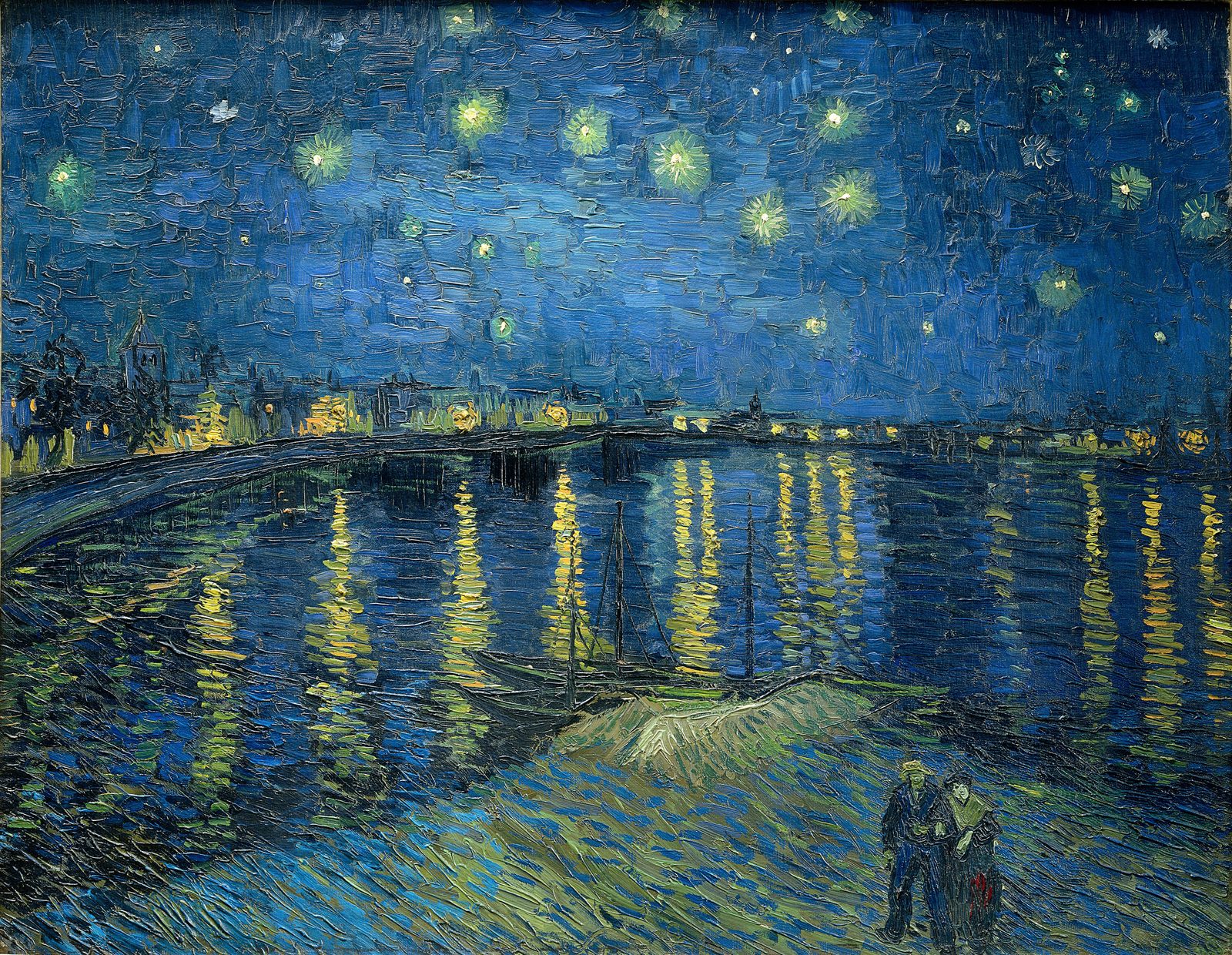
Starry Night Over the Rhône. Vincent van Gogh, September 1888 (Arles). Wikimedia Commons. Public domain.