
Psalm 82
8 verses · Lament over unjust rulers
I have said, ‘You are gods; you are all sons of the Most High.’
Introduction
Asaph, God in the Council, Book 3: The crisis of the throne, Poetry, Psalms Overview.
Asaph's guild wrote this short psalm, and Israel sang it in the temple as part of its ordinary weekly worship. It is set as a courtroom, with God presiding and the powers of the world on trial before Him. Readers have long divided over who the accused are, rulers in the unseen world or Israel's own judges, and the charge is the same on either reading. Listen for what they are charged with, which is how they treated people who had no one to speak for them. Read it as a promise to the powerless that every authority answers to a higher court.
Context
- Who
- Israelites living under authorities who protected the strong
- What
- A courtroom scene in which God judges the rulers who have judged unjustly.
- Where
- A council in session, with God standing up to pass sentence on those seated in it
- When
- The monarchy by its heading for Asaph, and the psalm names no king, event or year.
- Why
- To assure the powerless that every ruler answers to God, and to ask Him to judge the earth.
Historical context
The psalm carries Asaph's heading, and the Mishnah records it as the psalm the Levites sang in the temple on the third day of every week, so Israel put a trial of the powers into its ordinary weekly service. No date, king or event is given anywhere in the eight verses. The scene is a court, with God standing in the assembly while those He judges are seated, and a first hearer knew that judging in Israel was done in the open gateway of a town, where the elders sat on stone benches built into the passage. Two readings of the word the psalm uses for those judged are ancient and both are held today: one takes them as spiritual rulers set over the nations, the princes Daniel names over Persia and Greece, and the other as Israel's human judges, who bore God's own authority when they sat in court. The charges are the same on either reading, partiality to the wicked and failure to defend the poor, the fatherless and the needy. In Israel the fatherless and the widow had no man to speak for them at the gate, so a dishonest judge was the end of them.
Significance
To people at the bottom of somebody else's system, this said that the crooked power over them was neither permanent nor independent. It is on trial, and the verdict has already been read. The last line is the congregation's own petition, asking God to arise and judge the earth because all the nations are His inheritance, so they are asking the Judge to take direct possession.
This chapter in Jewish lifeWhat this chapter is in Jewish life and reading.
What is done
The Mishnah records this psalm as the one the Levites sang in the temple on the third day of every week, in tractate Tamid 7:4 in the Danby translation. This site carries that record with the chapter's historical context at scripts/data/historical-context/psalms-76-90.mjs. A trial of the powers stood in the ordinary weekly service, on the same footing as any other day's psalm.
How it is read
Rashi reads the assembly of verse 1 as a human courtroom. God stands in it to see whether the judges judge fairly, and the rebuke that follows is addressed to them (Rashi on Psalms 82:1:1). The blindness of verse 5 he explains by the bribe that blinds at Exodus 23:8, with the foundations of the earth tottering because of it (Rashi on Psalms 82:5:2). At verse 6, where the judged are called gods, he gives a reading held across the classical sources. The word means angelic creatures, and the sentence of death in verse 7 is the loss of a gift. The Torah was given on the condition that the angel of death would not rule over Israel (Rashi on Psalms 82:6:1). To die as man is then to die as Adam died, since the deeds were corrupted as his were. Rashi adds the Midrash reading, that the princes are the celestial princes visited at Isaiah 24:21 (Rashi on Psalms 82:7:1 and 82:7:2, citing Midrash Tehillim 82:3). A Christian reader meets two things here at once. This site reads the judged as real spiritual rulers set over the nations, as its divine council page sets out, and Jesus quotes verse 6 at John 10:34. Rashi's reading of the same verse addresses Israel at Sinai instead, and the classical sources hold both a human and a celestial sense of the word. The charge against the judges is the same on every reading. Rashi is quoted here from the Judaica Press complete Tanach with Rashi, translated by A. J. Rosenberg, under CC-BY.
What the rabbis say
The corpus records forty places where the Midrash and the Talmud draw on this psalm, cited here by reference. Verse 1 is drawn into the Babylonian Talmud at Berakhot 6a:8 and 6a:10, into Avot DeRabbi Natan 1:8 and its Recension B 18:8, and into Bereshit Rabbah 48:7 and 48:10. Verse 6, the line about gods, stands at Avodah Zarah 5a:6 and 5a:15, at Kohelet Rabbah 3:16:1 and 8:1:3, at Bamidbar Rabbah 7:4 and 16:24, and in the Mekhilta DeRabbi Yishmael, Tractate Bachodesh 9:12. Verse 5 is read at Sukkah 55a:5 and verse 8 at Sukkah 55a:4. Verse 3, on judging the poor and the fatherless, is carried into Chullin 134a:13 and the Jerusalem Talmud at Peah 4:7:6. Midrash Tehillim treats the psalm at 82:2 and 82:3.
Sources: Mishnah, Tamid 7:4, Danby translation, as recorded at scripts/data/historical-context/psalms-76-90.mjs, about AD 200; Rashi, Rashi on Psalms 82:1 to 82:8, the Judaica Press complete Tanach with Rashi, translated by A. J. Rosenberg, CC-BY, 1040 to 1105; Midrash Tehillim, 82:2 and 82:3, cited by reference; Babylonian Talmud, Berakhot 6a:8 and 6a:10, Avodah Zarah 5a:6 and 5a:15, Sukkah 55a:4 and 55a:5, cited by reference; MannaFest, the divine council page, src/components/featured/divine-council/DivineCouncilDeep.tsx, on Psalm 82:6 and John 10:34, 2026; The Sefaria corpus, scripts/data/sources/sefaria/psalms/82.json, fetched 2026-09-19, 2026.
Psalms 82:1-2
God presides in the divine assembly: Verse 1 uses elohim twice, first of God who presides and then of the gods He judges. The setting is a court, and the charge is partiality: judging unjustly and favoring the wicked. The judges themselves stand under judgment.
Psalms 82:1
“The power and honour of magistrates; they are the mighty. They are so in authority, for the public good (it is a great power that they are entrusted with), and they ought to be so in wisdom and courage. They are, in the Hebrew dialect, called gods; the same word is used for these subordinate governors that is used for the sovereign ruler of the world.”
Matthew Henry · Commentary on the Whole Bible (1707-1721)puritan
show partiality to the wicked?: Show partiality translates a phrase that Albert Barnes rendered literally as lift up the faces of the wicked. Such a judge looked at the person before the case. Jerome gave the plain picture of a poor man with a just case losing to a rich man with a bad one.
Psalms 82:2
“What the sin is they are here charged with; they judge unjustly, contrary to the rules of equity and the dictates of their consciences, giving judgment against those who have right on their side, out of malice and ill-will, or for those who have an unrighteous cause, out of favour and partial affection.”
Matthew Henry · Commentary on the Whole Bible (1707-1721)puritan
Psalms 82:3-4
Defend the cause of the weak: Four commands fill these two verses, and each names who is owed the court's protection: the weak, the fatherless, the afflicted, the oppressed, the needy. Rescue is the verb, and the hand it rescues from belongs to the wicked. Right judgment is their defense.
Psalms 82:3
“Defend the poor and fatherless. Cease to do evil, learn to do well. Look not to the interests of the wealthy whose hands proffer you bribes, but protect the rights of the needy, and especially uphold the claims of orphans whose property too often becomes a prey. Do not hunt down the peasant for gathering a few sticks, and allow the gentlemanly swindler to break through the meshes of the law. Do justice to the afflicted and needy.”
Charles Spurgeon · The Treasury of David, Vol. 4 (1874)Particular Baptist
3 more voices on this verse
Psalms 82:3
“They are to be the protectors of those who lie exposed to injury and the patrons of those who want advice and assistance: Defend the poor, who have no money wherewith to make friends or fee counsel, and the fatherless, who, while they are young and unable to help themselves, have lost those who would have been the guides of their youth.”
Matthew Henry · Commentary on the Whole Bible (1707-1721)puritan
Psalms 82:3
“Defend the poor and fatherless - literally, judge; that is, Pronounce just judgment; see that right is done to them. This is required everywhere in the Scriptures. The meaning is not that judgment is to be pronounced in their favor because they are poor, or because they are orphans, for this would be to do what they had just been charged with as in itself wrong, accepting of persons; that is, showing favor on account of condition or rank, rather than on account of a just claim.”
Psalms 82:3
“Defend the poor - You are their natural protectors under God. They are oppressed: punish their oppressors, however rich or powerful: and deliver them.”
Adam Clarke · Commentary on the Bible (1810-1826)evangelical
Rescue the weak and needy: Albert Barnes answered an objection here. Rescuing the needy, he wrote, is simple justice, and it stands against the partiality charged in verse 2. Matthew Henry noted that such clients bring a judge no fee and no gain.
Psalms 82:4
“Deliver the poor and needy,.... From his adversary and oppressor, who is mightier than he, and draws him to the judgment seat; when it is not in his power to defend himself against him, and get out of his hands, unless a righteous judge will show a regard to him and his cause; and sometimes even an unjust judge, through importunity, will do this, as everyone ought, and every righteous one will: rid them out of the hand of the wicked; this was what the poor widow importuned the unjust judge for, and obtained, Luk 18:3.”
They do not know or understand: The judges know nothing and understand nothing, and they walk in the dark. Then the foundations of the earth are shaken. Barnes reads those foundations as the order of society itself, which gives way when the courts give way.
Psalms 82:5
“Walk on - They persist: it is their constant course. In darkness - In their sinful courses. The foundations - This corruption of the supreme rulers, flows from them to their inferior officers and members.”
John Wesley · Explanatory Notes upon the Old Testament (1765)evangelical
Psalms 82:6-7
Jesus quotes this verse at John 10:34, I have said you are gods. Calvin reads the gods as human judges who judge in God's name, and Michael Heiser reads a council of spiritual rulers set over the nations. Either way they die like mortals and fall like rulers.
Psalms 82:6
“I said: you are gods, and all of you sons of the Most High. Let Eunomius hear, let Arius hear, who say that the Son of God is a son in the same way as we are. That we are gods, we are so not by nature, but by grace. 'For as many as received him, he gave them power to become sons of God.' Therefore I made man, that out of men gods might be made. I said: you are gods, and all of you sons of the Most High.”
Jerome · written before 420 · Homily 14, on Psalm 81patristic
2 more voices on this verse
Psalms 82:6
“I have said, ye are gods. The greatest honour was thus put upon them; they were delegated gods, clothed for a while with a little of that authority by which the Lord judges among the sons of men. And all of you are children of the Most High. This was their ex-officio character, not their moral or spiritual relationship.”
Charles Spurgeon · The Treasury of David, Vol. 4 (1874)Particular Baptist
Psalms 82:6
"You are called gods, but you have no patent for immortality; you shall die like men, like common men; and like one of them, you, O princes! shall fall. " Note, Kings and princes, all the judges of the earth, though they are gods to us, are men to God, and shall die like men, and all their honour shall be laid in the dust.
Matthew Henry · Commentary on the Whole Bible (1707-1721)puritan
Cross references
Psalms 82:6
- Quoted inJohn 10:34“Jesus replied, “Is it not written in your Law: ‘I have said you are gods’?”
'I said, Ye are gods' ('is it not written in your law')
like mortals you will die: Adam Clarke and Jerome both read like mortals as like Adam, who fell from his high place when he sinned. Charles Spurgeon saw the second clause in history. Rulers often died first and suddenly, cut down by battle, revolt and luxury.
Psalms 82:7
“But you shall die like men. You see, then, that he who is a man dies. For God does not die. And Adam, as long as he kept the commandment and was a god, did not die. But after he tasted of the forbidden tree, immediately he died. Finally God says to him: 'On whatever day you taste, you shall die the death.' It has it better in the Hebrew: 'But you shall die like Adam.' Just as he was cast out of paradise, so we too have been cast out. And you shall fall like one of the princes.”
Jerome · written before 420 · Homily 14, on Psalm 81patristic
1 more voice on this verse
Psalms 82:7
“But ye shall die like men. What sarcasm it seems! Great as the office made the men, they were still but men, and must die. To every judge this verse is a memento mori! He must leave the bench to stand at the bar, and on the way must put off the ermine to put on the shroud. And fall like one of the princes. Who were usually the first to die: for battle, sedition, and luxury, made greater havoc among the great than among any others.”
Charles Spurgeon · The Treasury of David, Vol. 4 (1874)Particular Baptist
Arise, O God, judge the earth: The psalm ends in a prayer for God to judge the earth Himself. The ground of the prayer is ownership: all the nations belong to Him as His inheritance. The case goes past them to God.
Psalms 82:8
“Arise, O God, and judge the earth. Come thou Judge of all mankind, put the bad judges to thy bar and end their corruption and baseness. Here is the world's true hope of rescue from the fangs of tyranny. For thou shalt inherit all nations. The time will come when all races of men shall own their God, and accept him as their king. There is one who is "King by right divine, "and he is even now on his way. The last days shall see him enthroned, and all unrighteous potentates broken like potter's vessels by his potent sceptre.”
Charles Spurgeon · The Treasury of David, Vol. 4 (1874)Particular Baptist
2 more voices on this verse
Psalms 82:8
“Up to this point God has spoken to men, and again the prophet speaks. Arise, O God, judge the earth. Arise, because our boat is battered by the waves. Arise, O God, judge the earth: since the bad judges do not judge, but overturn your law, and tear your flocks. Do you arise, who are the true judge. Because, then, the bad judges have died like Adam, and have fallen like one of the princes: therefore do you arise, do you judge, do you save your creature.”
Jerome · written before 420 · Homily 14, on Psalm 81patristic
Psalms 82:8
“To the kingdom of the Messiah. It is a prayer for the hastening of that, that Christ would come, who is to judge the earth, and that promise is pleaded, that God shall give him the heathen for his inheritance.”
Matthew Henry · Commentary on the Whole Bible (1707-1721)puritan
How this psalm is built
The form: A courtroom psalm in which the overlooker stands over those who sit in state, as Spurgeon classes it.
The patterns in this chapter
| Device | What it does | Where to see it |
|---|---|---|
| God standing while the court sits | Verse 1 puts God in the posture of the one who presides over a seated assembly. Spurgeon reads the standing as the point: when the great ones of the earth sit in state He stands over them, ready to deal with them the moment judgment is perverted.Charles Spurgeon, The Treasury of David, Vol. 4, 1874, on Psalm 82:1. | Psalm 82:1 |
| The four commands at the centre | Verses 3 and 4 give the judges their duty in four imperatives without a word of explanation between them: defend the weak and fatherless, uphold the afflicted and oppressed, rescue the weak and needy, save them from the hand of the wicked. The psalm states the office as a list of acts owed to named persons. | Psalm 82:3, Psalm 82:4 |
| The speech inside the psalm | Verses 2 to 7 are God's own words, opened at verse 1 by the line that He renders judgment among the gods and closed at verse 8 when the psalmist speaks again. The last verse is the only place where the psalm addresses God rather than reporting Him, and it asks Him to do what the judges failed to do. | Psalm 82:2, Psalm 82:7, Psalm 82:8 |
| Gods who die like mortals | Verse 6 gives the title twice, you are gods and you are all sons of the Most High. Verse 7 answers it twice, like mortals you will die and like rulers you will fall. The high naming and the plain ending are set in the same two-limbed shape so that each answers the other line for line. | Psalm 82:6, Psalm 82:7 |
Verse 6 is quoted in the New Testament. At John 10:34 Jesus answers the charge of blasphemy by asking whether it is not written in their Law, I have said you are gods, and the argument that follows turns on the fact that the word was addressed to those to whom the word of God came. The verse is one of the few from this part of the Psalter that the Gospels put on the Lord's own lips.
8 more paragraphs on the patterns
The psalm stands in the Asaph group and shares its habit of arguing about justice from the top down. Psalm 73 asks why the wicked prosper and answers by looking at their end; Psalm 82 asks the same question of the men whose job it was to stop them and gives the same answer, that they will fall.
Inside the psalm the pattern is a title given and then withdrawn. The judges are called gods and sons of the Most High in verse 6, and in verse 7 they are told they will die like mortals and fall like rulers. The last verse asks for the office to pass to the only one the title fits.
The New Testament's use
Verse 6 is quoted at John 10:34. Charged with blasphemy for making Himself God, Jesus answers by asking whether it is not written in their Law, I have said you are gods, and the argument turns on the fact that the word came to those the psalm addresses. The quotation is one of a small number in which the Lord argues a point of Scripture from a single line of a psalm, and it makes Psalm 82 unavoidable for anyone working on John 10.
The debated point
Who the gods of verse 1 are is the psalm's long dispute and it is unresolved. John Gill reads them as the judges of Israel, called gods because judgment was committed to them and because they stood in God's place when they gave it (Exposition of the Old Testament, 1748 to 1763, on Psalm 82:1); verses 2 to 4 support him, since the charge is the work of a human court. Augustine reads the assembly wider than a bench of magistrates and hears God rendering judgment among all who bear the name. Both readings are held by teachers the site cites. The two meet at verses 6 and 7, where the title is granted and then withdrawn on either reading, and the psalm itself gives no roster of who is present.
Where to go deeper
The office the psalm charges is set out at justice and righteousness and those it protects at the widow, orphan and stranger. The title of verse 6 is set out at son of God.
Keep studying
Sources for this chapter
The summary
Jamieson, Fausset & Brown, Commentary Critical and Explanatory; John Calvin, Commentaries; John Wesley, Notes on the Old Testament and Matthew Henry, Complete Commentary.
The form and classifications
Augustine of Hippo, Exposition on Psalm 82, 430, on Psalm 82:1; Charles Spurgeon, The Treasury of David, Vol. 4, 1874, on Psalm 82:1 and John Gill, Exposition of the Old Testament, 1748 to 1763, on Psalm 82:1.
The exposition
Adam Clarke, Commentary on the Bible; Albert Barnes, Notes on the Book of Psalms; Charles Spurgeon, The Treasury of David; Franz Delitzsch, Biblical Commentary on the Psalms; Jerome, Homilies on the Psalms; John Calvin, Commentary on the Book of Psalms; John Gill, Exposition of the Old Testament; Matthew Henry, Commentary on the Whole Bible and Michael Heiser, The Unseen Realm.
The painting
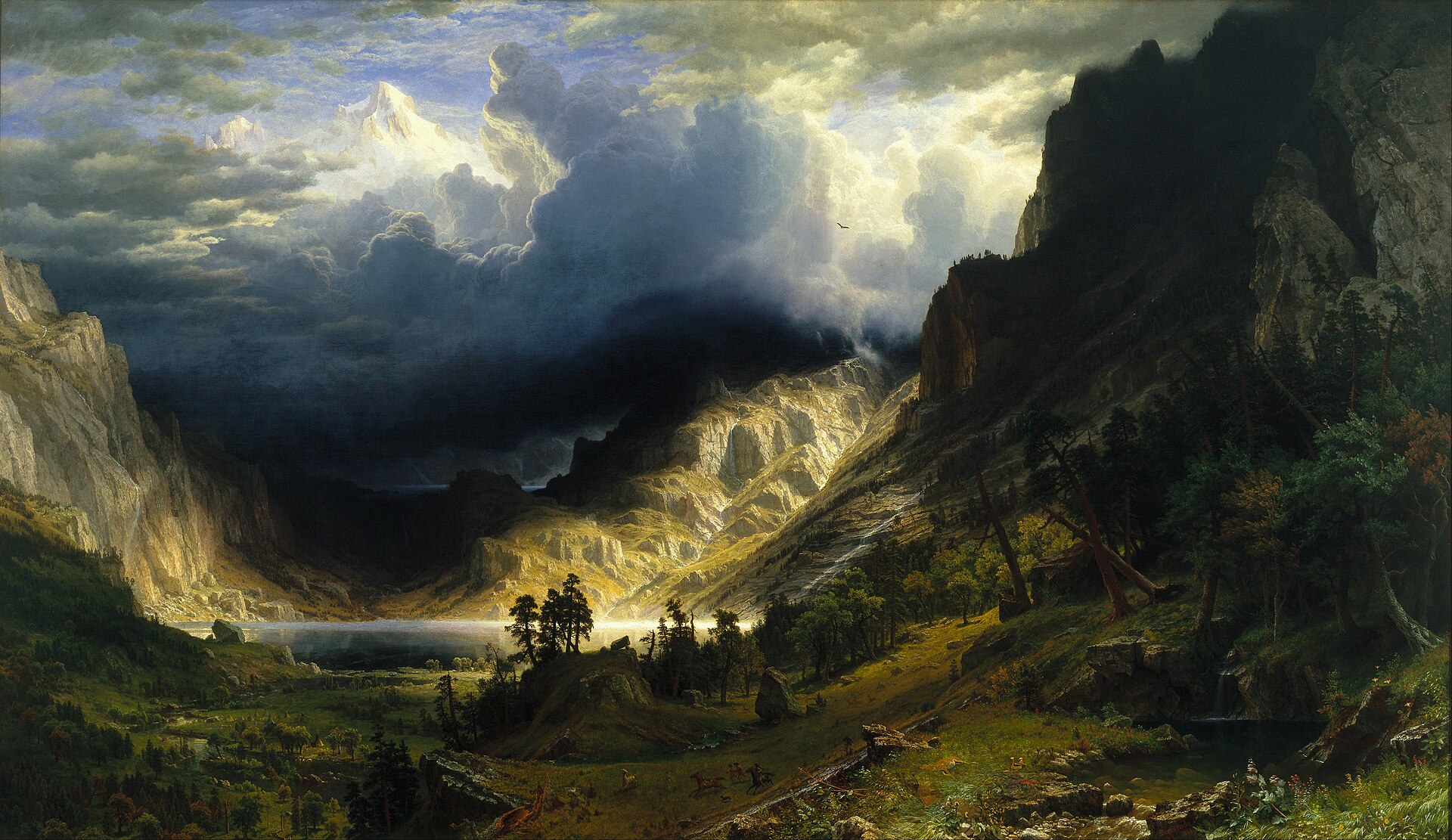
A Storm in the Rocky Mountains, Mt. Rosalie. Albert Bierstadt, 1866. Wikimedia Commons. Public domain.