
Psalm 72
20 verses · Royal psalm
Endow the king with Your justice, O God, and the son of the king with Your righteousness.
Introduction
Solomon, the King's Justice, Book 2: The Elohistic Psalter, Poetry, Psalms Overview.
Headed as Solomon's, this psalm is a prayer for a king at the start of his reign, asking God to give him the justice a throne exists to deliver. It was sung in a kingdom whose rulers were measured by what became of the weak under them, and it sets that measure higher than any king of Israel reached. Listen for the far coasts and desert kingdoms bringing gifts, for a reign that outlasts the lights of the sky, and for the note at the close that seals the second book of the Psalter. Israel kept singing it after the throne was gone.
Context
- Who
- A nation being told what its king is for
- What
- A royal psalm praying that God give His justice to the king and to the king's son.
- Where
- The court at Jerusalem, over a kingdom reaching from the Euphrates toward Egypt.
- When
- The accession of Solomon, about 970 BC, on the reading that its heading names him; the psalm gives no date.
- Why
- To set the standard of a righteous reign, measured by how the poor fare under it.
Historical context
The heading names Solomon, and the Hebrew allows both a psalm of Solomon and a psalm for Solomon, so it can be his own prayer at his crowning or his father's prayer over him. The request that opens it is the one Solomon made for himself at 1 Kings 3:9, an understanding heart to judge God's people. The place names are trade routes: Tarshish a far western port, Sheba the incense kingdom of south Arabia, and Seba across the Red Sea. From sea to sea traces the land promised to Abraham at Genesis 15:18. Kings across the ancient Near East claimed to protect the weak, and this psalm makes that the test of the throne.
Significance
Solomon's kingdom was rich and real, and no reign lasts as long as the sun and the moon, which everyone singing this came to know. Israel kept singing it after Solomon, after the kingdom split and after the throne was gone, and by then it described the King they were waiting for.
This chapter in Jewish lifeWhat this chapter is in Jewish life and reading.
How it is read
Psalm 72 closes Book II of the Psalter with a doxology at verses 18 and 19 and the note that the prayers of David son of Jesse are ended. Rashi reads the heading as David praying for his son. He says David foresaw that Solomon would ask God for "a heart to understand, to hear judgment" (Rashi on Psalms 72:1:1). The peace the mountains bear is then a plain harvest peace, where the fruit is enough that no one envies his neighbour (Rashi on Psalms 72:3:2). The reign from sea to sea he measures as the land of Israel, from the Sea of Reeds to the Mediterranean (Rashi on Psalms 72:8:1). The kings bringing tribute he reads against the ships of Tarshish at 1 Kings 10:23 and the gifts at 1 Kings 10:24 (Rashi on Psalms 72:10:1 and 72:11:1). Then he records a larger reading held by others. At the abundance of grain in verse 16 he reports a larger reading. The Sages, he says, explained the grain "as an expression of loaves of white bread during the messianic era (Keth. 111b, Shab. 30b)". They read the entire psalm as referring to that era (Rashi on Psalms 72:16:1). A Christian reader should notice what that means. The synagogue has long read this psalm of the days of the Messiah, as the church has read it of Christ. The two traditions differ over who the king is rather than over the kind of psalm it is. On the closing note Rashi gives the sages' reading of the word for ended, that it stands for all these. The whole book is then called David's even where Korah and the elders wrote it (Rashi on Psalms 72:20:1). Rashi is quoted here from the Judaica Press complete Tanach with Rashi, translated by A. J. Rosenberg, under CC-BY.
What the rabbis say
The corpus records forty places where the Midrash and the Talmud draw on this psalm, cited here by reference. Midrash Tehillim treats it at 72:4, 72:5 and 72:6, and cites its verses again at 17:11, 112:3 and 119:15. Verse 5, on fearing God while the sun endures, is drawn into the Babylonian Talmud at Berakhot 9b:15 and 29b:9. Verse 17, on the name that continues as long as the sun, stands at Bereshit Rabbah 1:4 and Eikhah Rabbah 1:51. Verse 16, the grain Rashi's sages read of the messianic era, is read at Bereshit Rabbah 15:7, 48:10 and 86:1. The doxology of verses 18 and 19 is carried into the Mekhilta DeRabbi Yishmael, Tractate Shirah 8:22.
Sources: Rashi, Rashi on Psalms 72:1 to 72:20, the Judaica Press complete Tanach with Rashi, translated by A. J. Rosenberg, CC-BY, 1040 to 1105; Midrash Tehillim, 72:4 to 72:6 and 119:15, cited by reference; Babylonian Talmud, Berakhot 9b:15 and 29b:9, cited by reference; Bereshit Rabbah, 1:4, 15:7, 48:10 and 86:1, cited by reference; The Sefaria corpus, scripts/data/sources/sefaria/psalms/72.json, fetched 2026-09-19, 2026; MannaFest, the shape of the Psalter, src/components/book/dossier-content/psalms-structure.ts, on the doxology at 72:18-19, 2026.
Psalms 72:1-2
Endow the king with Your justice: The request is that God hand his own justice and righteousness to a king, and to the king's son after him. A throne gets these by gift. Verse 2 says what the gift is for, judging God's people with righteousness and the afflicted among them with justice.
Psalms 72:1
“Give the king thy judgments, O God. The right to reign was transmitted by descent from David to Solomon, but not by that means alone: Israel was a theocracy, and the kings were but the viceroys of the greater King; hence the prayer that the new king might be enthroned by divine right, and then endowed with divine wisdom. Our glorious King in Zion hath all judgment committed unto him. He rules in the name of God over all lands. He is king "Dei Gratia" as well as by right of inheritance. And thy righteousness unto the king's son.”
Charles Spurgeon · The Treasury of David, Vol. 3 (1872)Particular Baptist
3 more voices on this verseWhat preachers and commentators have said about this verse, in their own words.
Psalms 72:1
“And I support this from Psalm 71 [LXX], which says, "Give to the king your judgment, O God; and your justice to the king's son, to judge your people with justice, and your poor with judgment." For clearly the psalm, which has been ascribed to Solomon, prophesies of Christ.”
Origen of Alexandria · written before 253 · Commentary on the Gospel of John 1:193patristic
Psalms 72:1
“Give the King thy judgments, O God,.... A prayer of David, or of the church he represents, to God the Father concerning Christ; for he is "the King" meant; which is the sense of the old Jewish synagogue: the Targum is, "give the constitutions of thy judgments to the King Messiah;'' and so their Midrash (m) interprets it.”
Psalms 72:1
“Give the king, &c.--a prayer which is equivalent to a prediction. judgments--the acts, and (figuratively) the principles of a right government (Joh 5:22; 9:39). righteousness--qualifications for conducting such a government. king's son--same person as a king--a very proper title for Christ, as such in both natures.”
Jamieson, Fausset & Brown · Commentary Critical and Explanatory on the Whole Bible (1871)reformed
ConnectionsMatthew 2:11
Your afflicted with justice: Your afflicted names the poor as God's own, and the king judges them on God's behalf. Albert Barnes matched the verse to Isaiah 11:3 and 4, a passage he held to describe the Messiah. Matthew Henry said their cases receive particular care.
Psalms 72:2
“He shall judge thy people with righteousness. Clothed with divine authority, he shall use it on the behalf of the favoured nation, for whom he shall show himself strong, that they be not misjudged, slandered, or in any way treated maliciously. His sentence shall put their accusers to silence, and award the saints their true position as the accepted of the Lord. What a consolation to feel that none can suffer wrong in Christ's kingdom: he sits upon the great white throne, unspotted by a single deed of injustice, or even mistake of judgment: reputations are safe enough with him.”
Charles Spurgeon · The Treasury of David, Vol. 3 (1872)Particular Baptist
1 more voice on this verse
Psalms 72:2
“That this prophecy must refer to the kingdom of the Messiah is plain, because there are many passages in it which cannot be applied to the reign of Solomon. There was indeed a great deal of righteousness and peace, at first, in the administration of his government; but, before the end of his reign, there were both trouble and unrighteousness.”
Matthew Henry · Commentary on the Whole Bible (1707-1721)puritan
Psalms 72:3-4
the mountains bring peace: Peace comes up out of the land itself, the mountains and the hills yielding it where righteousness governs. Verse 4 names the work by the people it serves: the afflicted vindicated, the children of the needy saved, the oppressor crushed. The measure of the reign is the poorest in it.
Psalms 72:3
“The mountains shall bring peace to the people. Thence, aforetime, rushed the robber bands which infested the country; but now the forts there erected are the guardians of the land, and the watchmen publish far and near the tidings that no foe is to be seen. Where Jesus is there is peace, lasting, deep, eternal. Even those things which were once our dread, lose all terror when Jesus is owned as monarch of the heart: death itself, that dark mountain, loses all its gloom.”
Charles Spurgeon · The Treasury of David, Vol. 3 (1872)Particular Baptist
crush the oppressor: Matthew Henry quoted the old Roman rule for a good king, to spare the vanquished and bring down the proud. He took the oppressor finally as the devil, whom Christ will break. Mercy and force serve the same people.
Psalms 72:4
“He shall judge the poor of the people. He will do them justice, yea, and blessed be his name, more than justice, for he will delight to do them good. He shall save the children of the needy. Poor, helpless things, they were packhorses for others, and paupers themselves, but their King would be their protector. Happy are God's poor and needy ones; they are safe under the wing of the Prince of Peace, for he will save them from all their enemies. And shall break in pieces the oppressor. He is strong to smite the foes of his people.”
Charles Spurgeon · The Treasury of David, Vol. 3 (1872)Particular Baptist
Psalms 72:5-7
as long as the sun shines: The terms of the prayer run past any one reign: the sun, the moon, all generations, and a flourishing until the moon is no more. Verse 6 gives the picture, rain falling on freshly cut grass. Spurgeon read it as a psalm of Christ on that ground.
Psalms 72:5
“They shall fear thee as long as the sun and moon endure. And well they may. Such righteousness wins the cheerful homage of the poor and the godly, and strikes dismay into the souls of unrighteous oppressors; so that all through the lands, both good and bad are filled with awe. Where Jesus reigns in power men must render obeisance of some sort. His kingdom, moreover, is no house of cards, or dynasty of days; it is as lasting as the lights of heaven; days and nights will cease before he abdicates his throne.”
Charles Spurgeon · The Treasury of David, Vol. 3 (1872)Particular Baptist
1 more voice on this verse
Psalms 72:5
“Thee - Thee, O God, this shall be another blessed fruit of this righteous government, that together with peace, true religion shall be established, and that throughout all generations, which was begun in Solomon's days, but not fully accomplished 'till Christ came.”
John Wesley · Explanatory Notes upon the Old Testament (1765)evangelical
like rain that falls on freshly cut grass: Albert Barnes noted that the Hebrew word for cut grass means a shearing and elsewhere names a fleece. The Greek translators read fleece here, and Augustine saw in it Gideon's fleece in Judges 6, fulfilled in Christ. Rain falls on what has been cut down.
Psalms 72:6
“Nor is it strange that they should suffer the drought of unbelief, whom the Lord deprived of the fertilizing shower of prophecy, saying, "I will command my clouds that they rain not on that vineyard." For there is a health-giving shower of salutary grace, as David also said: "He came down like rain on a fleece and like drops that fall on the earth." The divine Scriptures promised us this rain on the whole earth, to water the world with the dew of the divine Spirit at the coming of the Savior.”
Ambrose of Milan · written before 397 · On the Holy Spirit 1.8patristic
1 more voice on this verse
Psalms 72:6
“He shall come down like rain upon the mown grass. Blessings upon his gentle sway! Those great conquerors who have been the scourges of mankind have fallen like the fiery hail of Sodom, transforming fruitful lands into deserts; but he with mild, benignant influence softly refreshes the weary and wounded among men, and makes them spring up into newness of life.”
Charles Spurgeon · The Treasury of David, Vol. 3 (1872)Particular Baptist
May the righteous flourish in his days: Flourish carries on the rain of verse 6. Barnes took the word from plants that spring up, a picture of prosperity. Clarke saw it first under Solomon, when the people lived in peace, each under his own vine and fig tree.
Psalms 72:7
“In his days shall the righteous flourish. Beneath the deadly Upas of unrighteous rule no honest principles can be developed, and good men can scarcely live; but where truth and uprightness are on the throne, the best of men prosper most. A righteous king is the patron and producer of righteous subjects. None flourish under Nero but those who are monsters like himself: like will to like; and under the gentle Jesus the godly find a happy shelter. And abundance of peace so long as the moon endureth.”
Charles Spurgeon · The Treasury of David, Vol. 3 (1872)Particular Baptist
2 more voices on this verse
Psalms 72:7
“And the oracle in the Psalms, which says about Christ, "There shall rise in his days justice and peace," is in agreement with this. And I think that is why he is called "Prince of Peace" in the prophecy that I quoted before this. And I would ask you to notice that the prophet we are considering says at the outset that the Lord will come from heaven and that the subject of the prophecy will only pasture his flock after his birth at Bethlehem.”
Eusebius of Caesarea · written before 339 · Proof of the Gospel 7:2patristic
Psalms 72:7
“Solomon's name signifies peaceable, and such was his reign; for in it Israel enjoyed the victories of the foregoing reign and preserved the tranquillity and repose of that reign. But peace is, in a special manner, the glory of Christ's kingdom; for, as far as it prevails, it reconciles men to God, to themselves, and to one another, and slays all enmities; for he is our peace.”
Matthew Henry · Commentary on the Whole Bible (1707-1721)puritan
Psalms 72:8-9
from sea to sea: The rule runs from sea to sea and out to the ends of the earth. The second boundary is nahar in the Hebrew, a river, and the Berean names it the Euphrates, the line Genesis 15:18 draws around Abraham's land. The nomads bow, and his enemies lick the dust.
Psalms 72:8
“He shall have dominion also from sea to sea. Wide spread shall be the rule of Messiah; only the Land's End shall end his territory: to the Ultima Thule shall his sceptre be extended. From Pacific to Atlantic, and from Atlantic to Pacific, he shall be Lord, and the oceans which surround each pole shall be beneath his sway. All other power shall be subordinate to his; no rival nor antagonist shall he know. Men speak of the Emperor of all the Russias, but Jesus shall be Ruler of all mankind.”
Charles Spurgeon · The Treasury of David, Vol. 3 (1872)Particular Baptist
1 more voice on this verse
Psalms 72:8
“This was accomplished in Christ, and in him only. The river - Euphrates: which was the eastern border of the kingdom of Canaan, allotted by God, but enjoyed only by David, Solomon, and Christ. Of whose kingdom this may be mentioned, as one of the borders; because the kingdom of Christ is described under the shadow of Solomon's kingdom.”
John Wesley · Explanatory Notes upon the Old Testament (1765)evangelical
May the nomads bow before him: The Hebrew word behind nomads names dwellers in dry places, and Albert Barnes noted it is used elsewhere of desert beasts. Augustine's Latin read Ethiopians, and he took that people at the ends of the earth to stand for all nations. The whole earth bows.
Psalms 72:9
“They that dwell in the wilderness shall bow before him. Unconquered by arms, they shall be subdued by love. Wild and lawless as they have been, they shall gladly wear his easy yoke; then shall their deserts be made glad, yea, they shall rejoice and blossom as the rose. And his enemies shall lick the dust. If they will not be his friends, they shall be utterly broken and humbled. Dust shall be the serpent's meat; the seed of the serpent shall be filled therewith.”
Charles Spurgeon · The Treasury of David, Vol. 3 (1872)Particular Baptist
Psalms 72:10-11
the kings of Tarshish: Tarshish, Sheba and Seba sit at the far edges of the world the psalm knows, and their kings arrive carrying tribute. The wealth comes in as a gift offered to the throne. Verse 11 widens it from named kings to all kings and all nations.
Psalms 72:10
“The kings of Tarshish and of the isles shall bring presents. Trade shall be made subservient to the purposes of mediatorial rule; merchant princes, both far and near, shall joyfully contribute of their wealth to his throne. Seafaring places are good centres from which to spread the gospel; and seafaring men often make earnest heralds of the cross.”
Charles Spurgeon · The Treasury of David, Vol. 3 (1872)Particular Baptist
1 more voice on this verse
Psalms 72:10
“They shall present themselves to him; that is the best present we can bring to Christ, and without that no other present is acceptable, Rom. xii. They shall offer gifts, spiritual sacrifices of prayer and praise, offer them to Christ as their God, on Christ as their altar, which sanctifies every gift.”
Matthew Henry · Commentary on the Whole Bible (1707-1721)puritan
May all kings bow down to him: Clarke found a first fulfilment in 1 Kings 10, where the kings of the earth brought Solomon gifts. Henry saw two ways to bow down, as willing servants or as conquered enemies. Every king bows in one of those ways.
Psalms 72:11
“They shall fall before him, either as his willing subjects or as his conquered captives, as suppliants for his mercy or expectants of his judgment.”
Matthew Henry · Commentary on the Whole Bible (1707-1721)puritan
Psalms 72:12-14
deliver the needy who cry out: Verse 12 gives the ground of the greatness, rescue. He delivers the needy who cry out, pities the poor, saves the lives of the oppressed, and redeems them from oppression and violence. Their blood is precious in his sight, and that is the measure of the reign.
Psalms 72:12
We are taught, therefore, to be of good cheer when we are afflicted in the world. We learn that the reason for being of good cheer is this: the world has been conquered and, of course, subjected to him who conquered it. For this reason, all the nations, set free from those who formerly controlled them, serve him, because "he delivered the poor from the mighty" through his own passion, "and the needy who had no helper."
Origen of Alexandria · written before 253 · Commentary on the Gospel of John 6:286patristic
2 more voices on this verse
Psalms 72:12
“For he shall deliver the needy. Here is an excellent reason for man's submission to the Lord Christ; it is not because they dread his overwhelming power, but because they are won over by his just and condescending rule. Who would not fear so good a Prince, who makes the needy his peculiar care, and pledges himself to be their deliverer in times of need? When he crieth. He permits them to be so needy as to be driven to cry bitterly for help, but then he hears them, and comes to their aid.”
Charles Spurgeon · The Treasury of David, Vol. 3 (1872)Particular Baptist
Psalms 72:12
“He will spare the needy that throw themselves on his mercy, and will not be rigorous and severe with them; he will save their souls, and that is all they desire. Blessed are the poor in spirit, for theirs is the kingdom of heaven. Christ is the poor man's King.”
Matthew Henry · Commentary on the Whole Bible (1707-1721)puritan
He will take pity on the poor and needy: Henry called Christ the King of the poor, who takes pity on the needy that cast themselves on Him. Augustine read the pity as forgiveness given to the afflicted who look to Him for help. Pity comes before rescue.
Psalms 72:13
“He shall spare the poor and needy. His pity shall be manifested to them; he will not allow their trials to overwhelm them; his rod of correction shall fall lightly; he will be sparing of his rebukes, and not sparing in his consolations. And shall save the souls of the needy. His is the dominion of souls, a spiritual and not a worldly empire; and the needy, that is to say, the consciously unworthy and weak, shall find that he will give them his salvation. Jesus calls not the righteous, but sinners to repentance.”
Charles Spurgeon · The Treasury of David, Vol. 3 (1872)Particular Baptist
their blood is precious in his sight: Wesley took oppression and violence as the two ways lives are taken, by fraud and by force. Spurgeon pictured the fox and the lion joined against the lambs. This king will redeem them and hold their blood precious.
Psalms 72:14
“He shall redeem their soul from deceit and violence. These two things are the weapons with which the poor are assailed: both law and no law are employed to fleece them. The fox and the lion are combined against Christ's lambs, but the Shepherd will defeat them, and rescue the defenceless from their teeth. A soul hunted by the temptations of Satanic craft, and the insinuations of diabolical malice, will do well to fly to the throne of Jesus for shelter. And precious shall their blood be in his sight.”
Charles Spurgeon · The Treasury of David, Vol. 3 (1872)Particular Baptist
1 more voice on this verse
Psalms 72:14
“Deceit and violence - The two ways whereby the lives of men are usually destroyed. Precious - He will not be prodigal of the lives of his subjects, but like a true father of his people, will tenderly preserve them, and severely avenge their blood upon those who shall shed it.”
John Wesley · Explanatory Notes upon the Old Testament (1765)evangelical
Psalms 72:15-17
gold from Sheba: Gold, prayer and blessing come to the king, and the land answers with grain on the hills. Verse 17 asks that his name endure, and that all nations find blessing in him, the promise God made to Abraham at Genesis 22:18. The prayer for one king reaches every nation.
Psalms 72:15
“And he shall live. Vive le Roi! O King! live for ever! He was slain, but is risen and ever liveth. And to him shall be given of the gold of Sheba. These are coronation gifts of the richest kind, cheerfully presented at his throne. How gladly would we give him all that we have and are, and count the tribute far too small.”
Charles Spurgeon · The Treasury of David, Vol. 3 (1872)Particular Baptist
1 more voice on this verse
Psalms 72:15
“Live - Long and prosperous, as Solomon: yea, eternally as Christ. Gold - This was done to Solomon, 1 Kings x, 15, and to Christ, Matt. ii, 11. But such expressions as these being used of Christ and his kingdom, are commonly understood in a spiritual sense.”
John Wesley · Explanatory Notes upon the Old Testament (1765)evangelical
may it sway atop the hills: Grain atop the hills means a harvest where the land is poorest. Barnes pictured the grain waving on the mountain tops. Henry read it of the gospel sown among the nations and yielding an abundance of fruit.
Psalms 72:16
“There shall be an handful of corn in the earth upon the top of the mountains. From small beginnings great results shall spring. A mere handful in a place naturally ungenial shall produce a matchless harvest. What a blessing that there is a handful; "except the Lord of hosts had left unto us a very small remnant we should have been as Sodom, and we should have been like unto Gomorrah:" but now the faithful are a living seed, and shall multiply in the land. The fruit thereof shall shake like Lebanon.”
Charles Spurgeon · The Treasury of David, Vol. 3 (1872)Particular Baptist
1 more voice on this verse
Psalms 72:16
“A handful - This intimates the small beginnings of his kingdom; and therefore does not agree to Solomon, whose kingdom was in a manner as large at the beginning of his reign, as at the end, but it exactly agrees to Christ.”
John Wesley · Explanatory Notes upon the Old Testament (1765)evangelical
May his name endure forever: Barnes took the name that endures forever as the king himself enduring. Justin Martyr pressed the next line on Trypho: the nations promised a blessing in Abraham's seed are blessed in Christ. The nations call blessed the One who blesses them.
Psalms 72:17
“His name shall endure for ever. In its saving power, as the rallying point of believers, and as renowned and glorified, his name shall remain for ever the same. His name shall be continued as long as the sun. While time is measured out by days, Jesus shall be glorious among men. And men shall be blessed in him. There shall be cause for all this honour, for he shall really and truly be a benefactor to the race. He himself shall be earth's greatest blessing; when men wish to bless others they shall bless in his name.”
Charles Spurgeon · The Treasury of David, Vol. 3 (1872)Particular Baptist
1 more voice on this verse
Psalms 72:17
“And if, as David says in the seventy-first [LXX] psalm, "His name remains before the sun and before the moon, from one generation to another," how did he receive what he always had, even before he now received it? Or how is he exalted, being before his exaltation the Most High? Or how did he receive the right of being worshiped, who before he now received it, was always worshiped? It is not an obscure saying but a divine mystery.”
Athanasius of Alexandria · written before 373 · Discourses Against the Arians 1.11.41patristic
Psalms 72:18-19
Blessed be the LORD God: The psalm ends in a doxology, a short burst of praise set as a seal on a collection. Here it blesses the LORD God who alone does marvelous deeds, and asks that His glory fill all the earth. The same blessing closes Book One at Psalm 41:13.
Psalms 72:18
“Blessed be the Lord God - David foresaw all Solomon’s grandeur; his justice equity, and the happiness of the subjects under his government; and his soul has, in consequence, sensations of pleasure and gratitude to God, which even his own wondrous pen cannot describe. But it is worthy of remark, that God did not reveal to him the apostasy of this beloved son. He did not foresee that this once holy, happy, wise, and prosperous man would be the means of debasing the Divine worship, and establishing the grossest idolatry in Israel.”
Adam Clarke · Commentary on the Bible (1810-1826)evangelical
1 more voice on this verse
Psalms 72:18
“As Quesnel well observes, these verses explain themselves. They call rather for profound gratitude, and emotion of heart, than for an exercise of the understanding; they are rather to be used for adoration than for exposition. It is, and ever will be, the acme of our desires, and the climax of our prayers, to behold Jesus exalted King of kings and Lord of lords.”
Charles Spurgeon · The Treasury of David, Vol. 3 (1872)Particular Baptist
Amen and amen: Adam Clarke heard two meanings in the double amen: the first asks that it be so, and the second declares that it shall be. Matthew Henry grieved over how empty the earth still is of God's glory. The prayer asks for it filled.
Psalms 72:19
“19 And blessed be his glorious name for ever: and let the whole earth be filled with his glory; 20 The prayers of David the son of Jesse are ended. Such an illustrious prophecy as is in the foregoing verses of the Messiah and his kingdom may fitly be concluded, as it is here, with hearty prayers and praises.”
Matthew Henry · Commentary on the Whole Bible (1707-1721)puritan
the prayers of David: The line declares the prayers of David son of Jesse finished, and with them the psalm's prayers for the king. A colophon is the note a scribe set at the end of a collection. Delitzsch read this one as the seam of an older gathering.
Psalms 72:20
“The prayers of David the son of Jesse are ended. The Septuagint version renders it, the hymns.”
2 more voices on this verse
Psalms 72:20
“The prayers of David the son of Jesse are ended - This was most probably the last Psalm he ever wrote. There may be several in the after part of this book which were written by him; but they were probably composed in a former period of his life, for this was the end of the poetic prayers of David the son of Jesse. Those that were found afterwards have got out of their proper connection.”
Adam Clarke · Commentary on the Bible (1810-1826)evangelical
Psalms 72:20
“The prayers of David the son of Jesse are ended. What more could he ask? He has climbed the summit of the mount of God; he desires nothing more. With this upon his lip, he is content to die. He strips himself of his own royalty and becomes only the "son of Jesse, "thrice happy to subside into nothing before the crowned Messiah.”
Charles Spurgeon · The Treasury of David, Vol. 3 (1872)Particular Baptist
How this psalm is built
The form: A royal psalm, a prayer for the king the LORD anoints, standing at the seam that closes Book II, as Gunkel classes it.
The patterns in this chapter
| Device | What it does | Where to see it |
|---|---|---|
| As long as the sun and the moon | The psalm sets its terms by the lights of heaven at verse 5 and returns to them at verse 17, with the moon named again at verse 7. Spurgeon reads the kingdom as lasting as those lights, so that days and nights will cease before the king leaves his throne. The frame puts the whole prayer past the span of any one reign.Charles Spurgeon, The Treasury of David, Vol. 3, 1872, on Psalm 72:5. | Psalm 72:5, Psalm 72:7, Psalm 72:17 |
| The far places and their kings | Tarshish, the distant shores, Sheba and Seba are named in order at verse 10, and verse 11 widens the list to all kings and all nations. Spurgeon reads the tribute as trade made to serve the throne, with merchant princes near and far bringing their wealth to it. The list works inward from the edges of the map the psalm knows.Charles Spurgeon, The Treasury of David, Vol. 3, 1872, on Psalm 72:10. | Psalm 72:8, Psalm 72:10, Psalm 72:11 |
| Justice and righteousness, given and then used | Verse 1 asks justice for the king and righteousness for the king's son, and verse 2 turns the pair around, righteousness for the people and justice for the afflicted. Jamieson, Fausset and Brown read the judgments as the acts and the principles of a right government, and the righteousness as the qualification for conducting one. The two words carry the psalm as far as verse 7.Jamieson, Fausset and Brown, Commentary Critical and Explanatory on the Whole Bible, 1871, on Psalm 72:1. | Psalm 72:1, Psalm 72:2, Psalm 72:3, Psalm 72:7 |
| The prayer that turns into a statement | Verses 1 to 11 are asked of God, and verse 12 changes to plain declaration, that he will deliver the needy who cry out. Spurgeon reads verse 12 as the reason men submit to this king, since he makes the needy his own care and pledges himself to be their deliverer. The ground of the greatness comes after the description of it.Charles Spurgeon, The Treasury of David, Vol. 3, 1872, on Psalm 72:12. | Psalm 72:1, Psalm 72:12, Psalm 72:14 |
| Blessed, said of the king and then of the LORD | Verse 17 asks that all nations be blessed in him and call him blessed, and verses 18 and 19 turn the word twice back on the LORD God of Israel. Spurgeon holds that these last verses explain themselves, and are given for adoration more than for exposition. The word moves from the throne to the One who set it up.Charles Spurgeon, The Treasury of David, Vol. 3, 1872, on Psalm 72:18 and 72:19. | Psalm 72:17, Psalm 72:18, Psalm 72:19 |
In the New Testament
6 more paragraphs on the patterns
The published notes on Psalm 72 name no New Testament citation of it, and the teachers still read it against the Gospels. Wesley takes the gold of Sheba at verse 15 as brought to Solomon at 1 Kings 10:15 and to Christ at Matthew 2:11. Eusebius sets the justice and peace of verse 7 beside the title Prince of Peace and beside the birth at Bethlehem.
Origen reads verse 12 of a king who delivered the poor from the mighty through his own passion. Athanasius argues from verse 17 against the Arians, asking how one whose name stood before the sun could receive at a later date what he always had. Verse 17 also asks that all nations find blessing in him, which is the promise God made to Abraham at Genesis 22:18.
Inside the psalm
The psalm measures the reign by the people at the bottom of it. Verse 4 asks that the afflicted be vindicated, the children of the needy saved and the oppressor crushed. Verses 12 to 14 give that same list as fact, ending with the blood of the oppressed counted precious in the king's sight. Everything between those two passages, the tribute, the dominion and the gold, stands on that one qualification.
Where it stands in the Psalter
Psalm 72 closes Book II, which runs from Psalm 42 to Psalm 72, and the second Davidic collection inside it runs from Psalm 51 to Psalm 71. Its doxology at verses 18 and 19 matches the one that closes Book I at Psalm 41:13. The colophon at verse 20 then shuts the door on the prayers of David, although psalms carrying his name stand later in the book, which is the fact Clarke was accounting for.
Keep studying
Studies6
People and groups1
Sources for this chapter
The summary
Jamieson, Fausset & Brown, Commentary Critical and Explanatory; John Calvin, Commentaries; John Wesley, Notes on the Old Testament and Matthew Henry, Complete Commentary.
The form and classifications
Hermann Gunkel, Einleitung in die Psalmen, 1933, as set out for students in C. Hassell Bullock, Encountering the Book of Psalms, 2001; the type this site publishes for Psalm 72; John Gill, Exposition of the Old Testament, 1748 to 1763, on Psalm 72:1 and Matthew Henry, Commentary on the Whole Bible, 1710, on Psalm 72:2.
The exposition
Adam Clarke, Commentary on the Bible; Albert Barnes; Alexander Maclaren, The Psalms, Expositor's Bible; Augustine of Hippo, Exposition on Psalm 72; Charles Spurgeon; Franz Delitzsch, Biblical Commentary on the Psalms; Jamieson, Fausset & Brown, Commentary Critical and Explanatory on the Whole Bible; John Gill, Exposition of the Old Testament; John Wesley, Explanatory Notes upon the Old Testament; Justin Martyr, Dialogue with Trypho and Matthew Henry, Commentary on the Whole Bible.
The painting
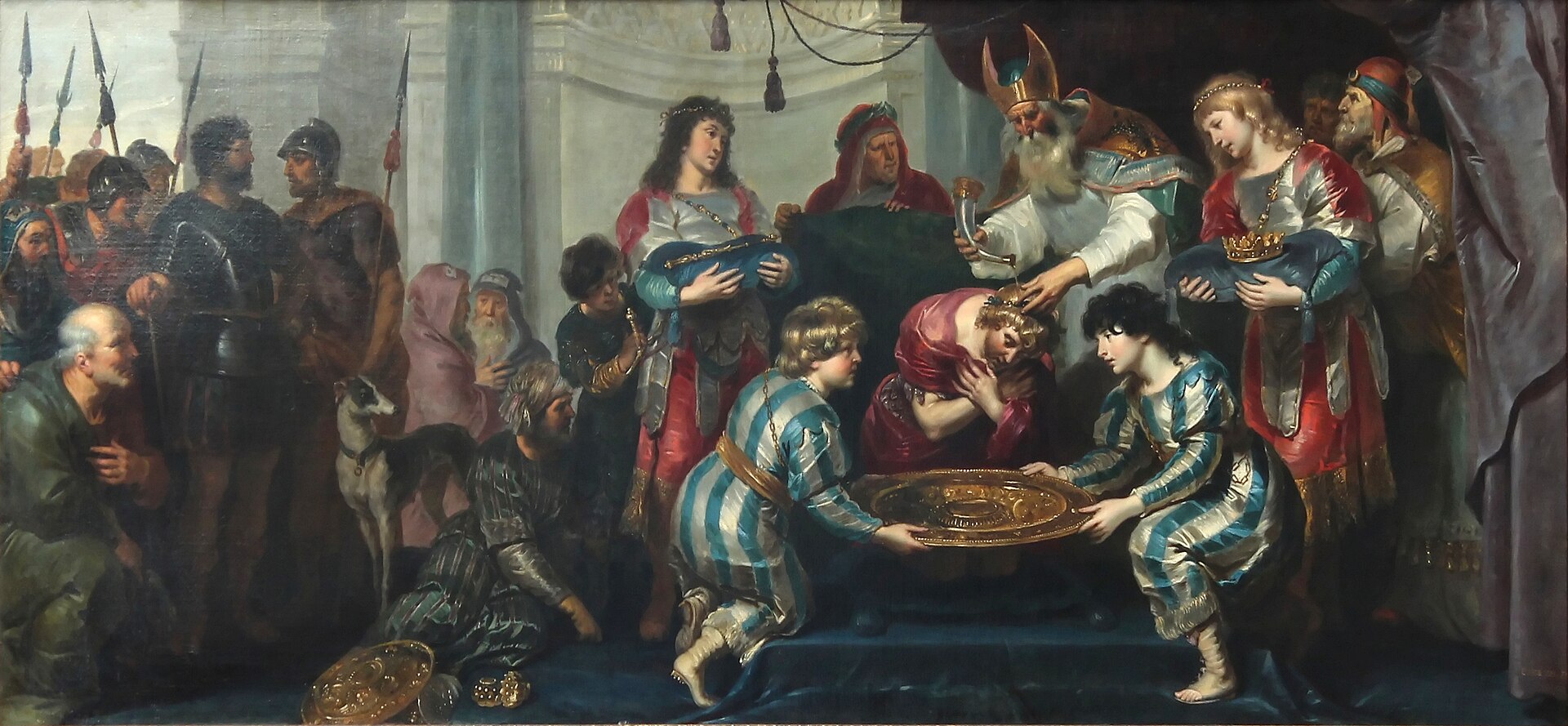
The anointing of Solomon. Cornelis de Vos, 17th century. Wikimedia Commons. Public domain.