
Psalms 72:1
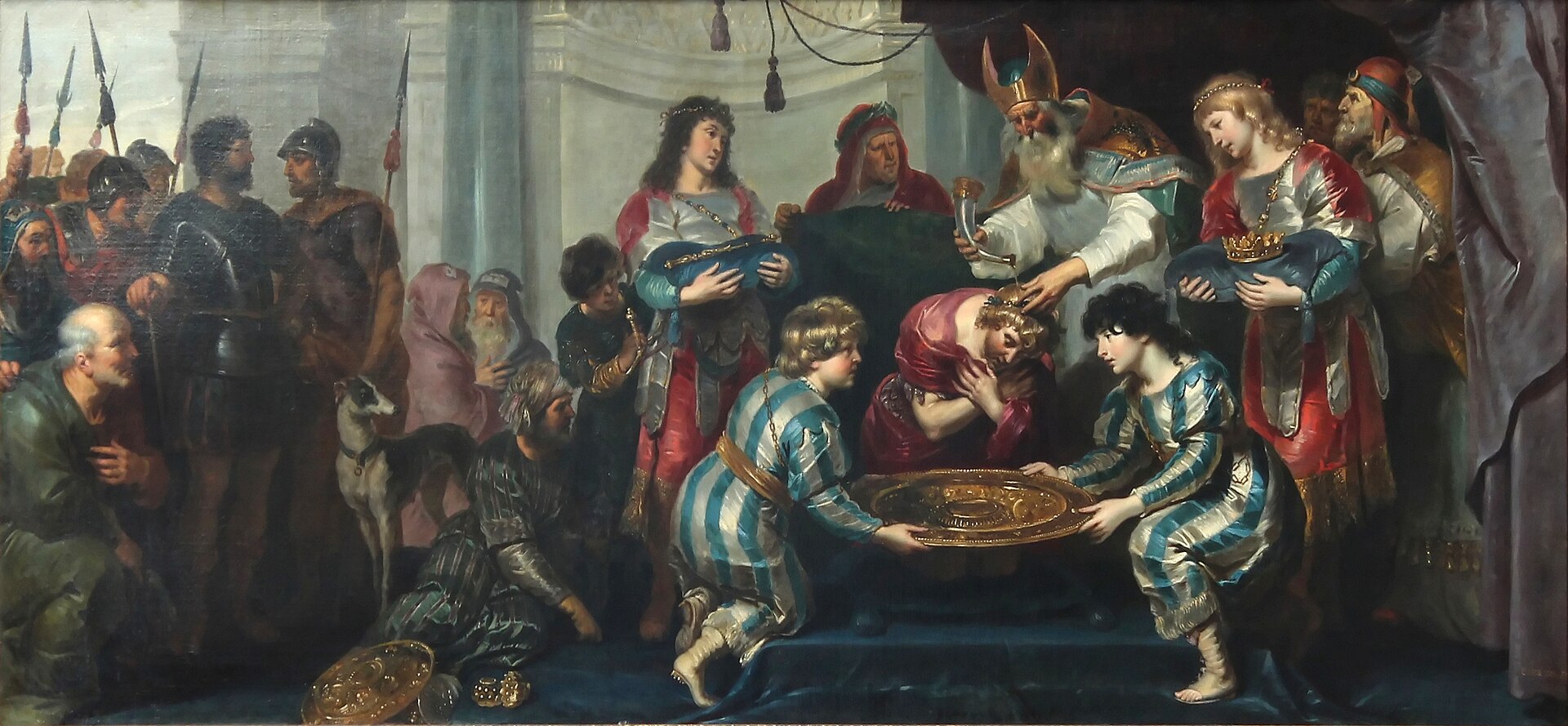
in Psalms 72Endow the king with Your justice, O God, and the son of the king with Your righteousness.
BSB
The same verse in ASV and KJV ▾
ASV
Give the king thy judgments, O God, And thy righteousness unto the king’s son.
KJV
Give the king thy judgments, O God, and thy righteousness unto the king’s son.
⋯
This verse in Psalms 72
Commentary
12 notes on this verseAnd I support this from Psalm 71 [LXX], which says, "Give to the king your judgment, O God; and your justice to the king's son, to judge your people with justice, and your poor with judgment." For clearly the psalm, which has been ascribed to Solomon, prophesies of Christ.
This site's exposition
Endow the king with Your justice
on Psalms 72:1-2
The request is that God hand his own justice and righteousness to a king, and to the king's son after him. A throne gets these by gift. Verse 2 says what the gift is for, judging God's people with righteousness and the afflicted among them with justice.
The record, by era
The Church Fathers3 voices
"O God, Your judgment to the King give Thou, and Your justice to the King's Son" [Psalm 72:1]. The Lord Himself in the Gospel says, "The Father judges not any one, but all judgment He has given to the Son:" [John 5:22] this is then, "O God, Your judgment to the King give Thou." He that is King is also the Son of the King: because God the Father also is certainly King. Thus it has been written, that the King made a marriage for His Son. [Matthew 22:2] But after the manner of Scripture the same thing is repeated. For that which he has said in, "Your judgment;" the same he has otherwise expressed in, "Your justice:" and that which he has said in, "the King," the same he has otherwise expressed in, "to the King's Son."...But these repetitions do much commend the divine sayings, whether the same words, or whether in other words the same sense be repeated: and they are mostly found in the Psalms, and in the kind of discourse whereby the mind's affection is to be awakened.
Further, to persuade you that you have not understood anything of the Scriptures, I will remind you of another psalm, dictated to David by the Holy Spirit, which you say refers to Solomon, who was also your king. But it refers also to our Christ. But you deceive yourselves by the ambiguous forms of speech. For where it is said, 'The law of the Lord is perfect,' you do not understand it of the law which was to be after Moses, but of the law which was given by Moses, although God declared that He would establish a new law and a new covenant. And where it has been said, 'O God, give Thy judgment to the king,' since Solomon was king, you say that the Psalm refers to him, although the words of the Psalm expressly proclaim that reference is made to the everlasting King, i.e., to Christ. For Christ is King, and Priest, and God, and Lord, and angel, and man, and captain, and stone, and a Son born, and first made subject to suffering, then returning to heaven, and again coming with glory, and He is preached as having the everlasting kingdom: so I prove from all the Scriptures.
As this psalm is addressed to Solomon, the first verse of the psalm must be referred to him, and all the rest to the son of Solomon, not Rehoboam, who was king of Israel after him, but him that was of his seed according to the flesh, the Christ of God; for all who are acquainted with the holy Scriptures will agree that it is impossible to connect what is said in this psalm with Solomon or his successors, because of what they reveal about Christ. No, how is it possible to apply to Solomon, or his son Rehoboam, the burden of the whole psalm?—for instance, "He shall rule from sea to sea, and from the river to the ends of the earth." And "He shall remain as long as the sun, and before the moon for ever," and other similar statements. Yet the words at the beginning of the psalm are at once seen to apply to Solomon, which say, "O God, you will give judgment to the king," And the addition, "And your justice to the king's son," to the Son of Solomon, not his first-born who succeeded him in the kingdom (for he only ruled the Jewish nation seventeen years, being a wicked king), nor any of the successors of Rehoboam, but only to one of the seed of David, who could thus be called the son both of David and Solomon. And this is our Lord and Savior Jesus Christ. For his kingdom and its throne will stand as long as the sun. And he alone of people, as the Word of God, existed before the moon and the creation of the world, and he alone came down like dew from heaven on all the earth; and it was said in our quotation a little above, that he had risen on all people and that his justice would remain even until the consummation of life, which is called the removal of the moon. And our Savior's power is supreme from the eastern sea to the west, beginning its activity at the river, which is either the sacrament of baptism, or from Jordan, where he first appeared to benefit humankind. […]
The Puritans and the Awakening2 voices
Give the King thy judgments, O God,.... A prayer of David, or of the church he represents, to God the Father concerning Christ; for he is "the King" meant; which is the sense of the old Jewish synagogue: the Targum is, "give the constitutions of thy judgments to the King Messiah;'' and so their Midrash (m) interprets it.
Judgments - He saith judgments in the plural number, because though the office of judging and ruling was but one, yet there were divers parts and branches, of it; in all which he begs that Solomon may be directed to do as God would have him to do.
5 more voices on this verse
The Nineteenth Century5 voices
Give the king thy judgments, O God. The right to reign was transmitted by descent from David to Solomon, but not by that means alone: Israel was a theocracy, and the kings were but the viceroys of the greater King; hence the prayer that the new king might be enthroned by divine right, and then endowed with divine wisdom. Our glorious King in Zion hath all judgment committed unto him. He rules in the name of God over all lands. He is king "Dei Gratia" as well as by right of inheritance. And thy righteousness unto the king's son.
A commentator
Jamieson, Fausset & Brown1802–1910
Commentary Critical and Explanatory on the Whole Bible (1871)
Give the king, &c.--a prayer which is equivalent to a prediction. judgments--the acts, and (figuratively) the principles of a right government (Joh 5:22; 9:39). righteousness--qualifications for conducting such a government. king's son--same person as a king--a very proper title for Christ, as such in both natures.
Give the king thy judgments, O God. The right to reign was transmitted by descent from David to Solomon, but not by that means alone: Israel was a theocracy, and the kings were but the viceroys of the greater King; hence the prayer that the new king might be enthroned by divine right, and then endowed with divine wisdom. Our glorious King in Zion hath all judgment committed unto him. He rules in the name of God over all lands. He is king "Dei Gratia" as well as by right of inheritance. And thy righteousness unto the king's son. Solomon was both king and king's son; so also is our Lord. He has power and authority in himself, and also royal dignity given of his Father. He is the righteous king; in a word, he is "the Lord our righteousness." We are waiting till he shall be manifested among men as the ever righteous Judge. May the Lord hasten on his own time the long looked for day. Now wars and fightings are even in Israel itself, but soon the dispensation will change, and David, the type of Jesus warring with our enemies, shall be displaced by Solomon the prince of peace.
Give the king thy judgments - Let Solomon receive thy law, as the civil and ecclesiastical code by which he is to govern the kingdom. And thy righteousness unto the king’s son - Righteousness may signify equity. Let him not only rule according to the strict letter of thy law, that being the base on which all his decisions shall be founded; but let him rule also according to equity, that rigorous justice may never become oppressive. Solomon is called here the king, because now set upon the Jewish throne; and he is called the king’s son, to signify his right to that throne on which he now sat.
A commentator
Albert Barnes1798–1870
Notes, Explanatory and Practical, on the Old and New Testaments (1832-1869)
proposed
Give the king - Supposing the psalm to have been composed by David in view of the inauguration of his son and successor, this is a prayer that God would bestow on him the qualifications which would tend to secure a just, a protracted, and a peaceful reign. Though it is to be admitted that the psalm was designed to refer ultimately to the Messiah, and to be descriptive of “his” reign, yet there is no impropriety in supposing that the psalmist believed the reign of Solomon would be, in some proper sense emblematic of that reign, and that it was his desire the reign of the one “might,” as far as possible, resemble that of the other. There is no improbability, therefore, in supposing that the mind of the psalmist might have been directed to both in the composition of the psalm, and that while he used the language of prayer for the one, his eye was mainly directed to the characteristics of the other. Thy judgments - Knowledge; authority; ability to execute thy judgments, or thy laws. That is, he speaks of the king as appointed to administer justice; to maintain the laws of God, and to exercise judicial power. It is one of the primary ideas in the character of a king that he is the fountain of justice; the maker of the laws; the dispenser of right to all his subjects. The officers of the law administer justice “under” him; the last appeal is to him. And thy righteousness - That is, Clothe him, in the administration of justice, with a righteousness like thine own. Let it be seen that he represents “thee;” that his government may be regarded as thine own administration through him. Unto the king’s son - Not only to him, but to his successor; that is, let the administration of justice in the government be perpetuated. […]
How the passage was read
What the Jewish commentators add
Concerning Solomon He prayed this prayer on behalf of his son Solomon, for he foresaw with the holy spirit that he [Solomon] was destined to request of the Holy One, blessed be He, “a heart to understand, to hear judgment.”
This section is reception history: how the passage was read and kept in the Jewish tradition. Where a reading parts from an essential of the Christian faith, the section says so at that point.
Texts and citation data: Sefaria; each excerpt follows its version’s licence. 5 further sources are cited on this chapter that carry no English text this site may quote or only restate the verse.
The words behind it
7 Hebrew wordsEvery Hebrew word of this verse in the order it stands, with what it means and the door to its own study. The last column counts the times a word stands in the whole Bible: the rarer the word, the more the places it appears belong together.
| Hebrew | Sound | Meaning | Word study | In the Bible |
|---|---|---|---|---|
| אֱֽלֹהִ֗ים | ʾelohim | O God | H430 → | 2601 times |
| מִ֭שְׁפָּטֶיךָ | mishpateikha | judgments your | H4941 → | 422 times |
| לְמֶ֣לֶךְ | lemelekh | to [the] king | H4428 → | 2525 times |
| תֵּ֑ן | ten | give | H5414 → | 2011 times |
| וְצִדְקָתְךָ֥ | vetzidkatecha | and righteousness your | H6666 → | 157 times |
| לְבֶן־ | leven- | to [the] son of | H1121 → | 4930 times |
| מֶֽלֶךְ׃ | melekh | [the] king | H4428 → | 2525 times |
אֱֽלֹהִ֗יםO God
ʾelohimH430 →2601 times
מִ֭שְׁפָּטֶיךָjudgments your
mishpateikhaH4941 →422 times
לְמֶ֣לֶךְto [the] king
lemelekhH4428 →2525 times
תֵּ֑ןgive
tenH5414 →2011 times
וְצִדְקָתְךָ֥and righteousness your
vetzidkatechaH6666 →157 times
לְבֶן־to [the] son of
leven-H1121 →4930 times
מֶֽלֶךְ׃[the] king
melekhH4428 →2525 times
A shaded row is a word that stands 400 times or fewer in the Bible.
The walk
8 stopsEach card is a verse this one points to, and under it the verses that one points to in turn. Where several paths arrive at the same place, that place is listed first: the text keeps returning to it.
Through
2 Chronicles 1:10Now grant me wisdom and knowledge, so that I may lead this people. For who is able to govern this great people of Yours?”
it leads to
- 1 Kings 3:9
Therefore give Your servant an understanding heart to judge Your people and to discern between good and evil. For who is able to govern this great people of Yours?”
- Proverbs 4:7
Wisdom is supreme; so acquire wisdom. And whatever you may acquire, gain understanding.
- Proverbs 2:2–6
if you incline your ear to wisdom and direct your heart to understanding,
- Psalms 119:34
Give me understanding that I may obey Your law, and follow it with all my heart.
- James 1:5
Now if any of you lacks wisdom, he should ask God, who gives generously to all without finding fault, and it will be given to him.
- 1 Kings 3:9
Through
1 Kings 1:39Zadok the priest took the horn of oil from the tabernacle and anointed Solomon. Then they blew the ram’s horn, and all the people proclaimed, “Long live King Solomon!”
it leads to
- Psalms 89:20
I have found My servant David; with My sacred oil I have anointed him.
- 1 Kings 1:34
There Zadok the priest and Nathan the prophet are to anoint him king over Israel. You are to blow the ram’s horn and declare, ‘Long live King Solomon!’
- Psalms 89:20
Through
1 Chronicles 29:19And give my son Solomon a whole heart to keep and carry out all Your commandments, decrees, and statutes, and to build Your palace for which I have made provision.”
it leads to
- 1 Chronicles 28:9
As for you, Solomon my son, know the God of your father and serve Him wholeheartedly and with a willing mind, for the LORD searches every heart and understands the intent of every thought.…
- 1 Chronicles 28:9
Where this verse is studied
On this page
Studies4
About Psalms
This page draws on 11 works. Open the list of works
This page draws on Adam Clarke, Commentary on the Bible; Albert Barnes, Notes, Explanatory and Practical, on the Old and New Testaments (1832-1869); Augustine of Hippo, Exposition on Psalm 72; Charles Spurgeon, The Treasury of David, Vol. 3; Eusebius of Caesarea, PROOF OF THE GOSPEL 7:3; Jamieson, Fausset & Brown, Commentary Critical and Explanatory on the Whole Bible; John Gill, Exposition of the Old Testament (1748-1763); John Wesley, Explanatory Notes upon the Old Testament; Justin Martyr, Dialogue with Trypho, Chapter XXXIV; Matthew Henry, Commentary on the Whole Bible and Origen of Alexandria, COMMENTARY ON THE GOSPEL OF JOHN 1:193.