
Psalm 60
12 verses · Psalm of lament
Who will bring me to the fortified city? Who will lead me to Edom?
Introduction
David, the Banner after Defeat, Book 2: The Elohistic Psalter, Poetry, Psalms Overview.
David wrote this during a war on two fronts, when his armies were far to the north and Edom struck the undefended south. Israel had taken a beating before the victory came. The psalm is for a people who have lost and must fight again. Listen for how it opens with defeat laid at God's door, for the oracle in the middle where God claims the land piece by piece, and for the one line on the worth of human help. Its second half returns in Psalm 108.
Context
- Who
- An army and a nation that had been mauled before it won
- What
- A national lament after a defeat, holding an oracle from God and a prayer for victory over Edom.
- Where
- Judah, with the army fighting Aramean states in the north while Edom struck the undefended south
- When
- David's northern wars and the Edomite campaign. About 995 BC, from the campaign the heading names
- Why
- To let a beaten people name their loss in worship and ask God to go out with their armies again.
Historical context
The heading gives the psalm to David and names a two-front crisis, the war with Aram-naharaim and Aram-zobah and the return of Joab to strike Edom in the Valley of Salt. While the army was far to the north, Edom attacked the exposed south, and the Valley of Salt is the flat salt plain at the southern end of the Dead Sea. This heading says twelve thousand Edomites, while Samuel and Chronicles give eighteen thousand and credit Abishai, and the straightforward reading is that a campaign had more than one engagement. A washpot was the basin a servant carried in for a guest's feet, and throwing a sandal onto a piece of ground was a recognised way of claiming possession. The banner of verse 4 is an army standard, a rallying point after the ranks have broken.
Significance
A victory psalm that opens with defeat is a rare thing, and Israel was allowed to say You have rejected us in public worship. It turns on one line, that the help of man is worthless, and first hearers learned to name the loss honestly before asking for the win.
This chapter in Jewish lifeWhat this chapter is in Jewish life and reading.
How it is read
The heading of this psalm carries the longest comment of Rashi in the whole range, and it is a piece of Jewish teaching a Christian reader will not have seen. He tells a story about Joab at the war with Aram, who was asked by the Arameans how a son of Jacob could attack the children of Laban when Jacob had sworn a pile of stones as witness between them, and who had no answer until the court in Jerusalem gave him one, at Rashi on Psalms 60:1:1. The whole comment turns the word in the title, which means a rose, into a name for that court. The war the psalm looks back on Rashi gives from the books of Samuel and Chronicles:
and Joab returned and smote of Edom, etc. [of] the eighteen thousand stated in Scripture (II Sam. 8:13, I Chron. 18:12), Abishai slew six thousand the first time, and Joab slew twelve thousand when he returned from battling Aram. (Rashi on Psalms 60:2:1)
He reads the complaint of the third line forward rather than back, as David foreseeing what Edom would do to Israel later:
When Edom fell into his hand, he foresaw with the holy spirit that they are destined to rule over Israel and to levy evil decrees upon Israel. (Rashi on Psalms 60:3:1)
At the eleventh line he names the city he takes Edom's stronghold to be, at Rashi on Psalms 60:11:1, and the city is Rome. That identification is the one a Christian reader most needs to understand, because it shaped how Jewish commentators read every psalm about Edom for a thousand years. The second half of this psalm was set again as the second half of Psalm 108, and this site carries the join in the feature page it owes on the psalms re-set. Ibn Ezra stands on this chapter at Ibn Ezra on Psalms 60:1:1, 60:5:1 and 60:13:1, and Sefaria holds no English version of those references, so this card cites them without quotation.
What the rabbis say
The corpus records 40 places where the rabbinic literature takes up a line of this psalm, 38 of them in the Midrash. Rashi carries two of the sayings himself in his comment on the heading. The Sages read the psalm's word for a coveted thing as a word about David's own bearing:
Our Sages, however, expounded this as referring to David, who behaved as a humble (מך) and innocent man, even when he occupied the throne. (Rashi on Psalms 60:1:1)
A second reading of the same word he gives from the Aggadah, and it is the kind of tradition this card exists to show:
Another Aggadah explains that his wound (מכתו) was perfect (תמה), i.e., he was born circumcised (Sotah 10b). (Rashi on Psalms 60:1:1)
The rabbis teach it, and this site reports it as their teaching rather than as a statement of the psalm. Bereshit Rabbah takes the psalm up at Bereshit Rabbah 74:15, 59:11, 55:1 and 42:5, Aggadat Bereshit at Aggadat Bereshit 32:2, 24:1, 53:1, 13:3 and 59:2 and the Midrash on the Psalms at Midrash Tehillim 60:1, 60:2, 60:3 and 35:1. The Talmud takes up a line at Jerusalem Talmud Berakhot 9:1:12 and Sotah 37a:4.
Sources: Rashi, Rashi on Psalms, in The Judaica Press complete Tanach with Rashi, translated by A. J. Rosenberg, under a CC-BY licence; Ibn Ezra, Ibn Ezra on Psalms, cited at Ibn Ezra on Psalms 60:1:1, 60:5:1 and 60:13:1; Bereshit Rabbah, cited at Bereshit Rabbah 74:15, 59:11, 55:1 and 42:5; Midrash Tehillim, the Midrash on the Psalms, cited at Midrash Tehillim 60:1, 60:2, 60:3 and 35:1; The Talmud, cited at Jerusalem Talmud Berakhot 9:1:12 and Sotah 37a:4; MannaFest, the psalms re-set, Psalms 57, 60 and 108, in the feature pages owed at docs/lanes/FEATURE-PAGES-OWED.md, 2026; MannaFest, the Sefaria corpus at scripts/data/sources/sefaria/psalms/60.json, fetched 2026-09-19, 2026.
Psalms 60:1-3
You have rejected us, O God: Every act reported in these three verses is God's own. He rejected, broke, was angry, shook the land, tore it open and made the people drink. The prayer for restoring goes to the same hand that did the breaking.
Psalms 60:1
“Therefore, "O God, you have cast us off." You have cast off those who in proportion to their sins removed themselves a distance from you. You have destroyed the accumulations of our wickedness, doing good to us because of our weakness. You were angry, since "we were by nature children of wrath," having no hope and being without God in the world. You had mercy on us when "you sent forth your only-begotten Son as a propitiation for our sins," in order that in his blood we might find redemption.”
Basil of Caesarea · written before 379 · Homilies on the Psalms 20:3patristic
1 more voice on this verseWhat preachers and commentators have said about this verse, in their own words.
Psalms 60:1
“Before the days of Saul, Israel had been brought very low; during his government it had suffered from internal strife, and his reign was closed by an overwhelming disaster at Gibeon. David found himself the possessor of a tottering throne, troubled with the double evil of factions at home, and invasion from abroad. He traced at once the evil to its true source, and began at the fountainhead. His were the politics of piety, which after all are the wisest and most profound.”
Charles Spurgeon · The Treasury of David, Vol. 3 (1872)Particular Baptist
Heal its fractures, for it is quaking: The picture is an earthquake, the ground split open and still shaking. Charles Spurgeon read it as the state of the kingdom, with the priests murdered, the army broken and the government despised. Heal is the verb for mending what is broken.
Psalms 60:2
“Thou hast made the earth to tremble. Things were as unsettled as though the solid earth had been made to quake; nothing was stable; the priests had been murdered by Saul, the worst men had been put in office, the military power had been broken by the Philistines, and the civil authority had grown despicable through insurrections and intestine contests. Thou hast broken it. As the earth cracks, and opens itself in rifts during violent earthquakes, so was the kingdom rent with strife and calamity. Heal the breaches thereof.”
Charles Spurgeon · The Treasury of David, Vol. 3 (1872)Particular Baptist
we are staggered from the wine You made us drink: The hardship is pictured as a cup God handed His people. Charles Spurgeon marked that they are still called Your people, though verse 1 said God had rejected them. The same cup of staggering stands at Isaiah 51:17.
Psalms 60:3
“Thou hast showed thy people hard things. Hardships had been heaped upon them, and the psalmist traces these rigorous providences to their fountainhead. Nothing had happened by chance, but all had come by divine design and with a purpose, yet for all that things had gone hard with Israel. The psalmist claims that they were still the Lord's own people, though in the first verse he had said, "thou hast cast us off." The language of complaint is usually confused, and faith in time of trouble ere long contradicts the desponding statements of the flesh.”
Charles Spurgeon · The Treasury of David, Vol. 3 (1872)Particular Baptist
Psalms 60:4-5
You have raised a banner for those who fear You: A banner is a pole raised where an army can see it and gather to it. Here it is raised so they can flee the bow. Verse 5 opens the block this psalm shares with Psalm 108, which repeats it word for word at 108:6.
Psalms 60:4
“Here the strain takes a turn. The Lord has called back to himself his servants, and commissioned them for his service, presenting them with a standard to be used in his wars. Thou hast given a banner to them that fear thee. Their afflictions had led them to exhibit holy fear, and then being fitted for the Lord's favour, he gave them an ensign, which would be both a rallying point for their hosts, a proof that he had sent them to fight, and a guarantee of victory.”
Charles Spurgeon · The Treasury of David, Vol. 3 (1872)Particular Baptist
that Your beloved may be delivered: The Hebrew is plural, Your beloved ones. Charles Spurgeon noted that the name David means beloved, and he read the beloved as the remnant for whose sake God keeps the whole nation. The plea rests on God's love for them.
Psalms 60:5
“That thy beloved may be delivered. David was the Lord's beloved, his name signifies "dear, or beloved, "and there was in Israel a remnant according to the election of grace, who were the beloved of the Lord; for their sakes the Lord wrought great marvels, and he had an eye to them in all his mighty acts. God's beloved are the inner seed, for whose sake he preserves the entire nation, which acts as a husk to the vital part.”
Charles Spurgeon · The Treasury of David, Vol. 3 (1872)Particular Baptist
Psalms 60:6-8
God has spoken from His sanctuary: God speaks and hands out the land, Shechem and the Valley of Succoth, Gilead and Manasseh. Ephraim is His helmet and Judah His scepter, and the neighbors become household things, Moab His washbasin and His sandal tossed on Edom. Psalm 108:7 to 9 carries the same oracle.
Psalms 60:6
“Rejoice - Therefore I will turn my prayers into praises, for what God has already done. Divide - Which supposeth possession and dominion. Shechem - A place within Jordan, in mount Ephraim.”
John Wesley · Explanatory Notes upon the Old Testament (1765)evangelical
Ephraim is My helmet, Judah is My scepter: Gilead lay east of the Jordan, Ephraim was the strongest tribe of the north, and Judah was the royal tribe. Genesis 49:10 gave the scepter to Judah. Basil of Caesarea read the verse as God joining together parts that had been severed.
Psalms 60:7
"Gilead is mine, and Manasseh is mine." Gilead is a grandson of Manasseh; this is said in order that he may show that the succession of the patriarchs, from whom is descended Christ according to the flesh, comes down from God. "And Ephraim is the support of my head. Judah is my king." He will join together by agreement the parts that are severed. "Moab is the washbasin of my hope."
Basil of Caesarea · written before 379 · Homilies on the Psalms 20:4patristic
Moab is My washbasin: Moab becomes the basin for washing feet. Charles Spurgeon recalled that Moab once defiled Israel on Balaam's counsel and now holds the dirty water. Tossing a sandal over a field claimed it, and a sandal changes hands to seal a transfer at Ruth 4:7.
Psalms 60:8
“For who does not know that sandals are made from dead animals? But the Lord coming incarnate appeared as if shod, because in his divinity he assumed the dead flesh of our corruption. Hence also through the Prophet he says: "Over Edom I will extend my sandal." For by Edom the Gentile world is signified, and by the sandal the assumed mortality is designated. Therefore the Lord asserts that he extends his sandal over Edom, because when he became known to the Gentiles through flesh, divinity came to us as if shod.”
Gregory the Dialogist · written before 604 · Forty Gospel Homilies, Homily 7patristic
1 more voice on this verse
Psalms 60:8
“Having looked at home with satisfaction, the hero king now looks abroad with exultation. Moab, so injurious to me in former years, is my washpot. The basin into which the water falls when it is poured from an ewer upon my feet. A mere pot to hold the dirty water after my feet have been washed in it. Once she defiled Israel, according to the counsel of Balaam, the son of Beor; but she shall no longer be able to perpetrate such baseness; she shall be a washpot for those whom she sought to pollute.”
Charles Spurgeon · The Treasury of David, Vol. 3 (1872)Particular Baptist
Psalms 60:9-10
Who will bring me to the fortified city?: Verse 9 asks twice who will bring him in, to the fortified city and to Edom. Verse 10 puts the question to God, whether He has rejected them and will no longer march out with the armies. The oracle had already claimed Edom.
Psalms 60:9
“As yet the interior fortresses of Edom had not been subdued. Their invading bands had been slain in the valley of salt, and David intended to push his conquests even to Petra the city of the rock, deemed to be impregnable. Who will bring me into the strong city? It was all but inaccessible, and hence the question of David. When we have achieved great success it must be a stimulus to greater efforts, but it must not become a reason for self confidence.”
Charles Spurgeon · The Treasury of David, Vol. 3 (1872)Particular Baptist
1 more voice on this verse
Psalms 60:9
“City - The cities; the singular number for the plural. Having beaten his enemies out of the field, he desires God's assistance to take their strong-holds, and so secure himself from farther attempts. Edom - Which was an high and rocky country, Obad 1-3, fortified by nature, as well as by art, and therefore not to be subdued without a Divine hand.”
John Wesley · Explanatory Notes upon the Old Testament (1765)evangelical
Will You no longer march out, O God, with our armies?: The God who rejected them is asked to lead them. Charles Spurgeon put it plainly, that the chastising God is their only hope. Strong to smite, he wrote, He is also strong to save.
Psalms 60:10
“Wilt not thou, O God, which hadst cast us off? Yes, the chastising God is our only hope. He loves us still. For a small moment doth he forsake, but with great mercy does he gather his people. Strong to smite, he is also strong to save. He who proved to us our need of him by showing us what poor creatures we are without him, will now reveal the glory of his help by conducting great enterprises to a noble issue. And thou, O God, which didst not go out with our armies?”
Charles Spurgeon · The Treasury of David, Vol. 3 (1872)Particular Baptist
Psalms 60:11-12
Give us aid against the enemy: Verse 11 asks for aid and gives the reason, the help of man is worthless. Verse 12 puts the valor on the people and the trampling on God. Psalm 108:12 and 13 close with the same two lines.
Psalms 60:11
“Therefore, let the church of God be saluted and let it be taught to say what we were just saying: "Give us help from trouble; for the help of people is worthless." So, perhaps, the meaning of the psalm does not at all permit us to allege weakness, if indeed affliction is a patron of help and not an occasion of infirmity.”
Basil of Caesarea · written before 379 · Homilies on the Psalms 20:1patristic
1 more voice on this verse
Psalms 60:11
“Give us help from trouble. Help us to overcome the disasters of civil strife and foreign invasion; save us from further incursions from without and division within. Do thou, O Lord, work this deliverance, for vain is the help of man. We have painfully learned the utter impotence of armies, kings, and nations without thine help. Our banners trailed in the mire have proven our weakness without thee, but yonder standard borne aloft before us shall witness to our valour now that thou hast come to our rescue.”
Charles Spurgeon · The Treasury of David, Vol. 3 (1872)Particular Baptist
With God we will perform with valor: The people fight and God tramples, both in one verse. Charles Spurgeon held that God's working is the best spur to courageous effort. Helped in the past, the army expects help again.
Psalms 60:12
“Through God we shall do valiantly. From God all power proceeds, and all we do well is done by divine operation; but still we, as soldiers of the great king, are to fight, and to fight valiantly too. Divine working is not an argument for human inaction, but rather is it the best excitement for courageous effort. Helped in the past, we shall also be helped in the future, and being assured of this we resolve to play the man. For he it is that shall tread down our enemies.”
Charles Spurgeon · The Treasury of David, Vol. 3 (1872)Particular Baptist
How this psalm is built
The form: A national lament after a reverse in war, carrying an oracle God speaks in the middle of it, as Gill classes it.
The patterns in this chapter
| Device | What it does | Where to see it |
|---|---|---|
| Every verb is God's | In verses 1 to 3 the acts are all God's own. He rejected, He broke, He was angry, He shook the land, He tore it open and He made the people drink. The prayer for restoring in the same breath goes to the hand that did it.Charles Spurgeon, The Treasury of David, Vol. 2, 1870, on Psalm 60:1. | Psalm 60:1, Psalm 60:2, Psalm 60:3 |
| God's own speech in the middle | Verses 6 to 8 change speaker. God speaks from His sanctuary and parcels out the land, Shechem and the Valley of Succoth, Gilead and Manasseh, and then names the neighbours as household things. The oracle stands between the lament that precedes it and the question that follows it, and it is the ground of both.John Gill, Exposition of the Old Testament, 1748 to 1763, on Psalm 60:6. | Psalm 60:6, Psalm 60:7, Psalm 60:8 |
| The nations made into household objects | Verse 8 makes Moab a washbasin and throws a sandal over Edom. A washpot was the basin a servant carried in for a guest's feet, which was the lowest work in the house. Throwing a sandal onto ground was a recognised way of claiming it, and the book of Ruth records when a sandal changes hands to seal a transfer of property. The line is a claim of ownership in the vocabulary of a household.Albert Barnes, Notes, Explanatory and Practical, on the Old and New Testaments, 1832 to 1869, on Psalm 60:8. | Psalm 60:8 |
| The question asked twice, then turned | Verse 9 asks twice who will bring him to the fortified city and to Edom. Verse 10 turns the same question on God, whether He has rejected them and will no longer march out with the armies. The oracle at verse 8 had already claimed Edom, so the question is put to the one who made the claim.Matthew Henry, Commentary on the Whole Bible, 1710, on Psalm 60:9. | Psalm 60:9, Psalm 60:10 |
The pattern of the psalm is a nation told to say the loss out loud before asking for the win.
8 more paragraphs on the patterns
The structure carried into another psalm
Verses 5 to 12 stand again at Psalm 108:6 to 13, where they are joined to the first half of Psalm 57. The site's exposition notes record the three joins. Verse 5 stands at Psalm 108:6, the oracle of verses 6 to 8 at Psalm 108:7 to 9, and the closing lines of verses 11 and 12 at Psalm 108:12 and 13. Psalm 60 and Psalm 57 are therefore the two halves out of which Psalm 108 was made, and a student can read the older pair and the newer psalm side by side.
The insight
The banner of verse 4 is an army standard. Units of that world marched and rallied to poles carrying emblems, and losing the standard meant losing the formation. The psalm asks for a rallying point after the ranks have broken rather than for a decoration.
The New Testament's use
The psalm is not quoted in the New Testament. Its closing claim, that the help of man is worthless and that with God the army will perform with valour, is the Old Testament's standing form of the confidence the apostles state in other words.
Where it stands
It closes the run of psalms in this book whose headings come from David's campaigns and flights, and it should be read with Psalm 108 beside it.
Keep studying
Studies2
Sources for this chapter
The summary
Jamieson, Fausset & Brown, Commentary Critical and Explanatory; John Calvin, Commentaries; John Wesley, Notes on the Old Testament and Matthew Henry, Complete Commentary.
The form and classifications
John Gill, Exposition of the Old Testament, 1748 to 1763, on Psalm 60:6 and Matthew Henry, Commentary on the Whole Bible, 1710, on Psalm 60:1.
The exposition
Albert Barnes, Notes on the Book of Psalms; Basil of Caesarea, Homilies on the Psalms; Charles Spurgeon, The Treasury of David; Franz Delitzsch, Biblical Commentary on the Psalms; Jamieson, Fausset & Brown, Commentary Critical and Explanatory on the Whole Bible; John Calvin, Commentary on the Book of Psalms; John Gill, Exposition of the Old Testament and Matthew Henry, Commentary on the Whole Bible.
The painting
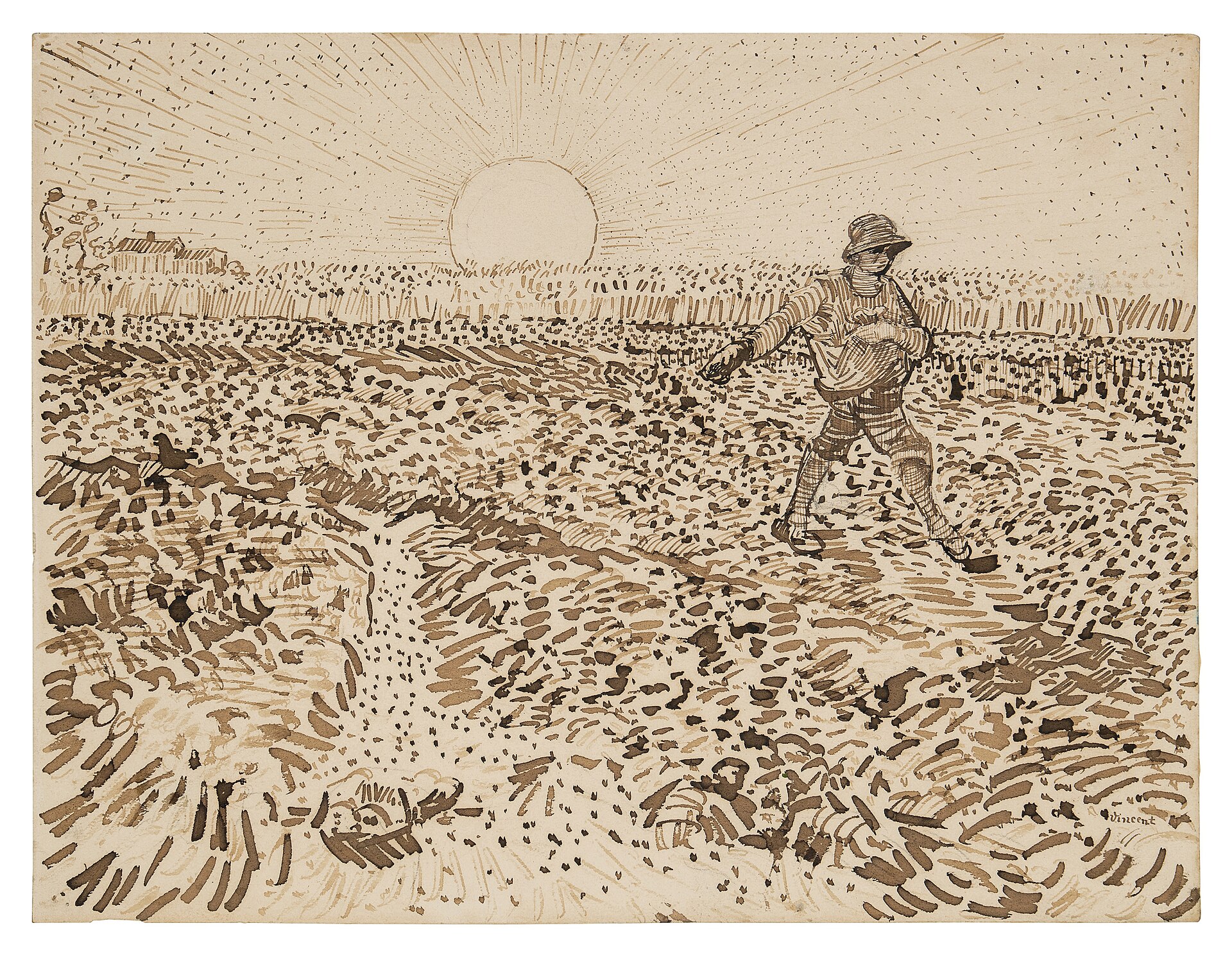
Sower with Setting Sun. Vincent van Gogh, mid July 1888. Sotheby's, New York, 18 November 2025, lot 4. Public domain.