
Psalm 59
17 verses · Psalm of lament
But I will sing of Your strength and proclaim Your loving devotion in the morning. For You are my fortress, my refuge in times of trouble.
Introduction
David, the Night Watch, Book 2: The Elohistic Psalter, Poetry, Psalms Overview.
David wrote this on the night Saul posted men outside his house to kill him in the morning, before his wife let him down through a window. He was still a servant of the king at the time. The psalm is for anyone watched by people who mean harm. Listen for the two refrains, one about a pack of dogs circling the city at evening and the other about God as a high stronghold. The night ends with a song planned for the morning.
Context
- Who
- People under watch, waiting out a night they might not survive
- What
- A night prayer by a man whose house is watched by killers, with one refrain on the prowling dogs and another on God his fortress.
- Where
- A house in Gibeah with Saul's men posted outside it through the night
- When
- David's last days at Saul's court. About 1016 BC, from the event the heading names
- Why
- To give a person under watch a stronghold to name and a morning song to wait for.
Historical context
The heading gives the psalm to David and names the occasion, the night Saul sent men to watch his house in order to kill him. David was still a servant of the court at the time, and Michal let him down through a window. A house built into the town wall had a window on the outer face, which is how Rahab lowered the spies at Jericho. The dogs of verses 6 and 14 were half-wild scavengers that worked the refuse heaps in packs after dark, and calling a man a dog was one of the strongest insults available. Ancient kings kept defeated rebels alive and visible as a standing lesson, which is why verse 11 asks that the enemies not be killed outright and verse 13 asks that they be consumed. The word carried through the psalm for God's protection means a high place, a crag or a fortified height.
Significance
This is a night song for people being watched. It said that the men circling the house were a scavenger pack and that the God of Israel was the crag they could not climb, and it ends with singing already scheduled for a deliverance that has not yet arrived.
This chapter in Jewish lifeWhat this chapter is in Jewish life and reading.
What is done
The corpus ties the sixteenth line of this psalm, where the psalmist says he will sing of God's strength in the morning, to the liturgical tractate at Tractate Soferim 7:4. The corpus carries it as a locator, so the ruling stands at its reference. Rashi reads the same line as the song of a man who has got away:
And I when I escape them, I will sing of Your power in the morning. (Rashi on Psalms 59:17:1)
How it is read
Rashi sets this psalm at the night Saul's men watched David's house, and he names the woman who got him out:
and they guarded the house when Michal told them that he was ill (I Sam. 19:14) and she allowed him to flee at night. (Rashi on Psalms 59:1:2)
He gives the psalm's title the same sense he gives it at Psalm 57, as the cry of a man close to being destroyed, at Rashi on Psalms 59:1:1. The dogs that prowl the city at evening he reads as the watchers changing their work from day to night, at Rashi on Psalms 59:7:1 and Rashi on Psalms 59:15:1. On the strange request that God would not kill the enemies outright he writes:
Do not kill them because this is not recognizable [as] revenge. (Rashi on Psalms 59:12:1)
That is a hard saying plainly stated, and it is the sort of line a Christian reader is likelier to meet in a Jewish commentary than in a sermon. Ibn Ezra stands on this chapter at Ibn Ezra on Psalms 59:2:1, 59:3:1, 59:4:1 and 59:6:1 and Radak at Radak on Psalms 59:2:1 and 59:3:1, and Sefaria holds no English version of those references, so this card cites them without quotation.
What the rabbis say
The corpus records 27 places where the rabbinic literature takes up a line of this psalm, 25 of them in the Midrash. The Midrash on the Psalms treats it at Midrash Tehillim 59:1, 59:2, 59:3, 59:4, 2:6, 69:2 and 69:3, Midrash Tanchuma at Midrash Tanchuma, Noach 17:1 and Noach 17:2 and Shemot Rabbah at Shemot Rabbah 9:2 and 23:6. The Talmud takes up a line at Sanhedrin 109a:14 and Tractate Soferim 7:4. Each is a locator, so the saying stands at its reference and is read there.
Sources: Rashi, Rashi on Psalms, in The Judaica Press complete Tanach with Rashi, translated by A. J. Rosenberg, under a CC-BY licence; Ibn Ezra, Ibn Ezra on Psalms, cited at Ibn Ezra on Psalms 59:2:1, 59:3:1, 59:4:1 and 59:6:1; Radak, Radak on Psalms, cited at Radak on Psalms 59:2:1 and 59:3:1; Midrash Tehillim, the Midrash on the Psalms, cited at Midrash Tehillim 59:1, 59:2, 59:3, 59:4, 2:6, 69:2 and 69:3; The Talmud, cited at Sanhedrin 109a:14 and Tractate Soferim 7:4; Tractate Soferim, Tractate Soferim 7:4, cited as the corpus records it; MannaFest, the Sefaria corpus at scripts/data/sources/sefaria/psalms/59.json, fetched 2026-09-19, 2026.
Psalms 59:1-3
Deliver me from my enemies, O my God: The enemy is named four times and the names get worse each time, enemies, those who rise up, workers of iniquity, men of bloodshed. Verse 3 gives the ground of the prayer, no transgression or sin of his own. The innocence is what the plea rests on.
Psalms 59:1
“Deliver me from mine enemies, O my God. They were all round the house with the warrant of authority, and a force equal to the carrying of it out. He was to be taken dead or alive, well or ill, and carried to the slaughter. No prowess could avail him to break the cordon of armed men, neither could any eloquence stay the hand of his bloody persecutor. He was taken like a bird in a net, and no friend was near to set him free.”
Charles Spurgeon · The Treasury of David, Vol. 3 (1872)Particular Baptist
save me from men of bloodshed: The men Saul sent to the house came to kill, which is why they are called men of bloodshed. John Gill read the heap of names in verses 1 and 2 as the measure of David's distress. Charles Spurgeon saw evil men ruling at Saul's court.
Psalms 59:2
“Deliver me from the workers of iniquity,.... See Gill on Psa 6:8; and save me from bloody men; such as Saul sent to kill David, as appears from the title of the psalm; and such as were concerned in the death of Christ; and such, are the enemies of God's people, the followers of the man of sin. The heap of words, the various expressions used in a way of petition, in this verse and Psa 59:1, show the distress the psalmist was in, and whom he represents; his importunity, earnestness, and fervency in prayer.”
1 more voice on this verse
Psalms 59:2
“Deliver me from the workers of iniquity. Saul was treating him very unjustly, and besides that was pursuing a tyrannical and unrighteous course towards others, therefore David the more vehemently appeals against him. Evil men were in the ascendant at court, and were the ready tools of the tyrant, against these also he prays. Bad men in a bad cause may be pleaded against without question.”
Charles Spurgeon · The Treasury of David, Vol. 3 (1872)Particular Baptist
for no transgression or sin of my own: The innocence claimed is innocence toward Saul in this quarrel. Charles Spurgeon set the enemies crouching like beasts against the man waiting before God in prayer. Matthew Henry read the plea as a suit for justice against hardened men who had shown no mercy.
Psalms 59:3
“For, lo, they lie in wait for my soul. They were in ambuscade for the good man's life. He knew their design and cried to God to be rescued from it. Like wild beasts they crouched, and waited to make the fatal spring; but their victim used effectual means to baffle them, for he laid the matter before the Lord. While the enemy lies waiting in the posture of a beast, we wait before God in the posture of prayer, for God waits to be gracious to us and terrible towards our foes. The mighty are gathered against me.”
Charles Spurgeon · The Treasury of David, Vol. 3 (1872)Particular Baptist
2 more voices on this verse
Psalms 59:3
“For, lo, they lie in wait for my soul,.... As the men did that watched his house, when Saul sent to kill him; so the Jews sought and lay in wait to take away the life of Christ; and very often was it the case of the Apostle Paul, that he was in danger of his life, through the lying in wait of the Jews; so Satan makes use of cunning devices, stratagems, and wiles, to ruin the souls of God's people, if possible; and false teachers lie in wait to deceive them.”
Psalms 59:3
“He knew his enemies were wicked transgressors, wilful, malicious, and hardened in their transgressions both against God and man, and therefore he sues for justice against them, judgment without mercy. Let not those expect to find mercy who never showed mercy, for such are wicked transgressors.”
Matthew Henry · Commentary on the Whole Bible (1707-1721)puritan
Psalms 59:4-5
For no fault of my own: Verse 4 repeats the innocence of verse 3 and then asks God to arise, to help and to take notice. Verse 5 widens the plea past his own enemies to all the nations, and names Him LORD God of Hosts, God of Israel. He asks no mercy for the traitors.
Psalms 59:4
“They run and prepare themselves without my fault. They are all alive and active, they are swift to shed blood. They prepare and use their best tactics; they besiege me in my house, and lay their ambuscades as for some notable enemy. They come up fully armed to the attack, and assail me with all the vigour and skill of a host about to storm a castle; and all for no cause, but out of gratuitous malice.”
Charles Spurgeon · The Treasury of David, Vol. 3 (1872)Particular Baptist
O LORD God of Hosts, the God of Israel: The three names gather God's power and His covenant into one address. John Wesley read the nations as Israelites by birth who were heathen in their ways, and Charles Spurgeon took them as false hearted among Israel. Selah marks a pause after the cry.
Psalms 59:5
“Thou, thyself, work for me personally, for the case needs thine interposition. Therefore, because I am unjustly assailed, and cannot help myself. O Lord, ever living, God of Hosts, able to rescue me; the God of Israel, pledged by covenant to redeem thine oppressed servant; awake to visit all the heathen, arouse thy holy mind, bestow thy sacred energies, punish the heathen among thine Israel, the false hearted who say they are Jews and are not, but do lie.”
Charles Spurgeon · The Treasury of David, Vol. 3 (1872)Particular Baptist
2 more voices on this verse
Psalms 59:5
“Thou therefore, O Lord God of hosts,.... Of the armies in heaven, the angels, and of all the inhabitants of the earth; who are all under him, and at his dispose, and can do among them and with them whatsoever he pleases; the God of Israel; of the people of Israel, literally understood; and mystically of all the elect of God, Jews and Gentiles.”
Psalms 59:5
“The God - A God in covenant with all true Israelites, whom thou hast promised to protect and bless. The heathen - Or, these heathens, who though they are Israelites by birth; yet in their dispositions they are mere Heathens.”
John Wesley · Explanatory Notes upon the Old Testament (1765)evangelical
Psalms 59:6-8
They return in the evening: Verse 6 has them returning in the evening, dogs snarling and prowling the city, and verse 14 says it again word for word. Their mouths are the weapon, sharp words and the boast, for who can hear us. Verse 8 answers that: the LORD laughs, as at Psalm 2:4.
Psalms 59:6
“They return at evening. Like wild beasts that roam at night, they come forth to do mischief. If foiled in the light, they seek the more congenial darkness in which to accomplish their designs. They mean to break into the house in the dead of might. They make a noise like a dog, and go round about the city. Howling with hunger for their prey, they sneak round and round the walls, prowling with stealthy footstep, and barking in unamiable concert.”
Charles Spurgeon · The Treasury of David, Vol. 3 (1872)Particular Baptist
3 more voices on this verse
Psalms 59:6
“Return - Watching for me: which they did at this time all the night long, 1 Sam. xix, 11. A dog - When he is pursuing his prey. Go round - When they did not find him in his own house, they sought for him in other parts of the city.”
John Wesley · Explanatory Notes upon the Old Testament (1765)evangelical
Psalms 59:6
“They return at evening,.... It was at evening Saul sent messengers to watch David's house, that they might take him in the morning; but missing him, perhaps after a fruitless search for him all the day, returned at evening to watch his house again; or they might come, and go and return the first evening.”
Psalms 59:6
“Thus the persecutors of our Lord Jesus, who are compared to dogs ( Ps. xxii. 16 ), ran him down with noise; for else they could not have taken him, at least no on the feast-day, for there would have been an uproar among the people.”
Matthew Henry · Commentary on the Whole Bible (1707-1721)puritan
sharp words from their lips: Sharp words is the Berean rendering of swords in their lips. Matthew Henry read them as slanders that stab a man's name and whetted Saul's sword against him. Their question, who can hear us, is answered in verse 8.
Psalms 59:7
“Behold they belch out with their mouth. The noisy creatures are so remarkable in their way, that attention is called to them with a behold. Ecce homines, might we not say, Ecce canes! Their malicious speech gushes from them as from a bubbling fountain. The wicked are voluble in slander; their vocabulary of abuse is copious, and as detestable as it is abundant. What torrents of wrathful imprecation will they pour on the godly! They need no prompters, their feelings force for themselves their own vent, and fashion their own expressions. Swords are in their lips. They speak daggers.”
Charles Spurgeon · The Treasury of David, Vol. 3 (1872)Particular Baptist
1 more voice on this verse
Psalms 59:7
“Swords are in their lips; that is, reproaches that would my heart with grief ( Ps. xlii. 10 ), and slanders that stab and wound my reputation. They were continually suggesting that which drew and whetted Saul's sword against him, and the fault is laid upon the false accusers.”
Matthew Henry · Commentary on the Whole Bible (1707-1721)puritan
But You, O LORD, laugh at them: They asked who could hear them, and God hears and laughs. Matthew Henry drew in the question of Psalm 94:9, whether He who planted the ear cannot hear. Charles Spurgeon pictured the men at the door sent away without their victim, made fools of by Michal.
Psalms 59:8
“But thou, O Lord, shalt laugh at them. He speaks to God, as to one who is close at hand. He points to the liers in wait and speaks to God about them. They are laughing at me, and longing for my destruction, but thou hast the laugh of them seeing thou hast determined to send them away without their victim, and made fools of by Michal. The greatest, cleverest, and most malicious of the enemies of the church are only objects of ridicule to the Lord; their attempts are utterly futile, they need give no concern to our faith.”
Charles Spurgeon · The Treasury of David, Vol. 3 (1872)Particular Baptist
1 more voice on this verse
Psalms 59:8
"They think God does not hear them, does not heed them; but thou, O Lord! shalt laugh at them for their folly, to think that he who planted the ear shall not hear, and thou shalt have not them only, but all such other heathenish people that live without God in the world, in derision. " Note, Atheists and persecutors are worthy to be laughed at and had in derision.
Matthew Henry · Commentary on the Whole Bible (1707-1721)puritan
Psalms 59:9-10
I will keep watch for You: Fortress is the word that carries the rest of the psalm, here and twice more at verses 16 and 17. Verse 10 has God coming to meet him and letting him stare down his foes. God is named here by His loving devotion.
Psalms 59:9
“Because of his strength will I wait upon thee. Is my persecutor strong? Then, my God, for this very reason I will turn myself to thee, and leave my matters in thy hand. It is a wise thing to find in the greatness of our difficulties a reason for casting ourselves on the Lord. For God is my defence, my high place, my fortress, the place of my resort in the time of my danger. If the foe be too strong for me to cope with him, I will retreat into my castle, where he cannot reach me.”
Charles Spurgeon · The Treasury of David, Vol. 3 (1872)Particular Baptist
2 more voices on this verse
Psalms 59:9
“Because of his strength will I wait upon thee,.... Either because of the strength of Saul, who was stronger than David, he determined to wait upon the Lord for salvation and deliverance from him; or because of the strength of the Lord, which he expected from him, and therefore would wait upon him for it. The Septuagint and Vulgate Latin versions, and also the Chaldee paraphrase, render the words, "my strength will I keep for thee"; or "with thee".”
Psalms 59:9
“By judicious expositors, and on good grounds, this is better rendered, "O my strength, on Thee will I wait" (Ps 59:17). defence--(Compare Ps 18:3).”
Jamieson, Fausset & Brown · Commentary Critical and Explanatory on the Whole Bible (1871)reformed
My God of loving devotion will come to meet me: The older versions read prevent me, meaning go before me. Charles Spurgeon read it as mercy prepared before the need, the refuge built before the danger. John Gill took the title as the God of all grace, citing 1 Peter 5:10.
Psalms 59:10
“The God of my mercy shall prevent me. God who is the giver and fountain of all the undeserved goodness I have received, will go before me and lead my way as I march onward. He will meet me in my time of need. Not alone shall I have to confront my foes, but he whose goodness I have long tried and proved will gently clear my way, and be my faithful protector. How frequently have we met with preventing mercy—the supply prepared before the need occurred, the refuge built before the danger arose.”
Charles Spurgeon · The Treasury of David, Vol. 3 (1872)Particular Baptist
1 more voice on this verse
Psalms 59:10
“The God of my mercy shall prevent me,.... Or "of my grace", or "goodness", as the Targum; see 1Pe 5:10. God is gracious in himself, and he has treasured up a fulness of grace in Christ: he is the donor of all the blessings of grace in the covenant; and the author of all internal grace in the hearts of his people; and who supplies them with more grace as they want it; and he is the Father of all temporal and spiritual mercies.”
Psalms 59:11-13
Do not kill them, or my people will forget: David asks God to leave them alive and scatter them, so his people will not forget. Verse 12 puts the charge on their mouths, curses and lies, and verse 13 asks that they be consumed till they are no more. Cain was kept alive as a sign at Genesis 4:15.
Psalms 59:11
So likewise that conditional threat of the sword, "If you refuse and do not listen to me, the sword shall devour you," has proved that the sword was Christ, for rebellion against whom they have perished. In the fifty-ninth psalm he demands of the Father their dispersion: "Scatter them in your power." By Isaiah he also says, as he finishes a prophecy of their consumption by fire: "Because of me this has happened to you; you shall lie down in sorrow."
Tertullian · written before 220 · Against Marcion 3.23patristic
2 more voices on this verse
Psalms 59:11
“My people - Over whom thou hast appointed me to be governor in due time. Forget - Their former danger, and thy glorious mercy in delivering them. Scatter - Let them wander from place to place, that they may carry the tokens of thy justice, and their own shame to all places.”
John Wesley · Explanatory Notes upon the Old Testament (1765)evangelical
Psalms 59:11
“Slay them not, lest my people forget. It argues great faith on David's part, that even while his house was surrounded by his enemies he is yet so fully sure of their overthrow, and so completely realises it in his own mind, that he puts in a detailed petition that they may not be too soon or too fully exterminated. God's victory over the craft and cruelty of the wicked is so easy and so glorious that it seems a pity to end the conflict too soon.”
Charles Spurgeon · The Treasury of David, Vol. 3 (1872)Particular Baptist
let them be trapped in their pride: The sin charged here is speech, curses and lies. Charles Spurgeon held sins of the lips are punishable sins, and he asked that the men who hoped to take a victim be taken themselves. Their pride is the snare.
Psalms 59:12
“For the sin of their mouth and the words of their lips let them even be taken in their pride. Such dreadful language of atheism and insolence deserves a fit return. As they hope to take their victims, so let them be taken themselves, entangled in their own net, arrested in the midst of their boastful security. Sins of the lips are real sins, and punishable sins. Men must not think because their hatred gets no further than railing and blasphemy that therefore they shall be excused.”
Charles Spurgeon · The Treasury of David, Vol. 3 (1872)Particular Baptist
God rules over Jacob: Verse 11 asked that they not be killed, and verse 13 asks that they be consumed. Charles Spurgeon heard the cry doubled, then tripled. Matthew Henry held that the purpose of such judgments is to show the world that the Lord reigns.
Psalms 59:13
“Consume them in wrath. As if he had changed his mind and would have them brought to a speedy end, or if spared would have them exist as ruins, he cries, consume them, and he redoubles his cry, consume them; nay, he gives a triple note, that they may not be. Revilers of God whose mouths pour forth such filth as David was on this occasion obliged to hear, are not to be tolerated by a holy soul; indignation must flame forth, and cry to God against them.”
Charles Spurgeon · The Treasury of David, Vol. 3 (1872)Particular Baptist
1 more voice on this verse
Psalms 59:13
“The design of God's judgments is to convince men that the Lord reigns, that he fulfils his own counsels, gives law to all the creatures, and disposes all things to his own glory, so that the greatest of men are under his check, and he makes what use he pleases of them. He rules in Jacob; for there he keeps his court; there it is known, and his name is great.”
Matthew Henry · Commentary on the Whole Bible (1707-1721)puritan
Psalms 59:14-15
snarling like dogs and prowling around the city: Verse 14 repeats verse 6 word for word, the dogs back at the city in the evening. Verse 15 leaves them scavenging for food and growling when they are not satisfied. They end the psalm hungry.
Psalms 59:14
“Here verse six is repeated, as if the songster defied his foes and revelled in the thought of their futile search, their malice, their disappointment, their rage, their defeated vigilance, their wasted energy. He laughs to think that all the city would know how they were deceived, and all Israel would ring with the story of the image and the goats' hair in the bed.”
Charles Spurgeon · The Treasury of David, Vol. 3 (1872)Particular Baptist
They scavenge for food: The dogs of verse 14 find nothing and go on hungry. John Gill notes that the Hebrew can also read that they lodge all night unsatisfied. Charles Spurgeon applied the picture to Saul's men, who paraded the city in vain hope of their prey.
Psalms 59:15
“Let them wander up and down for meat,.... Like hungry dogs; and grudge if they be not satisfied; or murmur and howl as dogs when hungry, and can find nothing to eat; or "when they shall not be satisfied, and shall lodge" (z); when they shall get nothing to satisfy their hungry appetite, and shall go to bed without a supper, and lie all night without food.”
1 more voice on this verse
Psalms 59:15
“Let them wander up and down for meat. Like dogs that have missed the expected carcass, let them go up and down dissatisfied, snapping at one another, and too disappointed to be quiet and take the matter easily. And grudge if they be not satisfied. Let them act like those who cannot believe that they have lost their prey: like a herd of Oriental dogs, unhoused, unkennelled, let them prowl about seeking a prey which they shall never find. Thus the menial followers of Saul paraded the city in vain hope of satisfying their malice and their master.”
Charles Spurgeon · The Treasury of David, Vol. 3 (1872)Particular Baptist
Psalms 59:16-17
But I will sing of Your strength: The singing comes in the morning, where the dogs came in the evening. Fortress lands a third time here, and refuge in times of trouble stands beside it. Verse 17 names God strength and loving devotion.
Psalms 59:16
“But I will sing of thy power. The wicked howl, but I sing and will sing. Their power is weakness, but thine is omnipotence; I see them vanquished and thy power victorious, and for ever and ever will I sing of thee. Yea, I will sing aloud of thy mercy in the morning. When those lovers of darkness find their game is up, and their midnight howlings die away, then will I lift up my voice on high and praise the lovingkindness of God without fear of being disturbed.”
Charles Spurgeon · The Treasury of David, Vol. 3 (1872)Particular Baptist
To You, O my strength, I sing praises: Verse 9 said I will keep watch for You, and verse 17 turns the same line into I sing praises. Charles Spurgeon marked that the strength that overcame the enemy was God's, with no stray note for man. John Gill tied the titles back to verses 9 and 10.
Psalms 59:17
“Unto thee, O my strength, will I sing. What transport is here! What a monopolising of all his emotions for the one object of praising God! Strength has been overcome by strength; not by the hero's own prowess, but by the might of God alone. See how the singer girds himself with the almightiness of God, and calls it all his own by faith. Sweet is the music of experience, but it is all for God; there is not even a stray note for man, for self, or for human helpers.”
Charles Spurgeon · The Treasury of David, Vol. 3 (1872)Particular Baptist
2 more voices on this verse
Psalms 59:17
“Unto thee, O my strength, will I sing,.... That is, to God, whom he made his strength, and put his trust in for strength, and from whom he received it; and he therefore determined to sing praise to him for it, and give him the glory of it; for God is my defence: as before in Psa 59:9; and the God of my mercy; See Gill on Psa 59:10.”
Psalms 59:17
“What tongue, then, can sufficiently narrate the depths of divine mercy? What spirit does not stand amazed at the riches of such great kindness? The Psalmist considered these riches of divine kindness when he said: "My helper, to you I will sing praise, for you, O God, are my protector, my God, my mercy." Behold, perceiving in what labors human life is placed, he called God his helper; and because he receives us from present tribulation into eternal rest, he also calls him protector.”
Gregory the Dialogist · written before 604 · Forty Gospel Homilies, Homily 19patristic
How this psalm is built
The form: A night lament with a refrain, closing in praise set for the morning, as Spurgeon classes it.
The patterns in this chapter
| Device | What it does | Where to see it |
|---|---|---|
| The dogs at evening | Verse 6 and verse 14 are the same sentence word for word, men returning at evening, snarling like dogs and prowling around the city. The second time it is followed by verse 15, which leaves them scavenging and growling when they are not satisfied, so the repetition ends worse than it began.Franz Delitzsch, Biblical Commentary on the Psalms, cited in this site's exposition note on Psalm 59:6 to 8. | Psalm 59:6, Psalm 59:14, Psalm 59:15 |
| The enemy named four times over | Verses 1 and 2 name the same men four times and each name is worse than the last: enemies, those who rise against me, workers of iniquity, men of bloodshed. The escalation is the psalm's way of measuring the danger before it states the innocence.Albert Barnes, Notes, Explanatory and Practical, on the Old and New Testaments, 1832 to 1869, on Psalm 59:1. | Psalm 59:1, Psalm 59:2 |
| Fortress, three times | The word stands at verse 9, at verse 16 and at verse 17, and it carries the second half of the psalm. The site's exposition note records the three. The Hebrew word means a high place, a crag or a fortified height, which is the answer to a house with men outside its door.John Gill, Exposition of the Old Testament, 1748 to 1763, on Psalm 59:9. | Psalm 59:9, Psalm 59:16, Psalm 59:17 |
| Evening against morning | The men come at evening in verses 6 and 14, and the singing comes in the morning at verse 16. The psalm is written from inside a night, and it sets the two ends of that night against each other rather than describing what happens between them.Charles Spurgeon, The Treasury of David, Vol. 2, 1870, on Psalm 59:16. | Psalm 59:6, Psalm 59:16 |
The psalm's pattern is a night measured in two returns. The men come back at evening twice, and the second time they are left hungry.
6 more paragraphs on the patterns
The debate
Verse 11 asks God not to kill them and verse 13 asks that they be consumed, and the two look contradictory until the politics are read. Ancient kings kept defeated rebels alive and visible as a standing lesson. The psalm asks for the same, a public and remembered end rather than a quiet removal, so that the people will not forget. The site's exposition note sets the request beside Genesis 4:15, where Cain was kept alive under a sign. The commentators divide over whether verse 11 asks for a scattering first and an end afterwards or for a slow ruin in the sight of the nation, and the text carries both.
Where it points
The laughter of verse 8 is the laughter of Psalm 2:4, where God laughs at the nations that plot against Him, and the site's exposition note records the link. The word the psalm uses for God's protection stands behind the names of clifftop strongholds in Israel's own geography.
Where it stands
It belongs with the psalms of David's years under Saul, Psalms 52, 54, 56, 57 and 60. Its nearest match in subject is Psalm 56, where the watching is done by foreigners rather than by the king's own guard.
Keep studying
Sources for this chapter
The summary
Jamieson, Fausset & Brown, Commentary Critical and Explanatory; John Calvin, Commentaries; John Wesley, Notes on the Old Testament and Matthew Henry, Complete Commentary.
The form and classifications
Albert Barnes, Notes, Explanatory and Practical, on the Old and New Testaments, 1832 to 1869, on Psalm 59:3 and Charles Spurgeon, The Treasury of David, Vol. 2, 1870, on Psalm 59:16.
The exposition
Albert Barnes, Notes on the Book of Psalms; Charles Spurgeon, The Treasury of David; Franz Delitzsch, Biblical Commentary on the Psalms; John Gill, Exposition of the Old Testament; John Wesley, Explanatory Notes upon the Old Testament and Matthew Henry, Commentary on the Whole Bible.
The painting
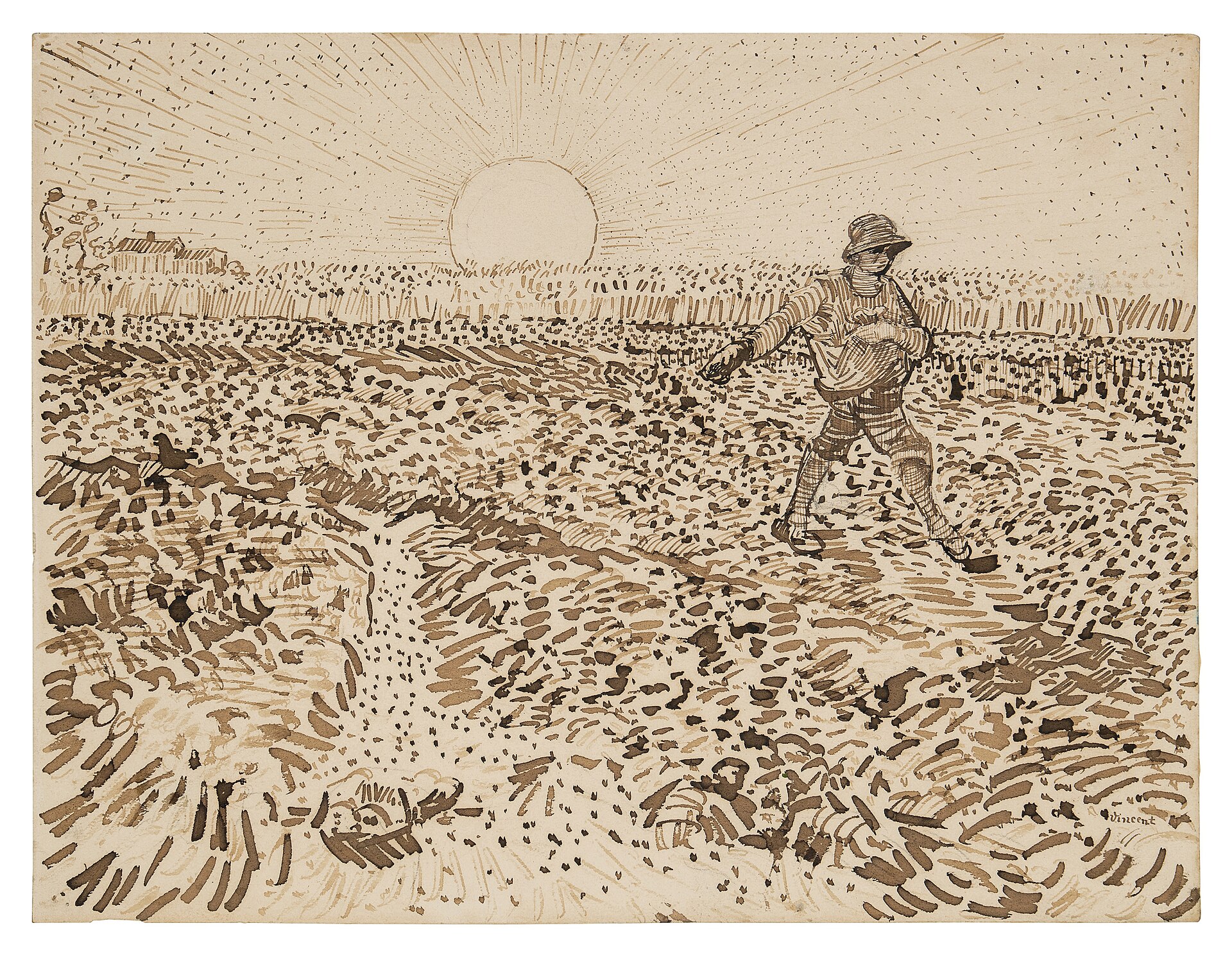
Sower with Setting Sun. Vincent van Gogh, mid July 1888. Sotheby's, New York, 18 November 2025, lot 4. Public domain.