
Psalm 41
13 verses · Psalm of lament
Even my close friend whom I trusted, the one who shared my bread, has lifted up his heel against me.
Introduction
David, the Sickbed Prayer, Book 1: The book of David, Poetry, Psalms Overview.
David wrote this from a sickbed, and it is the last psalm of the first book of the Psalter. He had been generous to people in need, and now he was the one in need, with visitors who wished him dead and a trusted friend who had turned against him. The psalm tests a promise against a hard week. Listen for the confession set in the middle of the complaint, and for the betrayal at the table that Jesus applied to Judas. The last line is a blessing that closes the whole first book.
Context
- Who
- Israelites lying ill while others calculated what their death would mean
- What
- A prayer from a sickbed, made by a man slandered by his visitors and betrayed by a friend.
- Where
- A sickbed in David's household, with visitors at it.
- When
- The reign of David, about 1010 to 970 BC by the superscription, which names no event.
- Why
- To hold God to His promise of mercy for the merciful when that man is ill and alone.
Historical context
The psalm is David's by its title and it is the last psalm of Book One of the Psalter, and its final verse is the doxology that seals the book. Verse 1 blesses the man who considers the poor, and the law required exactly that: gleanings left in the field, the third-year tithe, and loans without interest. Verse 6 puts a visitor at the bedside speaking falsehood while his heart gathers slander to spread outside. Visiting the sick was a social duty, so the psalm describes a cruelty carried out through a courtesy. Eating a man's bread created an obligation in that world, so the friend of verse 9 who shared a table and then turned had broken something stronger than an agreement. The enemies' reading of the illness at verse 8 reflects the common assumption that a severe sickness was a judgment.
Significance
For the first hearers the psalm was a promise put to the test. It states at verses 1 to 3 what happens to the merciful man in the day of trouble, and then spends nine verses in that day. Verse 11 gives the verdict in a form a hearer could check, and the evidence offered is an outcome he could see.
This chapter in Jewish lifeWhat this chapter is in Jewish life and reading.
What is done
This psalm is where the rabbis root the duty of visiting the sick. Rashi takes the poor man of its second line to be the ill man, and the blessing of the line to be the reward of the one who goes to see him:
the poor Heb. דל, the ill, to visit him, as the matter that is stated (in II Sam. 13:4): “Why are you so poor (דל)...?” mentioned in reference to Amnon. (Rashi on Psalms 41:2:1)
He reads the preserving of the third line as spoken of the visitor rather than of the patient, at Rashi on Psalms 41:3:1, and he cites the tractate Nedarim on what the day of calamity means, at Rashi on Psalms 41:2:2. The sick man he places on the seventh day of the illness, when it is at its worst, citing the Midrash on the Psalms at Rashi on Psalms 41:4:1. A Christian reader who visits the sick is doing what this psalm is read to command in Jewish practice, and the two traditions keep the same duty from the same text.
How it is read
Rashi reads the psalm as the speech of a sick man surrounded by false friends. On the visitor who comes to gather material against him he writes:
he speaks falsely He pretends to be troubled, and when he sits before me, his heart gathers thoughts of violence to himself, [of] what evil he will speak when he leaves, and when he goes outside, he speaks of it. (Rashi on Psalms 41:7:1)
He reads the whispering of the eighth and ninth lines as a curse the enemies lay on the sick man, at Rashi on Psalms 41:8:1 and Rashi on Psalms 41:9:1, and the psalm's last lines as the thanksgiving of a man who has got up from his bed:
Blessed is the Lord When I stand up from my illness, I will bless You in this manner. (Rashi on Psalms 41:14:1)
This psalm closes the first of the five books of the Psalter, which this site reads from its Psalms page as Psalms 1 to 41. Ibn Ezra stands on this chapter at Ibn Ezra on Psalms 41:3:1, 41:5:1, 41:6:1, 41:7:1, 41:10:1, 41:11:1 and 41:13:1, Radak at Radak on Psalms 41:1:1, 41:6:1, 41:8:1 and 41:9:1 and Malbim at Malbim on Psalms 41:1:1. Sefaria holds no English version of those references, so this card cites them without quotation.
What the rabbis say
The corpus records 40 places where the rabbinic literature takes up a line of this psalm, 34 of them in the Midrash. Rashi points to two of them himself, to the tractate Nedarim at Rashi on Psalms 41:2:2 and to the Aggadah of the Psalms at Rashi on Psalms 41:4:1. The Midrash on the Psalms treats the psalm at Midrash Tehillim 52:1, 41:4, 119:23 and 55:1, Ein Yaakov at Ein Yaakov, Nedarim 4:11, Nedarim 4:13, Shabbat 1:14 and Sanhedrin 1:8 and Aggadat Bereshit at Aggadat Bereshit 35:1, 38:1, 2:2 and 62:4. The Talmud takes up lines of the psalm at Jerusalem Talmud Peah 8:8:9, Jerusalem Talmud Shekalim 5:4:4, Nedarim 40a:5, Nedarim 40a:6, Sanhedrin 43a:22 and Sanhedrin 106b:22.
Sources: Rashi, Rashi on Psalms, in The Judaica Press complete Tanach with Rashi, translated by A. J. Rosenberg, under a CC-BY licence; Ibn Ezra, Ibn Ezra on Psalms, cited at Ibn Ezra on Psalms 41:3:1, 41:5:1, 41:6:1, 41:7:1, 41:10:1, 41:11:1 and 41:13:1; Radak, Radak on Psalms, cited at Radak on Psalms 41:1:1, 41:6:1, 41:8:1 and 41:9:1; Malbim, Malbim on Psalms, cited at Malbim on Psalms 41:1:1; Midrash Tehillim, the Midrash on the Psalms, cited at Midrash Tehillim 52:1, 41:4, 119:23 and 55:1; The Talmud, cited at Jerusalem Talmud Peah 8:8:9, Jerusalem Talmud Shekalim 5:4:4, Nedarim 40a:5, Nedarim 40a:6, Sanhedrin 43a:22 and Sanhedrin 106b:22; MannaFest, the five books of the Psalter, at /book/psalms, 2026; MannaFest, the Sefaria corpus at scripts/data/sources/sefaria/psalms/41.json, fetched 2026-09-19, 2026.
Psalms 41:1-3
cares for the poor: Blessing is promised to the one who cares for the poor: deliverance in trouble, protection, and the LORD sustaining him on a bed of illness. Henry reads the verb as a practical concern that plans relief. The rest of the psalm tests that promise on a sickbed.
Psalms 41:1
“Blessed is he that considereth the poor. This is the third Psalm opening with a benediction, and there is a growth in it beyond the first two. To search the word of God comes first, pardoned sin is second, and now the forgiven sinner brings forth fruit unto God available for the good of others. The word used is as emphatic as in the former cases, and so is the blessing which follows it. The poor intended, are such as are poor in substance, weak in bodily strength, despised in repute, and desponding in spirit.”
Charles Spurgeon · The Treasury of David, Vol. 2 (1870)Particular Baptist
1 more voice on this verseWhat preachers and commentators have said about this verse, in their own words.
Psalms 41:1
“Faith comes first, and mercy comes second.… Happy, therefore, is the one who understands the poverty of Christ, his utter destitution. Christ, though he was very rich, became poor for us. In his kingdom, he was rich; in his flesh, he was poor, for he took on himself the flesh of the poor. We had indeed become very poor, because, by fraud practiced on us by the serpent, we lost the rich robes of virtue and were put out of paradise. We were thrown out of our native land and banished into exile. We were even stripped of clothing.”
Ambrose of Milan · written before 397 · Commentaries on the Twelve Davidic Psalmspatristic
refuse to surrender him: Barnes read the promise to protect, preserve and bless as a general rule of the LORD's dealings, true in the main and open to exceptions. Care for the sick looks for care in trouble. Spurgeon saw it kept in Jesus, whose life no foe could take before His hour.
Psalms 41:2
“The Lord will preserve him, and keep him alive. His noblest life shall be immortal, and even his mortal life shall be sacredly guarded by the power of Jehovah. Jesus lived on till his hour came, nor could the devices of crafty Herod take away his life till the destined hour had struck; and even then no man took his life from him, but he laid it down of himself, to take it again.”
Charles Spurgeon · The Treasury of David, Vol. 2 (1870)Particular Baptist
his bed of illness: Henry read the promise as strength to bear sickness with patience, with no pledge that sickness will never come or never end in death. Spurgeon pictured the LORD as nurse at the bed of illness. The God who smites with one hand sustains with the other.
Psalms 41:3
“The Lord will strengthen him upon the bed of languishing. The everlasting arms shall stay up his soul as friendly hands and downy pillows stay up the body of the sick. How tender and sympathising is this image; how near it brings our God to our infirmities and sicknesses! Whoever heard this of the old heathen Jove, or of the gods of India or China? This is language peculiar to the God of Israel; he it is who deigns to become nurse and attendant upon good men. If he smites with one hand he sustains with the other.”
Charles Spurgeon · The Treasury of David, Vol. 2 (1870)Particular Baptist
1 more voice on this verse
Psalms 41:3
“Note, God has promised his people that he will strengthen them, and make them easy, under their bodily pains and sicknesses. He has not promised that they shall never be sick, nor that they shall not lie long languishing, nor that their sickness shall not be unto death; but he has promised to enable them to bear their affliction with patience, and cheerfully to wait the issue.”
Matthew Henry · Commentary on the Whole Bible (1707-1721)puritan
Psalms 41:4-6
The prayer asks for healing and gives the reason, for I have sinned against You. The enemies ask when he will die, and the visitor speaks falsehood, gathering slander in his heart to spread abroad. Gill reads the visit as a call to gather a reproach.
Psalms 41:4
“I said —said it in earnest prayer— Lord, be merciful unto me. Prove now thy gracious dealings with my soul in adversity, since thou didst aforetime give me grace to act liberally in my prosperity. No appeal is made to justice; the petitioner but hints at the promised reward, but goes straightforward to lay his plea at the feet of mercy. How low was our Redeemer brought when such petitions could come from his reverend mouth, when his lips like lilies dropped such sweet smelling but bitter myrrh! Heal my soul.”
Charles Spurgeon · The Treasury of David, Vol. 2 (1870)Particular Baptist
2 more voices on this verse
Psalms 41:4
“Heal - The soul is said to be healed, when it is pardoned and purged. For - For I acknowledge that I have sinned.”
John Wesley · Explanatory Notes upon the Old Testament (1765)evangelical
Psalms 41:4
“I said--I asked the mercy I show. heal my soul--(Compare Ps 30:2). "Sin and suffering are united," is one of the great teachings of the Psalms. A graphic picture of the conduct of a malignant enemy.”
Jamieson, Fausset & Brown · Commentary Critical and Explanatory on the Whole Bible (1871)reformed
In verse 1 the LORD will deliver the one who cares for the poor, and here his enemies wait for him to die. Barnes found nothing more unkind than wishing a sick man dead and forgotten. Spurgeon said even his memory offends such foes.
Psalms 41:5
“Mine enemies speak evil of me. It was their nature to do and speak evil; it was not possible that the child of God could escape them. The viper fastened on Paul's hand: the better the man the more likely, and the more venomous the slander. Evil tongues are busy tongues, and never deal in truth. Jesus was traduced to the utmost, although no offence was in him. When shall he die, and his name perish? They could not be content till he was away.”
Charles Spurgeon · The Treasury of David, Vol. 2 (1870)Particular Baptist
My visitor speaks falsehood: The visitor comes to the bed of illness to spy. Barnes read him as watching for anything he could speak against the sick man once he goes out. Spurgeon compared him to a fox that speaks soft words to a sick lamb.
Psalms 41:6
“Judas went out, and he spoke. He went out from the faith, he went out from the council and number of the apostles. He went out from Christ's banquet to the villainy of Satan; he went out from the grace that sanctifies to the noose that strangles. He went to speak vain things to infidels. He went outside, leaving behind the mysteries of life that lay within. He went out, for he had never known the mysteries that are contained in Scripture.”
Ambrose of Milan · written before 397 · Commentary on Twelve Psalms 41:17patristic
1 more voice on this verse
Psalms 41:6
“And if he come to see me, he speaketh vanity. His visits of sympathy are visitations of mockery. When the fox calls on the sick lamb his words are soft, but he licks his lips in hope of the carcass. It is wretched work to have spies haunting one's bedchamber, calling in pretence of kindness, but with malice in their hearts. Hypocritical talk is always fulsome and sickening to honest men, but especially to the suffering saint. Our divine Lord had much of this from the false hearts that watched his words. His heart gathereth iniquity to itself.”
Charles Spurgeon · The Treasury of David, Vol. 2 (1870)Particular Baptist
Psalms 41:7-9
All who hate me whisper: The enemies read the illness as a death sentence, a vile disease poured in, and no getting up again. The sharpest wound is a trusted friend who shared his bread. Jesus applies the line to Judas at John 13:18, quoting it as Scripture to be fulfilled.
Psalms 41:7
“All that hate me whisper together against me,.... That is, they privately conspired against him; see Mat 22:15; against me do they devise my hurt; not only to take away his name and credit, but his life.”
1 more voice on this verse
Psalms 41:7
“All that hate me whisper together against me. The spy meets his comrades in conclave and sets them all a whispering. Why could they not speak out? Were they afraid of the sick warrior? Or were their designs so treacherous that they must needs be hatched in secrecy? Mark the unanimity of the wicked— all. How heartily the dogs unite to hunt the stag!”
Charles Spurgeon · The Treasury of David, Vol. 2 (1870)Particular Baptist
The Hebrew behind vile disease is literally a word of Belial, as Barnes notes. Jamieson, Fausset and Brown took it as slander poured on him. Clarke heard a disease of the devil, and Spurgeon heard enemies whisper that a curse lay on him.
Psalms 41:8
An evil disease--literally, "a word of Belial," some slander. cleaveth--literally, "poured on him." that he lieth--who has now laid down, "he is utterly undone and our victory is sure."
Jamieson, Fausset & Brown · Commentary Critical and Explanatory on the Whole Bible (1871)reformed
1 more voice on this verse
Psalms 41:8
“An evil disease, say they, cleaveth fast unto him. They whisper that some curse has fallen upon him, and is riveted to him. They insinuate that a foul secret stains his character, the ghost whereof haunts his house, and never can be laid. An air of mystery is cast around this doubly dark saying, as if to show how indistinct are the mutterings of malice. Even thus was our Lord accounted "smitten of God and afflicted." His enemies conceived that God had forsaken him, and delivered him for ever into their hands.”
Charles Spurgeon · The Treasury of David, Vol. 2 (1870)Particular Baptist
my close friend whom I trusted: Barnes gives the Hebrew for close friend as one at peace with him, the one he trusted in the day of trouble. Wesley held the words true of David first. The Holy Ghost, he said, looked further, to Christ and Judas.
Psalms 41:9
“We need not imagine that Jesus did not know that Judas was going to betray him.… Of course Jesus knew it. But in order to emphasize how damnable was the deed, Jesus speaks of the hopes he had held regarding Judas' loyalty.… We come down more heavily on one in whom we say we had high hopes or great trust, if afterwards that person robs us of our hope and high opinion.… This is why Jesus says that he had hoped, it was as though he had a right to hope.”
Ambrose of Milan · written before 397 · Commentary on Twelve Psalms 41:21-22patristic
2 more voices on this verse
Psalms 41:9
“As David and his fortunes typified Christ and His (compare Introduction), so these words expressed the treatment he received, and also that of his Son and Lord; hence, though not distinctly prophetical, our Saviour (Joh 13:18) applies them to Judas, "that the Scripture may be fulfilled." This last phrase has a wide use in the New Testament, and is not restricted to denote special prophecies.”
Jamieson, Fausset & Brown · Commentary Critical and Explanatory on the Whole Bible (1871)reformed
Psalms 41:9
“Yea - These words were literally fulfilled in David, and yet the Holy Ghost looked farther in them, even to Christ and Judas, in whom they received a fuller accomplishment.”
John Wesley · Explanatory Notes upon the Old Testament (1765)evangelical
Cross references
Psalms 41:9
- Quoted inJohn 13:18“I am not speaking about all of you; I know whom I have chosen. But this is to fulfill the Scripture: ‘The one who shares My bread has lifted up his heel against Me.’”
'He that eateth bread with me hath lifted up his heel against me' (Judas; 'that the scripture may be fulfilled')
ConnectionsJohn 13:18
Psalms 41:10-12
that I may repay them: The request is healing and redress together, that I may repay them. Verse 11 gives the sign of favour, an enemy who does not triumph, and verse 12 sets the man upright in God's presence forever. Henry reads that integrity as an answer to the charge brought.
Psalms 41:10
“But thou, O Lord, be merciful unto me. How the hunted and affrighted soul turns to her God! How she seems to take breath with a "but, thou!" How she clings to the hope of mercy from God when every chance of pity from man is gone! And raise me up. Recover me from my sickness, give me to regain my position. Jesus was raised up from the grave; his descent was ended by an ascent. That I may requite them.”
Charles Spurgeon · The Treasury of David, Vol. 2 (1870)Particular Baptist
my enemy does not triumph: The sign of favour is modest. Barnes notes the word for triumph means a shout of victory, and the enemy raises none over his bed. Spurgeon said one with no triumph over his enemies may still delight that they have none over him.
Psalms 41:11
“We are all cheered by tokens for good, and the psalmist felt it to be an auspicious omen, that after all his deep depression he was not utterly given over to his foe. By this I know that thou favourest me. Thou hast a special regard to me, I have the secret assurance of this in my heart, and, therefore, thine outward dealings do not dismay me, for I know that thou lovest me in them all. Because mine enemy doth not triumph over me.”
Charles Spurgeon · The Treasury of David, Vol. 2 (1870)Particular Baptist
In my integrity You uphold: Barnes notes the Hebrew opens on a bare pronoun, then turns at once to God, who will set him in His presence forever. Spurgeon held that the LORD must uphold integrity itself. A man is like a glass with no foot, set upright only while God holds it.
Psalms 41:12
“And as for me, despite them all and in the sight of them all, thou upholdest me in mine integrity; thy power enables me to rise above the reach of slander by living in purity and righteousness. Our innocence and consistency are the result of the divine upholding. We are like those glasses without feet, which can only be upright while they are held in the hand; we fall, and spill, and spoil all, if left to ourselves. The Lord should be praised every day if we are preserved from gross sin.”
Charles Spurgeon · The Treasury of David, Vol. 2 (1870)Particular Baptist
1 more voice on this verse
Psalms 41:12
“Settest - Or, hast confirmed me in thy presence, under thine eye and special care: to minister unto thee, as a king over thy people. And in regard of his posterity, the kingdom was established forever. Amen - Signifies an hearty assent and approbation, and withal an earnest desire of the thing, to which it is annexed.”
John Wesley · Explanatory Notes upon the Old Testament (1765)evangelical
Blessed be the LORD: The God of Israel is blessed from everlasting to everlasting. This blessing closes the first book of the Psalter, and Delitzsch reads the double Amen as the congregation answering aloud. The psalm that opened on a bed of illness closes in blessing.
Psalms 41:13
“The Psalm ends with a doxology. Blessed be the Lord, i.e., let him be glorified. The blessing at the beginning from the mouth of God is returned from the mouth of his servant. We cannot add to the Lord's blessedness, but we can pour out our grateful wishes, and these he accepts, as we receive little presents of flowers from children who love us. Jehovah is the personal name of our God. God of Israel is his covenant title, and shows his special relation to his elect people. From everlasting and to everlasting.”
Charles Spurgeon · The Treasury of David, Vol. 2 (1870)Particular Baptist
1 more voice on this verse
Psalms 41:13
"So be it, so be it" is also an indication that you have reached the end of a book. The psalter appears to be divided into five books, and the first book ends with this psalm, namely, the forty-first. The forty-first psalm concludes very fittingly with the passion, just as the forty-day period of Lent concludes with the Lord's passion. This allows the second book to begin with the mysteries of regeneration.
Ambrose of Milan · written before 397 · Commentary on Twelve Psalms 41:37patristic
How this psalm is built
The form: A psalm of the sick and slandered man, closing the first book of the Psalter, as Delitzsch classes it.
The patterns in this chapter
| Device | What it does | Where to see it |
|---|---|---|
| The beatitude at the front, tested by the psalm behind it | Verse 1 blesses the man who considers the poor and promises deliverance in the day of trouble. Verses 4 to 12 put the writer in exactly that day. The psalm is a promise followed by the case that examines it, and verse 11 gives the verdict: by this I know that You delight in me.Matthew Henry, Commentary on the Whole Bible, 1710, on Psalm 41:1 to 4. | Psalm 41:1, Psalm 41:11 |
| The visitor who comes to gather material | Verse 6 puts a caller at the bedside speaking falsehood while his heart collects slander to spread outside. John Gill reads the visit as a call made to gather a reproach. It is the psalm's most specific picture and it names a kind of cruelty that is done politely.John Gill, Exposition of the Old Testament, 1748 to 1763, on Psalm 41:6. | Psalm 41:5, Psalm 41:6 |
| The bed, kept in view through the whole psalm | Verse 3 has the LORD sustaining a man on his bed of illness and restoring him from his bed of sickness, verse 8 has the enemies saying he will not rise from where he lies, and verse 10 asks to be raised up. The one piece of furniture carries the psalm's argument from the promise to the plea.Charles Spurgeon, The Treasury of David, Vol. 2, 1870, on Psalm 41:3. | Psalm 41:3, Psalm 41:8, Psalm 41:10 |
| The friend who ate the bread | Verse 9 is set apart from the enemies of the verses before it by three marks: he is a close friend, he was trusted, and he shared the writer's bread. Eating a man's bread in that culture created an obligation, which is what makes the lifted heel the sharpest line in the psalm.Matthew Henry, Commentary on the Whole Bible, 1710, on Psalm 41:5 to 9. | Psalm 41:9 |
The New Testament's use
8 more paragraphs on the patterns
Jesus quotes verse 9 at John 13:18, at the table, about Judas, and He introduces it as Scripture that must be fulfilled. The quotation drops the words my close friend whom I trusted and keeps the eating of bread and the lifted heel, which is the part the situation required.
The psalm's request at verse 10, that I may repay them, is the line that most troubles Christian readers, and it stands in a psalm that Jesus quotes. Reading verse 10 in place, after the promise of verse 1 has been put in question, is what the psalm asks of a student.
Verse 12 answers verse 6 directly. The visitor gathered slander against his character, and verse 12 has God upholding him because of his integrity and setting him in His presence forever. The charge and the verdict use the same subject.
The psalm that opens the Psalter and the psalm that closes its first book both begin with the word blessed, so Book One is bracketed by a beatitude at Psalm 1:1 and a beatitude here at verse 1.
The debated concept
Verse 10 asks for healing so that I may repay them, and the request sits in a psalm that Jesus quotes. Matthew Henry reads the repayment as the act of a king restored to office, executing a public justice rather than a private revenge. John Gill reads it as the plain request of a wronged man under the old covenant. Charles Spurgeon grants that the words are hard and holds that the psalm is honest about what a sufferer wants. The New Testament's use of verse 9 does not extend to verse 10, and no commentator cited here claims that Christ prays it.
The divine connection
Jesus quotes verse 9 at John 13:18 and introduces it as Scripture that must be fulfilled, so the connection is made by citation rather than by inference. He drops the words my close friend whom I trusted and keeps the eating of bread and the lifted heel, which is what the situation at the table required, and a student should note the change rather than read the whole verse into the scene.
Keep studying
Sources for this chapter
The summary
Jamieson, Fausset & Brown, Commentary Critical and Explanatory; John Calvin, Commentaries; John Wesley, Notes on the Old Testament and Matthew Henry, Complete Commentary.
The form and classifications
Albert Barnes, Notes on the Book of Psalms, 1832 to 1869, on Psalm 41:13; Charles Spurgeon, The Treasury of David, Vol. 2, 1870, on Psalm 41:9; Franz Delitzsch, Biblical Commentary on the Psalms, on Psalm 41 and Matthew Henry, Commentary on the Whole Bible, 1710, on Psalm 41.
The exposition
Adam Clarke, Commentary on the Bible; Albert Barnes; Charles Spurgeon, The Treasury of David; Franz Delitzsch, Biblical Commentary on the Psalms; Jamieson, Fausset & Brown, Commentary Critical and Explanatory on the Whole Bible; John Gill, Exposition of the Old Testament; John Wesley, Explanatory Notes upon the Old Testament and Matthew Henry, Commentary on the Whole Bible.
The painting
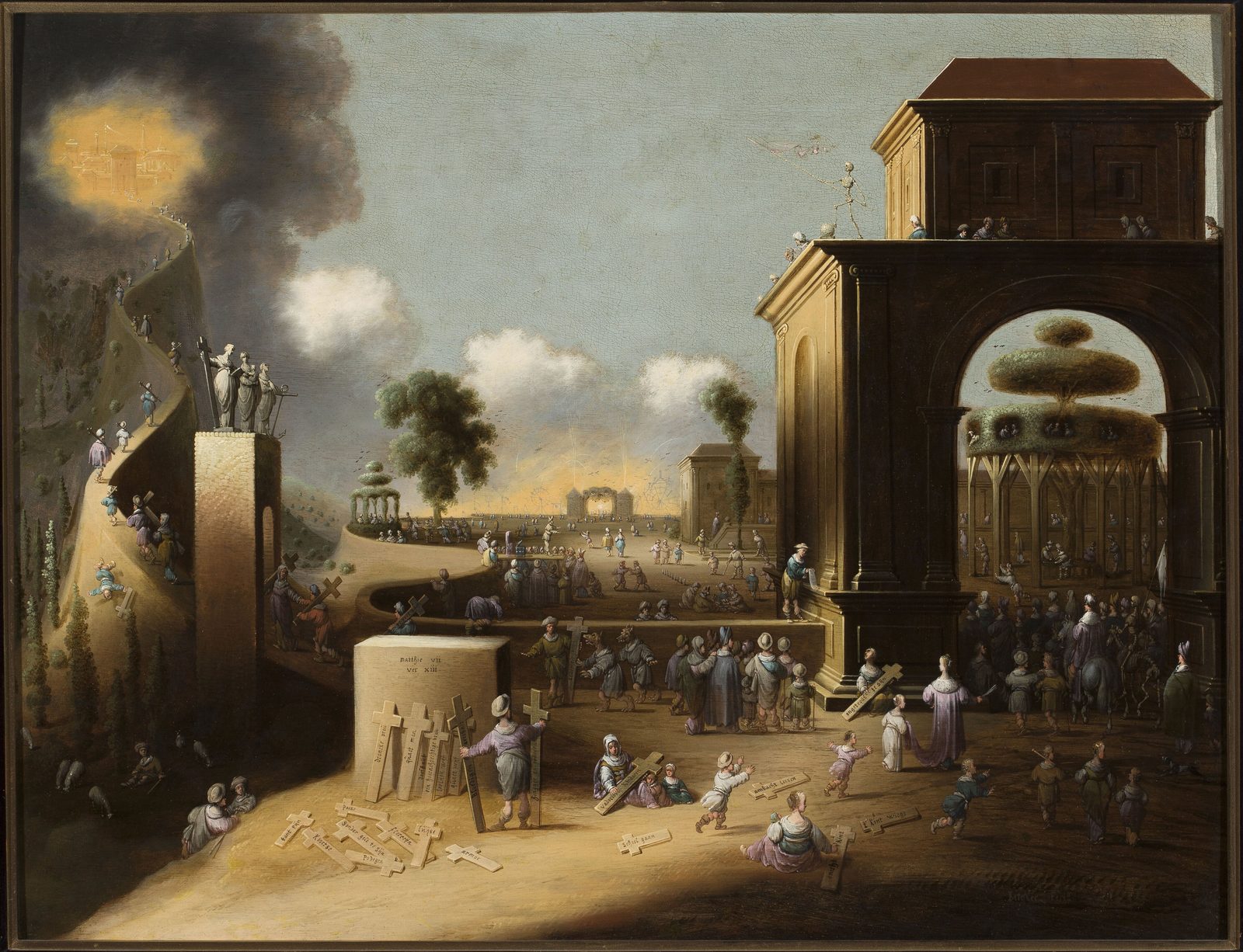
Narrow Road of Virtue and Wide Road of Sin. Jan Micker, not stated on the file page. National Museum in Warsaw. Public domain.