
Psalm 147
20 verses · Hallelujah psalm of praise
He determines the number of the stars; He calls them each by name.
Introduction
Author unstated, the Rebuilder of Jerusalem, Book 5: The return and the great Hallelujah, Poetry, Psalms Overview.
This psalm was sung in the years when Jerusalem was being rebuilt and its scattered people were coming home. Its writer is not named. It moves between the vast and the small, from the stars to a single broken heart, from the winter weather to the grain of the harvest. Listen for the three calls to praise that divide it, and for the claim that God is pleased by trust more than by military strength. It gave a small and weak community a reason to sing.
Context
- Who
- Israelites who had come back to ruins and were slowly putting a city together
- Where
- A repaired city with its gates barred again, in the middle of a cold Judean winter
- When
- The rebuilding of Jerusalem after the exile. No author is named; the psalm says the LORD is building up Jerusalem and has strengthened the bars of its gates, which places it in the years the walls went back up, in the fifth century BC
Historical context
The psalm names its own occasion rather than its author: the LORD builds up Jerusalem, gathers the exiles of Israel and strengthens the bars of its gates. A city gate was closed with heavy wooden beams dropped into stone sockets, and until those bars were in place the city could keep no one out. The same God counts the stars and heals the brokenhearted, and the number of the stars was the Old Testament's own byword for a thing no one could count, as at Genesis 15:5. Jerusalem sits high enough that snow falls there in some years, so snow like wool and frost like ashes were ordinary to a first hearer in an unheated stone house. The horse and the legs of a man mean chariot teams and infantry, the two things every surrounding empire counted.
Significance
The returned community was small, poor and militarily defenceless. This psalm tells them that the things they lacked were never what God was impressed by. It points to what they had that nobody else did, since God declared His word and His statutes to Israel and to no other nation.
This chapter in Jewish lifeWhat this chapter is in Jewish life and reading.
What is done
Psalm 147 is the second of the final Hallel, which the book's structure file and the site's page at /featured/the-hallel both give as Psalms 146 to 150, the five psalms that open and close with Hallelujah and stand as the doxology of the whole Psalter. Its subject is the God who builds Jerusalem and gathers the scattered of Israel, and both commentators who carry English text in the corpus read the psalm as spoken from inside that hope rather than after it. Ibn Ezra reads the opening as the composer's words "by way of prophecy, praising God as he sees his vision" of the city built and the dispersed gathered (Ibn Ezra on Psalms 147:1:1, Sefaria Community Translation, CC0).
How it is read
Malbim takes the whole psalm to praise one fact, that the LORD Himself builds Jerusalem, with His particular providence occupied in its building, and that He Himself brings the scattered back into it. He gives a second possible sense, that the psalm speaks of the ingathering of the tribes and their joining to one another in the city, and ties it back to his own reading of Psalm 122. Ibn Ezra reads the broken-hearted of the third verse as a named group: "They are the mourners of Zion" (Ibn Ezra on Psalms 147:3:1, Sefaria Community Translation, CC0). On the binding of their wounds he sets out three readings, the plain one from Isaiah, a second from Rabbi Yitzchak the Spaniard that takes the word of God fashioning their design, and his own, that God is like one who touches them at the place that saddens them most. Rashi's comments here are short and mostly on wording, on the word for the raven's food, on the hoarfrost, which he gives in Old French, and on the ice hurled like crumbs, where he adds a reading from the Midrash Aggadah that the cold is measured to what each man can bear, and that God is lenient with the poor man who lacks clothing. Radak comments on two verses with no English version in the corpus and stands as a citation, at Radak on Psalms 147:4:1.
What the rabbis say
The corpus records forty locators on this chapter, thirty-three Midrash and seven Talmud. The whole psalm is taken up at Midrash Tehillim 147:1 and 147:2. The building of Jerusalem and the gathering of the outcasts is taken up at Berakhot 49a:14 and Ein Yaakov, Menachot 9:3. The healing of the broken-hearted is taken up at Pesikta DeRav Kahana 24:5 and two passages of Midrash Tanchuma Buber on Exodus. The counting of the stars and the naming of each is taken up at Bamidbar Rabbah 11:7 and Bereshit Rabbah 78:4, and the greatness that has no number at Pesikta Rabbati 11:1 and Avodah Zarah 4a:4. The wheat given to the borders is taken up at Bava Metzia 59a:9 and Berakhot 57a:5, and the ice of the seventeenth verse at Jerusalem Talmud Chagigah 2:1:2 and 2:1:3. Each is a locator without text in the corpus.
Sources: Ibn Ezra, Ibn Ezra on Psalms 147:1:1, 147:2:1, 147:3:1, 147:3:2 and 147:15:2, Sefaria Community Translation, CC0; Malbim, Malbim on Psalms 147:2:1, translated by Rabbi Mike Feuer, Jerusalem Anthology, CC-BY; Rashi, Rashi on Psalms 147:1:1, 147:9:1, 147:14:1, 147:16:1, 147:17:1 and 147:18:1, the Judaica Press complete Tanach with Rashi, translated by A. J. Rosenberg, CC-BY; Radak, Radak on Psalms 147:4:1, cited only, no English version in the corpus; Midrash, Midrash Tehillim 147:1, 147:2, 146:5 and 5:8, Pesikta DeRav Kahana 24:5, Bamidbar Rabbah 11:7, 1:5 and 2:5, Bereshit Rabbah 78:4 and 69:7, Pesikta Rabbati 11:1 and 32:1, Shemot Rabbah 20:3; Babylonian Talmud, Berakhot 49a:14 and 57a:5, Avodah Zarah 4a:4, Bava Metzia 59a:9; Jerusalem Talmud, Chagigah 2:1:2 and 2:1:3, Sheviit 7:1:6; MannaFest, the final Hallel, at /featured/the-hallel and in src/components/book/dossier-content/psalms-structure.ts, 2026.
Psalms 147:1-2
How good it is to sing praises: Praise is called good, pleasant and lovely in one breath. The work named next is building and gathering: the LORD builds up Jerusalem and brings home the exiles of Israel. Matthew Henry takes that building as the church, framed in God's counsels and founded by the preaching of the gospel.
Psalms 147:1
“Praise ye the Lord, or Hallelujah: The flow of the broad river of the Book of Psalms ends in a cataract of praise. The present Psalm begins and ends with Hallelujah. Jehovah and happy praise should ever be associated in the mind of a believer. Jove was dreaded, but Jehovah is beloved. To one and all of the true seed of Israel the Psalmist acts as choir master, and cries, "Praise ye the Lord." Such an exhortation may fitly be addressed to all those who owe anything to the favour of God; and which of us does not?”
Charles Spurgeon · The Treasury of David, Vol. 7 (1885)Particular Baptist
1 more voice on this verseWhat preachers and commentators have said about this verse, in their own words.
Psalms 147:1
Praise the Lord, for a psalm is good. The one hundred and forty-sixth psalm is headed with the title "Alleluia." Those who do not know the Hebrew language, when they see "alleluia" set at the head of a psalm, are wont to ask what it means. This psalm, then, has "alleluia" not only in its title, but also at the very opening of the psalm. For where it says "Praise the Lord," in the Hebrew it says "alleluia."
Jerome · written before 420 · Homily 56, on Psalm 146patristic
He gathers the exiles of Israel: Adam Clarke joined the two clauses: the gathered exiles are the builders of the rising walls. Albert Barnes heard in the gathering the words the prophets had used for the return from exile, as at Isaiah 11:12. Charles Spurgeon allowed the verse to fit Nehemiah's company or David's.
Psalms 147:2
“In both cases, The Lord builds up Jerusalem. The gospel-church, the Jerusalem that is from above, is of this building. He framed the model of it in his own counsels; he founded it by the preaching of his gospel; he adds to it daily such as shall be saved, and so increases it.”
Matthew Henry · Commentary on the Whole Bible (1707-1721)puritan
2 more voices on this verse
Psalms 147:2
“When he is here called the builder of Jerusalem, the allusion is not so much to the outward form and structure, as to the spiritual worship of God. It is a common figure in treating of the Church to speak of it as a building or temple.”
John Calvin · Commentaries (1554)reformed
Psalms 147:2
DOES not this show us the great gentleness and infinite mercy of God? And as we know most of God in the Person of our Lord, Jesus Christ, should it not charm us to remember that when He came on earth He did not visit kings and princes, but He came unto the humble and simple folk? He did not seek out Pharisees, wrapped up in their own supposed righteousness, but He sought out the guilty, for He said, "They that are whole have no need of the physician, but they that are sick."
Psalms 147:3-4
He heals the brokenhearted: One hand heals the brokenhearted, binds up their wounds, and fixes the number of the stars. Charles Spurgeon reads the Healer of verse 3 beside the Builder of verse 2, restoring broken hearts as He restores broken walls. Isaiah 40:26 counts and names them too.
Psalms 147:3
“Who heals the contrite of heart. You see how Jerusalem is built: the contrite of heart are healed. A contrite and humbled heart God does not spurn. And who binds up their bruises. Do you crush your own heart, and the Lord will bind up your bruises. That Samaritan who was coming down from Jerusalem to Jericho, when he saw the wounded man lying in the road, bound up his wounds. This is the one of whom now too it is said, And binding up their bruises. This is said of those who do penance.”
Jerome · written before 420 · Homily 56, on Psalm 146patristic
3 more voices on this verse
Psalms 147:3
“He healeth the broken in heart, and bindeth up their wounds. This the Holy Spirit mentions as a part of the glory of God, and a reason for our declaring his praise: the Lord is not only a Builder, but a Healer; he restores broken hearts as well as broken walls. The kings of the earth think to be great through their loftiness; but Jehovah becomes really so by his condescension. Behold, the Most High has to do with the sick and the sorry, with the wretched and the wounded! He walks the hospitals as the good Physician!”
Charles Spurgeon · The Treasury of David, Vol. 7 (1885)Particular Baptist
Psalms 147:3
“They are broken in heart, and wounded, humbled, and troubled, for sin, inwardly pained at the remembrance of it, as a man is that is sorely wounded. Their very hearts are not only pricked, but rent, under the sense of the dishonour they have done to God and the injury they have done to themselves by sin.”
Matthew Henry · Commentary on the Whole Bible (1707-1721)puritan
Psalms 147:3
“Though applicable to the captive Israelites, this is a general and precious truth. wounds--(Compare Margin). God's power in nature (Isa 40:26-28, and often) is presented as a pledge of His power to help His people. telleth . . . stars--what no man can do (Ge 15:5).”
Jamieson, Fausset & Brown · Commentary Critical and Explanatory on the Whole Bible (1871)reformed
He determines the number of the stars: Adam Clarke tied the counting to verse 2: a God who can tell every star can find every scattered exile of Israel. John Gill recalled the ancient astronomers fixed the stars at a thousand, a number the telescope overturned. Matthew Henry read the naming as a general mustering his soldiers.
Psalms 147:4
“He telleth the number of the stars. None but he can count the mighty host, but as he made them and sustains them he can number them. To Jehovah stars are as mere coins, which the merchant tells as he puts them into his bag. He calleth them all by their names. He has an intimate acquaintance with each separate orb, so as to know its name or character. Indeed, he gives to each its appropriate title, because he knows its constitution and nature.”
Charles Spurgeon · The Treasury of David, Vol. 7 (1885)Particular Baptist
2 more voices on this verse
Psalms 147:4
“Who numbers the multitude of the stars. What is the connection, according to the letter, between "And binding up their bruises" and "who numbers the multitude of the stars"? But because he healed the contrite of heart and bound up their bruises, those who before had been contrite, and afterward were healed, he turns into stars. Who numbers the multitude of the stars. The multitude. For many were those who sinned: many are those who have been cured. Who numbers the multitude of the stars.”
Jerome · written before 420 · Homily 56, on Psalm 146patristic
Psalms 147:4
“He telleth the number of the stars,.... Which no man can do exactly; see Gen 15:5; the ancient astronomers pretended to tell them, as Aratus and Eudoxus (o), and fixed their number at a thousand and some odd; but then these were only such as were of some magnitude and influence, and such as commonly appeared; but since the use of telescopes many are seen which were not before; and especially those clusters of them in the Milky Way cannot be distinctly discerned and told; but the Lord that made them can tell their exact number.”
Psalms 147:5-6
His understanding has no limit: The LORD's understanding has no limit. The next line turns power toward men: the humble are held up, and the wicked are put on the ground. Matthew Henry reads the humble as those who abase themselves before God and whom men trample on.
Psalms 147:5
“Great is our Lord. Our Lord and King is great—magnanimous, infinite, inconceivably glorious. None can describe his majesty, or reckon up the number of his excellencies. And of great power. Doing as he wills, and willing to do mighty deeds. His acts reveal something of his might, but the mass of his power is hidden, for all things are possible with God, even the things impossible with men. His understanding is infinite. There is no fathoming his wisdom, or measuring his knowledge. He is infinite in existence, in power, and in knowledge; as these three phrases plainly teach us.”
Charles Spurgeon · The Treasury of David, Vol. 7 (1885)Particular Baptist
1 more voice on this verse
Psalms 147:5
“Great is our Lord, and great is his power, and of his wisdom there is no number. Great is his power: Christ, the power of God and the wisdom of God. And of his wisdom there is no number. Christ is wisdom: and the one wisdom cannot be numbered.”
Jerome · written before 420 · Homily 56, on Psalm 146patristic
The LORD sustains the humble: Spurgeon saw the LORD reversing the order of things, lifting the meek and throwing down the wicked. Albert Barnes linked both halves to the psalm before, where the LORD lifts those who are weighed down and frustrates the wicked. Jerome read the lifted humble as the stars of verse 4.
Psalms 147:6
“The Lord lifteth up the meek: he casteth the wicked down to the ground. He reverses the evil order of things. The meek are down, and he lifts them up; the wicked are exalted, anti he hurls them down to the dust. The Lord loves those who are reverent to himself, humble in their own eyes, and gentle to their fellow men: these he lifts up to hope, to peace, to power, to eternal honour. When God lifts a man, it is a lift indeed.”
Charles Spurgeon · The Treasury of David, Vol. 7 (1885)Particular Baptist
Psalms 147:7-11
Sing to the LORD with thanksgiving: The call to sing opens onto weather: clouds, rain for the earth, grass on the hills. Food follows for the animals and the young ravens. The horse's strength and man's legs are passed over, and the LORD's pleasure rests on those who fear Him and hope in His loving devotion.
Psalms 147:7
“Sing unto the Lord with thanksgiving,.... These are the words of the psalmist unto the Israelites, according to Aben Ezra and Kimchi; but may be an exhortation to all men, especially good men; who are capable of observing the following things concerning providential goodness and special grace, on account of which they are called upon to "sing unto the Lord": or to "answer" (q); to sing alternately, or by responses; the word is used for singing, Hos 2:15; see Exo 15:21; and intends vocal singing, as the next clause instrumental singing, as Kimchi observes.”
1 more voice on this verse
Psalms 147:7
“In this paragraph the contrast announced in the former section is enlarged upon from another point of view, namely, as it is seen in nature and in providence. Sing unto the Lord with, thanksgiving; or rather, "respond to Jehovah." He speaks to us in his works, let us answer him with our thanks. All that he does is gracious, every movement of Iris hand is goodness; therefore let our hearts reply with gratitude, and our lips with song. Our lives should be responses to divine love. Jehovah is ever engaged in giving, let us respond with thanksgiving.”
Charles Spurgeon · The Treasury of David, Vol. 7 (1885)Particular Baptist
who prepares rain for the earth: Charles Spurgeon traced a chain of purpose: the clouds are made ready for the rain, and the rain for the fields below. Adam Clarke noted the Septuagint and Vulgate add a half-line, naming plants for the service of man, which he took as lost from the Hebrew.
Psalms 147:8
“Who covereth the heaven with clouds. He works in all things, above as well as below. Clouds are not caused by accident, but produced by God himself, and made to assume degrees of density by which the blue firmament is hidden. A sky scape might seem to be a mere fortuitous concourse of vapours, but it is not so: the Great Artist's hand thus covers the canvas of the heavens. Who prepareth rain for the earth. The Lord prepares clouds with a view to rain, and rain with an eye to the fields below.”
Charles Spurgeon · The Treasury of David, Vol. 7 (1885)Particular Baptist
for the young ravens when they call: John Wesley explained why ravens are named. They were unclean to Israel, and their parents leave them as soon as they can fly, so the young depend wholly on God's providence. John Gill reasoned that He will feed His own people much more.
Psalms 147:9
“I SHALL open this sermon with a quotation. I must give you, in Caryl's own words his note upon ravens. "Naturalists tell us that when the raven has fed his young in the nest till they are well fledged and able to fly abroad, he thrusts them out of the nest and will not let them abide there, but puts them out to get their own living. Now when these young ones are upon their first flight from their nest and are little acquainted with means how to help themselves with food, then the Lord provides food for them.”
1 more voice on this verse
Psalms 147:9
“Ravens - Which he mentions because they were most contemptible, especially to the Jews, to whom they were unclean: and because they are not only neglected by men, but also forsaken by their dams as soon as ever they can fly, and so are wholly left to the care of Divine providence.”
John Wesley · Explanatory Notes upon the Old Testament (1765)evangelical
the strength of the horse: Albert Barnes heard an army, the horse for the cavalry and the legpower of the man for the quick march of the foot soldier. Monarchs trusted both, as Charles Spurgeon observed. Matthew Henry drew the lesson that the strength God is pleased to own is the strength of grace.
Psalms 147:10
“He delighteth not in the strength of the horse. Not to great and strong animals doth the Creator in any measure direct his special thought; but in lesser living things he has equal pleasure. If man could act the Creator's part, he would take peculiar delight in producing noble quadrupeds like horses, whose strength and speed would reflect honour upon their maker; but Jehovah has no such feeling; lie cares as much for helpless birds in the nest as for the war horse in the pride of its power. He taketh not pleasure in the legs of a man.”
Charles Spurgeon · The Treasury of David, Vol. 7 (1885)Particular Baptist
1 more voice on this verse
Psalms 147:10
“In times when great things are doing, and there are great expectations of the success of them, it concerns us to know (since the issue proceeds from the Lord) whom, and what, God will delight to honour and crown with victory. It is not the strength of armies, but the strength of grace, that God is pleased to own.”
Matthew Henry · Commentary on the Whole Bible (1707-1721)puritan
who hope in His loving devotion: The verse sets fear and hope side by side, and Augustine held that each needs the other. Judas feared without hope, and hanged himself. Adam Clarke noted that in every ancient version except the Chaldee a psalm ends here and a new one begins at verse 12.
Psalms 147:11
“The Lord is well pleased with those who fear him. One fear casts out many fears. Is it not better to fear one, that you may not fear many, than to fear many, that you may not fear one? And with those who hope in his mercy. They hope not in their own works, but in the mercy of the judge. Praise the Lord, for a psalm is good; for in those who hope in his mercy is salvation alone. To whom is glory forever and ever. Amen.”
Jerome · written before 420 · Homily 56, on Psalm 146patristic
1 more voice on this verse
Psalms 147:11
“The Lord taketh pleasure in them that fear him in those that hope in his mercy. While the bodily powers give no content to God, spiritual qualities are his delight. He cares most for those emotions which centre in himself: the fear which he approves is fear of him, and the hope which he accepts is hope in his mercy. It is a striking thought that God should not only be at peace with some kinds of men, but even find a solace and a joy in their company. Oh!”
Charles Spurgeon · The Treasury of David, Vol. 7 (1885)Particular Baptist
Psalms 147:12-14
Exalt the LORD, O Jerusalem: Jerusalem is addressed, and four gifts follow. The LORD strengthens her gate bars, blesses the children inside her, makes peace at her borders, and fills her with the finest wheat. John Wesley reads the bars as God's protection behind the walls, and the border peace as peace over the land.
Psalms 147:12
“Praise the Lord, O Jerusalem; praise your God, O Zion. Just now we heard the holy presbyter preaching that, because of its transgression of the law, the Jewish people has been forsaken; and how is it that now it is said, Praise the Lord, O Jerusalem; praise your God, O Zion? Praise the Lord, O Jerusalem. Jerusalem, "vision of peace." Praise your God, O Zion. Zion is interpreted "watchtower." You see, then, what he says: Praise the Lord, O Jerusalem. Wherever there is a vision of peace, wherever there is contemplation of God, there let there be praise of God.”
Jerome · written before 420 · Homily 57, on Psalm 147patristic
2 more voices on this verse
Psalms 147:12
“Praise the Lord, O Jerusalem,.... The inhabitants of it, as Kimchi; not Jerusalem in a literal sense, for this respects future time, as Aben Ezra; the world to come, the times of the Messiah: and intends the spiritual Jerusalem, as Arama; that which is free, the mother of us all; the Gospel church, and the members of it; which have great reason to praise the Lord, for their special blessings and peculiar privileges; see Gal 4:26; praise thy God, O Zion; not the house and family of David, as R.”
Psalms 147:12
“Praise the Lord, O Jerusalem; praise thy God, O Zion. How the poet insists upon praise: he cries praise, praise, as if it were the most important of all duties. A peculiar people should render peculiar praise. The city of peace should be the city of praise; and the temple of the covenant God should resound with his glories. If nowhere else, yet certainly in Zion there should be joyful adoration of Zion's God. Note, that we are to praise the Lord in our own houses in Jerusalem as well as in his own house in Zion.”
Charles Spurgeon · The Treasury of David, Vol. 7 (1885)Particular Baptist
He strengthens the bars of your gates: Adam Clarke read the psalm as moving from walls still rising in verse 2 to walls finished here, with the gates set up and barred. Augustine observed that bars are strengthened on shut gates. Charles Spurgeon paired the two halves as safety outside and blessing within.
Psalms 147:13
“For he has strengthened the bars of your gates. Is it, then, of this Jerusalem that he speaks? Of this Zion? Praise your God. Why? For he has strengthened the bars of your gates. There are no gates: and how, then, are the bars kept safe? He has blessed your children within you. How has he blessed, he who said, Your house shall be left to you desolate? For he has strengthened the bars of your gates. The Lord loves the gates of Zion above all the tabernacles of Jacob. We said the gates of Zion are the prophets.”
Jerome · written before 420 · Homily 57, on Psalm 147patristic
2 more voices on this verse
Psalms 147:13
“For he hath strengthened the bars of thy gates. Her fortifications were finished, even to the fastenings of the gates, and God had made all sound and strong, even to her bolts and bars: thus her security against invading foes was guaranteed. This is no small mercy. Oh, that our churches were thus preserved from all false doctrine and unholy living! This must be the Lord's doing; and where he has wrought it his name is greatly to be praised.”
Charles Spurgeon · The Treasury of David, Vol. 7 (1885)Particular Baptist
Psalms 147:13
“If there be trouble any where, it is in the borders, the marches of a country; the frontier-towns lie most exposed, so that, if there be peace in the borders, there is a universal peace, a mercy we can never be sufficiently thankful for.”
Matthew Henry · Commentary on the Whole Bible (1707-1721)puritan
He fills you with the finest wheat: Albert Barnes rendered finest wheat literally as fat of wheat. Jerome asked his hearers whether wheat has fat, and took the phrase as a call to read the verse spiritually. Adam Clarke set the peace after the return, when the Samaritans and the Moabites had ceased to trouble the city.
Psalms 147:14
“He maketh peace in thy borders. Even to the boundaries quiet extends; no enemies are wrangling with the borderers. If there is peace there, we may be sure that peace is everywhere. "When a man's ways please the Lord he maketh even his enemies to be at peace with him." Peace is from the God of peace.”
Charles Spurgeon · The Treasury of David, Vol. 7 (1885)Particular Baptist
Psalms 147:15-18
He sends forth His command: The command runs to the earth and the word runs swiftly, and the winter follows: snow like wool, frost like ashes, hail like pebbles. The same word melts them and the waters flow. Spurgeon reads the thaw as the word doing the whole work, the hardest ice dissolved at once.
Psalms 147:15
“He sendeth forth his commandment upon earth. His messages fly throughout his dominions: upon earth his warrants are executed as well as in heaven. From his church his word goes forth; from Zion he missions the nations with the word of life. His word runneth very swiftly: his purposes of love are speedily accomplished. Oriental monarchs laboured hard to establish rapid postal communication; the desire, will, and command of the Lord flash in an instant from pole to pole, yea, from heaven to earth.”
Charles Spurgeon · The Treasury of David, Vol. 7 (1885)Particular Baptist
4 more voices on this verse
Psalms 147:15
“Who sends forth his word to the earth. Answer, O Jew: if he was speaking of wheat, And he fills you with the fat of the wheat, how does he now say, Who sends forth his word to the earth? In the beginning was the Word. This Word is sent forth in the flesh. And the Word was made flesh, and dwelt among us. Who sends forth his word to the earth. At that time was fulfilled, The earth has given its fruit. Who sends forth his word to the earth.”
Jerome · written before 420 · Homily 57, on Psalm 147patristic
Psalms 147:15
“He sendeth forth his commandment upon earth,.... Which Kimchi interprets of rain, which causes the wheat to grow; since afterwards mention is made of snow, and of hoar frost and ice. Aben Ezra understands it of the decree of God, which he executes on earth. The Targum, of the "Memra", or Word of the Lord; the essential Word, the Messiah; whom the Lord sent on earth to perform the great work of redemption and salvation; and who came speedily, and tarried not when the fulness of time was come, as follows.”
Psalms 147:15
“God's Word, as a swift messenger, executes His purpose, for with Him to command is to perform (Ge 1:3; Ps 33:9), and He brings about the wonders of providence as easily as men cast crumbs.”
Jamieson, Fausset & Brown · Commentary Critical and Explanatory on the Whole Bible (1871)reformed
Psalms 147:15
“As the lightning, which passes through the air in an instant, such is the word of God's providence, and such the word of his grace, when it is sent forth with commission, Luke xvii. Angels, who carry his word and fulfil it, fly swiftly, Dan. ix. In particular, frosts and thaws are both of them wonderful changes, and in both we must acknowledge the word of his power.”
Matthew Henry · Commentary on the Whole Bible (1707-1721)puritan
He spreads the snow like wool: John Gill found the likeness in the whiteness of snow and in its light, gentle fall, and he noted ancient writers called snow woolly water. Snow clothes the ground as wool clothes the sheep, Spurgeon added. The God who gave the finest wheat in verse 14 also sends the winter.
Psalms 147:16
“Here follow instances of the power of God upon the elements. He giveth snow like wool. As a gift he scatters the snow, which falls in flakes like fleecy wool. Snow falls softly, covers universally, and clothes warmly, even as wool covers the sheep. The most evident resemblance lies in the whiteness of the two substances; but many other likenesses are to be seen by the observant eye. It is wise to see God in winter and in distress as well as in summer and prosperity.”
Charles Spurgeon · The Treasury of David, Vol. 7 (1885)Particular Baptist
1 more voice on this verse
Psalms 147:16
“He giveth snow like wool,.... For colour as white as wool; so the Targum and Kimchi: and for the manner of its falling, lightly and gently as a lock of wool; which for its thinness and fineness it also resembles. Hence the ancients used to call snow εριωδες υδωρ, "woolly water" (t); and Martial (u) gives it the name of "densum veilus aquarum", "a thick fleece of waters": so another poet (w) calls clouds flying fleeces of wool, to which they sometimes seem like; Pliny (x) calls it the from of the celestial waters.”
He casts forth His hail like pebbles: The Hebrew the Berean renders pebbles means a morsel of bread, and Albert Barnes pictured God scattering hail as easily as a man scatters crumbs. Adam Clarke cited a Crusader chronicler who saw poor people and beasts of burden die of the cold near Mount Tabor.
Psalms 147:17
“He casteth forth his ice like morsels. Such are the crumbs of hail which he casts forth, or the crusts of ice which he creates upon the waters. These morsels are his ice, and he casts them abroad. The two expressions indicate a very real presence of God in the phenomena of nature. Who can stand before his cold? None can resist the utmost rigours of cold any more than they can bear the vehemence of heat. God's withdrawals of light are a darkness that may be felt, and his withdrawals of heat are a cold which is absolutely omnipotent.”
Charles Spurgeon · The Treasury of David, Vol. 7 (1885)Particular Baptist
1 more voice on this verse
Psalms 147:17
“He sends his crystal like morsels. As his loaves are broken and become morsels, so too this crystal is broken and turned into morsels. Crystal has this nature: it forms whenever waters are frozen — what we call ice. Between crystal and water, then, there is the same difference as between water and ice: for water is poured out, as it were, very broadly, whereas crystal is, as it were, compacted into itself, and reduced into one form. Whenever water freezes, it makes crystal.”
Jerome · written before 420 · Homily 57, on Psalm 147patristic
He sends forth His word and melts them: Albert Barnes called it His wind because He directs it, the warm south wind of the thaw. Matthew Henry read the thawing word as the gospel of Christ and the thawing wind as His Spirit, and he pointed to John 3:8. Jerome heard the Father, the Word and the Spirit.
Psalms 147:18
“He shall send forth his word, and shall melt them. Of that one of whom he had said, He sends forth his word to the earth: He shall send forth his word. Who shall send it forth? God the Father. And the Word was with God, and the Word was God. We have named the Father, we have named the Son: we cannot believe in a twofold number, unless the Trinity be completed. His spirit shall blow, and the waters shall flow.”
Jerome · written before 420 · Homily 57, on Psalm 147patristic
1 more voice on this verse
Psalms 147:18
“He sendeth out his word, and melteth them. When the frost is sharpest, and the ice is hardest, the Lord intervenes; and though he doth no more than send his word, yet the rocks of ice are dissolved at once, and the huge bergs begin to float into the southern seas. The phenomena of winter are not so abundant in Palestine as with us, yet they are witnessed sufficiently to cause the devout to bless God for the return of spring.”
Charles Spurgeon · The Treasury of David, Vol. 7 (1885)Particular Baptist
Psalms 147:19-20
He declares His word to Jacob: The weather of the verses before reaches every nation; the word, the statutes and the judgments go to Jacob and Israel. The psalm says plainly that no other nation received this. Matthew Henry calls it a distinguishing mercy, God's word shown to Jacob and his statutes made known through it.
Psalms 147:19
“He sheweth his word unto Jacob, his statutes and his judgments unto Israel. He who is the Creator is also the Revealer. We are to praise the Lord above all things for his manifesting himself to us as he does not unto the world. Whatever part of his mind he discloses to us, whether it be a word of instruction, a statute of direction, or a judgment of government, we are bound to bless the Lord for it.”
Charles Spurgeon · The Treasury of David, Vol. 7 (1885)Particular Baptist
2 more voices on this verse
Psalms 147:19
“They did not find out God's statutes and judgments of themselves, but God showed his word unto Jacob, and by that word he made known to them his statutes and judgments. It is a great mercy to any people to have the word of God among them; for faith comes by hearing and reading that word, that faith without which it is impossible to please God.”
Matthew Henry · Commentary on the Whole Bible (1707-1721)puritan
Psalms 147:19
“He showeth his word unto Jacob,.... From the things of nature and providence, the psalmist passes to the blessings of grace and goodness; for which the Lord is to be praised, particularly for his word and ordinances.”
He has done this for no other nation: Charles Spurgeon called this election the loudest call to grateful adoration, and he read the closing Hallelujah as praise that can rise no higher. John Gill counted the gift as the law, the worship and the promises of Christ. Adam Clarke saw the ordinances pointing to glorious things ahead.
Psalms 147:20
“He hath not dealt so with any nation. Israel had clear and exclusive knowledge of God, while others were left in ignorance. Election is the loudest call for grateful adoration. And as for his judgments, they have not known them; or, and judgments they had not known them, as if not knowing the laws of God, they might be looked upon as having no laws at all worth mentioning. The nations were covered with darkness, and only Israel sat in the light. This was sovereign grace in its fullest noontide of power. Praise ye the Lord.”
Charles Spurgeon · The Treasury of David, Vol. 7 (1885)Particular Baptist
1 more voice on this verse
Psalms 147:20
“He hath not dealt so with any nation,.... Or "every nation" (b); or all the nations under the heavens; only with the Jewish nation: these only for many hundreds of years were favoured with the divine revelation, with the word and ordinances of God; with the law, and with the Gospel, and with the service and worship of God; as well as with promises and prophecies of Christ, and good things to come by him.”
How this psalm is built
The form: A praise psalm of the rebuilt city, where the God who builds Jerusalem is praised as Builder and Maker in the material world and the spiritual alike, as Spurgeon classes it.
The patterns in this chapter
| Device | What it does | Where to see it |
|---|---|---|
| The enormous and the small in one line | Verse 3 heals the brokenhearted and binds up their wounds; verse 4 determines the number of the stars and calls them each by name. Spurgeon says the connection is what strikes a reader every time, and that the Holy Spirit names the healing of broken hearts as part of the glory of God. Barnes reads the healing first of the captives crushed by their long exile and then of anyone.Charles Spurgeon, The Treasury of David, Vol. 7, 1885, on Psalm 147:3. | Psalm 147:3, Psalm 147:4 |
| Three calls to praise, three grounds | The psalm restarts twice. Verse 1 calls for praise and gives the grounds in verses 2 to 6. Verse 7 calls again and gives the grounds in verses 8 to 11. Verse 12 calls a third time, naming Jerusalem and Zion, and gives the grounds in verses 13 to 20. The three movements are why the Greek and Latin tradition divided the psalm.Jerome, Homily 57, on Psalm 147, on Psalm 147:1. | Psalm 147:1, Psalm 147:7, Psalm 147:12 |
| The winter, closely watched | Verses 16 to 18 name the weather piece by piece, snow like wool, frost scattered like ashes, hail cast like pebbles, then a word sent that melts them and winds that set the waters flowing. Clarke and Barnes both read the sequence as observation rather than decoration, the ordinary winter of a high stone city where the question who can withstand His icy blast is an honest one.Albert Barnes, Notes, Explanatory and Practical, on the Old and New Testaments, 1832 to 1869, on Psalm 147:4. | Psalm 147:16, Psalm 147:17, Psalm 147:18 |
| Not the horse, not the legs of a man | Verse 10 names the two things every surrounding empire counted, chariot teams and infantry, and says God takes no pleasure in either. Verse 11 says what He is pleased with instead, those who fear Him and hope in His loving devotion. The pair is the psalm's argument to a small and undefended community.Charles Spurgeon, The Treasury of David, Vol. 7, 1885, on Psalm 147:11. | Psalm 147:10, Psalm 147:11 |
The structure
8 more paragraphs on the patterns
The threefold call at verses 1, 7 and 12 is the psalm's frame, and the Greek and Latin traditions treated it as two psalms, dividing at verse 12. Jerome writes from inside that numbering, calling this psalm the one hundred and forty sixth and explaining the alleluia at its head. That is why the Greek and Latin numbering of the Psalms runs one behind the Hebrew as far as this point and rejoins it after.
The prophecy and the New Testament's use
No New Testament writer quotes Psalm 147. Verse 9, which provides food for the animals and for the young ravens when they call, is the picture Jesus uses at Luke 12:24, where God feeds the ravens who neither sow nor reap. Verse 3, on healing the brokenhearted and binding up their wounds, stands in the same family as Isaiah 61:1, which Jesus reads at Nazareth.
The insight
Verse 4 says that God determines the number of the stars and calls them each by name. The claim the text makes is about God's knowledge, and a reader should keep it there rather than turn it into an astronomical report. What can be said is that the number of the stars was the Old Testament's own byword for a thing no one could count. At Genesis 15:5 the LORD takes Abram outside and tells him to count them if he is able. Barnes, writing in the nineteenth century, states the position plainly, that the stars are so numerous that no astronomer can count them and that God alone can.
The psalm's point stands wherever the count now stands, and its force is in the pairing. The one who holds that number is the one who binds a wound.
The debate
Whether the psalm is one piece or two is a real question with textual evidence on both sides. The Hebrew tradition keeps it whole. The Septuagint and the Vulgate divide it at verse 12 and count the halves as two psalms, which is the numbering Jerome uses. The case for the division is the fresh call to praise at verse 12 and the change of address to Jerusalem and Zion. The case against it is that the same fresh call stands at verse 7 without a division. The winter section of verses 15 to 18 also answers the weather of verse 8 across the supposed break.
Keep studying
Sources for this chapter
The summary
Jamieson, Fausset & Brown, Commentary Critical and Explanatory; John Calvin, Commentaries; John Wesley, Notes on the Old Testament and Matthew Henry, Complete Commentary.
The form and classifications
Adam Clarke, Commentary on the Bible, 1832, on Psalm 147:2; Charles Spurgeon, The Treasury of David, Vol. 7, 1885, on Psalm 147:2 and John Calvin, Commentaries, 1554, on Psalm 147:2.
The exposition
Adam Clarke, Commentary on the Bible; Albert Barnes; Augustine of Hippo, Exposition on Psalm 147; Charles Spurgeon, The Treasury of David; Franz Delitzsch, Biblical Commentary on the Psalms; Jerome; John Calvin, Commentary on the Book of Psalms; John Gill, Exposition of the Old Testament; John Wesley, Explanatory Notes upon the Old Testament and Matthew Henry, Commentary on the Whole Bible.
The painting
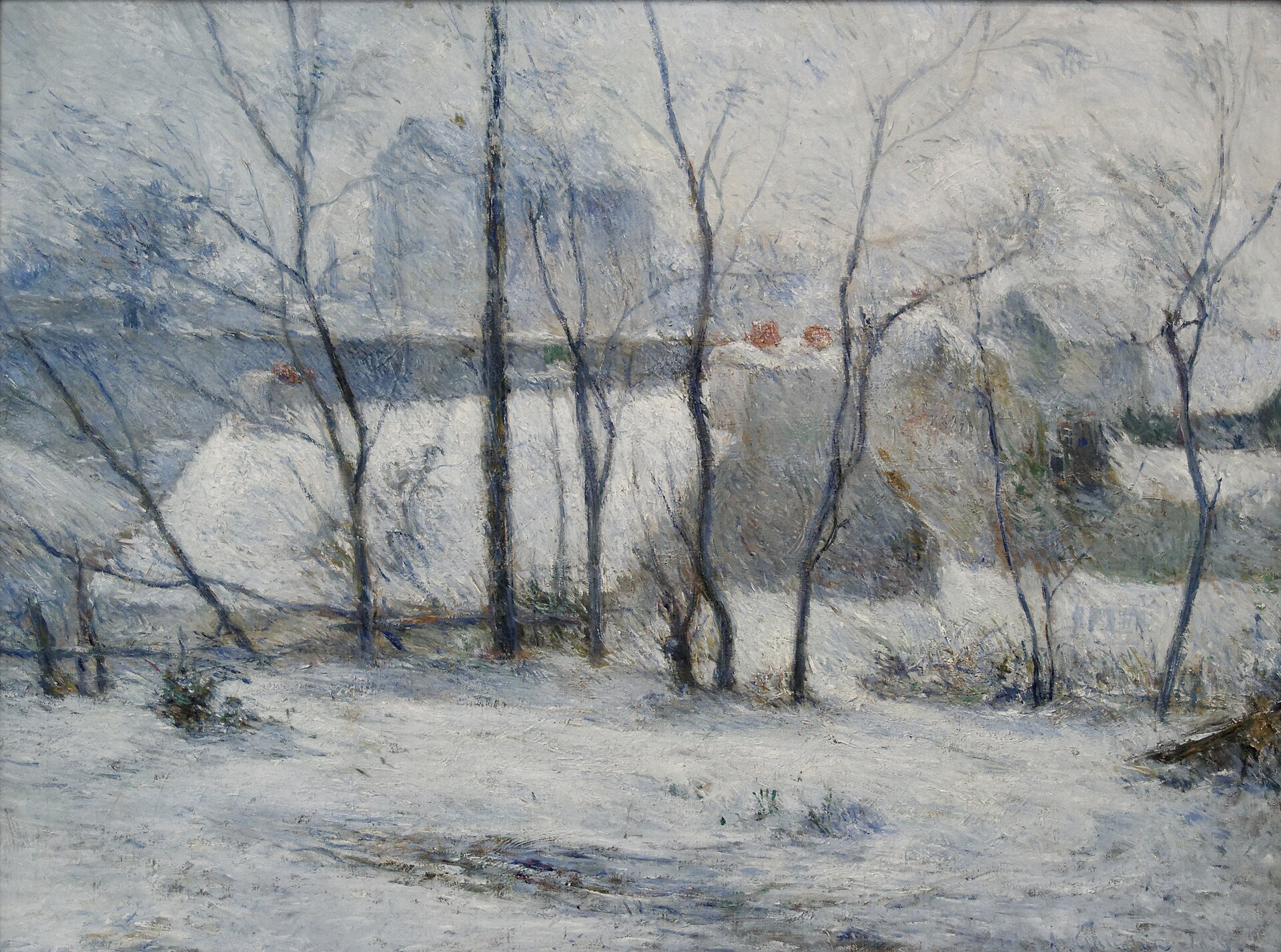
Garden under Snow. Paul Gauguin, 1879. Wikimedia Commons. Public domain.