
Psalm 128
6 verses · Song of Ascents, wisdom psalm
Blessed are all who fear the LORD, who walk in His ways!
Introduction
Author unstated, the Blessed Household, Book 5: The return and the great Hallelujah, Poetry, Psalms Overview.
This psalm names no writer and speaks to one ordinary man, a farmer with a house, a table and a family. It follows the previous psalm and shows what a household looks like when the LORD is the one who builds it. The picture widens from his own work to his wife and children, then to Jerusalem and his grandchildren. Listen for the plants of a village courtyard, and for the blessing that comes to him from Zion.
Context
- Who
- Israelite farmers who wanted nothing more exotic than a harvest they got to eat
- What
- A blessing on the man who fears the LORD, pictured in his work, his wife, his children and his old age.
- Where
- A village house in Israel, with its courtyard and its table.
- When
- Undated; it fits any time the temple stood, since its blessing comes from Zion.
- Why
- To show the pilgrim what a household blessed from Zion looks like.
Historical context
No name stands in the heading, and the psalm is addressed throughout to one man. Grapevines were trained along the inner walls of a courtyard, so the vine really did stand inside the house. Olive trees send up young shoots from the base of the trunk, and a mature tree stands in a small crowd of its own saplings. In that world an army, a raiding party or a tax collector routinely arrived at harvest and took the crop. The curses of the covenant list exactly that, that you will plant and another will eat. Life was short, infant deaths were common, and a man who lived to see grandchildren had beaten hard odds. The blessing at the end comes from Zion, where the pilgrim singing it was headed.
Significance
This follows the psalm about houses built in vain and shows the other side of it, what a house looks like when God builds it. Bread, a wife, children, grandchildren and peace over Israel make up the whole of it, and for the people singing it that was the whole hope.
This chapter in Jewish lifeWhat this chapter is in Jewish life and reading.
What is done
Psalm 128 is the ninth of the fifteen Songs of Ascents, sung within the collection whose setting this site records at /featured/psalms-of-ascent from Mishnah Middot 2:5 and Mishnah Sukkah 5:4. The psalm blesses the household of the man who fears the LORD, and the classical commentary on it is domestic throughout, on work, on marriage, on children and on grandchildren.
How it is read
Rashi reads the whole psalm as admonition and discipline rather than description. He notes that the opening says every man who fears the LORD, where other psalms say the man, and takes the word as widening the blessing to include a woman. On the fruitful vine he says that a woman whose blood is abundant will have many children, and on the innermost parts of the house he gives two readings, the custom of marital relations in private, and the separation kept while a wife is menstruating. On the olive shoots he reads a promise about the sons: "Just as olive trees cannot be grafted, so will your sons not have any disqualification" (Rashi on Psalms 128:3:3, the Judaica Press complete Tanach with Rashi, translated by A. J. Rosenberg, CC-BY). Malbim reads the blessing from Zion as a blessing on the whole people that reaches the individual through the whole, so that a man's days are spent seeking "the good of Jerusalem and the success of the whole" (Malbim on Psalms 128:5:1, translated by Rabbi Mike Feuer, Jerusalem Anthology, CC-BY). Metzudat David reads Zion in the same verse as the source of all blessing (Metzudat David on Psalms 128:5:1, Feuer translation, CC-BY). Ibn Ezra and Radak stand as citations here, at Ibn Ezra on Psalms 128:1:1 and Radak on Psalms 128:1:1.
What the rabbis say
Rashi hands on one saying with its locator, on the man who eats from the labour of his own hands: "He who benefits from the toil of his hands inherits two worlds", which he takes from Berakhot 8a (Rashi on Psalms 128:2:1). He also reads the closing line about seeing children born to one's children as a blessing that no woman of the household will come to the rite of halitzah, and that peace will rest on Israel because of it. The corpus records forty locators on this chapter, thirty Midrash and ten Talmud, among them Midrash Tehillim 128:1 on the opening blessing, Berakhot 8a:21 and Chullin 44b:11 on the labour of the hands, Berakhot 57a:6 and 57a:8 on the fruitful vine, and Ketubot 50a:14 on the children of one's children.
Sources: Rashi, Rashi on Psalms 128:1:1, 128:2:1, 128:3:1, 128:3:2, 128:3:3 and 128:6:1, the Judaica Press complete Tanach with Rashi, translated by A. J. Rosenberg, CC-BY; Malbim, Malbim on Psalms 128:5:1, translated by Rabbi Mike Feuer, Jerusalem Anthology, CC-BY; Metzudat David, Metzudat David on Psalms 128:5:1, Feuer translation, Jerusalem Anthology, CC-BY; Ibn Ezra, Ibn Ezra on Psalms 128:1:1, cited only, no English version in the corpus; Radak, Radak on Psalms 128:1:1, cited only; Babylonian Talmud, Berakhot 8a, as Rashi cites it; Berakhot 8a:21, Berakhot 57a:6 and 57a:8, Chullin 44b:11, Ketubot 50a:14, Sotah 40a:1; Midrash, Midrash Tehillim 128:1 and 119:4, Bamidbar Rabbah 15:12 and 8:9, Bereshit Rabbah 53:3, Eikhah Rabbah 1:2; Mishnah, Middot 2:5 and Sukkah 5:4, as /featured/psalms-of-ascent records them; MannaFest, the Songs of Ascents, at /featured/psalms-of-ascent, 2026.
Psalms 128:1-2
all who fear the LORD: The same Hebrew word closes Psalm 127 and opens this one, and Spurgeon called it the catch word joining the two songs. The blessing rests on those who fear the LORD and walk in His ways. A man eats the fruit of his own labor.
Psalms 128:1
“Blessed are all who fear the Lord. Just as no one can say 'The Lord is my portion' except the one who has no other portion in the world, so the one who fears anything else outside the Lord does not fear the Lord. Indeed, the Savior himself says: 'Do not fear those who can kill the body, but fear him who can kill both body and soul in hell.' You see, then, that whoever does not fear the Lord fears some other thing outside the Lord. The one who fears the Lord, what signs does he have?”
Jerome · written before 420 · Homily 42, on Psalm 127patristic
1 more voice on this verseWhat preachers and commentators have said about this verse, in their own words.
Psalms 128:1
“Blessed is every one that feareth the Lord. The last Psalm ended with a blessing, —for the word there translated "happy" is the same as that which is here rendered "blessed": thus the two songs are joined by a catch word. There is also in them a close community of subject. The fear of God is the corner stone of all blessedness. We must reverence the ever blessed God before we can be blessed ourselves.”
Charles Spurgeon · The Treasury of David, Vol. 7 (1885)Particular Baptist
when you eat the fruit of your labor: Verse 1 is said of all who fear the LORD, and verse 2 turns to you. Spurgeon called it the general doctrine given a personal application. Deuteronomy 28:33 uses the same word for labor in its curse, where a people Israel did not know eat the produce of its toil.
Psalms 128:2
“You will eat the labors of your hands. Many, not understanding, have interpreted this passage otherwise: 'You will eat the labors of your fruits.' Indeed the Latin copies have it thus: You will eat the labors of your fruits. But we read it written thus in the Hebrew: You will eat the labors of your hands. For who eats the labors of fruits? Surely it ought to be understood the other way around, that someone eats the fruit of his labors, and not the labors of his hands. For it is understood the other way around.”
Jerome · written before 420 · Homily 42, on Psalm 127patristic
1 more voice on this verse
Psalms 128:2
“For thou shalt eat the labour of thine hands. The general doctrine in Ps 128:1 here receives a personal application: note the change to the second person: "thou shalt eat", etc. This is the portion of God's saints, —to work, and to find a reward in so doing. God is the God of labourers. We are not to leave our worldly callings because the Lord has called us by grace: we are not promised a blessing upon romantic idleness or unreasonable dreaming, but upon hard work and honest industry.”
Charles Spurgeon · The Treasury of David, Vol. 7 (1885)Particular Baptist
Psalms 128:3-4
like a fruitful vine: The vine grows in the innermost part of the house, which is what the Hebrew word marks. The word for the sons' olive shoots stands once in the Hebrew Bible and means a young sucker. Verse 4 calls this the blessing of the God fearing man.
In this way indeed shall blessing come: The verse opens with behold in Hebrew, and Barnes heard a call to look at the man with his sons around him. The man is geber, the word for the blessed man with a full quiver at Psalm 127:5. Verse 5 turns the same verb for blessing into a prayer.
Psalms 128:4
“Behold, that thus shall the man be blessed that feareth the Lord. Mark this. Put a Nota Bene against it, for it is worthy of observation. It is not to be inferred that all blessed men are married, and are fathers; but that this is the way in which the Lord favours godly people who are placed in domestic life. He makes their relationships happy and profitable. In this fashion does Jehovah bless God fearing households, for he is the God of all the families of Israel.”
Charles Spurgeon · The Treasury of David, Vol. 7 (1885)Particular Baptist
1 more voice on this verse
Psalms 128:4
“This blessedness, arising from this blessing, is here secured, 1. To all the saints universally: Blessed is everyone that fears the Lord, whoever he be; in every nation he that fears God and works righteousness is accepted of him, and therefore is blessed whether he be high or low, rich or poor, in the world; if religion rule him, it will protect and enrich him.”
Matthew Henry · Commentary on the Whole Bible (1707-1721)puritan
Psalms 128:5-6
bless you from Zion: The blessing moves out from the house to Zion, Jerusalem and Israel. The man is given to see the prosperity of Jerusalem and his own grandchildren. Spurgeon set Proverbs 17:6 beside it, the crown of the aged.
Psalms 128:5
“The Loud shall bless thee out of Zion. A spiritual blessing shall be received by the gracious man, and this shall crown all his temporal mercies. He is one among the many who make up God's inheritance; his tent is part and parcel of the encampment around the tabernacle; and therefore, when the benediction is pronounced at the centre it shall radiate to him ill his place. The blessing of the house of God shall be upon his house.”
Charles Spurgeon · The Treasury of David, Vol. 7 (1885)Particular Baptist
Peace be upon Israel!: also closes Psalm 125, and Clarke read both as a prayer. Barnes called peace on Israel the crowning blessing, above prosperity and above the sight of your children's children. Gill read shalom as prosperity of every kind.
Psalms 128:6
“Yea, thou shalt see thy children's children. This is a great pleasure. Men live their young lives over again in their grandchildren. Does not Solomon say that "children's children are the crown of old men?" So they are. The good man is glad that a pious stock is likely to be continued; he rejoices in the belief that other homes as happy as his own will be built up wherein altars to the glory of God shall smoke with the morning and evening sacrifice.”
Charles Spurgeon · The Treasury of David, Vol. 7 (1885)Particular Baptist
How this psalm is built
The form: A song of the ascents that moves the blessing outward from a house to a city to a nation, as Spurgeon classes it.
The patterns in this chapter
| Device | What it does | Where to see it |
|---|---|---|
| The blessing widening in four steps | Verse 2 gives the man the fruit of his own labour. Verse 3 gives him a wife and sons at his table. Verse 5 gives him the prosperity of Jerusalem all his days. Verse 6 gives him his children's children, and the last words are peace upon Israel.Charles Spurgeon, The Treasury of David, Vol. 7, 1885, on Psalm 128:5. | Psalm 128:2, Psalm 128:3, Psalm 128:5, Psalm 128:6 |
| The vine and the olive shoots | Verse 3 gives two pictures from the same farm. The wife is a fruitful vine in the innermost part of the house, which is what the Hebrew marks, and the sons are olive shoots round the table. The word for those shoots stands once in the Hebrew Bible and means a young sucker at the root of a tree.John Gill, Exposition of the Old Testament (1748 to 1763), on Psalm 128:3. | Psalm 128:3 |
| The fear of the LORD at both ends | Verse 1 opens on all who fear the LORD and verse 4 closes the first half on the man who fears the LORD, so the description is bracketed by the one condition it depends on. Everything between the two lines is what that fear looks like in a house.Franz Delitzsch, Biblical Commentary on the Psalms, on Psalm 128:4. | Psalm 128:1, Psalm 128:4 |
The structure
10 more paragraphs on the patterns
Six verses in two halves. Verses 1 to 4 describe the blessing and are bracketed by the one condition it rests on. Verse 1 opens on all who fear the LORD and verse 4 closes on the man who fears the LORD. Verses 5 and 6 are a blessing pronounced on him from outside.
The blessing widens in four steps. Verse 2 gives the man the fruit of his own labour. Verse 3 gives him a wife and sons at his table. Verse 5 gives him the prosperity of Jerusalem all his days. Verse 6 gives him his children's children, and the last words are peace upon Israel.
Across the canon
The word blessed closes Psalm 127 and opens this psalm, and Charles Spurgeon called it the catch word joining the two. Psalm 127 says the household is a heritage given by the LORD, and Psalm 128 says what it looks like when a man who fears Him receives it.
The closing line, peace be upon Israel, also closes Psalm 125. Both psalms end a private comfort with a national one, so the blessing on one house is not allowed to stop at its own door.
The children's children of verse 6 stand beside Proverbs 17:6, where grandchildren are called the crown of the aged, and Charles Spurgeon set the two texts together.
In the New Testament
No New Testament writer quotes this psalm.
The Songs of Ascents
Psalm 128 is the ninth of the fifteen songs of ascents and the pair of Psalm 127, joined to it by the blessing that ends the one and begins the other. Albert Barnes records the reading that takes the title Songs of Degrees from an ascent of thought in these psalms (Notes on the Book of Psalms, on Psalm 124:2). On that reading a line takes up the words of the line before and carries them one step further. Here the blessed of verse 1 returns as the blessing of verse 4 and becomes a prayer in verse 5, May the LORD bless you from Zion. Verses 5 and 6 then climb by two clauses that each open on that you may see. It closes on Peace be upon Israel, the same words that close Psalm 125.
Keep studying
Sources for this chapter
The summary
Jamieson, Fausset & Brown, Commentary Critical and Explanatory; John Calvin, Commentaries; John Wesley, Notes on the Old Testament and Matthew Henry, Complete Commentary.
The form and classifications
Charles Spurgeon and John Gill, Exposition of the Old Testament (1748 to 1763), on Psalm 128:4.
The exposition
Adam Clarke, Commentary on the Bible; Albert Barnes, Notes on the Book of Psalms; Charles Spurgeon, The Treasury of David; Franz Delitzsch, Biblical Commentary on the Psalms; John Gill, Exposition of the Old Testament and Matthew Henry, Commentary on the Whole Bible.
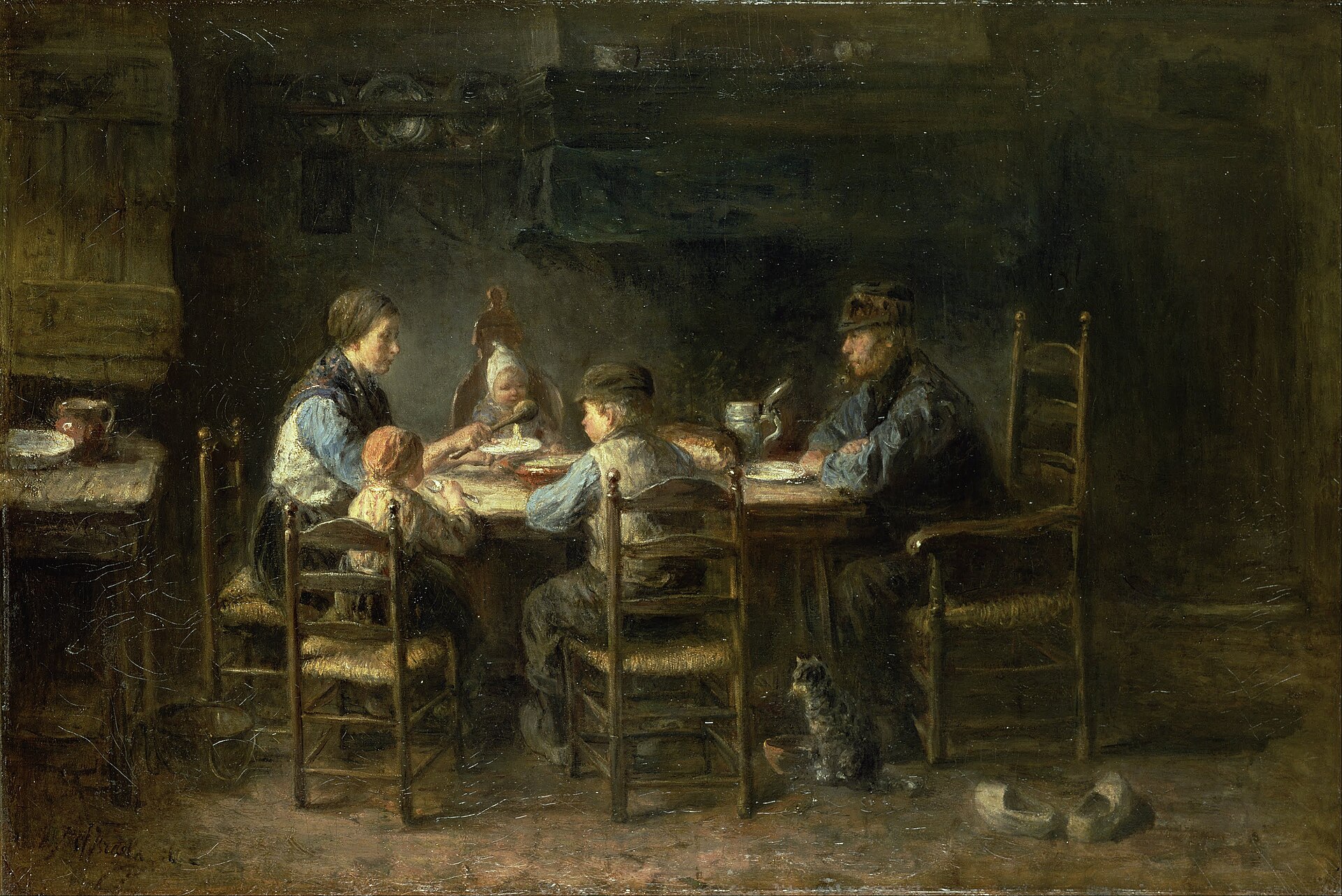
The painting
Peasant family at the table. Jozef Israëls, 1882. Wikimedia Commons. Public domain.