
Psalm 124
8 verses · Song of Ascents, community thanksgiving
If the LORD had not been on our side— let Israel now declare—
Introduction
David, the Escape, Book 5: The return and the great Hallelujah, Poetry, Psalms Overview.
David is named as the writer of this song, and it was made to be sung by the whole nation, a leader calling out and the people answering. It looks back on a disaster that nearly happened and names no enemy, so every generation could sing it about its own escape. Listen for the sentence that is started twice and left unfinished, for the pictures of flood and trap, and for the confession at the close that another Song of Ascents made first.
Context
- Who
- Israelites who had been one decision away from being destroyed
- What
- A thanksgiving sung by the whole congregation for an escape it credits to the LORD alone.
- Where
- The congregation of Israel gathered in worship.
- When
- The reign of David, about 1010 to 970 BC by the superscription, and sung again at every later escape.
- Why
- To teach every generation to say aloud that its survival came from the LORD.
Historical context
The heading assigns this psalm to David. It names no enemy and no date, so any generation could sing it about its own escape, with a leader calling out the first line and Israel answering. Its first picture is a flash flood. A dry stony valley that has held nothing for months fills in minutes after a storm on distant hills, and people and flocks caught in it are gone. The second picture is trapping. Birds were caught with a net staked flat on the ground and sprung by a cord, and a snapped cord meant the bird was out and away before the net closed. Between the two comes a set of teeth, the plain fear of a small nation surrounded by larger ones with standing armies.
Significance
The first hearers had lived through invasions that other nations did not survive, since Assyria and Babylon erased peoples permanently. So the song credits the escape to the LORD alone. If the LORD had not been on our side, it begins, and then it lets the sentence hang, because everyone singing could finish it from memory.
This chapter in Jewish lifeWhat this chapter is in Jewish life and reading.
What is done
Psalm 124 is the fifth of the fifteen Songs of Ascents and the second of them to carry David's name. It is said within the collection, whose setting this site records at /featured/psalms-of-ascent from Mishnah Middot 2:5 and Mishnah Sukkah 5:4. The psalm's subject is a rescue already given, and Jewish reading has taken it as the thanksgiving of a people who survived what should have ended them.
How it is read
The classical commentary on this chapter is thin in the corpus and turns mostly on wording. Rashi glosses three words. On the third verse he reads the word for their kindled anger as the same grammatical form as the word for making, on the fourth he reads the word for the torrent as an expression of illness, and on the seventh he takes the escape of the soul to be "like a bird that escaped from the hunter's snare" (Rashi on Psalms 124:7:1, the Judaica Press complete Tanach with Rashi, translated by A. J. Rosenberg, CC-BY). Radak comments on all eight verses and Ibn Ezra on seven, with Metzudat David on six. The corpus holds no English version of any of theirs on this chapter under a licence permitting quotation, so they stand as citations: Radak on Psalms 124:1:1, Ibn Ezra on Psalms 124:1:1, Metzudat David on Psalms 124:1:1.
What the rabbis say
The corpus records twenty-four locators on this chapter, twenty-three Midrash and one Talmud. The opening line, that if the LORD had not been for us, is the line the rabbis gathered around, and the locators there include Midrash Tehillim 124:1, Bereshit Rabbah 68:11, Bereshit Rabbah 74:11, Sifrei Devarim 322:2 and 322:3, and Megillah 11a:7. The escape from the snare in the seventh verse is taken up at Shemot Rabbah 20:6, Tanna DeBei Eliyahu Rabbah 7:1 and Midrash Lekach Tov on Lamentations 3:52:1. Each of these is a locator without text in the corpus, so this site names where the rabbis took the psalm up and leaves what they said there to the reader who follows the reference.
Sources: Rashi, Rashi on Psalms 124:3:1, 124:4:1 and 124:7:1, the Judaica Press complete Tanach with Rashi, translated by A. J. Rosenberg, CC-BY; Radak, Radak on Psalms 124:1:1, cited only, no English version in the corpus; Ibn Ezra, Ibn Ezra on Psalms 124:1:1, cited only; Metzudat David, Metzudat David on Psalms 124:1:1, cited only; Midrash, Midrash Tehillim 124:1, Bereshit Rabbah 68:11 and 74:11, Sifrei Devarim 322:2 and 322:3, Shemot Rabbah 20:6, Tanna DeBei Eliyahu Rabbah 7:1; Babylonian Talmud, Megillah 11a:7; Mishnah, Middot 2:5 and Sukkah 5:4, as /featured/psalms-of-ascent records them; MannaFest, the Songs of Ascents, at /featured/psalms-of-ascent, 2026.
Psalms 124:1-2
let Israel now declare—: The condition is stated twice: the LORD was on Israel's side when men attacked. Matthew Henry marks where the danger came from, men of their own kind. Israel is called to declare it aloud.
Psalms 124:1
“If it had not been the Lord who was on our side, now may Israel say. The opening sentence is abrupt, and remains a fragment. By such a commencement attention was aroused as well as feeling expressed: and this is ever the way of poetic fire—to break forth in uncontrollable flame. The many words in italics in our authorized version will show the reader that the translators did their best to patch up the passage, which, perhaps, had better have been left in its broken grandeur, and it would then have run thus:—"Had it not been Jehovah!”
Charles Spurgeon · The Treasury of David, Vol. 6 (1882)Particular Baptist
2 more voices on this verseWhat preachers and commentators have said about this verse, in their own words.
Psalms 124:1
“If it had not been the Lord who was on our side,.... Or, "was for us" (h). The Syriac version is, "that rose up for us"; against their enemies, that rose up against them, as in Psa 123:2, or, "was with us", as Kimchi and Ben Melech; to help and assist, support and supply, strengthen and defend: or, "was among us", as the Arabic version; as their King, Protector, and Saviour.”
Psalms 124:1
“To get quit of this difficulty they observe, that what had not yet come to pass is described prophetically; but this is a forced conjecture, for the Prophets usually speak of things to come in a different manner. It is more probable that David here sets forth a known history, and exhorts the faithful to reflect upon the divine succor which they had already actually experienced.”
John Calvin · Commentaries (1554)reformed
when men attacked us: John Calvin gives the reason Israel must declare it twice. Once the men who attacked are gone, the rescued shrink the danger in memory and lose sight of the LORD on their side. The repetition keeps that grace in view.
Psalms 124:2
“If it had not been the Lord who was on our side,.... This he repeats both for the confirmation of it, and to excite the attention of the Israelites to it; as well as to observe that it was not once only, but again and again, many times the Lord appeared to be on their side. The Targum renders it, "the Word of the Lord;'' the essential Word, the Son of God; and so in Psa 123:1, in the king's Bible; when men rose up against us; wicked men; though no hard epithet is given in the text, however just.”
1 more voice on this verse
Psalms 124:2
“But for Jehovah who was on our side. It is not without cause that he twice repeats the same sentence. So long as we are in danger our fear is immoderate; but no sooner are we delivered than we lessen the greatness of our calamity, and Satan, deceiving us by this artifice, leads us to obscure the grace of God.”
John Calvin · Commentaries (1554)reformed
Psalms 124:3-5
their anger flared against us: Three clauses stack what almost happened, each opening with then. The first is being swallowed alive, and the next two turn to water, a torrent engulfing them and raging waters sweeping them away. The anger of verse 3 becomes water by verse 5.
Psalms 124:3
“Then they had swallowed us up quick, when their wrath was kindled against us. They were so eager for our destruction that they would have made only one morsel of us, and have swallowed us up alive and whole in a single instant. The fury of the enemies of the church is raised to the highest pitch, nothing will content them but the total annihilation of God's chosen. Their wrath is like a fire which is kindled, and has taken such firm hold upon the fuel that there is no quenching it.”
Charles Spurgeon · The Treasury of David, Vol. 6 (1882)Particular Baptist
1 more voice on this verse
Psalms 124:3
“Then they had swallowed us up quick,.... Or "alive"; as the earth swallowed up Korah and his company; or as the fish swallowed up Jonah; or rather as ravenous beasts swallow their prey; to which the allusion is.”
the torrent would have overwhelmed us: The torrent is nachal, a winter stream in a narrow valley. Charles Spurgeon sees two waters, the flood that engulfed and the torrent that overwhelmed, one rising and one rushing. The word stands at Psalm 18:4, where torrents overwhelmed the psalmist and the LORD drew him out of deep waters.
Psalms 124:4
“Then the waters had overwhelmed us. Rising irresistibly, like the Nile, the flood of opposition would soon have rolled over our heads. Across the mighty waste of waters we should have cast an anxious eye, but looked in vain for escape. The motto of a royal house is, "Tossed about but not submerged": we should have needed an epitaph rather than an epigram, for we should have been driven by the torrent and sunken, never to rise again. The stream had gone over our soul. The rushing torrent would have drowned our soul, our hope, our life.”
Charles Spurgeon · The Treasury of David, Vol. 6 (1882)Particular Baptist
the raging waters: Raging renders zeydon, boiling water, a word used only here. Jamieson, Fausset and Brown read the proud waters of the King James as the insolent men, a flood that would have swept Israel away. Psalm 123:4 had just named contempt from the proud.
Psalms 124:5
“Then the proud waters had gone over our soul. The wicked, who, through their pride, persecute the poor saints: these proud tyrants and persecutors would prevail over them, to their ruin and destruction; who, for their number, force, and strength, and especially for their pride and haughtiness, are like to the strong, boisterous, and swelling waves of the sea, were they not stopped and bounded by him who has said, Thus far shall ye go, and no farther, Job 38:11.”
2 more voices on this verse
Psalms 124:5
“Then the proud waters had gone over our soul. The figure represents the waves as proud, and so they seem to be when they overleap the bulwarks of a frail bark, and threaten every moment to sink her. The opposition of men is usually embittered by a haughty scorn which derides all our godly efforts as mere fanaticism or obstinate ignorance. In all the persecutions of the church a cruel contempt has largely mingled with the oppression, and this is overpowering to the soul.”
Charles Spurgeon · The Treasury of David, Vol. 6 (1882)Particular Baptist
Psalms 124:5
“The epithet proud added to waters denotes insolent enemies. The figure is changed to that of a rapacious wild beast (Ps 3:7), and then of a fowler (Ps 91:3), and complete escape is denoted by breaking the net.”
Jamieson, Fausset & Brown · Commentary Critical and Explanatory on the Whole Bible (1871)reformed
Psalms 124:6-7
as prey to their teeth: The picture changes from teeth to a bird in a snare. Matthew Henry notes the word means a little bird, a sparrow. Verse 7 says snare twice and escaped twice, and the net between them is torn.
Psalms 124:6
“What then is our duty, my brothers, for the sake of these things, but to praise and give thanks to God, the king of all? And let us first exclaim in the words of the psalms, "Blessed be the Lord, who has not given us over as a prey to their teeth." Let us keep the feast in that way that he has dedicated for us unto salvation—the holy day Easter—so that we may celebrate the feast which is in heaven with the angels.”
Athanasius of Alexandria · written before 373 · Letter 10.11patristic
2 more voices on this verse
Psalms 124:6
“Blessed be the Lord, who hath not given us as a prey to their teeth. Leaving the metaphor of a boiling flood, he compares the adversaries of Israel to wild beasts who desired to make the godly their prey. Their teeth are prepared to tear, and they regard the godly as their victims. The Lord is heartily praised for not permitting his servants to be devoured when they were between the jaws of the raging ones.”
Charles Spurgeon · The Treasury of David, Vol. 6 (1882)Particular Baptist
Psalms 124:6
“God's people are taken in the snare, and are as unable to help themselves out as any weak and silly bird is; and then is God's time to appear for their relief, when all other friends fail; then God breaks the snare, and turns the counsel of the enemies into foolishness: The snare is broken and so we are delivered. Isaac was saved when he lay ready to be sacrificed.”
Matthew Henry · Commentary on the Whole Bible (1707-1721)puritan
the net is torn: The same word for snare stands at Psalm 91:3, where the LORD delivers from the snare of the fowler. Adam Clarke reads this psalm against Esther, with Haman caught in the snare he had set. The net is torn by the LORD blessed in verse 6.
Psalms 124:7
“Our soul is escaped as a bird out of the snare of the fowlers. Our soul is like a bird for many reasons; but in this case the point of likeness is weakness, folly, and the ease with which it is enticed into the snare. Fowlers have many methods of taking small birds, and Satan has many methods of entrapping souls. Some are decoyed by evil companions, others are enticed by the love of dainties; hunger drives many into the trap, and fright impels numbers to fly into the net.”
Charles Spurgeon · The Treasury of David, Vol. 6 (1882)Particular Baptist
1 more voice on this verse
Psalms 124:7
“It is the same with David. Where the soul is supported with spiritual wings, he has chosen to describe the soul as a bird, as he has said in one place, "My soul has escaped like a bird from the snare of the fowlers"; and again, In the Lord I take refuge; how can you say to my soul, "Flee like a bird to the mountain." Thus the soul has its wings by which it can raise itself free from the earth.”
Ambrose of Milan · written before 397 · Concerning Virginity 18patristic
Our help is in the name: The psalm ends on the confession of Psalm 121:2, help in the name of the LORD, Maker of heaven and earth. Psalm 121:2 puts the confession in the singular, and this verse puts it in the plural. The waters and the snare came out of what He made.
Psalms 124:8
“Our help, our hope for the future, our ground of confidence in all trials present and to come. Is in the name of the Lord. Jehovah's revealed character is our foundation of confidence, his person is our sure fountain of strength. Who made heaven and earth. Our Creator is our preserver. He is immensely great in his creating work; he has not fashioned a few little things alone, but all heaven and the whole round earth are the works of his hands. When we worship the Creator let us increase our trust in our Comforter.”
Charles Spurgeon · The Treasury of David, Vol. 6 (1882)Particular Baptist
How this psalm is built
The form: A song of the ascents of David in which the people are told to say for themselves what would have happened without the LORD, as Henry classes it.
The patterns in this chapter
| Device | What it does | Where to see it |
|---|---|---|
| The condition stated twice | Verse 1 and verse 2 open with the same clause, if the LORD had not been on our side, and the sentence is not finished until verse 3. Between the two halves stands the instruction, let Israel now declare, so the congregation says the line back before hearing what hangs on it.Matthew Henry, Commentary on the Whole Bible, 1710, on Psalm 124:1. | Psalm 124:1, Psalm 124:2 |
| Three clauses beginning with then | Verses 3, 4 and 5 stack what almost happened, each opening with then. The first is being swallowed alive, and the next two turn to water, a torrent engulfing them and raging waters sweeping them away. The anger of verse 3 has become a flood by verse 5.Albert Barnes, Notes, Explanatory and Practical, on the Old and New Testaments (1832 to 1869), on Psalm 124:4. | Psalm 124:3, Psalm 124:4, Psalm 124:5 |
| The bird and the torn net | Verse 7 says snare twice and escaped twice, and puts the torn net between them, so the sentence itself opens and the bird goes through. Matthew Henry notes that the Hebrew word names a little bird, a sparrow, which is the smallest thing a fowler would bother to trap.Matthew Henry, Commentary on the Whole Bible, 1710, on Psalm 124:7. | Psalm 124:6, Psalm 124:7 |
The structure
10 more paragraphs on the patterns
Eight verses in three movements held by a single unfinished sentence. Verses 1 and 2 open with the same clause twice, if the LORD had not been on our side, and the sentence is not completed until verse 3. Verses 3 to 5 stack three clauses each beginning with then. Verses 6 to 8 are the blessing, the escape and the confession.
The danger changes shape twice inside those eight verses. It is teeth in verses 3 and 6, water in verses 4 and 5, and a fowler's net in verse 7. Each picture is dropped as soon as it has done its work.
Verse 7 is built to sound like what it describes. It says snare twice and escaped twice and puts the torn net between them, so the sentence itself opens and the bird goes through.
Across the canon
The last verse is the confession of Psalm 121:2 in another number, singular there and plural here. The same title closes the collection at Psalm 134:3, where the LORD who made heaven and earth blesses the pilgrim from Zion. One name of God stands at the road, the rescue and the farewell.
The opening call, let Israel now declare, returns word for word at Psalm 129:1, where the subject is a persecution endured from youth rather than a single escape.
In the New Testament
No New Testament writer quotes this psalm. The title of God in verse 8 is on the lips of the church at Acts 4:24. There the believers pray to the Sovereign Lord who made the heaven and the earth and the sea and everything in them. Paul uses the same title at Lystra at Acts 14:15 to turn a crowd from its idols.
The Songs of Ascents
Psalm 124 is the fifth of the fifteen songs of ascents, and it was made to be sung in turns, a leader giving the line and Israel declaring it back. Albert Barnes records the reading that takes the title Songs of Degrees from an ascent of thought in these psalms (Notes on the Book of Psalms, on Psalm 124:2). On that reading a line takes up the words of the line before and carries them one step further. This psalm is the one Barnes names: its opening line, if the LORD had not been on our side, is said and then said again with more added, when men attacked us. Verses 3 to 5 climb the same way by a run of clauses that each open on then. Its last verse takes up the confession of Psalm 121:2, the Maker of heaven and earth. The fifteen songs repeat their words from one psalm to another as well as from one line to the next.
Keep studying
Studies1
Words8
Sources for this chapter
The summary
Jamieson, Fausset & Brown, Commentary Critical and Explanatory; John Calvin, Commentaries; John Wesley, Notes on the Old Testament and Matthew Henry, Complete Commentary.
The form and classifications
Charles Spurgeon, The Treasury of David, Vol. 6, 1882, on Psalm 124:7; Franz Delitzsch, Biblical Commentary on the Psalms, on Psalm 124:8 and Matthew Henry, Commentary on the Whole Bible, 1710, on Psalm 124:1.
The exposition
Adam Clarke, Commentary on the Bible; Albert Barnes, Notes on the Book of Psalms; Charles Spurgeon, The Treasury of David; Franz Delitzsch, Biblical Commentary on the Psalms; Jamieson, Fausset & Brown, Commentary Critical and Explanatory on the Whole Bible; John Calvin, Commentary on the Book of Psalms; John Gill, Exposition of the Old Testament and Matthew Henry, Commentary on the Whole Bible.
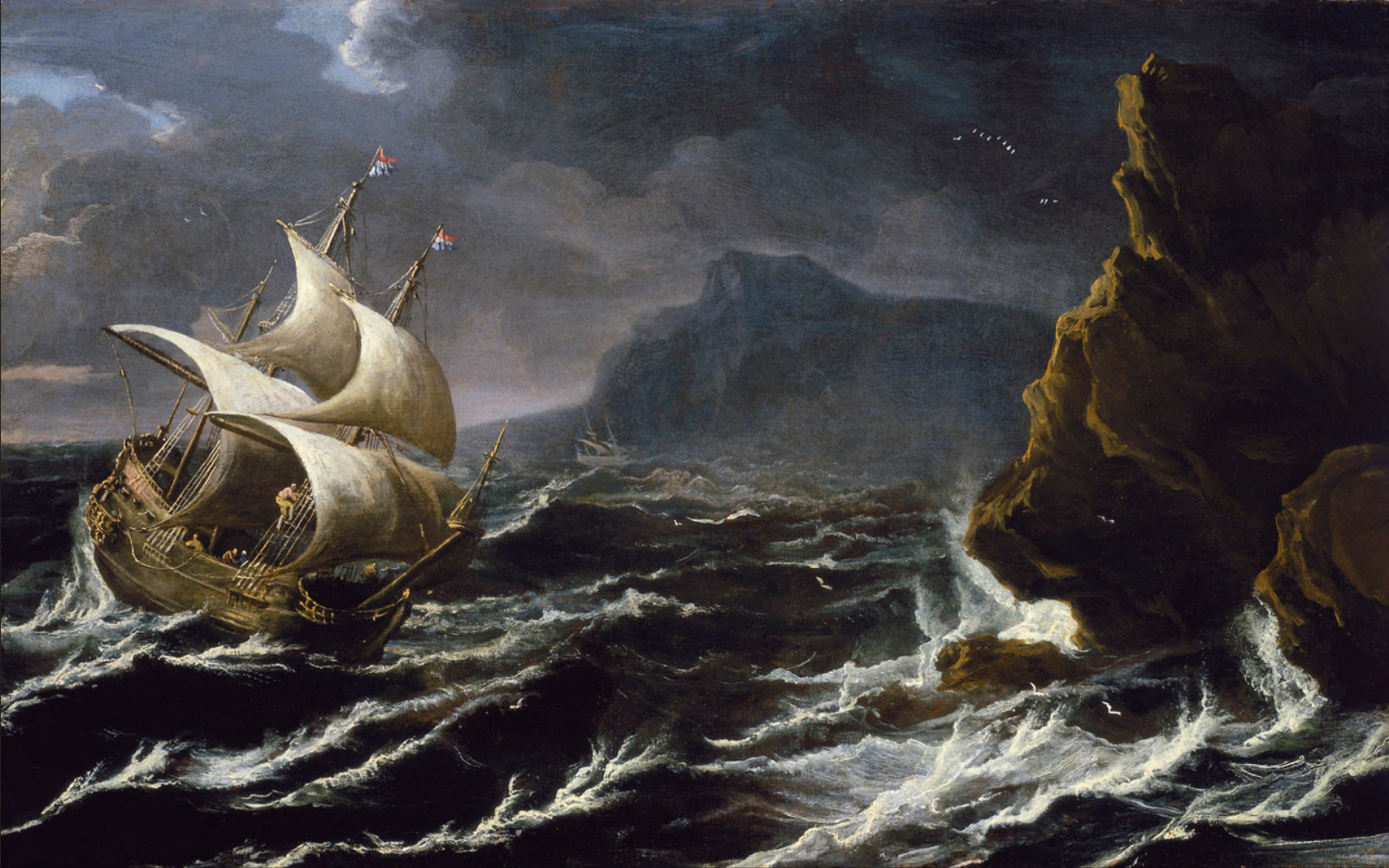
The painting
A Dutch Ship Running on to a Rocky Coast. Matthieu van Plattenberg, late 1640s. Wikimedia Commons. Public domain.