
Psalm 121
8 verses · Song of Ascents, psalm of trust
I lift up my eyes to the hills. From where does my help come?
Introduction
Author unstated, the Keeper, Book 5: The return and the great Hallelujah, Poetry, Psalms Overview.
Written for families about to walk the long road up to Jerusalem for a feast, this psalm names no writer and was sung as a blessing at the start of the walk. It is the second of the fifteen Songs of Ascents. A single question opens it, and the rest is one answer spoken back to the traveller by a second voice. Listen for one Hebrew verb, to guard, which returns six times, and for how each time it reaches a little further than before.
Context
- Who
- Israelite families walking a dangerous road together, carrying their offerings with them
- What
- A pilgrim song that asks where help comes from and answers that the Maker of heaven and earth keeps the one who walks.
- Where
- The hill country on the road up to Jerusalem, with the traveller looking at the ridges ahead
- When
- Undated; the heading places its use on the pilgrim road to the three yearly feasts.
- Why
- To send a traveller out on a dangerous road with the LORD named as his keeper from the day he leaves to the day he returns.
Historical context
The fifteen psalms headed a song of ascents, Psalms 120 to 134, belonged to the road up to Jerusalem. Deuteronomy 16:16 requires every Israelite man to appear before the LORD three times a year, so families travelled in groups along ridge roads through broken country to reach the sanctuary. Ravines and caves along those routes sheltered bandits, and a traveller carrying an offering was worth robbing. High points across the region also held local shrines, so a man in trouble on that road was surrounded by invitations to ask a local god for protection. A foot slipping on a stony descent could end a walk of days, the sun in that country is a weapon by midday, and the moon was widely held to bring on sickness at night.
Significance
A family setting out on a week's walk sang this as a departure blessing. It promised protection for the going out and the coming in, which is the whole round trip, door to door. In the pilgrim collection it comes straight after the psalm of the man stranded far from home, and the first thing he needs is to survive the road.
This chapter in Jewish lifeWhat this chapter is in Jewish life and reading.
What is done
Psalm 121 stands second in the Songs of Ascents, the fifteen psalms of 120 to 134 that the fifth book of the Psalter gathers as pilgrim songs sung going up to Jerusalem. Jewish tradition sets the fifteen against the fifteen steps rising from the Court of the Women to the Court of Israel at Mishnah Middot 2:5, with the Levites standing on them to sing at Mishnah Sukkah 5:4. Both tractate references are the ones this site has already checked, on its page for the collection at /featured/psalms-of-ascent. Rashi reads the title as that practice, and says that when the Levites began to ascend the steps "they recited this song" (Rashi on Psalms 121:1:1, the Judaica Press complete Tanach with Rashi, translated by A. J. Rosenberg, CC-BY).
How it is read
Rashi gives the psalm two readings. The first is the plain one, the Levites on the steps, and he adds that the songs of the collection do not stand in the order of the events they belong to. The second he takes from the Sifrei, and it reads the title as a promise rather than a stair: "It does not say here, 'A song of ascents' but, 'A song for ascents'; a song for the One Who is destined to make ascents for the righteous in the future" (Rashi on Psalms 121:1:2, citing Sifrei Ekev 47). Ibn Ezra, Radak, Metzudat David and Malbim all comment on this chapter. The corpus holds no English version of any of their comments here under a licence permitting quotation, so they stand as citations: Ibn Ezra on Psalms 121:1:1, Radak on Psalms 121:3:1, Metzudat David on Psalms 121:2:1, Malbim on Psalms 121:2:1.
What the rabbis say
The corpus records forty rabbinic locators on this chapter, thirty-seven of them Midrash and three Talmud, and every one is a locator without text, so this site cites where the rabbis took the psalm up rather than what they said there. The verse about the Keeper of Israel who neither slumbers nor sleeps draws the most of them, among them Bamidbar Rabbah 11:5, Bamidbar Rabbah 20:20, Eikhah Rabbah 1:52 and Jerusalem Talmud Maaser Sheni 5:5:15. The verse naming the LORD as the shade at the right hand is taken up at Sifrei Bamidbar 40:1 and at Menachot 33b:3, and the closing promise over the going out and the coming in at Bereshit Rabbah 79:2, Devarim Rabbah 7:5 and Avodah Zarah 11a:5. Rashi himself hands on one saying with its locator, the Sifrei passage quoted above.
Sources: Rashi, Rashi on Psalms 121:1:1 and 121:1:2, the Judaica Press complete Tanach with Rashi, translated by A. J. Rosenberg, CC-BY; Ibn Ezra, Ibn Ezra on Psalms 121:1:1, cited only, no English version in the corpus; Radak, Radak on Psalms 121:3:1, cited only; Metzudat David, Metzudat David on Psalms 121:2:1, cited only; Malbim, Malbim on Psalms 121:2:1, cited only; Sifrei, Sifrei Ekev 47, as Rashi cites it; Sifrei Bamidbar 40:1; Midrash, Bamidbar Rabbah 11:5 and 20:20, Eikhah Rabbah 1:52, Bereshit Rabbah 79:2, Devarim Rabbah 7:5; Babylonian Talmud, Menachot 33b:3, Avodah Zarah 11a:5; Jerusalem Talmud, Maaser Sheni 5:5:15; Mishnah, Middot 2:5 and Sukkah 5:4, as /featured/psalms-of-ascent records them; MannaFest, the Songs of Ascents, at /featured/psalms-of-ascent, 2026.
Psalms 121:1-2
I lift up my eyes: The eyes go up to the hills, and a question goes with them. Verse 2 answers it: help comes from the LORD, Maker of heaven and earth. The hills themselves are part of what He made.
the Maker of heaven and earth: Albert Barnes ties the help to the making: the One who created all can defend all. The Maker of heaven and earth returns in the blessing of Psalm 134:3, where the LORD blesses from Zion. Help and blessing come from one Maker.
Psalms 121:3-6
your Protector will not slumber: One word holds this psalm together, shamar, and it stands six times, rendered Protector, keeper, guard, preserve and watch over. Matthew Henry sets verse 4 beside verse 5, so the keeper of Israel is the keeper of each one. Verse 6 covers the sun by day, the moon by night.
Psalms 121:3
He will not suffer thy foot to be moved. Though the paths of life are dangerous and difficult, yet we shall stand fast, for Jehovah will not permit our feet to slide; and if he will not suffer it we shall not suffer it. If our foot will be thus kept we may be sure that our head and heart will be preserved also. In the original the words express a wish or prayer, —"May he not suffer thy foot to be moved."
Charles Spurgeon · The Treasury of David, Vol. 6 (1882)Particular Baptist
the Protector of Israel: John Gill reads it against Jacob asleep at Bethel. There the LORD promised at Genesis 28:15 to watch over him, with shamar, the verb behind Protector here. Israel the man would sleep, and the Protector of Israel would neither slumber nor sleep.
Psalms 121:4
“Behold, he that keepeth Israel shall neither slumber nor sleep. The consoling truth must be repeated: it is too rich to be dismissed in a single line. It were well if we always imitated the sweet singer, and would dwell a little upon a choice doctrine, sucking the honey from it. What a glorious title is in the Hebrew—"The keeper of Israel, "and how delightful to think that no form of unconsciousness ever steals over him, neither the deep slumber nor the lighter sleep.”
Charles Spurgeon · The Treasury of David, Vol. 6 (1882)Particular Baptist
the shade on your right hand: Verses 3 and 4 speak of the Protector by title, and here the keeper is named, the LORD, twice over. Albert Barnes sets the shade at the right hand, the place where a protector stood, as at Psalm 16:8. The busiest hand gets the most shade.
Psalms 121:5
“Those must needs be well kept that have the Lord for their keeper. If, by affliction, they be made his prisoners, yet still he is their keeper. The same that is the protector of the church in general is engaged for the preservation of every particular believer, the same wisdom, the same power, the same promises.”
Matthew Henry · Commentary on the Whole Bible (1707-1721)puritan
The sun will not strike you by day: The verb behind strike is nakah, the word for a blow, and Albert Barnes hears sunstroke in it. Adam Clarke reads the sun and moon as heat by day and cold by night. The shade of verse 5 answers this sun.
Psalms 121:6
“Smite - With excessive heat. Moon - With that cold and moisture which come into the air by it. Intemperate heats and colds are the springs of many diseases.”
John Wesley · Explanatory Notes upon the Old Testament (1765)evangelical
Psalms 121:7-8
guard you from all evil: Verse 7 sets the guard over all evil and over the soul. Verse 8 sets it over coming and going, the Hebrew way of naming a whole life's business, as at Deuteronomy 28:6. The last words are now and forevermore.
Psalms 121:7
“The Lord shall preserve thee from all evil, or keep thee from all evil. It is a great pity that our admirable translation did not keep to the word keep all through the psalm, for all along it is one. God not only keeps his own in all evil times but from all evil influences and operations, yea, from evils themselves. This is a far reaching word of covering: it includes everything and excludes nothing: the wings of Jehovah amply guard Iris own from evils great and small, temporary and eternal.”
Charles Spurgeon · The Treasury of David, Vol. 6 (1882)Particular Baptist
1 more voice on this verse
Psalms 121:7
“Thee Lord shall preserve them from all evil,.... The Word of the Lord, as the Targum.”
both now and forevermore: Charles Spurgeon sets the LORD's watch at the doorway, where every coming and going turns a fresh side to the enemy. Now and forevermore returns at Psalm 125:2 and 131:3.
Psalms 121:8
“The Lord shall preserve thy going out, and thy coming in,.... In transacting all the business of life, in going in and out about it; in all ways, works, and conversation; in journeying and travelling; in all affairs, civil and religious; and not only preserve, but prosper in all, Psa 1:3; the Lord blessing him, coming in and going out, Deu 28:6; and such, with the poet (x), are said to go with a good or prosperous foot.”
1 more voice on this verse
Psalms 121:8
“The Lord shall preserve thy going out and thy coming in from this time forth, and even for evermore. When we go out in the morning to labour, and come home at eventide to rest, Jehovah shall keep us. When we go out in youth to begin life, and come in at the end to die, we shall experience the same keeping. Our exits and our entrances are under one protection.”
Charles Spurgeon · The Treasury of David, Vol. 6 (1882)Particular Baptist
How this psalm is built
The form: A pilgrim song in which the keeper of Israel is shown to be the keeper of each single person who sings it, as Henry classes it.
The patterns in this chapter
| Device | What it does | Where to see it |
|---|---|---|
| The question, then the answer | Verse 1 lifts the eyes to the hills and asks where help comes from. Verse 2 gives the answer, the LORD who made heaven and earth, so the hills themselves are part of what He made. John Gill reads those hills as Moriah and Zion, where the ark of God stood.John Gill, Exposition of the Old Testament (1748 to 1763), on Psalm 121:1. | Psalm 121:1, Psalm 121:2 |
| The keeping word, six times over | One Hebrew verb, shamar, to guard, stands six times in eight verses. The Berean renders it Protector, keeper, guard, preserve and watch over. Matthew Henry sets verse 4 beside verse 5, so the Protector of Israel is also the keeper of the one traveller.Matthew Henry, Commentary on the Whole Bible, 1710, on Psalm 121:4. | Psalm 121:3, Psalm 121:4, Psalm 121:5, Psalm 121:7, Psalm 121:8 |
| The whole day and the whole life | Verse 6 covers the day in two halves, the sun by day and the moon by night. Verse 8 covers a life the same way, the coming and the going, which is how Deuteronomy 28:6 names the whole business of a man.Franz Delitzsch, Biblical Commentary on the Psalms, on Psalm 121:8. | Psalm 121:6, Psalm 121:8 |
The structure
13 more paragraphs on the patterns
Eight verses in two halves. Verses 1 and 2 are a question and its answer in the first person. Verses 3 to 8 are the answer enlarged, spoken to the traveller, and they are held together by one Hebrew verb.
That verb is shamar, to guard, and it stands six times in the six verses. The Berean renders it Protector, keeper, guard, preserve and watch over. Each time it widens its reach: the foot, then Israel, then the shade at the right hand, then all evil, then the soul, then the coming and the going.
Verse 6 is a merism, a pair of opposites standing for everything between them, the sun by day and the moon by night. Verse 8 is another, the coming and the going, which Deuteronomy 28:6 uses for the whole business of a man's life.
Across the canon
The confession of verse 2 returns at Psalm 124:8 with one change of number. Here it is singular, my help comes from the LORD, the Maker of heaven and earth. There it is plural, our help is in the name of the LORD, the Maker of heaven and earth. The same title closes the collection at Psalm 134:3.
The lifted eyes of verse 1 are lifted again at Psalm 123:1, and that psalm names where they go, to the One enthroned in heaven. Read in order the two psalms move the gaze from the hills to the throne.
In the New Testament
No New Testament writer quotes this psalm. Revelation 7:16 promises of the redeemed that the sun will not beat down upon them, nor any scorching heat. That is the promise of verse 6 made against the same danger. The Berean carries the line in single quotation marks as an echo of earlier Scripture rather than a named citation.
What is debated
What the hills of verse 1 are is read two ways, and both readings are old. John Gill rejects the idea that the singer is scanning the ridges for a rescue party. He takes the hills as Moriah and Zion, where the ark of God stood, or else heaven itself, and on that reading verse 1 is already a prayer. Matthew Henry reads them the same way, as the hills on which the temple was built.
The other reading takes the hills as the danger of the road itself, the country the bandits held, so that verse 2 corrects the direction of the look. The Hebrew supplies no article of place to settle it, and the psalm works on either reading.
The Songs of Ascents
Psalm 121 is the second of the fifteen psalms headed a song of ascents, Psalms 120 to 134, and like the rest it is short enough for a walking family to carry by heart. Albert Barnes records the reading that takes the title Songs of Degrees from an ascent of thought in these psalms (Notes on the Book of Psalms, on Psalm 124:2). On that reading a line takes up the words of the line before and carries them one step further. Here the step is plain: verse 3 ends on your Protector will not slumber, and verse 4 takes up the same word and climbs to the Protector of Israel will neither slumber nor sleep. Jerome reads the fifteen songs as one climb (Homily 46, on the last Song of Ascents). He counts this psalm as the second step, the eyes lifted to the mountains after the cry of Psalm 120. That psalm is Psalm 133 in his numbering and Psalm 134 in the Berean. The Mishnah records a second reading of the heading, the fifteen steps between two courts of the temple on which the Levites stood and sang, one step for each song (Mishnah, Sukkah 5.4).
Keep studying
Sources for this chapter
The summary
Jamieson, Fausset & Brown, Commentary Critical and Explanatory; John Calvin, Commentaries; John Wesley, Notes on the Old Testament and Matthew Henry, Complete Commentary.
The form and classifications
John Gill, Exposition of the Old Testament (1748 to 1763), on Psalm 121:1 and Matthew Henry.
The exposition
Adam Clarke, Commentary on the Bible; Albert Barnes, Notes on the Book of Psalms; Charles Spurgeon, The Treasury of David; Franz Delitzsch, Biblical Commentary on the Psalms; John Gill, Exposition of the Old Testament and Matthew Henry, Commentary on the Whole Bible.
The painting
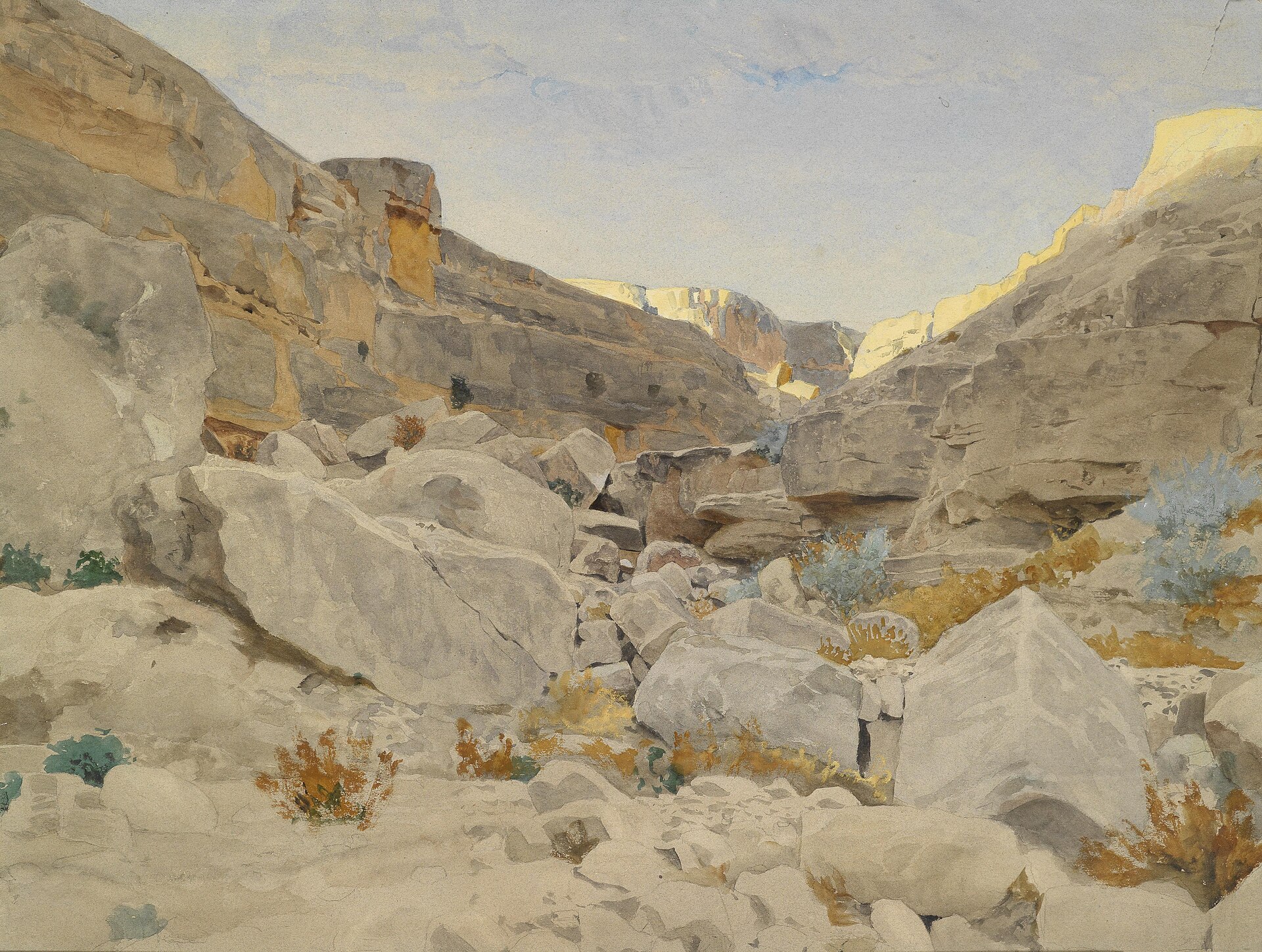
Landschaft in Sinai. Attributed to Adolf von Meckel, by 1893. Wikimedia Commons. Public domain.