
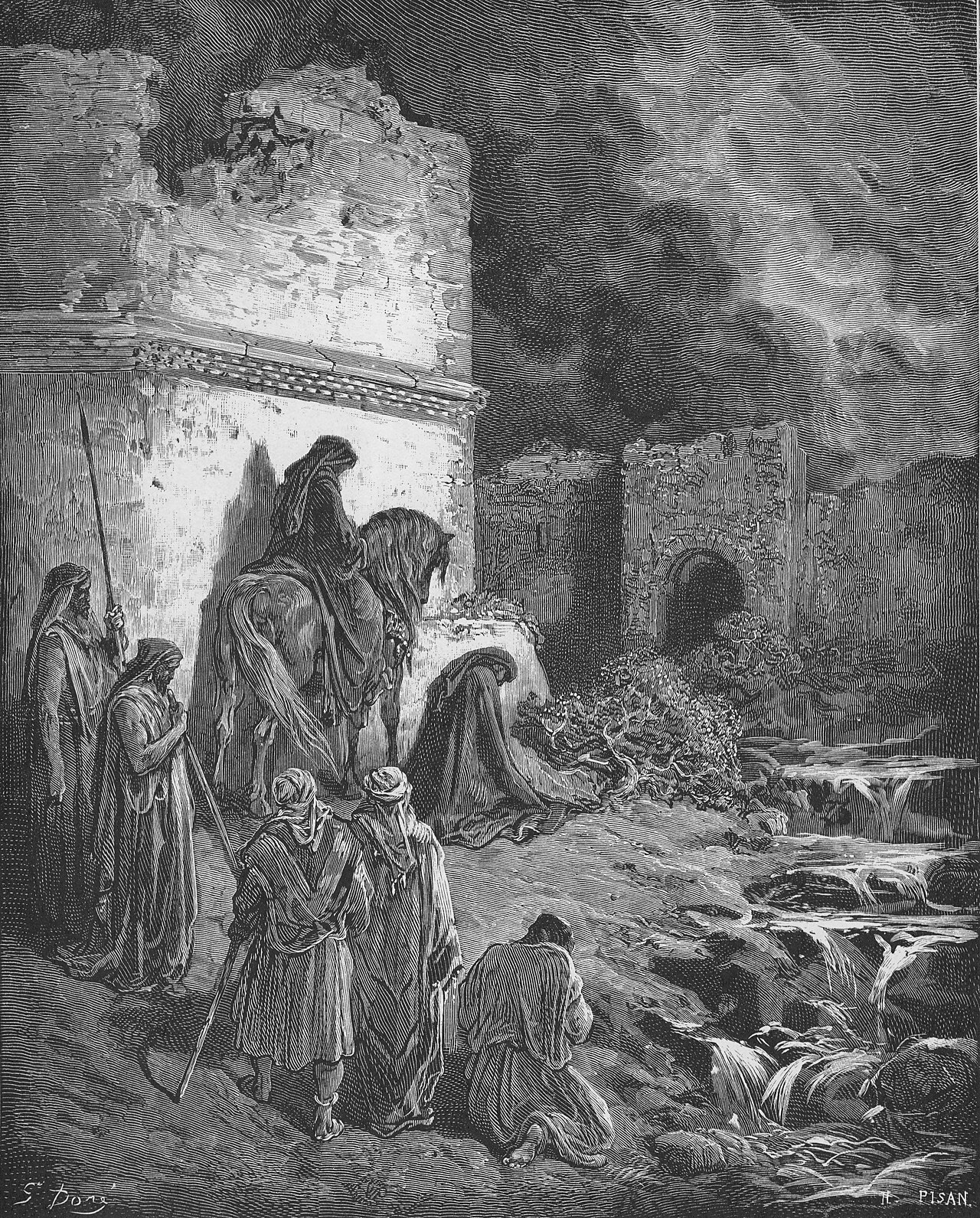
Nehemiahchapter 5
19 verses · Nehemiah · 5th century BC · History
Please restore to them immediately their fields, vineyards, olive groves, and houses, along with the percentage of the money, grain, new wine, and oil that you have been assessing them.”
Introduction
Nehemiah, History, Nehemiah Overview.
Nehemiah records this as the governor who had to deal with it, and he writes it in the middle of the building story. His hearers knew the pressure of famine, royal taxes and debt, and some had seen their own children taken as security. The chapter turns from the enemies outside the wall to a wrong inside the community. Listen for the three complaints and the order in which they come, and for the account Nehemiah gives of his own conduct as governor. The chapter asks what a rebuilt city is worth if its people oppress one another.
Context
- Who
- Poor families being squeezed by their own leading citizens
- What
- The outcry of poor families against wealthy Jews who charged them interest and took their land and children, and Nehemiah's remedy.
- Where
- Jerusalem and the towns of Judah, at a public assembly called to deal with the outcry.
- When
- 445 BC, during the rebuilding, with a look back over Nehemiah's twelve years as governor to 433 BC.
- Why
- To show that obedience to God's law in the treatment of the poor mattered as much as the wall itself.
Historical context
The complaint comes in three tiers, and each is an economic snapshot. Large families with no grain in a famine year. Families mortgaging fields, vineyards and houses to buy food. And families borrowing money specifically to pay the king's tribute against their land, Persian provincial taxation was assessed in silver and had to be paid whether the harvest came in or not.
Show the rest of the historical context, 2 more paragraphs
The end of that road was debt slavery, which the law allowed but hedged about with limits. Children were being sold into servitude, and some daughters already were, by creditors who were their own countrymen and nobles.
Nehemiah's remedy is a public restoration, return the fields, vineyards, oliveyards and houses, and the hundredth part of the money and grain, sworn before the priests, with a symbolic shaking-out of the lap as a curse on anyone who breaks it. He also states his own record as governor: for twelve years he did not take the governor's food allowance, though earlier governors had "laid burdens upon the people," and he fed a hundred and fifty men at his table daily out of his own resources.
Significance
The rebuke lands where the workers could not have expected it. The wall was going up against enemies outside, and the community was being hollowed out by lenders inside.
Show the rest of the significance, 1 more paragraph
His argument is reputational and covenantal at once: "ought ye not to walk in the fear of our God because of the reproach of the heathen our enemies?" A people who bought their brothers' children back from foreigners and then enslaved them themselves had no standing to talk about anything.
This chapter in Jewish lifeWhat this chapter is in Jewish life and reading.
What is done
This chapter has no place in the synagogue year. The site's own table in src/lib/hebraic/readings.ts printed parashot total 0 and haftarah uses total 0 for Nehemiah, and no festival reading.
The chapter is about loans, pledges and the sale of children for debt, and the corpus sets few legal locators on it. Under the fifteenth verse, where Rashi reads the former governors as making the tax heavy upon the people (Rashi on Nehemiah 5:15:1), it carries Sanhedrin 93b:17 with Ein Yaakov at Sanhedrin 11:22 and the Glick Edition at 11:23. Under the nineteenth it carries Rosh Hashanah 32b:4 and Sanhedrin 93b:16.
How it is read
Rashi is the one commentator on this chapter whose English the corpus carries, quoted here from The Judaica Press complete Tanach with Rashi, translated by A. J. Rosenberg, which Sefaria reports as CC-BY. He names both sides of the outcry. The poor were crying, and they cried against their brothers the rich Jews (Rashi on Nehemiah 5:1:1 and 5:1:2). He gives each complaint its reason. "So were they crying about the rich Jews who did not wish to support them." (Rashi on Nehemiah 5:2:1). Others had pledged their fields for grain, and others had borrowed against their fields to pay the king's tax (Rashi on Nehemiah 5:3:1 and 5:4:1).
The claim that our flesh is like our brothers' flesh Rashi reads as a claim to equal standing. The poor were as esteemed and distinguished as their rich brothers, and so were their children (Rashi on Nehemiah 5:5:1 and 5:5:2). Nehemiah took counsel with himself before he spoke (Rashi on Nehemiah 5:7:1).
The remedy is read as an example before a command. Nehemiah and his companions had lent money too, and they would relinquish those loans (Rashi on Nehemiah 5:10:1). The nobles were to do as he did and release all the debts (Rashi on Nehemiah 5:11:1). The shaking out of his garment Rashi explains from a word in Isaiah for the fold of a garment (Rashi on Nehemiah 5:13:1).
His table is the last subject. A hundred and fifty men ate there, and Rashi adds the proselytes who came from the nations and ate there as well (Rashi on Nehemiah 5:17:1).
The corpus carries three further notes on this chapter without an English text, each marked linked because Sefaria holds no English version of the ref. They stand cited and unquoted at Ibn Ezra on Nehemiah 5:2:1, Malbim on Nehemiah 5:6:1 and Metzudat David on Nehemiah 5:19:1.
What the rabbis say
The corpus carries fifteen rabbinic locators on this chapter and the text of none, so each is cited and linked here rather than quoted. On the fourteenth verse it holds Midrash Lekach Tov on Esther, Introduction 3. On the fifteenth it holds Ein Yaakov (Glick Edition), Sanhedrin 11:23, Ein Yaakov, Sanhedrin 11:22 and Sanhedrin 93b:17. On the eighteenth it holds Bamidbar Rabbah 21:19, Introductions to Tanaitic Literature, Introductions to Tractates of the Mishnah, Pesachim 39, Midrash Tanchuma, Pinchas 12:1, Pesikta DeRav Kahana 6:1, Pesikta Rabbati 16:1, Pesikta Rabbati, Supplement A 1:4 and Yalkut Shimoni on Torah 776:14.
On the nineteenth verse the corpus holds Ein Yaakov, Rosh Hashanah 4:6, Midrash Sekhel Tov, Bereshit 22:18:11, Rosh Hashanah 32b:4 and Sanhedrin 93b:16. What each of them teaches is a saying of the rabbis, and is reported as theirs wherever this site quotes one. The quotations wait on a fetch that carries the text.
Sources: Rashi, Rashi on Nehemiah 5:1:1 to 5:18:1, The Judaica Press complete Tanach with Rashi, translated by A. J. Rosenberg, reported CC-BY; Ibn Ezra, Ibn Ezra on Nehemiah 5:2:1, cited by ref because the corpus carries no English text; Malbim, Malbim on Nehemiah 5:6:1, cited by ref because the corpus carries no English text; Metzudat David, Metzudat David on Nehemiah 5:19:1, cited by ref because the corpus carries no English text; The Sefaria corpus, scripts/data/sources/sefaria/nehemiah/5.json, the 15 Talmud and Midrash locators of this chapter; The site's own files, src/lib/hebraic/readings.ts, printing no portion, no Haftarah and no festival reading for this book.
The heads below are this chapter's scenes. The numbered points under each are its verses.
A great cry: our children are as theirs, yet we sell them into bondage
Nehemiah 5:1-3
there was a great outcry from the people: The complaint rises "against their fellow Jews" rather than against Persia. Some have many mouths and no grain: "We must get grain in order to eat and stay alive" (5:2). Others are "mortgaging our fields, our vineyards, and our homes to get grain during the famine" (5:3).
Nehemiah 5:1
“The condition of the poorer inhabitants was indeed deplorable; for, besides the deficient harvests caused by the great rains (Ezr 10:9; also Hag 1:6-11), a dearth was now threatened by the enemy keeping such a multitude pent up in the city, and preventing the country people bringing in provisions.”
Jamieson, Fausset & Brown · Commentary Critical and Explanatory on the Whole Bible (1871)reformed
Clarke reads this first group as families with more sons and daughters than grain to feed them, forced to borrow from richer countrymen. Borrowing for grain led to the mortgaged fields of verse 3 and the slavery of verse 5. Hunger came first.
Nehemiah 5:2
“We, our sons, and our daughters, are many - Our families are larger than we can provide for; we are obliged to go in debt; and our richer brethren take advantage of our necessitous situation, and oppress us. The details which are given in the next verse are sufficiently plain.”
Adam Clarke · Commentary on the Bible (1810-1826)evangelical
Gill explains the mortgage as land handed over as a pledge for money received. Clarke recalls an earlier famine in Zerubbabel's day, when Haggai tied the failed harvests to the neglected house of the Lord (Haggai 1:9). This group still owned land and pledged it for grain.
Nehemiah 5:3
“Some also there were that said, we have mortgaged our lands, vineyards, and houses,.... Made them over to others, put them into their hands as pledges for money received of them: that we may buy corn; for the support of their families: because of the dearth; or famine; which might be occasioned by their enemies lying in wait and intercepting all provisions that might be brought to them; for this seems not to be the famine spoken of in Hag 1:10 for that was some years before this, and for a reason which now was not.”
1 more voice on this verse
Nehemiah 5:3
“Because of the dearth - About the time of Zerubbabel, God had sent a judicial dearth upon the land, as we learn from Haggai, Hag 1:9, etc., for the people it seems were more intent on building houses for themselves than on rebuilding the house of the Lord: “Ye looked for much, and, lo, it is come to little; because of mine house that is waste; and ye run, every man unto his own house. Therefore the heaven over you is stayed from dew, and the earth is stayed from her fruit.”
Adam Clarke · Commentary on the Bible (1810-1826)evangelical
Nehemiah 5:4-5
A third group has borrowed against their land "to pay the king’s tax on our fields and vineyards," a tax none could refuse. Some daughters are already gone, with no power left to redeem them. Lender and borrower share one blood and one covenant, the ground of Nehemiah's coming charge.
Nehemiah 5:4
“There were also that said,.... Who though they were able to buy corn for their families without mortgaging their estates: yet, say they: we have borrowed money for the king's tribute, and that upon our lands and vineyards; for though the priests, Levites, and Nethinims, were exempted from it, yet not the people in common; and some of these were so poor, that they could not pay it without borrowing upon their estates, and paying large usury for it, see Ezr 6:8.”
1 more voice on this verse
Nehemiah 5:4
“We have borrowed money - This should be read, We have borrowed money for the king’s tribute on our lands and vineyards. They had a tax to pay to the Persian king in token of their subjection to him, and though it is not likely it was heavy, yet they were not able to pay it.”
Adam Clarke · Commentary on the Bible (1810-1826)evangelical
we are powerless to redeem them: Barnes notes that the Law let a father sell a daughter (Exodus 21:7), and that this verse shows a son could be sold. Henry sharpens the charge against the brothers who held the fields: they had themselves just been redeemed from bondage. Selling daughters showed how heavy the need was.
Nehemiah 5:5
“The power of a father to sell his daughter into slavery is expressly mentioned in the Law Exo 21:7. The power to sell a son appears from this passage. In either case, the sale held good for only six years, or until the next year of jubilee (see the marginal references).”
2 more voices on this verse
Nehemiah 5:5
“Our flesh - We are of the same nature, and religion with them, though they treat us as if we were beasts or Heathens. Bondage - We are compelled to sell them for our subsistence. Daughters - Which was an evidence of their great necessity, because their daughters were more tender, and weak, and unfit for bond-service, and more exposed to injuries than their sons.”
John Wesley · Explanatory Notes upon the Old Testament (1765)evangelical
Nehemiah 5:5
“But let those who show no mercy expect judgment without mercy. It was an aggravation of the sin of these oppressing Jews that they were themselves so lately delivered out of the house of bondage, which obliged them in gratitude to undo the heavy burdens, Isa. lviii.”
Matthew Henry · Commentary on the Whole Bible (1707-1721)puritan
Restore it to them this day, and the assembly answers Amen
Nehemiah 5:6-7
I became extremely angry: Nehemiah becomes "extremely angry," but he acts only "after serious thought," deliberation placed between the provocation and the act. He charges the nobles and officials, "You are exacting usury from your own brothers!" He answers a private wrong with a public remedy: "So I called a large assembly against them."
Nehemiah 5:6
“And I was very angry when I heard their cry, and these words. Their complaint expressed in this manner; it not only raised pity and compassion in his breast towards these poor distressed people, but indignation at the rich that oppressed them.”
1 more voice on this verse
Nehemiah 5:6
“I was very angry when I heard their cry and these words--When such disorders came to the knowledge of the governor, his honest indignation was roused against the perpetrators of the evil.”
Jamieson, Fausset & Brown · Commentary Critical and Explanatory on the Whole Bible (1871)reformed
after serious thought I rebuked the nobles: Barnes reads the usury charged against the nobles as lending on mortgage and pledge, the practice of verses 3 and 4. Wesley sets Nehemiah beside Ezra, who wept over the sin of the people and their leaders, while Nehemiah forced a reform. Both served the same work of God.
Nehemiah 5:7
“Ye exact usury - The phrase is unique to Nehemiah, and is best explained by the context, which shows the practice of the rich Jews at the time to have been not so much to lend on usury as to lend on mortgage and pledge.”
1 more voice on this verse
Nehemiah 5:7
“Ezra was a man of a mild tender spirit, and when told of the sin of the rulers, rent his clothes and wept: Nehemiah forced them to reform, being of a warm and eager spirit. So God's work may be done, and yet different methods taken in doing it; which is a good reason why we should not arraign the management of others, nor make our own standard.”
John Wesley · Explanatory Notes upon the Old Testament (1765)evangelical
Nehemiah 5:8-9
they could find nothing to say: Nehemiah sets his own record against theirs. His hearers "could find nothing to say" (5:8). Verse 9 names the standard, "the fear of our God," and "the reproach of our foreign enemies," so the watching nations testify against usury.
Nehemiah 5:8
“Nehemiah contrasts his own example with that of the rich Jews. He had spent money in redeeming some countrymen in servitude among the pagan; they were causing others to be sold into slavery among the Jews.”
walk in the fear of our God: Clarke draws out the argument: the foreign enemies who mocked the wall in chapter 4 were watching how Jews treated Jews. Injustice inside the city would bring reproach on the God they served. Nehemiah calls them back to the fear of our God.
Nehemiah 5:9
“Ought ye not to walk in the fear of our God - If ye wish to accredit that religion ye profess which comes from the God of justice and mercy; should you not, in the sight of the heathen, abstain from injustice and cruelty? Can they credit your profession, when they see such practices? The inconsistent conduct of some professors of religion does much harm in the Church of God.”
Adam Clarke · Commentary on the Bible (1810-1826)evangelical
Nehemiah 5:10-11
let us stop this usury: Nehemiah admits he, his brothers and his servants "have been lending the people money and grain," and he gives up his claim. He calls for restitution that is immediate and total. Naming his own claim first and setting it aside is the pattern the chapter carries to the governor's table.
Nehemiah 5:10
“Brethren - In office; these who are employed with me in the government of this people. Servants - In my name, and for my use. Exact - As a just recompense for our pains and care for the publick good, to which we wholly devote ourselves, even to the neglect of all our private concerns.”
John Wesley · Explanatory Notes upon the Old Testament (1765)evangelical
along with the percentage of the money: Barnes takes the percentage as interest of one hundredth a month, twelve percent a year. The Law forbade interest on loans to fellow Israelites (Exodus 22:25; Leviticus 25:36). Restoring the fields, vineyards, olive groves and houses undid the mortgages of verse 3.
Nehemiah 5:11
“The hundredth part of the money ... - i. e. the interest. It is conjectured that the 100th part was payable monthly, or, in other words, that interest was taken at the rate of twelve per cent. The Law altogether disallowed the taking of interest from Israelites (see Exo 22:25; Lev 25:36, etc.).”
2 more voices on this verse
Nehemiah 5:11
“Also - Also require not: which is to be supplied out of the next verse, where it is expressed in their grant of this desire. Hundredth part - Which they required every month for the use of their monies or goods, according to the custom then used.”
John Wesley · Explanatory Notes upon the Old Testament (1765)evangelical
Nehemiah 5:11
“If men borrow large sums to trade with, to increase their stocks, or to purchase land, there is no reason why the lender should not share with the borrower in his profit; or if to spend upon their lusts, or repair what they have so spent, why should they not pay for their extravagances?”
Matthew Henry · Commentary on the Whole Bible (1707-1721)puritan
Nehemiah 5:12-13
required of the nobles and officials an oath: The nobles agree in one sentence, "We will restore it," yet Nehemiah summons the priests and takes an oath of them. He acts out the curse: "May God likewise shake out of His house and possession every man who does not keep this promise" (5:13).
shook out the folds of my robe: Barnes takes the folds of the robe as a pocket, shaken out as a picture of the man God would shake out. Wesley calls it a form of oath then in use. Henry notes the people did as they had promised, where their fathers released slaves and took them back.
Nehemiah 5:13
“This cheerfulness in promising was well, but that which follows was better: They did according to this promise, and adhered to what they had done, not as their ancestors in a like case, who re-enslaved those whom a little before they had released, Jer. xxxiv. Good promises are good things, but good performances are all in all.”
Matthew Henry · Commentary on the Whole Bible (1707-1721)puritan
2 more voices on this verse
Nehemiah 5:13
“I shook my lap - Compare the marginal references. By “lap” is meant a fold in the bosom of the dress, capable of serving as a pocket. Compare Isa 49:22 margin.”
Nehemiah 5:13
“My lap - The extreme parts of my garment, which I first folded together, and then shook it and scattered it asunder. This was a form of swearing then in use.”
John Wesley · Explanatory Notes upon the Old Testament (1765)evangelical
Twelve years as governor without eating the governor's bread
Nehemiah 5:14-16
(twelve years total): Nehemiah turns to his own twelve years in office: "neither I nor my brothers ate the food allotted to the governor" (5:14). Former governors took "bread and wine plus forty shekels of silver," but Nehemiah gives his reason: "because of my fear of God" (5:15).
Nehemiah 5:14
“I and my brethren have not eaten the bread of the governor. - From what is related here, and in the following verse, we find that the table of the governor was always supplied by the people with bread and wine; and, besides, they had forty shekels per diem for their other expenses. The people were also greatly oppressed by the servants and officers of the governor; but, during the twelve years that Nehemiah had been with them, he took not this salary, and ate none of their bread.”
Adam Clarke · Commentary on the Bible (1810-1826)evangelical
because of my fear of God: Barnes reads the forty shekels as a daily levy. Wesley notes that the harshness of the governors' servants is charged to the governors who allowed it. Nehemiah names his reason in one phrase, his fear of God, the fear he pressed on the nobles in verse 9.
Nehemiah 5:15
“Forty shekels of silver - A daily sum from the entire province. For such a table as that kept by Nehemiah Neh 5:18, this would be a very moderate payment.”
devoted myself to the construction: Gill pictures Nehemiah at the wall every day, directing the work and the servants gathered there. His household acquired no land while others were mortgaging theirs. Matthew Henry recalls the word of Jesus that giving is more blessed than receiving (Acts 20:35).
Nehemiah 5:16
“Yea, also I continued in the work of this wall,.... Of building the wall of Jerusalem; here he gave his constant attendance to direct and encourage the workmen, and see that they kept to their work, and did it well: neither bought we any land; neither he nor the principal men with him, though they could have bought it cheap, but they chose not to take the advantage of the poverty of the people: and all my servants were gathered thither unto the work: all were employed in it, taking no wages for their work, being maintained at his expense.”
1 more voice on this verse
Nehemiah 5:16
“Say not then that he was a bad husband, but that he was a good governor, who aimed not to feather his own nest. Let us remember the words of the Lord, how he said, It is more blessed to give than to receive, Acts xx.”
Matthew Henry · Commentary on the Whole Bible (1707-1721)puritan
Nehemiah 5:17-18
There were 150 Jews and officials at my table: The ledger widens into a daily account: "150 Jews and officials" ate at his table "besides the guests from the surrounding nations" (5:17). He did not demand "the food allotted to the governor," and the reason is mercy: "because the burden on the people was so heavy."
Nehemiah 5:17
“A hundred and fifty of the Jews - He kept open house, entertained all comers; besides having one hundred and fifty Jews who had their food constantly at his table, and at his expense. To be able to bear all these expenses, no doubt Nehemiah had saved money while he was cup-bearer to the Persian king in Susa.”
Adam Clarke · Commentary on the Bible (1810-1826)evangelical
1 more voice on this verse
Nehemiah 5:17
“Rulers - Not only Jews of the inferior sort, for whom meaner provisions might suffice, but also their rulers, for whom better provision was fit; who resorted to him upon all occasions, to give him notice of the enemies designs; or to receive his orders.”
John Wesley · Explanatory Notes upon the Old Testament (1765)evangelical
one ox, six choice sheep: Clarke reckons the daily ox and six sheep enough food for more than two hundred people. Henry has Nehemiah paying for it from what he gained at the Persian court and from his own estate in Judah. The reason given is the heavy burden on the people.
Nehemiah 5:18
“One ox, and six choice sheep - This was food sufficient for more than two hundred men. Once in ten days store of all sorts of wine - It is supposed that every tenth day they drank wine; at all other times they drank water; unless we suppose the meaning of the phrase to be, that his servants laid in a stock of wine every ten days. Though the Asiatics drank sparingly of wine, yet it is not very likely that, in a case such as that above, wine was tasted only thrice in each month.”
Adam Clarke · Commentary on the Bible (1810-1826)evangelical
1 more voice on this verse
Nehemiah 5:18
“So far was he from extorting more than his due that he never demanded that, but lived upon what he had got in the king of Persia's court and his own estate in Judea: the reason he gives for this piece of self-denial is, Because the bondage was heavy upon the people.”
Matthew Henry · Commentary on the Whole Bible (1707-1721)puritan
Remember me favorably, O my God: The chapter closes on one line of prayer: "Remember me favorably, O my God, for all that I have done for this people" (5:19). Nehemiah asks the people he has fed and defended for nothing, no repayment and no praise, and turns the whole account toward God.
Nehemiah 5:19
“Think upon me, my God, for good, according to all that I have done for this people. He expected not any recompence from the people, but from the Lord; and from him not in a way of merit, but of grace and good will, who forgets not what is done for his name's sake, Heb 6:10.”
1 more voice on this verse
Nehemiah 5:19
“Think upon me, my God, for good - Nehemiah wishes for no reward from man; and he only asks mercy at the hand of his God for what his providence enabled him to do; and which, according to the good hand of his God upon him, he had done faithfully. He does not offer his good deeds to God in extenuation of his sins, or as a compensation for the heaven he expected.”
Adam Clarke · Commentary on the Bible (1810-1826)evangelical
Keep studying
People and groups1
Sources for this chapter
The summary
Jamieson, Fausset & Brown, Commentary Critical and Explanatory; John Wesley, Notes on the Old Testament and Matthew Henry, Complete Commentary.
The exposition
Adam Clarke, Commentary on the Bible; Albert Barnes, Notes, Explanatory and Practical, on the Old and New Testaments (1832-1869); Jamieson Fausset and Brown, Commentary Critical and Explanatory on the Whole Bible; John Gill; John Wesley, Explanatory Notes upon the Old Testament and Matthew Henry, Commentary on the Whole Bible.