
Nahumchapter 2
13 verses · Nahum · 663 to 612 BC · The Twelve
One who scatters advances against you, O Nineveh. Guard the fortress! Watch the road! Brace yourselves! Summon all your strength!
Introduction
Nahum, The Twelve, Nahum Overview.
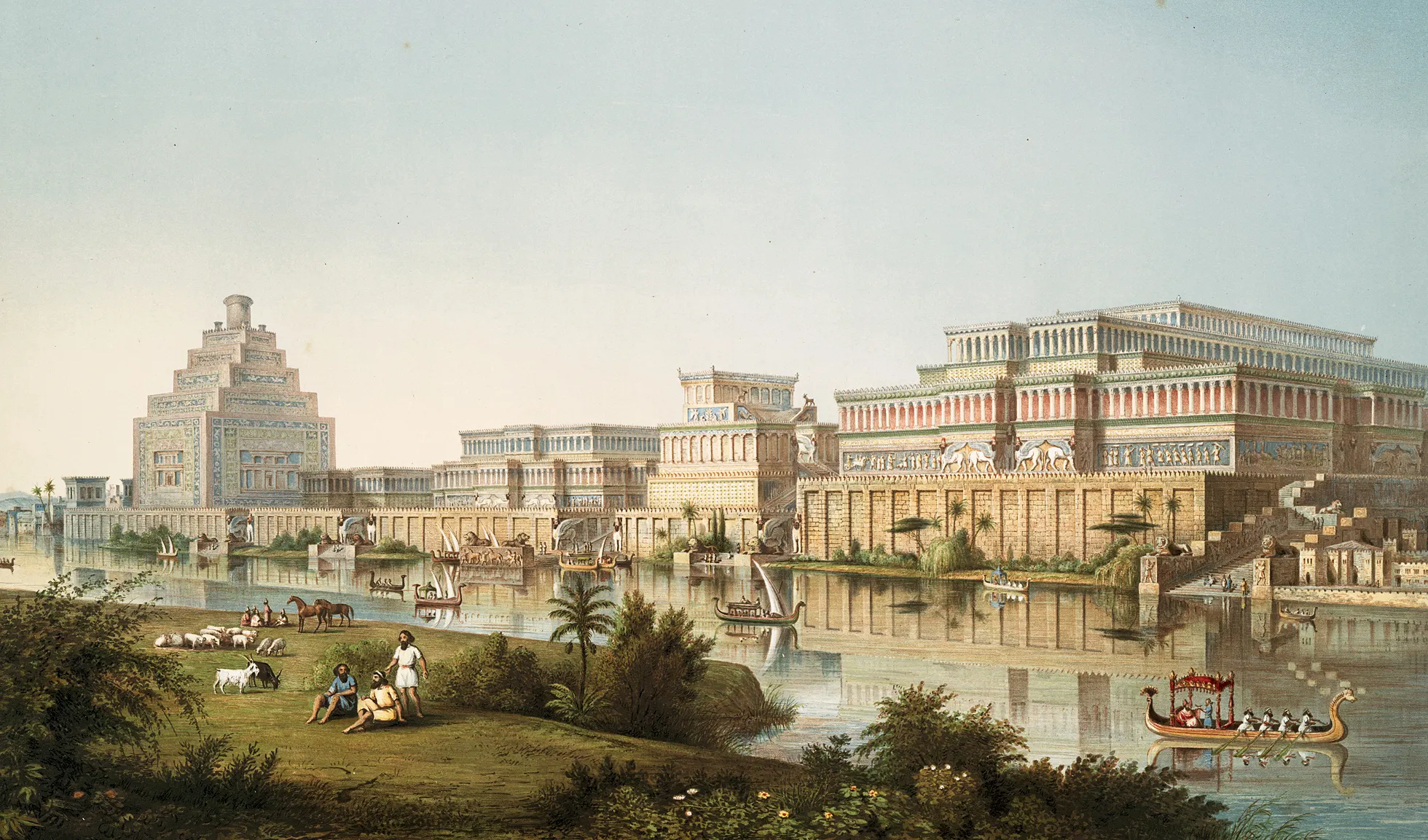
This chapter is a battle poem about a siege that had not yet happened when Nahum spoke it. Nineveh was the largest city of its day, walled, watered by rivers and filled with the plunder of nations. Judah had never known a world without it. The prophet writes as though he stands inside the gates while the enemy breaks in. Listen for the quick changes of scene, from the attackers to the defenders and back again. Listen too for the royal emblem Assyria carved on its own palace walls, and for who speaks the last word.
Context
- Who
- Judeans who had never imagined the city could be taken
- What
- A battle poem that describes the assault on Nineveh, the collapse of its defenses and the plunder of its treasure.
- Where
- Inside Nineveh, where the Khosr River met the Tigris, at its gates, walls, streets and palace.
- When
- Spoken before 612 BC, the year a Babylonian and Median army took Nineveh, as a description of events still to come.
- Why
- To show Judah that the strongest city they knew had an appointed end, and that the LORD Himself was its adversary.
Historical context
This chapter is a battle report written in the present tense. Chariots rage in the streets, shields are red, the defenders stumble on the wall, and the palace is dissolved.
Show the rest of the historical context, 4 more paragraphs
One line has drawn attention for a long time: "the gates of the rivers shall be opened, and the palace shall be dissolved." Nineveh sat where the Khosr river ran into the Tigris, and the city's water system involved dams, canals, and river gates. The Babylonian Chronicle records the city's fall to the allied army; later Greek tradition adds that a flooding river breached the defenses. How much weight the later tradition carries is debated, but the geography and the waterworks are real.
"Nineveh is of old like a pool of water" fits a city fed by an engineered water supply, including a long aqueduct built under Sennacherib whose remains have been found at Jerwan.
The lion imagery at the end of the chapter is precise and cutting. Assyrian kings hunted lions ceremonially, and the palace reliefs from Nineveh showing the royal lion hunt are among the most famous objects to come out of the ancient Near East. Nahum turns the emblem around: where is the dwelling of the lions, the feeding place of the young lions, where the lion tore enough for his whelps?
The plunder is real too. Nineveh's wealth came from tribute and loot hauled in from every direction for generations. "Take ye the spoil of silver, take the spoil of gold" describes a treasury built out of other people's cities being emptied by somebody else.
Significance
To hear the sack of Nineveh described in advance, in detail, was to hear that the strongest fortress in the world had an appointment.
Show the rest of the significance, 1 more paragraph
For Judah the practical meaning was survival. "The LORD turneth away the excellency of Jacob" acknowledges what Assyria had already done to God's people, and then says the empire that did it is finished.
This chapter in Jewish lifeWhat this chapter is in Jewish life and reading.
What is done
No part of this chapter is read in the synagogue year. Probed for this lane, the site's own table in src/lib/hebraic/readings.ts printed parashot total 0 and haftarah uses total 0 for Nahum, with no festival reading. A congregation does not hear this chapter on a Sabbath or a feast.
The one practice the chapter names is the paying of vows. The Hebrew text opens this chapter with the verse an English Bible sets as the last verse of chapter 1. The verse numbers in this card therefore run one higher than the Berean text on the page. Rashi reads that opening verse as a call to Judah to keep what it promised. They are the vows Judah made "if He would save you from the hand of Sennacherib, king of Assyria" (Rashi on Nahum 2:1:1). Rashi adds that Judah is now saved.
The chapter is met in the study of the Torah portions as well. Under the fourth verse in the Hebrew count the corpus carries Bereshit Rabbah 63:12 and 75:4, Midrash Tanchuma Buber, Vayishlach 4:2 and Sifrei Devarim 47:3. Under the tenth it carries Bereshit Rabbah 73:12 and Midrash Tanchuma Buber, Vayetzei 24:5.
How it is read
Rashi is the one commentator on this chapter whose English the corpus carries, quoted here from The Judaica Press complete Tanach with Rashi, translated by A. J. Rosenberg, which Sefaria reports as CC-BY. He reads the chapter as the fall of Assyria to Babylon. The scatterer who came up against Judah in the time of Hezekiah "is now besieged by the siege of Nebuchadnezzar king of Babylon, who has besieged him" (Rashi on Nahum 2:2:1). The shields dyed red belong to "The mighty of Nebuchadnezzar, who lay siege to Assyria" (Rashi on Nahum 2:4:1).
He calls on Judah to watch. "You men of Judah, watch the crossroads and see those going to besiege him [Sennacherib] and strengthen your loins and fortify your power mightily" (Rashi on Nahum 2:2:2). The emptiers of the third verse he reads with a word fit for a vine, since they plundered them and emptied them (Rashi on Nahum 2:3:2).
The siege he reads closely. The king of Assyria "shall contemplate going forth and waging war, but [he and his men] shall stumble in their walk" (Rashi on Nahum 2:6:1). The gates of the river are the gates of the cities on the rivers' banks (Rashi on Nahum 2:7:1). The palace shook under the stones of the catapult, which Rashi names in the French of his day (Rashi on Nahum 2:7:2). The one who is exposed and led away he reads as the queen who stands at the king's right, and he cites Psalm 45:10 for it (Rashi on Nahum 2:8:1 and 2:8:2).
The picture of the pool he reads as a long peace ended. "Since the day it was founded, it has been sitting tranquilly with no one disturbing it, like a pool of gathered water that does not move from its place" (Rashi on Nahum 2:9:1). The lions' den closes the chapter as a lament. "This is a lamentation over Nineveh, which was the dwellings of kings, hard and strong as lions" (Rashi on Nahum 2:12:1). For the lion that tore enough for his whelps he gives the Aramaic paraphrase of Jonathan. "The kings would bring much plunder, until there was enough for the members of their households" (Rashi on Nahum 2:13:1).
What the rabbis say
The corpus carries forty rabbinic locators on this chapter and the text of none, so each is cited here rather than quoted. On the first verse in the Hebrew count, the paying of vows, it holds Bamidbar Rabbah 11:7 and 2:10, Eikhah Rabbah 5:18 and Midrash Aggadah, Deuteronomy 3:23:6. It also holds Midrash Shmuel 19:5, Midrash Tanchuma Buber, Bamidbar 16:2, Midrash Tanchuma, Bamidbar 14:1 and Pesikta DeRav Kahana 16:8. On the second it holds Midrash Sekhel Tov, Bereshit 31:49:2.
On the fourth verse, the shields dyed red, the corpus holds the most. Beside the locators named above it holds Midrash Lekach Tov, Genesis 25:30:3, Midrash Sekhel Tov, Bereshit 25:34:24 and 33:17:8 and Yalkut Shimoni on Torah 111:1. On the fifth, the chariots dashing about, it holds Avot DeRabbi Natan, Recension B 43:16, Midrash Lekach Tov, Deuteronomy 1:9:1 and Midrash Tannaim on Deuteronomy 1:9:14 and 11:21:11. It also holds Midrash Tehillim 11:7, Pesikta DeRav Kahana 27:2, Shir HaShirim Rabbah 5:11:5 and Sifrei Devarim 10:2.
On the sixth verse it holds Aggadat Bereshit 52:3, Tractate Soferim 7:4 and Vayikra Rabbah 19:5. On the tenth, the plunder of silver and gold, it holds Midrash Lekach Tov, Numbers 31:9:1, Midrash Sekhel Tov, Bereshit 31:1:4 and Yalkut Shimoni on Torah 130:9 and 130:10. On the eleventh it holds Aggadat Bereshit 50:3, Midrash Aggadah, Numbers 22:2:2, Midrash Sekhel Tov, Shemot 15:14:2 and Pirkei DeRabbi Eliezer 50:6. On the twelfth it holds Shemot Rabbah 29:9, and on the thirteenth Bava Kamma 16b:5. What each of them teaches is a saying of the rabbis, and it is reported as theirs wherever this site quotes one. The quotations wait on a fetch that carries the text.
Sources: Rashi, Rashi on Nahum 2:1:1 to 2:14:1, The Judaica Press complete Tanach with Rashi, translated by A. J. Rosenberg, reported CC-BY; The Sefaria corpus, scripts/data/sources/sefaria/nahum/2.json, the 40 Talmud and Midrash locators of this chapter; The site's own files, src/lib/hebraic/readings.ts, probed for this book and printing parashot total 0, haftarah uses total 0 and festivalReadingForBook null.
The heads below are this chapter's scenes. The numbered points under each are its verses.
The shatterer comes up; chariots rage in the streets
Nahum 2:1-2
One who scatters advances against you: Verse 1 announces "One who scatters" and drills the city with mock orders to "Guard the fortress" and "Watch the road". Verse 2 gives the reason: "the LORD will restore," and it joins the comfort of chapter 1 to the assault of chapter 2. Nahum's name means comfort.
Nahum 2:1
“He that dasheth in pieces - Rather, “the Disperser,” the instrument of God, whereby he should “break her in pieces like a potter’s vessel, or should scatter” her in all lands, is come up against thy face, O Nineveh, i. e., either, over against thee” , confronting her as it were, face to face, or directed against thee . From the description of the peace of Judah, the prophet turns suddenly to her oppressor, to whom, not to Judah, the rest of the prophecy is directed. Jacob and Israel are spoken of, not to .”
2 more voices on this verseWhat preachers and commentators have said about this verse, in their own words.
Nahum 2:1
“The prophet speaks of it as just at hand, for it is neither doubtful nor far distant: "Look about thee, and see, he that dashes in pieces has come up before thy face. Nebuchadnezzar, who is noted, and will be yet more so, for dashing nations in pieces, begins with thee, and will dissipate and disperse thee;" so some render the word.”
Matthew Henry · Commentary on the Whole Bible (1707-1721)puritan
Nahum 2:1
“Ironical advice; equivalent to a prophecy, Thou shalt have need to use all possible means of defense; but use what thou wilt, all will be in vain. make thy loins strong--The loins are the seat of strength; to gird them up is to prepare all one's strength for conflict (Job 40:7).”
Jamieson, Fausset & Brown · Commentary Critical and Explanatory on the Whole Bible (1871)reformed
restore the splendor of Jacob: The reason for the attack on Nineveh is given in the middle of the battle. Albert Barnes reads the verse as God restoring His people, with the fall of their oppressor as the sign of it. The ruined vine is Israel stripped by its plunderers.
Nahum 2:2
“For the Lord hath turned away the excellency of Jacob--that is, the time for Nineveh's overthrow is ripe, because Jacob (Judah) and Israel (the ten tribes) have been sufficiently chastised. The Assyrian rod of chastisement, having done its work, is to be thrown into the fire.”
Jamieson, Fausset & Brown · Commentary Critical and Explanatory on the Whole Bible (1871)reformed
2 more voices on this verse
Nahum 2:2
“The waster spoken of here by the Prophet, some consider him to have been Sennacherib, and others, Nebuchodonosor. The verb lh, ole, is also variously explained: it is often taken metaphorically in Hebrew for vanishing, as we say in French, Il s'en va en fumee; for smoke ascends, and this is the reason for the metaphor.”
John Calvin · Commentaries (1554)reformed
Nahum 2:2
“For the Lord hath turned away - Bishop Newcome reads, for the Lord restoreth, by a slight alteration in the text. I do not see that we gain much by this. The Lord has been opposed to Jacob, and the enemy has prevailed against him. Emptied them out - Brought them from their own land into captivity. This was the emptying!”
Adam Clarke · Commentary on the Bible (1810-1826)evangelical
Nahum 2:3-5
The shields of his mighty men: The assault comes in color and speed: shields "are red," warriors are "dressed in scarlet," and chariots "appearing like torches". The commentators weigh the red as dyed shields, bronze catching the sun, or blood to come. The nobles "stumble as they advance," the defenders' panic inside the attack.
Nahum 2:3
“English Version supposes a transposition of the Hebrew letters. It is better to translate the Hebrew as it is, "the chariots (shall be furnished) with fire-flashing scythes" (literally, "with the fire," or glitter, of iron weapons).”
Jamieson, Fausset & Brown · Commentary Critical and Explanatory on the Whole Bible (1871)reformed
chariots dash through the streets: The chariots now fill the city's own streets. Jamieson, Fausset and Brown picture the squares flashing like torches as the sun catches the vehicles. The scene reads as both armies meeting in the streets in confusion.
Nahum 2:4
“The chariots shall rage in the streets,.... In the streets of Nineveh when taken; where they shall be drove in a furious manner from place to place, the men in them breathing out slaughter and death wherever they came. Kimchi understands this of the chariots of the Ninevites; who shall drive about in them in the streets of the city like madmen; not daring to go out to fight the enemy, being mightier and more numerous than they.”
1 more voice on this verse
Nahum 2:4
“The chariots shall rage - Those of the besiegers and the besieged, meeting in the streets, producing universal confusion and carnage.”
Adam Clarke · Commentary on the Bible (1810-1826)evangelical
stumble as they advance: The verse moves between the two armies without warning. The Assyrian king calls up his nobles, while Jamieson, Fausset and Brown read the shield as the covered frame the attackers set against the wall. The stumbling shows a failure of nerve as well as haste.
Nahum 2:5
“But in vain; for they shall stumble in their walk--"they shall stumble in their advance" through fear and hurry. the defence shall be prepared--rather, the covering machine used by besiegers to protect themselves in advancing to the wall. Such sudden transitions, as here from the besieged to the besiegers, are frequent (compare Eze 4:2), [MAURER].”
Jamieson, Fausset & Brown · Commentary Critical and Explanatory on the Whole Bible (1871)reformed
2 more voices on this verse
Nahum 2:5
“Nebuchadnezzar's commanders are here called his worthies, his gallants (so the margin reads it), his heroes; those he shall recount, and order them immediately and without fail to render themselves at their respective posts, for he is entering upon action, is resolved to take the field immediately, and to open the campaign with the siege of Nineveh.”
Matthew Henry · Commentary on the Whole Bible (1707-1721)puritan
Nahum 2:5
“He shall recount his worthies - The Assyrian king wakes as out of a sleep, literally, “he remembers his mighty men” (as Nah 3:18; Jdg 5:13; Neh 3:5); “they stumble in their walk,” literally, paths , not through haste only and eager fear, but from want of inward might and the aid of God. These whom God leads stumble not Isa 63:13. : “Perplexed every way and not knowing what they ought to do, their mind wholly darkened and almost drunken with ills, they reel to and fro, turn from one thing to another, and in all” labor in vain.”
The river gates opened; Nineveh emptied and void
Nahum 2:6-8
The river gates are thrown open: n and the palace collapses," and the ancient accounts of Nineveh's fall record the river turned against the city. The Hebrew the Berean text renders "It is decreed" has also been read as the queen, the city personified, or a name, Huzzab.
Nahum 2:6
“The gates of the rivers shall be opened - I have already referred to this, see the note on Nah 1:8; but it will be necessary to be more particular. The account given by Diodorus Siculus, lib. ii., is very surprising. He begins thus: Ην δ’ αυτῳ λογιον παραδεδομενον εκ προγονων, κ.τ.λ. - “There was a prophecy received from their forefathers, that Nineveh should not be taken till the river first became an enemy to the city.”
Adam Clarke · Commentary on the Bible (1810-1826)evangelical
1 more voice on this verse
Nahum 2:6
“Traces of dams ("gates," or sluices) for regulating the supply are still visible, so that the whole city could be surrounded with a water barrier (Na 2:8). Besides, on the east, the weakest side, it was further protected by a lofty double rampart with a moat two hundred feet wide between its two parts, cut in the rocky ground.”
Jamieson, Fausset & Brown · Commentary Critical and Explanatory on the Whole Bible (1871)reformed
moan like doves: The Hebrew word the Berean text renders as decreed was once read as a name, Huzzab, which Adam Clarke took for the queen of Nineveh. It is now read as the decree itself. Her servants mourn like doves and beat their breasts in grief.
Nahum 2:7
“And Huzzab shall be led away captive,.... The Targum translates it the queen; and Jarchi and Aben Ezra, after R.”
2 more voices on this verse
Nahum 2:7
“The first word should he rendered, “And it is decreed; She shall be laid bare. It is decreed.” All this took place, otherwise than man would have thought, because it was the will of God.”
Nahum 2:7
“MAURER makes it not a proper name, and translates, "It is established," or "determined" (compare Ge 41:32). English Version is more supported by the parallelism. led away captive--The Hebrew requires rather, "she is laid bare"; brought forth from the apartments where Eastern women remained secluded, and is stripped of her ornamental attire.”
Jamieson, Fausset & Brown · Commentary Critical and Explanatory on the Whole Bible (1871)reformed
like a pool of water: Nineveh had been full for centuries, like a pool holding its water, and Matthew Henry reads the water as her crowds of people. Now the pool drains. The cry to stop goes unheeded because panic has taken the whole city.
Nahum 2:8
“But Nineveh is of old like a pool of water - מימי mimey, from days. Bp. Newcome translates the line thus: “And the waters of Nineveh are a pool of waters.” There may be reference here to the fact given in the preceding note, the overflowing of the river by which the city was primarily destroyed. Stand, stand - Consternation shall be at its utmost height, the people shall flee in all directions; and though quarter is offered, and they are assured of safety it they remain, yet not one looketh back.”
Adam Clarke · Commentary on the Bible (1810-1826)evangelical
1 more voice on this verse
Nahum 2:8
“Stand, stand, shall they cry--that is, the few patriotic citizens shall cry to their fleeing countrymen; "but none looketh back," much less stops in flight, so panic-stricken are they.”
Jamieson, Fausset & Brown · Commentary Critical and Explanatory on the Whole Bible (1871)reformed
Nahum 2:9-10
The oracle gives the attackers the order to "Plunder the silver" and "Plunder the gold". Verse 10 follows with three words of rising sound, "emptied," "desolate" and "laid waste". The melting hearts, knocking knees and pale faces use the terms Joel and Isaiah use for the day of the LORD.
Nahum 2:9
“Take ye the spoil of silver, take the spoil of gold - Nineveh had not hearkened of old to the voice of the prophet, but had turned back to sin; it cannot hearken now, for fear. He turns to the spoiler to whom God’s judgments assigned her, and who is too ready to hear. The gold and silver, which the last Assyrian King had gathered into the palace which he fired, was mostly removed (the story says, treacherously) to Babylon.”
She is emptied!: Adam Clarke notes three Hebrew words of the same sound, bukah, mebukah and mebullakah, each longer than the one before. The desolation grows as the words grow. Four marks of fear in the body follow, from the melting heart to the pale face.
Nahum 2:10
“Hebrew, Bukah, Mebukah, Mebullakah (compare Isa 24:1, 3, 4; Zep 1:15). faces of all gather blackness--(See on Joe 2:6). CALVIN translates, "withdraw (literally, 'gather up') their glow," or flush, that is, grow pale.”
Jamieson, Fausset & Brown · Commentary Critical and Explanatory on the Whole Bible (1871)reformed
1 more voice on this verse
Nahum 2:10
“Their spirits shall melt away like wax before the fire; their knees shall smite together (as Belshazzar's did, in his agony, Dan. v. 6 ), so that they shall not be able to stand their ground, no, nor to make their escape; much pain shall be in all loins, as is the case in extreme frights, so that they shall not be able to hold up their backs.”
Matthew Henry · Commentary on the Whole Bible (1707-1721)puritan
Where is the lions' den now?
Nahum 2:11-13
Where is the lions’ lair: The chapter closes at an empty den, and it asks "Where is the lions’ lair". The lion was Assyria's royal emblem, carved on its palace walls, and the prophet turns the emblem into an epitaph. The last word is the LORD's, "Behold, I am against you," repeated at 3:5.
Nahum 2:11
“Where is the dwelling of the lions?.... Of the kings of Assyria, comparable to lions for their strength, courage, and cruelty, tyranny, and oppression; such as Pul, Tiglathpileser, Shalmaneser, and Sennacherib.”
1 more voice on this verse
Nahum 2:11
“It was as full of spoils of all nations as a lion's den is of remains of its prey. The question, "Where," &c., implies that Jehovah "would make an utter end of the place," so that its very site could not be found (Na 1:8).”
Jamieson, Fausset & Brown · Commentary Critical and Explanatory on the Whole Bible (1871)reformed
lion mauled enough for its cubs: The lion is the Assyrian king, and the prey he carried home is the spoil of conquered nations, as John Gill explains. The cubs and the lioness are the princes and the royal household the plunder enriched. The dens are its treasure houses.
Nahum 2:12
“The lion did tear - This verse gives us a striking picture of the manner in which the Assyrian conquests and depredations were carried on. How many people were spoiled to enrich his whelps - his sons, princes, and nobles! How many women were stripped and slain, whose spoils went to decorate his lionesses - his queen, concubines, and mistresses. And they had even more than they could assume; their holes and dens - treasure-houses, palaces, and wardrobes - were filled with ravin, the riches which they got by the plunder of towns, families, and individuals.”
Adam Clarke · Commentary on the Bible (1810-1826)evangelical
The LORD now speaks in His own voice. Albert Barnes notes that the Hebrew says toward you, God turning His face to a city He had long let pass. The silenced messengers are envoys like the Rabshakeh, who spoke against the living God.
Nahum 2:13
“Behold I, Myself, am against thee - (Literally, “toward thee”). God, in His long-suffering, had, as it were, looked away from him; now He looked toward (as in Psa 37:20) him, and in His sight what wicked one should stand? “Saith the Lord of hosts,” whose power is infinite and He changes not, and all the armies of heaven, the truly angels and evil spirits and men are in His Hand, whereto He directs or overrules them. “And I will burn her chariots in the smoke.” The Assyrian sculptures attest how greatly their pride and strength lay in their chariots.”
2 more voices on this verse
Nahum 2:13
“Behold, I am against thee, saith the Lord of hosts,.... Against Nineveh, and the whole Assyrian empire, for such rapine, violence, and oppression, their kings had been guilty of; and if he, who is the Lord of hosts, of all the armies of heaven and earth, was against them, nothing but ruin must inevitably ensue: or, "I come unto thee" (s); or will shortly come unto thee, and reckon with thee for all this; will visit thee in a way of wrath and vengeance.”
Nahum 2:13
“Thy messengers - Embassadors or muster-masters. Probably this refers to Rabshaketh who had blasphemed the living God. Those are not worthy to be heard again, that have once spoken reproachfully against God.”
John Wesley · Explanatory Notes upon the Old Testament (1765)evangelical
Keep studying
Sources for this chapter
The summary
Jamieson, Fausset & Brown, Commentary Critical and Explanatory; John Calvin, Commentaries; John Wesley, Notes on the Old Testament and Matthew Henry, Complete Commentary.
The exposition
Adam Clarke, Commentary on the Bible; Albert Barnes, Notes on the Old Testament; Carl Friedrich Keil, The Twelve Minor Prophets; Edward Bouverie Pusey, The Minor Prophets: A Commentary; Jamieson, Fausset & Brown, Commentary Critical and Explanatory on the Whole Bible; John Gill, Exposition of the Old Testament; John Wesley, Explanatory Notes upon the Old Testament and Matthew Henry, Commentary on the Whole Bible.