
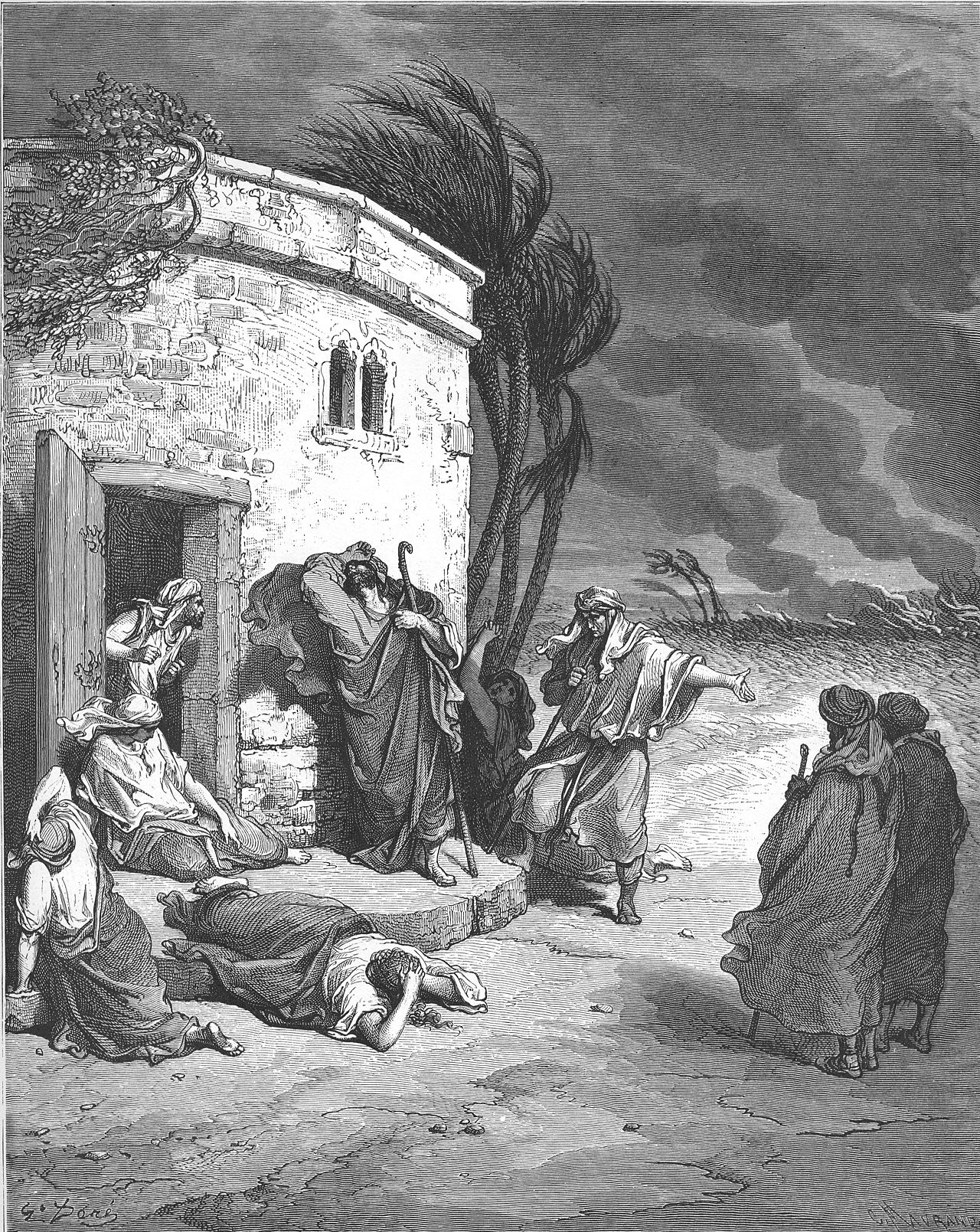
Jobchapter 9
35 verses · unknown · 10th century BC · Wisdom and poetry
He alone stretches out the heavens and treads on the waves of the sea.
Introduction
unknown, Wisdom and poetry, Job Overview.
Job answers Bildad, and in this chapter the debate starts to sound like a lawsuit. He agrees that God is just and mighty, and that agreement is what frightens him. His hearers knew village courts at the town gate, where a weak man facing a powerful one had little hope of a fair hearing. Listen for the words of the courtroom, such as contend, answer, summon and judge. Listen also for the hymn to God's power over mountains, sea and stars. At the close Job names the one figure he wishes stood between himself and God.
Context
- Who
- Hearers who had stood in a village lawsuit and known the other side had the better connections
- What
- Job's reply to Bildad, in which he grants God's justice and power, despairs of a fair hearing before Him, and longs for a mediator.
- Where
- The ash heap outside Job's town, with the argument framed as a case at law.
- When
- After Bildad's first speech, in the first round of the debate.
- Why
- To show that Job's trouble is his standing before God, and to voice the need for a mediator between God and man.
Historical context
Job grants the point and finds it terrifying. Of course a man cannot be just with God, but not for the reason Bildad thinks. Job's problem is procedural. If he went to law with God he could not answer one question in a thousand, could not summon him, could not compel a hearing, and could not trust a verdict he had no standing to appeal.
Show the rest of the historical context, 3 more paragraphs
The hymn in the middle is real astronomy and real geography as that world understood it. God removes mountains and shakes the earth out of its place; he commands the sun and it does not rise; he seals up the stars. Three constellations are named by their Hebrew names, generally taken as the Bear or Orion's neighbour, Orion himself, and the Pleiades, along with 'the chambers of the south', the stars that only rise for those far enough south to see them. Sky-watching was a serious discipline across the ancient Near East, and Job is claiming that the God who arranges the sky cannot be cross-examined by a man.
The comparisons for how fast his life is going are all transport: the runner carrying dispatches, the swift boats of reed, light papyrus skiffs used on the Nile and the marshes, and an eagle stooping on its prey.
The chapter ends with the word the whole book has been reaching for. Job wishes for a 'daysman', an umpire or arbiter who could lay his hand on both parties at once, the recognised role of the neutral third man in an ancient dispute. There is no such person between God and man, he says, and so no fair hearing is possible.
Significance
For the first hearers the cry for an arbiter was the deepest note yet sounded. Job is not asking to win. He is asking for a mediator with standing on both sides of the bench.
Show the rest of the significance, 1 more paragraph
The book does not answer that request here, and Israel lived with it open. It is the shape of a need long before anyone could name what would fill it.
This chapter in Jewish lifeWhat this chapter is in Jewish life and reading.
What is done
No weekly portion, Haftarah or festival reading in the site's table takes its text from this chapter. The probe of src/lib/hebraic/readings.ts printed parashot total 0 and haftarah uses total 0 for Job, and no festival reading.
The chapter's study setting in the corpus is chiefly the Talmud. Under the ninth verse it carries Berakhot 58b:12 and 58b:15, and under the tenth Berakhot 58a:16. Under the sixth it carries Chagigah 12b:2. Bava Batra 16a stands under three verses, at 16a:16 on the seventeenth, at 16a:10 and 16a:11 on the twenty-fourth, and at 16a:15 on the thirty-third.
How it is read
Malbim is quoted here from Malbim's Job, translated by Jeremy I. Pfeffer (Ktav, 2003), which Sefaria reports as CC-BY. He counts the chapter as the fifth oration, Job's reply to Bildad's first speech (Malbim on Job 9:1:1). In his reading Job denies ever suggesting that God perverts judgment. "On the contrary, his whole thesis had been based on the assumption of God's Perfection" (Malbim on Job 9:2:1). The same entry announces four ways by which one person can get the better of another, and the corpus text stops before it lists them.
Rashi is quoted from The Judaica Press complete Tanach with Rashi, translated by A. J. Rosenberg, which Sefaria reports as CC-BY. He reads the chapter as Job's case that no man can contend with God, and he glosses contending as debating (Rashi on Job 9:3:1). He ties the moving of mountains to the overturning of Sodom (Rashi on Job 9:5:1).
On the stretching out of the heavens Rashi says God did it alone. The angels were created on the second day, "lest you say that Michael stretched it out in the north and Gabriel in the south" (Rashi on Job 9:8:1).
Rashi then reads Job's fear. Job would fear to raise his voice before God (Rashi on Job 9:15:1), and he would be unable to believe an answer out of fear, since he does not see Him (Rashi on Job 9:16:1). Even innocent, his mouth would condemn him "because my words will be silenced out of fear, and my mouth will make me crooked" (Rashi on Job 9:20:1).
Rashi reads the close of the chapter through the Adversary. The scourge that suddenly kills the righteous is the scourge of the Adversary's tongue (Rashi on Job 9:23:1). The wicked one into whose hands the earth is given is the Adversary (Rashi on Job 9:24:1).
Two notes print a reading from other editions beside the main one. At the thirteenth verse God does not hold back His wrath for fear of a man, where other editions read righteousness (Rashi on Job 9:13:1). At the seventeenth Job's form was changed before God, where other editions read his status (Rashi on Job 9:17:1). The corpus carries one further note without an English text, marked linked because Sefaria holds no English version of the ref. It stands cited and unquoted at Metzudat David on Job 9:10:1.
What the rabbis say
The corpus carries forty rabbinic locators on this chapter and the text of none, so each is cited here by ref alone. On the third verse it holds Aggadat Bereshit 65:1 and Shemot Rabbah 9:7. On the fourth it holds Bamidbar Rabbah 14:6 and 14:7 and Eikhah Rabbah, Petichta 14. On the fifth it holds Aggadat Bereshit 25:1, Avot DeRabbi Natan, Recension B 1:7 and Bereshit Rabbah 49:6. On the sixth it holds Chagigah 12b:2, Ein Yaakov (Glick Edition), Khagigah 2:10 and Ein Yaakov, Khagigah 2:3.
On the seventh verse the corpus holds Aggadat Bereshit 70:3 and Bereshit Rabbah 12:11, and on the eighth Bereshit Rabbah 5:2 and Midrash Tehillim 93:3. On the ninth it holds Berakhot 58b:12 and 58b:15. On the tenth it holds Berakhot 58a:16 and Ein Yaakov (Glick Edition), Berakhot 9:9. On the eleventh it holds Mekhilta DeRabbi Yishmael, Tractate Vayehi Beshalach 6:13, and on the sixteenth Bereshit Rabbah 76:8. On the seventeenth it holds Bava Batra 16a:16 and Ein Yaakov (Glick Edition), Bava Batra 1:38.
On the eighteenth verse the corpus holds Otzar Midrashim, Midrash Shelosha v'Arba'ah 2:7. On the twentieth it holds Pirkei DeRabbi Eliezer 33:3, and on the twenty-first Midrash Aggadah, Exodus 2:25:1. On the twenty-second it holds Bereshit Rabbah 49:9 and Midrash Tanchuma Buber, Vaetchanan 1:1. On the twenty-third it holds Bereshit Rabbah 84:3 and Midrash Sekhel Tov, Bereshit 36:43:8. On the twenty-fourth it holds Bava Batra 16a:10 and 16a:11.
On the twenty-fifth verse the corpus holds Bereshit Rabbati, Parashat Vayechi 50. On the twenty-sixth it holds Midrash Aggadah, Numbers 1:9:1 and Otzar Midrashim, Perek Shirah ('Chapter of Song') 1:69. On the thirty-third it holds Bava Batra 16a:15 and Ein Yaakov, Bava Batra 1:38. On the thirty-fourth it holds Aggadat Bereshit 11:2 and Otzar Midrashim, Midrashim of Rabbi Akiba, The Enlarged Letters 11, and on the thirty-fifth Bereshit Rabbah 19:12. What each of them teaches is a saying of the rabbis, and is reported as theirs wherever this site quotes one. The quotations wait on a fetch that carries the text.
Sources: Malbim, Malbim on Job 9:1:1 and 9:2:1, Malbim's Job, trans. Jeremy I. Pfeffer, Ktav, 2003, reported CC-BY; Rashi, Rashi on Job 9:3:1 to 9:24:1, The Judaica Press complete Tanach with Rashi, translated by A. J. Rosenberg, reported CC-BY; Metzudat David, Metzudat David on Job 9:10:1, cited by ref because the corpus carries no English text; The Sefaria corpus, scripts/data/sources/sefaria/job/9.json, the 40 Talmud and Midrash locators of this chapter; The site's own files, src/lib/hebraic/readings.ts, printing no portion, no Haftarah and no festival reading for this book.
The heads below are this chapter's scenes. The numbered points under each are its verses.
Job: How Can a Man Be Just With God?
Job 9:1-4
Then Job answered: Job answers Bildad's true doctrine with the question the whole book turns on: "how can a mortal be righteous before God". A man who contends with God "could not answer Him one time out of a thousand," against a party who is both accuser and judge.
Job 9:1
“Then Job answered and said. Without taking notice of Bildad's harsh expressions and severe censures, or his unfriendliness to him; he enters directly into the argument, grants some things, confutes others, and defends himself and his conduct.”
how can a mortal be righteous before God?: Spurgeon called this the great question for the human race. Rosenmuller, as Barnes reports, heard Job answering Eliphaz at 4:17, which asks whether a mortal can be more righteous than God. Romans 3:26 answers it, as Jamieson, Fausset and Brown point out, with a God who is just and justifies.
Job 9:2
“I know it is so of a truth - I acknowledge the general truth of the maxims you have advanced. God will not ultimately punish a righteous person, nor shall the wicked finally triumph; and though righteous before man, and truly sincere in my piety, yet I know, when compared with the immaculate holiness of God, all my righteousness is nothing.”
Adam Clarke · Commentary on the Bible (1810-1826)evangelical
3 more voices on this verse
Job 9:2
“I know it is so of a truth, and that man put with God is not justified. For man being put under God receives righteousness; being put with God he loses it: for everyone that compares himself with the Author of all good things, bereaves himself of the good which he had received. For he that ascribes to himself blessings vouchsafed to him, is fighting against God with His own gifts. Therefore by whatsoever means he being in contempt is lifted up, it is meet that being so set up he be brought to the ground by the same.”
Gregory the Dialogist · written before 604 · Morals on the Book of Job, Book IXpatristic
Job 9:2
“I know it is so of a truth--that God does not "pervert justice" (Job 8:3). But (even though I be sure of being in the right) how can a mere man assert his right--(be just) with God. The Gospel answers (Ro 3:26).”
Jamieson, Fausset & Brown · Commentary Critical and Explanatory on the Whole Bible (1871)reformed
Job 9:2
“THE great question for the human race to answer has always been this, "How can man be just with God?" It is clear to every conscience that is at all awake that the thrice-holy God demands obedience to His Law and that disobedience to the Divine Law will certainly entail punishment. Hence the grand essential for each one of us is to be right towards God—to be accounted just even at His judgment bar.”
Charles Spurgeon · written before 1892 · The Metropolitan Tabernacle Pulpit, Sermon No. 2932: “False Justification and True” (lightly modernized text, CCEL edition)Particular Baptist
If one wished to contend with God: Contend is a word of the court, as Barnes notes, a suit at law between God and man. Jamieson, Fausset and Brown take the thousand as God's questions, and Clarke takes it as a thousand charges. Either way a man could answer none.
Job 9:3
“If he will contend with him - That is, if God enters into a controversy with man. If he chooses to charge crime on him, and to hold him responsible for his deeds. The language here is taken from courts of justice, and means that if a trial were instituted, where God should submit charges, and the matter were left to adjudication, man could not answer the charges against him; compare the notes at Isa 41:1. He cannot answer him one of a thousand - For one of a thousand of the sins charged on him.”
1 more voice on this verse
Job 9:3
“If thou wilt contend with Him, thou shalt not be able to answer Him one of a thousand. In Holy Scripture, the number a thousand is wont to be taken for totality. Hence the Psalmist saith, The word which He commanded to a thousand generations; when it is sufficiently plain that from the very beginning of the world up to the coming of our Lord no more than seventy-seven generations are reckoned up by the Evangelist.”
Gregory the Dialogist · written before 604 · Morals on the Book of Job, Book IXpatristic
God is wise in heart and mighty in strength: Clarke reads the two halves together, a wise heart that knows every sin and mighty strength to judge it. Wesley adds that God sees sins a man never saw in himself. Henry points to the dragon of Revelation 12, thrown down.
Job 9:4
“The dragon fights, but is cast out, Rev. xii. Wicked men harden themselves against God, dispute his wisdom, disobey his laws, are impenitent for their sins and incorrigible under their afflictions; they reject the offers of his grace, and resist the strivings of his Spirit; they make nothing of his threatenings, and make head against his interest in the world.”
Matthew Henry · Commentary on the Whole Bible (1707-1721)puritan
Job 9:5-10
He moves mountains without their knowledge: Job answers his own hard question with praise for the God who "moves mountains," "shakes the earth from its place," and "seals off the stars". "He is the Maker of the Bear and Orion" reaches into the created order the whirlwind speeches return to in chapters 38 and 39.
Job 9:5
“Which removeth the mountains - In order to show how vain it was to contend with God, Job refers to some exhibitions of his power and greatness. The “removal of the mountains” here denotes the changes which occur in earthquakes and other violent convulsions of nature. This illustration of the power of God is often referred to in the Scriptures; compare Jdg 5:5; 1Ki 19:11; Psa 65:6; Psa 114:4; Psa 144:5; Isa 40:12; Jer 4:24. And they know not - This is evidently a Hebraism, meaning suddenly, or unexpectedly.”
He shakes the earth from its place: Barnes and Clarke read the verse as an earthquake that shakes the earth from its place. The foundations are pillars in the Hebrew, as if the earth stood on posts. Clarke notes how the ground may tremble before the great shock.
Job 9:6
“The pillars thereof tremble - This also refers to an earthquake, and to that tremulous motion which sometimes gives warning of the approaching catastrophe, and from which this violent convulsion of nature has received its name. Earthquakes, in Scripture language, signify also violent commotions and disturbances in states; mountains often signify rulers; sun, empires; stars, petty states. But it is most likely that the expressions here are to be understood literally.”
Adam Clarke · Commentary on the Bible (1810-1826)evangelical
He commands the sun not to shine: Jamieson, Fausset and Brown tie the sun that does not shine to an eclipse or the darkness of an earthquake. Clarke pictures the stars sealed off like a letter folded and sealed. The Maker commands His lights.
Job 9:7
“The sun, at His command, does not rise; namely, in an eclipse, or the darkness that accompanies earthquakes (Job 9:6). sealeth up the stars--that is, totally covers as one would seal up a room, that its contents may not be seen.”
Jamieson, Fausset & Brown · Commentary Critical and Explanatory on the Whole Bible (1871)reformed
1 more voice on this verse
Job 9:7
“Which commandeth the sun, and it riseth not - Schultens supposes that all this is a description of the deluge - when the mountains were removed, when the fountains of the deep were broken up, and when the sun was obscured and seemed not to rise. Others have supposed that it refers to the fact that the sun is darkened by clouds and tempests, and appears not to rise and shine upon the earth.”
He alone stretches out the heavens: Barnes sets the heavens He stretches out beside Isaiah 40:22, where they spread like a curtain. The waves of the sea are its heights in the Hebrew. Clarke pictures God treading from wave to wave in a storm, and Wesley reads treads as rules.
Job 9:8
“And treadeth upon the waves - This is a very majestic image. God not only walks upon the waters, but when the sea runs mountains high, he steps from billow to billow in his almighty and essential majesty. There is a similar sentiment in David, Psa 29:10: “The Lord sitteth upon the flood; yea, the Lord sitteth King for ever.” But both are far outdone by the Psalmist, Psa 18:9-15, and especially in these words, Psa 18:10, He did fly on the wings of the wind. Job is great, but in every respect David is greater.”
Adam Clarke · Commentary on the Bible (1810-1826)evangelical
He is the Maker of the Bear and Orion: Orion is kesil, the fool, and Jamieson, Fausset and Brown tie the name to an old story of a rebel bound in the heavens. The Maker of the stars returns to Orion and the Pleiades at Job 38:31. Clarke shows how the versions differ over which stars are meant.
Job 9:9
“These he names as constellations of greatest eminency; but under them he seems to comprehend all the stars, which as they were created by God, so are under his government. Arcturus is a northern constellation, near that called the Bear. Orion is a more southerly constellation, that rises to us in December.”
John Wesley · Explanatory Notes upon the Old Testament (1765)evangelical
2 more voices on this verse
Job 9:9
“Orion--Hebrew, "the fool"; in Job 38:31 he appears fettered with "bands." The old legend represented this star as a hero, who presumptuously rebelled against God, and was therefore a fool, and was chained in the sky as a punishment; for its rising is at the stormy period of the year.”
Jamieson, Fausset & Brown · Commentary Critical and Explanatory on the Whole Bible (1871)reformed
Job 9:9
“Which maketh Arcturus - This verse, with others of the same description in the book of Job, is of special importance, as they furnish an illustration of the views which prevailed among the patriarchs on the subject of astronomy. There are frequent references to the sciences in this book (see the Introduction), and there is no source of illustration of the views which prevailed in the earliest times in regard to the state of the sciences, so copious as can be found in this poem. The thoughts of people were early turned to the science of astronomy.”
He does great things beyond searching out: Eliphaz had said almost the same words at 5:9. Job and his friends agree that God does great things beyond searching out, and differ over what that means for a righteous man who suffers. Gregory adds that the wonders are known best by one who admits they are without number.
Job 9:10
“Doth great things, &c. - Job here says the same that Eliphaz had said, chap. v, 9, and in the original, in the very same words, with design to shew his full agreement with him, touching the Divine perfections.”
John Wesley · Explanatory Notes upon the Old Testament (1765)evangelical
Job 9:11-13
Were He to pass by me, I would not see Him: The words "Were He to pass by me, I would not see Him" turn praise into an ache, a God active everywhere and visible nowhere. The line "the helpers of Rahab cower beneath Him" carries the same unanswerable strength further, since none can stand against Him.
Job 9:11
“Lo, if He come to me, I see Him not: if He passeth on, I perceive him not. For the human race being shut out from the interior joys, in due of sin, lost the eyes of the mind; and whither it is going with the steps of its deserts, it cannot tell. Thus, often that is the gift of grace which it takes to be wrath, and often that is the wrath of God's severity, which it supposes to be grace.”
Gregory the Dialogist · written before 604 · Morals on the Book of Job, Book IXpatristic
1 more voice on this verse
Job 9:11
“I see him not: he passeth on--The image is that of a howling wind (Isa 21:1). Like it when it bursts invisibly upon man, so God is felt in the awful effects of His wrath, but is not seen (Joh 3:8).”
Jamieson, Fausset & Brown · Commentary Critical and Explanatory on the Whole Bible (1871)reformed
If He takes away, who can stop Him?: Job had said at Job 1:21 that God gave and has taken away. Barnes renders who can stop Him as who can make Him restore what He takes away. Clarke calls each gift a loan.
Job 9:12
“He takes away our creature-comforts and confidences when and as he pleases, takes away health, estate, relations, friends, takes away life itself; whatever goes, it is he that takes it; by what hand so ever it is removed, his hand must be acknowledged in its removal.”
Matthew Henry · Commentary on the Whole Bible (1707-1721)puritan
1 more voice on this verse
Job 9:12
“He taketh away - He never gives, but he is ever lending: and while the gift is useful or is improved, he permits it to remain; but when it becomes useless or is misused, he recalls it. Who can hinder him? - Literally, Who can cause him to restore it? What doest thou? - He is supreme, and will give account of none of his matters. He is infinitely wise, and cannot mistake. He is infinitely kind, and can do nothing cruel. He is infinitely good, and can do nothing wrong.”
Adam Clarke · Commentary on the Bible (1810-1826)evangelical
God does not restrain His anger: Rahab carries the sense of pride, and the King James renders the helpers of Rahab as proud helpers. Barnes reports that the Septuagint saw sea monsters under God and Jerome saw those who hold up the earth. Every reading has them cower beneath Him.
Job 9:13
“Men of Israel, help, Acts xxi. If one enemy of God's kingdom fall under his judgment, the rest come proudly to help that, and think to deliver that out of his hand: but in vain; unless he pleases to withdraw his anger (which he often does, for it is the day of his patience) the proud helpers stoop under him, and fall with those whom they designed to help.”
Matthew Henry · Commentary on the Whole Bible (1707-1721)puritan
2 more voices on this verse
Job 9:13
“If God will not withdraw his anger - That is, if he perseveres in inflicting punishment. He will not turn aside his displeasure by any opposition or resistance made to him. The proud helpers - Margin, Helpers of pride, or, strength. Jerome renders this, “under whom they who bear up the world bow down.” The Septuagint, not less singularly, “by him the whales (or monsters - κήτος ketos) which are under heaven, are bowed down.” Codurcus renders it, “aids of pride,” and understands by it all the things on which proud men rely, as wealth, health, rank, talent.”
Job 9:13
“If God--rather, "God will not withdraw His anger," that is, so long as a mortal obstinately resists [UMBREIT]. the proud helpers--The arrogant, who would help one contending with the Almighty, are of no avail against Him.”
Jamieson, Fausset & Brown · Commentary Critical and Explanatory on the Whole Bible (1871)reformed
Job: He Destroyeth the Perfect and the Wicked Alike
Job 9:14-19
How then can I answer Him: m or choose my arguments against Him" draws the conclusion. If mountains and stars obey without argument, a man has less standing still. "For even if I were right, I could not answer" states Job's fear that real innocence would find no hearing.
Job 9:14
“How great am I that I should answer Him, and talk with Him in my words? As though he said in plain words, 'If that created being is unable to take thought of Him, which is not burthened by the flesh, in what spirit do I dispute about His judgments, who am straitened by the burthen of corruption?'”
Gregory the Dialogist · written before 604 · Morals on the Book of Job, Book IXpatristic
1 more voice on this verse
Job 9:14
“No, let all flesh be silent before him. He durst not insist upon his own justification before God. Though he vindicated his own integrity to his friends, and would not yield that he was a hypocrite and a wicked man, as they suggested, yet he would never plead it as his righteousness before God.”
Matthew Henry · Commentary on the Whole Bible (1707-1721)puritan
I could only beg my Judge for mercy: Jamieson, Fausset and Brown compare Paul at 1 Corinthians 4:4, whose clear conscience still left the verdict to the Lord. Even if he were right, Job would beg his Judge for mercy. He lays down his plea.
Job 9:15
“Who, though I possessed any thing righteous, yet would I not answer, but I would make supplication to my Judge. For, as we have often said, all human righteousness is proved unrighteousness, if it be judged by strict rules. And so there is need of prayer following after righteousness, that this, which if sifted to the bottom might be brought down, may be firmly established in the mere pitifulness of the Judge. And when this is possessed fully by the more perfect sort, it is said that they possess a something of it.”
Gregory the Dialogist · written before 604 · Morals on the Book of Job, Book IXpatristic
2 more voices on this verse
Job 9:15
"I dare not put myself upon that issue, lest God should charge that upon me which I did not discover in myself." Job will therefore wave that plea, and make supplication to his Judge, that is, will cast himself upon God's mercy, and not think come off by his own merit.
Matthew Henry · Commentary on the Whole Bible (1707-1721)puritan
Job 9:15
“Though I were conscious of no sin, yet I would not dare to say so, but leave it to His judgment and mercy to justify me (1Co 4:4). 16, 17. would I not believe that he had hearkened unto my voice--who breaketh me (as a tree stripped of its leaves) with a tempest.”
Jamieson, Fausset & Brown · Commentary Critical and Explanatory on the Whole Bible (1871)reformed
If I summoned Him and He answered me: If God answered a summons, Job could not believe He would listen. Barnes, following Schultens, reads summoned as a call to court. Wesley gives the reason Job would doubt: the marks of God's displeasure are still on him.
Job 9:16
“If I had called, and he had answered me,.... Mr. Broughton reads the words, "if I cry, will he answer me?" as if Job had some doubt upon his mind whether God would vouchsafe to answer him, though he should make his supplication to him, as he proposed; seeing he had so sorely afflicted him, and still continued his hand upon him; or the words may be rendered, "though I have called, and he has answered" (q), in times past.”
1 more voice on this verse
Job 9:16
“If I had called, and he had answered - I could scarcely suppose, such is his majesty and such his holiness, that he could condescend to notice a being so mean, and in every respect so infinitely beneath his notice. These sentiments sufficiently confuted that slander of his friends, who said he was presumptuous, had not becoming notions of the majesty of God, and used blasphemous expressions against his sovereign authority.”
Adam Clarke · Commentary on the Bible (1810-1826)evangelical
He would crush me with a tempest: Without cause is the phrase the LORD used at Job 2:3 when He told Satan that Job was ruined for no reason. Job speaks truly of his case. The Targum, Syriac and Arabic, as Clarke reports, read tempest as hair: God multiplies his wounds to every hair of his head.
Job 9:17
“Breaketh - Unexpectedly, violently, and irrecoverably. Cause - Not simply without any desert of his, but without any special cause of such singular afflictions; and peculiar and extraordinary guilt, such as his friends charged him with.”
John Wesley · Explanatory Notes upon the Old Testament (1765)evangelical
1 more voice on this verse
Job 9:17
“For he breaketh me with a tempest,.... Which rises suddenly, comes powerfully, and carries all before it irresistibly; hereby signifying the nature of his present sore afflictions, which came upon him at once, pressed him down, and utterly destroyed him, against which there was no standing: perhaps he may have some reference to the storm of wind that blew down the house, by which his children were destroyed.”
He does not let me catch my breath: Barnes links this verse to Job 7:19, where Job asked for a moment to swallow. He cannot catch his breath, and bitterness overwhelms him. Clarke reads it as pain without pause in body and mind.
Job 9:18
“He will not suffer me to take my breath - I have no respite in my afflictions; I suffer continually in my body, and my mind is incessantly harassed.”
Adam Clarke · Commentary on the Bible (1810-1826)evangelical
If it is a matter of strength: Clarke notes that almost every term from verse 11 to verse 24 comes from a court of justice. Summon means to set a day for a hearing. Henry adds that God is the highest Judge, with no court above Him.
Job 9:19
“If I speak of strength, lo, He is strong; if of equity in judgment, none dareth bear witness for me. For He tries the counts of our lives, Who does not make them out by the testimony of another; in that He, Who is one day revealed as a strict inflicter of punishment, Himself was for long the silent witness of the sin. For it is on this account that the Prophet says, I am judge and witness.”
Gregory the Dialogist · written before 604 · Morals on the Book of Job, Book IXpatristic
1 more voice on this verse
Job 9:19
“Is Strong - Stronger than I. Judgment - If I would contend with him in a way of right. Who - There is no superior judge that can summon him and me together.”
John Wesley · Explanatory Notes upon the Old Testament (1765)evangelical
Job 9:20-22
Even if I were righteous, my mouth would condemn me: e" states Job's despair of the process: any words he offers could be turned against him. "He destroys both the blameless and the wicked" is the hardest sentence Job speaks, a charge God never repeats and Job himself retracts at 42:6.
Job 9:20
“If I desire to justify myself; mine own, mouth shall condemn me; if I say I am perfect, it shall also prove me perverse. As if it were in plain words; 'Why should I speak about others, when I cannot bear testimony concerning myself?' But whereas thou art not competent to witness to thine own innocency, dost thou know the fact that thou art innocent?”
Gregory the Dialogist · written before 604 · Morals on the Book of Job, Book IXpatristic
1 more voice on this verse
Job 9:20
“In the judgment of Sodom indeed, which is called the vengeance of eternal fire ( Jude 7 ), far be it from God to slay the righteous with the wicked, and that the righteous should be as the wicked ( Gen. xviii. 25 ); but, in judgments merely temporal, the righteous have their share, and sometimes the greatest share.”
Matthew Henry · Commentary on the Whole Bible (1707-1721)puritan
Though I am blameless: Blameless is the word the narrator used of Job at Job 1:1. Jamieson, Fausset and Brown, citing Rosenmuller, read the verse as Job forced before God to despise his own life as if it were guilty. He knows he is blameless.
Job 9:21
“Literally, here (and in Job 9:20), "I perfect! I should not know my soul! I would despise," [that is], "disown my life"; that is, Though conscious of innocence, I should be compelled, in contending with the infinite God, to ignore my own soul and despise my past life as if it were guilty [ROSENMULLER].”
Jamieson, Fausset & Brown · Commentary Critical and Explanatory on the Whole Bible (1871)reformed
1 more voice on this verse
Job 9:21
“Though I were perfect, even this my soul shall not know. Most commonly if we know the good things that we do, we are led to entertain pride; if we are ignorant of them, we cannot keep them.”
Gregory the Dialogist · written before 604 · Morals on the Book of Job, Book IXpatristic
It is all the same: Here Job sets himself against Bildad, who said at Job 8:20 that God does not reject the blameless. Barnes reads Job as saying God treats the blameless and the wicked by one rule. Clarke limits it to sudden disaster.
Job 9:22
“This is one thing, that I have spoken, He destroyeth both the perfect and the wicked. The 'perfect man is destroyed' by the Creator, in that whatever his pureness may have been, it is swallowed up by the pureness of the divine immensity. For though we take heed to preserve pureness, yet by consideration of the interior Perfection it is shewn, that this which we practise is not purity; 'the wicked' likewise is 'destroyed' by the Creator, in that whilst God ordereth all things marvellously, his wickedness is caught in the noose of his own artifices.”
Gregory the Dialogist · written before 604 · Morals on the Book of Job, Book IXpatristic
1 more voice on this verse
Job 9:22
“This is one thing - My own observation shows, that in the course of providence the righteous and the wicked have an equal lot; for when any sudden calamity comes, the innocent and the guilty fall alike. There may be a few exceptions, but they are very extraordinary, and very rare.”
Adam Clarke · Commentary on the Bible (1810-1826)evangelical
Job 9:23-24
When the scourge brings sudden death: h, He mocks the despair of the innocent" extends Job's complaint from his case to disaster without regard to guilt. "The earth is given into the hand of the wicked; He blindfolds its judges" reads corrupt courts as further evidence, unjust judgment left unchecked.
Job 9:23
“If--Rather, "While (His) scourge slays suddenly (the wicked, Job 9:22), He laughs at (disregards; not derides) the pining away of the innocent." The only difference, says Job, between the innocent and guilty is, the latter are slain by a sudden stroke, the former pine away gradually.”
Jamieson, Fausset & Brown · Commentary Critical and Explanatory on the Whole Bible (1871)reformed
2 more voices on this verse
Job 9:23
“If He scourge, let Him slay once for all, and not laugh at the trial of the innocent. MYSTICAL INTERPRETATION Who would not suppose that this was uttered in pride, unless he heard the sentence of the Judge, Who pronounces, For ye have not spoken of Me the thing that is right, as My servant Job hath. Therefore it follows, that no one dare to find fault with the author's words, which it appears the Judge commends.”
Gregory the Dialogist · written before 604 · Morals on the Book of Job, Book IXpatristic
Job 9:23
“If the scourge slay suddenly - If calamity comes in a sudden and unexpected manner. Dr. Good, following Reiske, translates this,” if he suddenly slay the oppressor,” understanding the word scourge שׁוט shôṭ as meaning an oppressor, or one whom God employs as a scourge of nations. But this is contrary to all the ancient versions. The word שׁוט shôṭ means properly a whip, a scourge (compare the notes at Job 5:21), and then calamity or affliction sent by God upon men. Such is clearly the case here.”
The earth is given into the hand of the wicked: He blindfolds its judges recalls a custom Jamieson, Fausset and Brown find at Esther 7:8, where a condemned man's face was covered. Henry notes that the wicked is singular in the Hebrew and reads it of the devil. Job asks who else it could be.
Job 9:24
“The earth is given into the hand of the wicked. He covereth the faces of the judges thereof. For what is denoted by the designation of 'the earth,' saving the flesh? who by the title of 'the wicked,' save the devil? The 'hands' of this wicked one were they, who were the aggressors in the death of our Redeemer. Thus 'the earth is given into the hands of the wicked,' in that our Redeemer's Soul our old enemy could never corrupt, by himself tempting Him.”
Gregory the Dialogist · written before 604 · Morals on the Book of Job, Book IXpatristic
1 more voice on this verse
Job 9:24
“Referring to righteous "judges," in antithesis to "the wicked" in the parallel first clause, whereas the wicked oppressor often has the earth given into his hand, the righteous judges are led to execution--culprits had their faces covered preparatory to execution (Es 7:8).”
Jamieson, Fausset & Brown · Commentary Critical and Explanatory on the Whole Bible (1871)reformed
Job: There Is No Umpire Betwixt Us
Job 9:25-31
My days are swifter than a runner: r" returns to the speed of life. Resolving to "forget my complaint" brings no comfort, since "I would still dread all my sufferings". Even "If I should wash myself with snow and cleanse my hands with lye," God would plunge him "into the pit".
Job 9:25
“Now my days are swifter than a post: they are fled away, they have seen no good. For the business of a post is to tell what is coming after; and so all of the Elect that were born before the coming of the Redeemer, in that either by mode of life only, or by word of mouth likewise, they bore tidings of Him, were like a kind of post in the world.”
Gregory the Dialogist · written before 604 · Morals on the Book of Job, Book IXpatristic
1 more voice on this verse
Job 9:25
“Now my days are swifter than a post - Than a courier, runner, or racer, רוּץ rûts. Vulgate, cursore; Septuagint, δρομέως dromeōs, a racer. The word is not unfrequently applied to the runners or couriers, that carried royal commands in ancient times. It is applied to the mounted couriers of the Persians who carried the royal edicts to the distant provinces, Est 3:13, Est 3:15; Est 8:14, and to the body-guard and royal messengers of Saul and of David, 1Sa 22:17; 2Ki 10:25. The common rate of traveling in the East is exceedingly slow.”
They sweep by like boats of papyrus: The Hebrew behind boats of papyrus puzzled the King James translators. Barnes follows Gesenius, who explained them as light boats of papyrus on the Nile. The days sweep by like such boats and like an eagle swooping on its prey.
Job 9:26
“As the swift ships - אניות אבה oniyoth ebeh. Ships of desire, or ships of Ebeh, says our margin; perhaps more correctly, inflated ships, the sails bellying out with a fair brisk wind, tide favorable, and the vessels themselves lightly freighted. The Vulgate has, Like ships freighted with apples. Ships laden with the best fruits - Targum. Ships well adapted for sailing - Arabic. Shipes that be good under sale - Coverdale. Probably this relates to the light fast-sailing ships on the Nile, which were made of reeds or papyrus.”
Adam Clarke · Commentary on the Bible (1810-1826)evangelical
1 more voice on this verse
Job 9:26
“They are passed away as the ships carrying fruits. They that traverse seas transporting fruits, do themselves indeed enjoy the smell of the same, but the food thereof they convey to others. What else then did the ancient Fathers shew themselves, saving ships carrying fruits? They indeed in foretelling the mystery of God's Incarnation, themselves enjoyed the sweet odour of hope, but to ourselves they brought down the fruit by the completion of that hope. For what they but smelled at in expecting, we are replenished with in seeing and receiving.”
Gregory the Dialogist · written before 604 · Morals on the Book of Job, Book IXpatristic
Job tries the remedy the friends keep offering, a brave face. Henry notes how easily comforters tell a sufferer to forget his complaint and how hard it is to do. Clarke reads the change of expression as a forced smile.
Job 9:27
“It is easy to preach patience to those that are in trouble, and to tell them they must forget their complaints and comfort themselves; but it is not so soon done as said.”
Matthew Henry · Commentary on the Whole Bible (1707-1721)puritan
I would still dread all my sufferings: Barnes explains that God would acquit Job by ending his sufferings, so every day of pain looks like a verdict of guilty. Clarke gives acquit the same sense. Job dreads all his sufferings for what they seem to say.
Job 9:28
“I was afraid of all my works, knowing that Thou wouldest not spare me, when guilty of transgression. What were the works that blessed Job practised, the text of this sacred history makes plain. For he studied to propitiate his Maker by numberless burnt offerings; in that according to the number of his sons, as it is written, rising up early in the morning, he offered burnt offerings for each, and purified them not only from impure actions, but likewise from bad thoughts.”
Gregory the Dialogist · written before 604 · Morals on the Book of Job, Book IXpatristic
1 more voice on this verse
Job 9:28
“I am afraid of all my sorrows - Coverdale translates, after the Vulgate, Then am I afrayed of all my workes. Even were I to cease from complaining, I fear lest not one of my works, however well intentioned, would stand thy scrutiny, or meet with thy approbation. Thou wilt not hold me innocent - Coverdale, after the Vulgate, For I knowe thou favourest not an evil doer; but this is not the sense of the original: Thou wilt not acquit me so as to take away my afflictions from me.”
Adam Clarke · Commentary on the Bible (1810-1826)evangelical
Since I am already found guilty: The King James adds an if that Barnes says obscures the sense, and the Berean reads it as Barnes did: Job is already found guilty. Jamieson, Fausset and Brown note he yields to God's strength. Henry notes that with men an innocent man often labors in vain to clear himself.
Job 9:29
“If I be wicked, why then labour I in vain? - The word “if,” here introduced by our translators, greatly obscures the sense. The meaning evidently is, “I am held to be guilty, and cannot answer to that charge. God regards me as such, and if I should attempt to meet him on the charge, it would be a vain attempt; and I must admit its truth. It would be labor in vain to deny it against one so mighty as he is.” This interpretation accords with the argument in the whole chapter.”
1 more voice on this verse
Job 9:29
“But if even so I be wicked, why, then, have I laboured in vain? For if we be examined pity set aside, our work which we look to have recompensed with a reward is deserving of punishment. 'Therefore the holy man shrinking under secret judgment, says, But if even so I be wicked, why, then, have I laboured in vain? Not that he repents of having laboured, but that it grieves him even amidst labours to be in uncertainty about the reward.”
Gregory the Dialogist · written before 604 · Morals on the Book of Job, Book IXpatristic
If I should wash myself with snow: Barnes and Clarke both note that snow water was prized as the purest water for washing, and lye is a strong soap. Job names the best cleansing his hands could have. Spurgeon preached the verse on the vain labor of a sinner who tries to wash himself.
Job 9:30
“If I wash myself with snow water, and if my hands shine as if never so clean; yet shalt Thou stain me with filthiness, and mine own clothes shall abhor me. For 'snow water' is the weeping of humility; which same, in that it excels all other virtues in the eyes of the strict Judge, is as it were white by the colour of preeminent merit.”
Gregory the Dialogist · written before 604 · Morals on the Book of Job, Book IXpatristic
1 more voice on this verse
Job 9:30
“If I wash myself with snow water - Supposed to have a more detergent quality than common water; and it was certainly preferred to common water by the ancients. Of this we find an example in an elegant but licentious author: Tandem ergo discubuimus, pueris Alexandrinis Aquam in manus Nivatam infundentibus, aliisque insequentibus ad pedes - Petr. Satyr., cap. xxxi. “At length we sat down, and had snow water poured on our hands by lads of Alexandria,” etc. Mr. Good supposes that there is an allusion here to the ancient rite of washing the hands in token of innocence.”
Adam Clarke · Commentary on the Bible (1810-1826)evangelical
then You would plunge me into the pit: The pit here is a ditch of filth, and Barnes reads it as God throwing Job into the gutter after all his washing. Clarke adds that Job's own clothes would recoil from him as from a leper. Clean hands come out filthier than before.
Job 9:31
“Yet shalt thou plunge me in the ditch - God would treat me as if he should throw me into the gutter, and as if I were wholly defiled and polluted. The meaning is, God would not admit the proofs which I should adduce of my innocence, but would overwhelm me with the demonstrations of my guilt. I doubt not that Job urged this with some degree of impatience, and with some improper feelings. He felt, evidently, that God was so great and powerful, that it was vain to contend with him.”
Job 9:32-35
For He is not a man like me: e, that I can answer Him" states the imbalance, an opponent Job cannot meet at law. "Nor is there a mediator between us" is the first rung of a ladder the book climbs again at 16:19 and 19:25.
Job 9:32
“For He is not a man, such as I am, that I should answer Him, or that He can be heard with me in Judgment on an equal footing. When we 'contend with another in judgment on an equal footing,' we both learn what is urged against us, and in all we allege we are heard, and in proportion as we apprehend the points openly objected, we reply with boldness to the points propounded. In this way forasmuch as the invisible Judge sees all that we do, it is as if He hears things that we say.”
Gregory the Dialogist · written before 604 · Morals on the Book of Job, Book IXpatristic
Nor is there a mediator between us: Clarke gives the Hebrew as mochiach, one who argues a case between two parties or decides it. Such a mediator would lay his hand on God and on Job alike. Spurgeon's sermon on the verse is titled The Great Arbitration Case.
Job 9:33
“Neither is there any that is able to convict both of us, and to lay his hand upon us both. It sounds hard that any should be sought who might convict God, but it will not be hard, if we recall to mind what He Himself says by another Prophet; for He charges us by Isaiah, Cease to do evil, learn to do well. Seek judgment, relieve the oppressed, judge the fatherless, plead for the widow. Come, and convict Me, saith the Lord. For one whom we convict, we encounter with the authority of reason.”
Gregory the Dialogist · written before 604 · Morals on the Book of Job, Book IXpatristic
3 more voices on this verse
Job 9:33
“Lay his hand - Order and govern us in pleading; and oblige us to stand to his decision. Our Lord Jesus is now the blessed days-man, who has mediated between heaven and earth, has laid his hand upon us both: to him the father hath committed all judgment. But this was not made so clear then, as it is now by the gospel, which leaves no room for such a complaint as this.”
John Wesley · Explanatory Notes upon the Old Testament (1765)evangelical
Job 9:33
“Neither is there any daysman - Margin, One that should argue, or, umpire. The word daysman in English means ” “an umpire or arbiter, a mediator.” Webster. Why such a man is called a daysman I do not know.”
Job 9:33
“THE Patriarch Job, when reasoning with the Lord concerning his great affliction, felt himself to be at a disadvantage and declined the controversy, saying, "He is not a man, as I am, that I should answer Him and we should come together in judgment." Yet feeling that his friends were cruelly misstating his case, he still desired to spread it before the Lord, but wished for a mediator, a middleman, to act as umpire and decide the case.”
Let Him remove His rod from me: Clarke reports that Masoretic Bibles write His rod with a large letter teth, the numeral nine. The Masora read it as the nine calamities Job had suffered. Barnes hears Job asking God to remove His rod and His terror so that the two could meet in court.
Job 9:34
“Let him take his rod away - In the Masoretic Bibles, the word שבטו shibto, his rod, is written with a large ט teth, as above; and as the letter in numerals stands for 9, the Masora says the word was thus written to show the nine calamities under which Job had suffered, and which he wished God to remove.”
Adam Clarke · Commentary on the Bible (1810-1826)evangelical
2 more voices on this verse
Job 9:34
“Let Him take away His rod from Me, and let not His fear terrify me. MYSTICAL INTERPRETATION For in the Law God held the rod, in that He said, 'If any man do this or that, let him die the death.' But in His Incarnation He removed the rod, in that He shewed the paths of life by mild means. Whence it is said to Him by the Psalmist, Set forward, go forth prosperously and rejoice, because of truth, and meekness, and righteousness.”
Gregory the Dialogist · written before 604 · Morals on the Book of Job, Book IXpatristic
Job 9:34
“Fear - The fear and dread of his majesty and justice. Let him not deal with me according to his perfect justice, but according to his grace and clemency.”
John Wesley · Explanatory Notes upon the Old Testament (1765)evangelical
Then I would speak without fear of Him: Then Job would speak without fear. Barnes gives the margin's reading that Job is not himself, and Coverdale rendered that while fear lasts he can make no answer, as Clarke reports. The Berean reads it as a man on his own.
Job 9:35
“Then would I speak, and not fear Him. For the holy man, because he beholds the Redeemer of the world coming in meekness, does not assume fear towards a Master, but affection towards a Father. And he looks down on fear, in that through the grace of adoption he rises up to love. Hence John says; There is no fear in love, but perfect love casteth out fear. Hence Zachariah says, That we being delivered out of the hand of our enemies might serve Him without fear.”
Gregory the Dialogist · written before 604 · Morals on the Book of Job, Book IXpatristic
1 more voice on this verse
Job 9:35
“Then would I speak, and not fear him - I should then be able to maintain my cause on equal terms, and with equal advantages. But it is not so with me - Margin, I am not so with myself. Noyes, “I am not so at heart.” Good, “but not thus could I in my present state.” Literally, “for not thus I with myself.” The Syriac renders it, “for neither am I his adversary.” Very various interpretations have been given of this phrase.”
Keep studying
Sources for this chapter
The summary
Jamieson, Fausset & Brown, Commentary Critical and Explanatory; John Wesley, Notes on the Old Testament and Matthew Henry, Complete Commentary.
The context
Gregory the Great, Morals on the Book of Job and Matthew Henry, Commentary on the Whole Bible.
The exposition
Adam Clarke, Commentary on the Bible; Albert Barnes; Charles Spurgeon, The Metropolitan Tabernacle Pulpit; Franz Delitzsch, Biblical Commentary on the Book of Job; Gregory the Dialogist, Morals on the Book of Job; Gregory the Great, Morals on the Book of Job; Jamieson, Fausset & Brown, Commentary Critical and Explanatory on the Whole Bible; John Gill, Exposition of the Old Testament; John Wesley, Explanatory Notes upon the Old Testament and Matthew Henry, Commentary on the Whole Bible.