
Jobchapter 2
13 verses · unknown · 10th century BC · Wisdom and poetry
“Skin for skin!” Satan replied. “A man will give up all he owns in exchange for his life.
Introduction
unknown, Wisdom and poetry, Job Overview.
The second chapter finishes the prose opening of Job, and it moves from Job's goods to Job's own body. The book's writer is unknown, and he tells the story for people who knew grief at first hand and knew the customs that surround it. The court of heaven meets again, and the reader again hears more than Job does. Listen for the accuser's trading phrase and what it assumes about people. Then listen to the two parties closest to Job, his wife and his friends, and weigh what each one offers him. The long silence at the close is the last calm before the speeches begin.
Context
- Who
- Hearers who had sat with grieving neighbours and not known what to say
- What
- The second test of Job, in which he is struck with sores from head to foot, answers his wife, and is joined by three friends who sit with him in silence.
- Where
- The court of heaven, then the ash heap outside Job's town, where friends arrive from Teman, Shuah and Naamah.
- When
- Some days after the losses of chapter 1, in the patriarchal setting of the prologue, with the friends' silence lasting seven days and nights.
- Why
- To show Job holding to God when the loss reaches his own body, and to bring on the friends whose speeches fill the book.
Historical context
'Skin for skin' is a trader's phrase, the language of barter, where one hide is swapped for another of equal value. The accuser's argument is that Job has only traded away things he could afford to lose, and that a man will give anything he owns to keep his own body intact. So the second test goes after the body.
Show the rest of the historical context, 3 more paragraphs
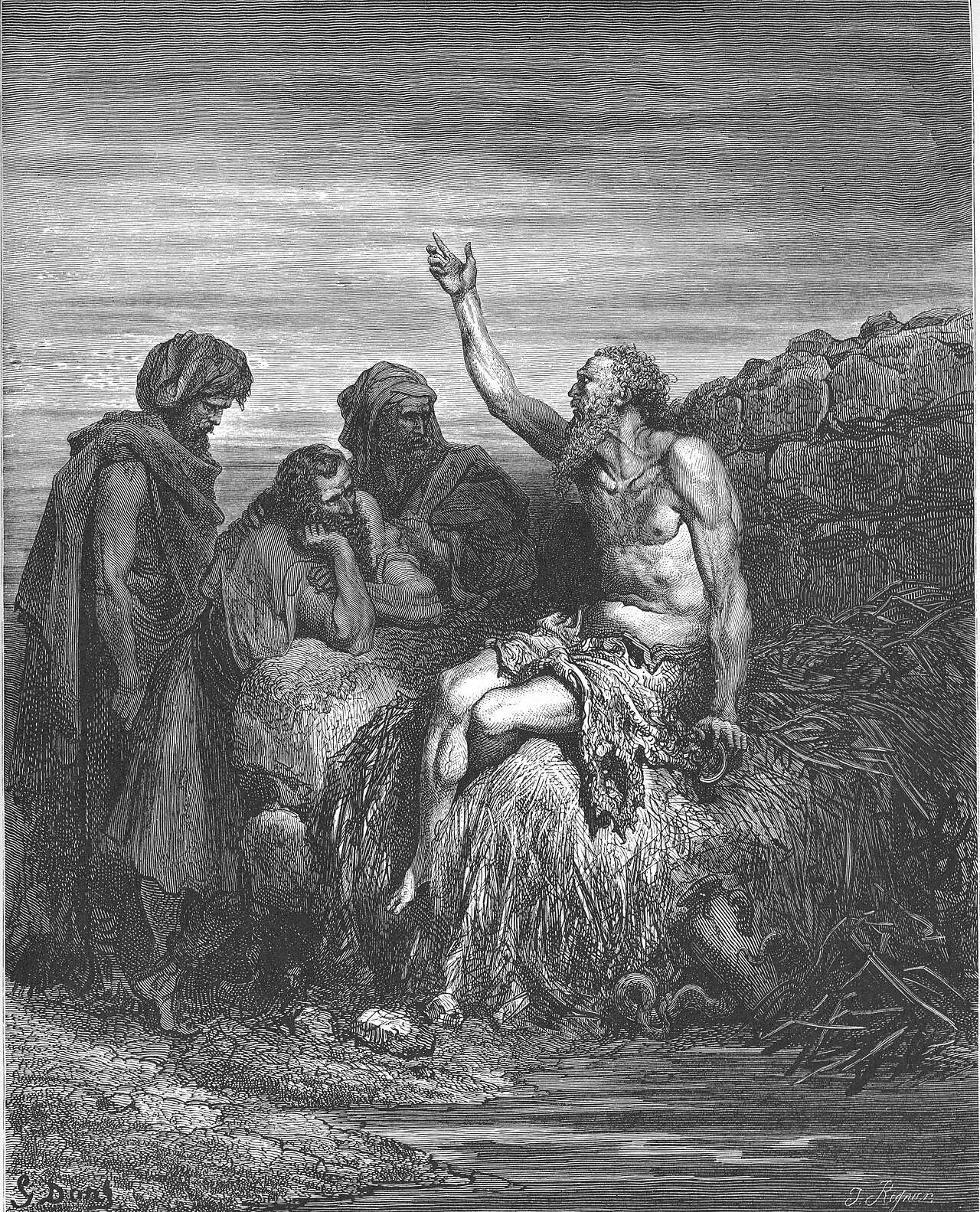
The disease is described as boils from the sole of the foot to the crown of the head, and the book later adds worms in the sores, blackened peeling skin, foul breath, sleeplessness, and burning fever. Attempts to name a modern diagnosis have never settled, and the text is not trying to give one. What matters is that it was disfiguring, agonising, and visible, the kind of thing that made a man untouchable.
The ash heap is a real place. Villages in that part of the world kept a mound outside the settlement where household ash, dung, and refuse were dumped and left to dry for fuel. It was where the diseased and destitute sat, because it was warm, outside the town, and nobody else wanted it. The scraping tool is just as ordinary, a shard of broken pottery, the most common object in any ancient household.
The friends do everything mourning custom asked. They tear their robes, throw dust into the air over their heads, weep aloud, and then sit on the ground with him for seven days without a word, the standard length of formal mourning, the same seven days later kept for the dead. They travelled from Teman in Edom, from the Shuhite country on the middle Euphrates, and from Naamah, which means they coordinated and came a long way.
Significance
The chapter puts two responses side by side and lets hearers weigh them. Job's wife says the honest, unbearable thing, curse God and die, since integrity has bought him nothing. Job answers that if we take the good from God's hand we cannot refuse the bad, and the text is careful to say he still did not sin with his lips.
Show the rest of the significance, 1 more paragraph
And the friends are at their best here, before they open their mouths. Seven days of silent company is the one thing in the book that everybody agrees was right.
This chapter in Jewish lifeWhat this chapter is in Jewish life and reading.
What is done
No weekly portion, no Haftarah and no festival reading comes from this chapter. The site's own table in src/lib/hebraic/readings.ts printed parashot total 0 and haftarah uses total 0 for Job, with no festival reading.
The corpus ties the chapter to the study of the Talmud. Bava Batra 16a stands under the first, third, fourth, sixth and tenth verses. The friends who sit on the ground in silence at the thirteenth verse draw locators in two tractates of the Jerusalem Talmud, Berakhot and Moed Katan. Midrash named for Torah portions also appears: Midrash Tanchuma at Mishpatim 11:4 on the seventh verse and at Yitro 16:5 on the ninth.
How it is read
Malbim opens the chapter, quoted here from Malbim's Job, translated by Jeremy I. Pfeffer (Ktav, 2003), which Sefaria reports as CC-BY. He asks why Satan now stands among those in attendance before the Lord. His answer rests on the kind of harm to come. The first losses came from nature and from raiders, and God had only to lift His protection. Disease is different, Malbim argues, because a righteous man's self-restraint guards his body by nature. Breaking that guard needs an act of Providence, and so "This time God's direct participation is needed" (Malbim on Job 2:1:1).
Rashi is quoted from The Judaica Press complete Tanach with Rashi, translated by A. J. Rosenberg, which Sefaria reports as CC-BY. He reads the word for enticing as drawing a person to one's counsel (Rashi on Job 2:3:2). The Adversary's saying about skin he reads as one limb given for another. "It is human nature that, when one sees a sword coming toward his head, he protects it with his arm in front of it" (Rashi on Job 2:4:1). A man who knows his life is at stake stops worrying about his money (Rashi on Job 2:4:2).
Both commentators set down the same saying of the Sages on the limit God placed at the sixth verse, that Job's life be spared. In Rashi the Sages said the Adversary's pain was greater than Job's, like a man told to break a barrel and keep its wine (Rashi on Job 2:6:1). Malbim gives the saying from Bava Batra 16a and calls it irony (Malbim on Job 2:6:1). The two notes carry one teaching in two translations.
Rashi's notes on Job's wife and on Job's answer are short. Her word to die is an imperative (Rashi on Job 2:9:2). Job's question to her is "a wonder", a question that answers itself (Rashi on Job 2:10:1). At the end of the tenth verse Rashi adds a sharp reading of his own. Job did not sin with his lips, "but in his heart he did sin" (Rashi on Job 2:10:2). A reader should weigh that note against Rashi's note at the close of the first chapter.
The friends are read with sympathy. They are those who loved him (Rashi on Job 2:11:1). They did not know him because his face had changed through his agonies (Rashi on Job 2:12:1). Throwing dust high over their heads "was their mourning custom" (Rashi on Job 2:12:2). They sat on the ground to share his pain (Rashi on Job 2:13:1).
The corpus carries four further notes on this chapter without an English text, each marked linked because Sefaria holds no English version of the ref. They stand cited and unquoted at Metzudat David on Job 2:1:1, 2:2:1 and 2:7:1, and at Ibn Ezra on Job 2:8:1.
What the rabbis say
The corpus carries forty rabbinic locators on this chapter and the text of none, so each is cited here by ref. On the first verse it holds Bava Batra 16a:3. On the second it holds Aggadat Bereshit 51:1, Jerusalem Talmud Shevuot 6:5:3 and Vayikra Rabbah 6:3. On the third it holds Bava Batra 16a:4, Chagigah 5a:4, Chullin 4b:10 and Avot DeRabbi Natan, Recension B 43:18. On the fourth it holds Bamidbar Rabbah 12:3, Bava Batra 16a:7, Ein Yaakov (Glick Edition), Bava Batra 1:34 and Mekhilta DeRabbi Yishmael, Tractate Bachodesh 10:11.
The affliction draws the next run. On the sixth verse the corpus holds Bava Batra 16a:8, Chullin 43a:6 and Midrash Lekach Tov, Numbers 23:16:1. On the seventh it holds Midrash Tanchuma, Mishpatim 11:4, Shemot Rabbah 20:1, Vayikra Rabbah 17:4 and Otzar Midrashim, Midrash Yelamdeinu, Last Composition from Midrash Yelamdenu 40. On the eighth it holds Bereshit Rabbah 64:9, Midrash Lekach Tov, Deuteronomy 28:21:1, Pesikta DeRav Kahana 7:10 and Ruth Rabbah (Lerner) 2:10:2.
Job's wife and his answer carry eight. On the ninth verse the corpus holds Aggadat Bereshit 70:3, Midrash Sekhel Tov, Shemot 9:19:3, Midrash Tanchuma, Yitro 16:5 and Yalkut Shimoni on Torah 302:2. On the tenth it holds Aggadat Bereshit 11:2, Avot DeRabbi Natan, Recension B 43:7, Bava Batra 15b:7 and Bava Batra 16a:10.
The friends carry the rest. On the eleventh verse the corpus holds Avodah Zarah 3a:9, Bava Batra 16b:4 and Ein Yaakov, Bava Batra 1:40. On the twelfth it holds Vayikra Rabbah 16:3. On the thirteenth it holds Jerusalem Talmud Berakhot 3:1:9 and Jerusalem Talmud Moed Katan 3:5:20 and 3:5:24. The corpus also files Yalkut Shimoni on Torah 934:6 under a twenty-fourth verse and Sifrei Devarim 306:3 under a twenty-seventh. Both numbers pass the thirteenth, where its commentaries on this chapter end, and they are listed as the corpus prints them.
What each of them teaches is a saying of the rabbis, and is reported as theirs wherever this site quotes one. The quotations wait on a fetch that carries the text.
Sources: Rashi, Rashi on Job 2:2:1 to 2:13:1, The Judaica Press complete Tanach with Rashi, translated by A. J. Rosenberg, reported CC-BY; Malbim, Malbim on Job 2:1:1 and 2:6:1, Malbim's Job, trans. Jeremy I. Pfeffer, Ktav, 2003, reported CC-BY; Metzudat David, Metzudat David on Job 2:1:1, 2:2:1 and 2:7:1, cited by ref because the corpus carries no English text; Ibn Ezra, Ibn Ezra on Job 2:8:1, cited by ref because the corpus carries no English text; The Sefaria corpus, scripts/data/sources/sefaria/job/2.json, the 40 Talmud and Midrash locators of this chapter; The site's own files, src/lib/hebraic/readings.ts, printing no portion, no Haftarah and no festival reading for this book.
The heads below are this chapter's scenes. The numbered points under each are its verses.
The Second Wager: Skin for Skin
Job 2:1-3
the sons of God came to present themselves: The second court scene repeats the formula of chapter 1. The added clause, "He still retains his integrity, even though you incited Me against him to ruin him without cause," is God's verdict. The words "without cause" settle in advance that none of it was deserved, whatever the friends claim.
Job 2:1
“He is asked the same question as before, Whence comest thou? and answers as before, From going to and fro in the earth; as if he had been doing no harm, though he had been abusing that good man.”
Matthew Henry · Commentary on the Whole Bible (1707-1721)puritan
The LORD puts the same question to Satan as at Job 1:7, and Gill notes Satan gives the same answer about roaming through the earth. Thomas Aquinas reads the reply with the same meaning as before. The second test opens exactly like the first.
Job 2:2
“And the Lord said unto Satan, Whence comest thou? And Satan answered the Lord, and said, From going to and fro in the earth, and from walking up and down in it. HISTORICAL INTERPRETATION. Because we have discussed these particulars very fully above, we the rather pass them over in silence, lest, whilst we often repeat points once gone into, we delay too long in coming to such as are untouched; although what is said to Satan by the Lord's voice, Whence comest thou?”
Gregory the Dialogist · written before 604 · Morals on the Book of Job, Book IIIpatristic
2 more voices on this verse
Job 2:2
“And the Lord said unto Satan ... - See the notes at Job 1:7.”
Job 2:2
“And the Lord said unto Satan, whence camest thou?.... The same question is put to him, and the same answer is returned by him; See Gill on Job 1:7.”
He still retains his integrity: Clarke notes the Hebrew for ruin means to swallow or devour, the word Peter echoes when the devil seeks to devour at 1 Peter 5:8. Wesley reads you incited Me as a picture of Satan's malice and God's permission. Without cause means Job's sins had called down none of this.
Job 2:3
“And the Lord said unto Satan, Hast thou considered my servant Job, that there is none like him in the earth, a perfect and an upright man, one that feareth God, and escheweth evil? and still he holdeth fast his integrity, although thou movedst me against him, to destroy him without cause. HISTORICAL INTERPRETATION. As if He said explicitly, 'Thou indeed hast wrought thy malice, but he has not lost his innocence; and thou art forced to serve to his advancement by the very means whence thou thoughtest to lessen his advancement.”
Gregory the Dialogist · written before 604 · Morals on the Book of Job, Book IIIpatristic
2 more voices on this verse
Job 2:3
“Hast thou considered - Notes, Job 1:8. That there is none like him in the earth - The same addition is made here by the Septuagint which occurs in Job 1:1; see the notes at that verse. And still he holdeth fast his integrity - Notwithstanding all the efforts made to show that his piety was the result of mere selfishness. The word “integrity” here תמה tûmmâh means “perfection;” another form of the word which is rendered “perfect” in Job 1:1; see the notes at that verse.”
Job 2:3
“Still - Notwithstanding all his afflictions, and thy suggestion to the contrary. Movedst - This, as the rest of this representation, is not to be understood literally: But the design is to signify both the devil's restless malice in promoting man's misery and God's permission of it for wise and holy ends.”
John Wesley · Explanatory Notes upon the Old Testament (1765)evangelical
Job 2:4-6
The words "Skin for skin" occur only here, a saying of barter in Gill and Clarke, one skin traded to save a more valuable one. "A man will give up all he owns in exchange for his life," so the losses so far had spared Job's own body.
Job 2:4
“Skin for skin--a proverb. Supply, "He will give." The "skin" is figurative for any outward good. Nothing outward is so dear that a man will not exchange it for some other outward good; "but" (not "yea") "life," the inward good, cannot be replaced; a man will sacrifice everything else for its sake.”
Jamieson, Fausset & Brown · Commentary Critical and Explanatory on the Whole Bible (1871)reformed
1 more voice on this verse
Job 2:4
“Skin for skin - That is, A man will part with all he has in the world to save his life; and he will part with all by piecemeal, till he has nothing left on earth, and even be thankful, provided his life be spared. Thou hast only destroyed his property; thou hast left him his life and his health. Thou hast not touched his flesh nor his bone; therefore he is patient and resigned.”
Adam Clarke · Commentary on the Bible (1810-1826)evangelical
strike his flesh and bones: Satan asks for leave a second time, and Barnes takes the request as proof he can strike Job only by permission. Matthew Henry sets the pain of flesh and bones beside Paul's thorn in the flesh at 2 Corinthians 12:7, borne by grace. Flesh and bones means the man himself.
Job 2:5
“But put forth thine hand now - Satan felt that he had no power to afflict Job without permission. Malignant as he was, he knew that God only could subject the holy man to this trial - another proof that Satan is under the control of the Almighty, and acts only as he is “permitted” to act in tempting and trying the good. And touch his bone - See the note at Job 1:11. Afflict his body so as to endanger his life. The words “bone” and “flesh” denote the whole body.”
1 more voice on this verse
Job 2:5
“There is no disputing against sense. St. Paul himself had much ado to bear a thorn in the flesh, nor could he have borne it without special grace from Christ, 2 Cor. xii.”
Matthew Henry · Commentary on the Whole Bible (1707-1721)puritan
Gregory notes the guard goes with the permission, so the LORD keeps Job even while He hands him over. Wesley reads Job as a type of Christ, for Satan was allowed to strike Christ's heel at Genesis 3:15 and to take His life. Job's life stays in the LORD's hands.
Job 2:6
“But save his life - His body thou shalt have permission to afflict, but against his life thou shalt have no power; therefore take care of his life. The original, נפשו שמר naphsho shemor, may be translated, keep his soul; but the word also signifies life; yet in the hands of the destroyer the life of this holy man is placed! How astonishing is the economy of salvation!”
Adam Clarke · Commentary on the Bible (1810-1826)evangelical
1 more voice on this verse
Job 2:6
“Job, in being thus maligned of Satan, was a type of Christ. He had permission to bruise his heel, to touch his bone and his flesh; yea, and his life also; because by dying he was to do what Job could not do, to destroy him that had the power of death.”
John Wesley · Explanatory Notes upon the Old Testament (1765)evangelical
Boils, Ashes, and a Wife's Counsel
Job 2:7-8
infected Job with terrible boils: The text gives "terrible boils from the soles of his feet to the crown of his head" and offers no diagnosis. Barnes calls any naming of the disease guesswork. Job scrapes himself as he sits "among the ashes," the posture of a mourner, as Delitzsch notes.
Job 2:7
“So went Satan forth - Job 1:12. And smote Job with sore boils - The English word boil denotes the well-known turnout upon the flesh, accompanied with severe inflammation; a sore angry swelling. “Webster.” The Hebrew word, however, is in the singular number שׁחין shechı̂yn, and should have been so rendered in our translation.”
1 more voice on this verse
Job 2:7
“Boils - Like those inflicted upon the Egyptians, which are expressed by the same word, and threatened to apostate Israelites, Deut. xxviii, 27, whereby he was made loathsome to himself, and to his nearest relations, and filled with consuming pains in his body, and no less torments and anguish in his mind.”
John Wesley · Explanatory Notes upon the Old Testament (1765)evangelical
a piece of broken pottery to scrape himself: Barnes identifies the broken pottery as a shard of a vessel, used to scrape the sores Satan struck on Job. Matthew Henry notes that the Greek version seats Job on a dunghill outside the city, while the Hebrew names only the ashes. Wesley adds that Job's hands were sore too.
Job 2:8
“And he took him a potsherd - The word used here חרשׁ chârâsh means a fragment of a broken vessel; see the notes at Isa 45:9. The Septuagint renders it ὄστρακον ostrakon - “a shell.” One object of taking this was to remove from his body the filth accumulated by the universal ulcer, compare Job 7:4-5; and another design probably was, to “indicate” the greatness of his calamity and sorrow.”
2 more voices on this verse
Job 2:8
“If God lay him among the ashes, there he will contentedly sit down. A low spirit becomes low circumstances, and will help to reconcile us to them. The LXX. reads it, He sat down upon a dunghill without the city (which is commonly said, in mentioning this story); but the original says no more than that he sat in the midst of the ashes, which he might do in his own house.”
Matthew Henry · Commentary on the Whole Bible (1707-1721)puritan
Job 2:8
“Nor with his own hands or fingers, which were also ulcerous, and so unfit for that use; but with potsherds, either because they were next at hand, and ready for his present use; or in token of his deep humiliation under God's hand, which made him decline all things that favoured of tenderness and delicacy. Hebrew. in dust or ashes, as mourners used to do.”
John Wesley · Explanatory Notes upon the Old Testament (1765)evangelical
Job 2:9-10
Her "Curse God and die" is read as the tempter speaking or the grief of a wife. Job answers, "You speak as a foolish woman speaks," a rebuke without the cursing Satan predicted. "Should we accept from God only good and not adversity" makes the wager's terms a settled principle.
Job 2:9
“The Jews (who covet much to be wise above what is written) say that Job's wife was Dinah, Jacob's daughter: so the Chaldee paraphrase. It is not likely that she was; but, whoever it was, she was to him like Michal to David, a scoffer at his piety.”
Matthew Henry · Commentary on the Whole Bible (1707-1721)puritan
The Hebrew for foolish is nabal, which Barnes traces from dullness to open wickedness, the name at 1 Samuel 25:25. Job files his wife's counsel under that word. The verse closes with the verdict that Job sinned in nothing he said, which Wesley takes as no impatient word against God.
Job 2:10
“Thou speakest as one of the foolish - Thou speakest like an infidel; like one who has no knowledge of God, of religion, or of a future state. The Targum, who calls this woman Dinah, translates thus: “Thou speakest like one of those women who have wrought folly in the house of their father.” This is in reference to an ancient rabbinical opinion, that Job lived in the days of the patriarch Jacob, whose daughter Dinah he had married.”
Adam Clarke · Commentary on the Bible (1810-1826)evangelical
1 more voice on this verse
Job 2:10
“That is, some affliction, whereby we may be made partakers of his holiness? Let murmuring therefore, as well as boasting, be forever excluded. Sin with his lips - By any reflections upon God, by any impatient or unbecoming expression.”
John Wesley · Explanatory Notes upon the Old Testament (1765)evangelical
Three Friends Sit Seven Days in Silence
Job 2:11-13
Eliphaz the Temanite, Bildad the Shuhite and Zophar the Naamathite arrive, and Eliphaz bears a town name from Edom, where the opening verse placed Job. They tear their robes and sit on the ground and "no one spoke a word to him because they saw how intense his suffering was".
Job 2:11
“Now when Job’s three friends heard - It would seem from this that these men were his particular friends. They came every one from his own place - His residence. This was the result of agreement or appointment thus to meet together. Eliphaz the Temanite - This was the most prominent of his friends. In the ensuing discussion he regularly takes the lead, advances the most important and impressive considerations, and is followed and sustained by the others. The Septuagint renders this Ελιφὰζ ὁ Θαιμαινῶν βασιλεὺς Elifaz ho Thaimainōn basileus - Eliphaz, the king of the Themanites.”
2 more voices on this verse
Job 2:11
“Zophar is thought by some to be the same with Zepho, a descendant from Esau, Gen. xxvi. The preserving of so much wisdom and piety among those that were strangers to the covenants of promise was a happy presage of God's grace to the Gentiles, when the partition-wall should in the latter days be taken down.”
Matthew Henry · Commentary on the Whole Bible (1707-1721)puritan
Job 2:11
“Teman means "at the right hand"; and then the south, namely, part of Idumea; capital of Edom (Am 1:12). Hebrew geographers faced the east, not the north as we do; hence with them "the right hand" was the south.”
Jamieson, Fausset & Brown · Commentary Critical and Explanatory on the Whole Bible (1871)reformed
they could barely recognize Job: Disease had so changed Job that his friends could barely recognize him from afar, as Barnes reads it. Thomas Aquinas adds the loss of his fine clothing. The torn robe and the dust thrown over the head are the old signs of deep grief that Clarke gathers from the ancients.
Job 2:12
“They rent every one his mantle - I have already had frequent occasions to point out and illustrate, by quotations from the ancients, the actions that were used in order to express profound grief; such as wrapping themselves in sackcloth, covering the face, strewing dust or ashes upon the head, sitting upon the bare ground, etc., etc.; significant actions which were in use among all nations.”
Adam Clarke · Commentary on the Bible (1810-1826)evangelical
Then they sat on the ground with him for seven days and seven nights: Seven days and seven nights was the usual time of mourning. Wesley notes that the friends kept the mourning for the dead, both for the children and for Job himself, a man dead while he lived. Jamieson, Fausset and Brown read the silence as suffering too intense for any word.
Job 2:13
“Seven days - Which was the usual time of mourning for the dead, and therefore proper both for Job's children, and for Job himself, who was in a manner dead, while he lived: not that they continued in this posture so long together, which the necessities of nature could not bear; but they spent the greatest part of that time in sitting with him, and silent mourning over him.”
John Wesley · Explanatory Notes upon the Old Testament (1765)evangelical
Keep studying
People and groups1
Sources for this chapter
The summary
Jamieson, Fausset & Brown, Commentary Critical and Explanatory; John Wesley, Notes on the Old Testament and Matthew Henry, Complete Commentary.
The exposition
Adam Clarke, Commentary on the Bible; Albert Barnes; Franz Delitzsch, Biblical Commentary on the Book of Job; Gregory the Dialogist, Morals on the Book of Job; Jamieson, Fausset & Brown, Commentary Critical and Explanatory on the Whole Bible; John Gill, Exposition of the Old Testament; John Wesley, Explanatory Notes upon the Old Testament; Matthew Henry, Commentary on the Whole Bible and Thomas Aquinas, Commentary on Job.