
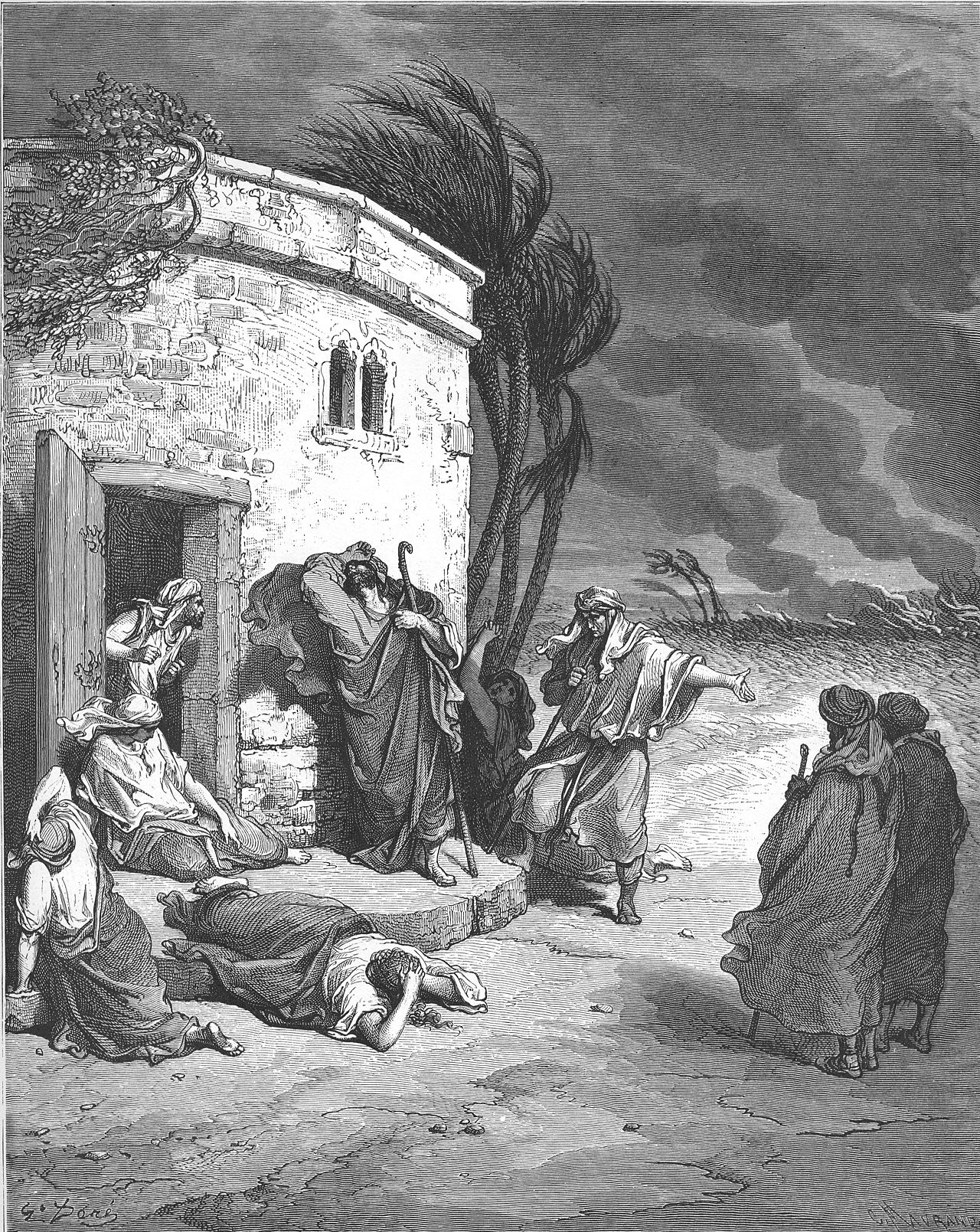
Jobchapter 18
21 verses · unknown · 10th century BC · Wisdom and poetry
You who tear yourself in anger—should the earth be forsaken on your account, or the rocks be moved from their place?
Introduction
unknown, Wisdom and poetry, Job Overview.
Bildad the Shuhite speaks for the second time, and his whole speech is one portrait. He is offended that Job treats the friends as fools, and he answers with a picture of the wicked man's end. His hearers knew the tools of the trapper and the fowler, and they knew what an unlit lamp in a house meant. Listen for how many traps are set in a few lines. Listen for the home, the name and the family that disappear one by one. Then ask whose house Bildad has in mind.
Context
- Who
- Hearers who had heard a family line described as cursed
- What
- Bildad's second speech, a portrait of the wicked man caught in traps, cut off from his home and forgotten.
- Where
- The ash heap outside Job's town.
- When
- The second round of speeches, Bildad's second turn.
- Why
- To warn Job that his ruin matches the fate of the wicked and to press him to see himself in it.
Historical context
Bildad's whole speech is one extended portrait of the wicked man's end, and the images come from the two most familiar trades in the region: trapping and mourning.
Show the rest of the historical context, 3 more paragraphs
The trapping section piles up six different devices in a few lines, a net, a snare, a noose held by the heel, a hidden cord on the ground, a trap on the path, and a pit. Fowlers and hunters used every one of them, and each Hebrew word names a different mechanism. The picture is of a man who cannot put a foot down anywhere without something closing on it.
'The light shall be dark in his tabernacle, and his candle shall be put out with him' is domestic. A household kept a small clay lamp burning through the night; an extinguished lamp meant the house was empty, and 'his lamp put out' was standard ancient shorthand for a family line ending.
The last images are the curse laid on a ruined site. Brimstone, sulphur, scattered on the place made it barren and marked it as accursed; sowing a destroyed site with salt or sulphur was a known ritual across the ancient Near East. And 'the firstborn of death' devouring his strength personifies a killing disease, the way that world spoke of plague as a power with a name. He is left with no son and no nephew among his people, and no one remaining in his dwellings, total erasure.
Significance
Every hearer knew who this portrait was aimed at. Job's lamp is out, his children are dead, his estate is gone, and his name in the town is a byword. Bildad has drawn the picture and pointed.
Show the rest of the significance, 1 more paragraph
The book lets the speech stand without comment because it wants hearers to feel how convincing a false diagnosis can be when the symptoms all line up.
This chapter in Jewish lifeWhat this chapter is in Jewish life and reading.
What is done
The site's reading table gives this chapter no Sabbath portion, no Haftarah and no festival reading. The probe of src/lib/hebraic/readings.ts printed parashot total 0 and haftarah uses total 0 for the book.
The corpus ties the chapter to other settings. It files the thirteenth verse under Midrash Tanchuma, Ki Teitzei 9:1 and Midrash Tanchuma Buber, Ki Teitzei 10:1, and the seventeenth under Midrash Tanchuma, Shemot 4:3. Its Talmud locators sit in Berakhot 5b under the fourth verse, Sanhedrin 22a under the sixth and Chagigah 15b under the nineteenth.
How it is read
Malbim, in Malbim's Job, translated by Jeremy I. Pfeffer (Ktav, 2003), which Sefaria reports as CC-BY, heads the chapter "The Tenth Oration - Bildad’s Speech in the Second Round" (Malbim on Job 18:1:1). He reads Bildad's anger as aimed at one admission of Job's. Job does not believe in, or at least doubts, "the survival of the soul after death."
If that were so, Bildad argues, man would be no better than the animals, and his mind would serve only to show him his own end. Malbim's Bildad answers from what is seen. God has given man spiritual powers found in no other animal, so the soul does not perish with the body and lives on for ever (Malbim on Job 18:1:2).
At the third verse Malbim puts the same charge another way. "Job’s anguish has unbalanced him." Nothing else, in Bildad's view, explains Job's denial that the soul survives the body (Malbim on Job 18:3:1).
Rashi, quoted here from The Judaica Press complete Tanach with Rashi, translated by A. J. Rosenberg, which Sefaria reports as CC-BY, reads the chapter closer to its words. Bildad asks how long Job will prolong the discussion, and asks for silence to understand and to hear (Rashi on Job 18:2:1 and 18:2:2).
At the third verse Rashi sets two readings of one word against each other. He takes it as stopped up, on the evidence of the Aramaic rendering of Genesis 26:15. Some explain it as hiding, and Rashi says they are in error, because that sense would need two letters nun (Rashi on Job 18:3:1). The difference is one of grammar, and Rashi settles it himself.
At the fourth verse Bildad turns to Job himself as one who destroys his own soul in his anger (Rashi on Job 18:4:1). Rashi then follows the wicked man's end step by step. His steps are shortened, his feet are sent onto a net, a trap seizes his heel, and the snare lies hidden in the ground under his feet (Rashi on Job 18:7:1 to 18:10:1). The terrors of the eleventh verse Rashi calls demons (Rashi on Job 18:11:1).
At the twelfth verse Rashi renders the word as his son and notes that it means literally his strength. The branches devoured at the thirteenth are "his sons and daughters" (Rashi on Job 18:12:1 and 18:13:1). He is torn from his wife, who dwells in his tent as a widow, and he is driven from heaven (Rashi on Job 18:14:1, 18:15:1 and 18:18:1). He leaves no grandson, and the later people wonder when they hear of his misfortune. Rashi sums up the dwellings of the unrighteous in four words. "This is their fate" (Rashi on Job 18:19:1 to 18:21:1).
The corpus carries three further notes on this chapter without an English text, each marked linked because Sefaria holds no English version of the ref. They stand cited and unquoted at Metzudat David on Job 18:6:1, 18:16:1 and 18:17:1.
What the rabbis say
The corpus carries twenty-eight rabbinic locators on this chapter and the text of none, so each is cited and linked here by ref alone. On the second verse it holds Midrash Sekhel Tov, Shemot 9:32:1. The fourth verse draws six. The corpus holds Aggadat Bereshit 25:1, Berakhot 5b:25 and 5b:26, Ein Yaakov (Glick Edition), Berakhot 1:20, Ein Yaakov, Berakhot 1:29 and Ruth Rabbah (Lerner) 2:2:1. On the sixth it holds Ein Yaakov (Glick Edition), Sanhedrin 2:17, Ein Yaakov, Sanhedrin 2:18 and Sanhedrin 22a:19.
On the tenth verse it holds Pirkei DeRabbi Eliezer 24:12 and Yalkut Shimoni on Torah 115:1, and on the eleventh Mekhilta DeRabbi Shimon Ben Yochai 14:24. The thirteenth verse, where Rashi reads the branches as the man's children, draws seven. The corpus holds Eikhah Rabbah 3:22, Midrash Shmuel 18:6, Midrash Tanchuma Buber, Ki Teitzei 10:1, Midrash Tanchuma, Ki Teitzei 9:1, Pesikta DeRav Kahana 3:6, Ruth Rabbah (Lerner) 7:12:6 and Yalkut Shimoni on Torah 938:32.
On the seventeenth verse it holds Midrash Tanchuma, Shemot 4:3 and Midrash Tannaim on Deuteronomy 25:19:3. On the eighteenth it holds Bamidbar Rabbah 11:7 and Sifrei Zuta 6:26:2. On the nineteenth it holds Chagigah 15b:5, Ein Yaakov (Glick Edition), Khagigah 2:25, Ein Yaakov, Khagigah 2:15 and Midrash Tehillim 9:10. What each of them teaches is a saying of the rabbis, and is reported as theirs wherever this site quotes one. The quotations wait on a fetch that carries the text.
Sources: Rashi, Rashi on Job 18:2:1 to 18:21:1, The Judaica Press complete Tanach with Rashi, translated by A. J. Rosenberg, reported CC-BY; Malbim, Malbim on Job 18:1:1 to 18:3:1, Malbim's Job, trans. Jeremy I. Pfeffer, Ktav, 2003, reported CC-BY; Metzudat David, Metzudat David on Job 18:6:1, 18:16:1 and 18:17:1, cited by ref because the corpus carries no English text; The Sefaria corpus, scripts/data/sources/sefaria/job/18.json, the 28 Talmud and Midrash locators of this chapter; The site's own files, src/lib/hebraic/readings.ts, printing no portion, no Haftarah and no festival reading for this book.
The heads below are this chapter's scenes. The numbered points under each are its verses.
Bildad: How Long Till Ye Make an End of Words?
Job 18:1-4
Then Bildad the Shuhite replied: Bildad opens irritated, "How long until you end these speeches". In "You who tear yourself in anger" the tearing Job used of God at 16:9 turns on Job. The question "should the earth be forsaken on your account" accuses him of asking the world to bend for him.
Job 18:1
“Then answered Bildad - The following analysis of this speech, by Mr. Heath, is judicious: “Bildad, irritated to the last degree that Job should treat their advice with so much contempt, is no longer able to keep his passions within the bounds of decency. He proceeds to downright abuse; and finding little attention given by Job to his arguments, he tries to terrify him into a compliance.”
Adam Clarke · Commentary on the Bible (1810-1826)evangelical
The plural of Bildad's question puzzles the commentators. Wesley takes it as Job alone, addressed in the plural of respect. Jamieson, Fausset and Brown think Bildad tells his two companions to end their long speeches and talk sense.
Job 18:2
“How long will it be ere ye make an end - It is difficult to say to whom this address is made: being in the plural number, it can hardly be supposed to mean Job only. It probably means all present; as if he had said, It is vain to talk with this man, and follow him through all his quibbles: take notice of this, and then let us all deliver our sentiments fully to him, without paying any regard to his self-vindications.”
Adam Clarke · Commentary on the Bible (1810-1826)evangelical
1 more voice on this verse
Job 18:2
“Ye - Thou, O Job; of whom he speaks here, as also ver. 3, in the plural number, as was a common idiotism of the Eastern language, to speak thus of one person, especially where he was one of eminency.”
John Wesley · Explanatory Notes upon the Old Testament (1765)evangelical
Why are we regarded as cattle: Bildad takes Job's words at 12:7, where Job sent the friends to the cattle to know God, as an insult. Barnes says the friends feel treated as if they had no sense. Henry calls it pride.
Job 18:3
“Wherefore are we counted as beasts,.... This seems to refer to Job 12:7; where Job sends them to the beasts, to get knowledge and instruction; and therefore it was concluded he reckoned them as such, and put them on a level with them, yea, made them inferior to them; or to Job 17:4; where they are represented as destitute of wisdom and understanding, and therefore it is supposed were counted by Job no other than as beasts.”
Henry calls anger a sin that is its own punishment, and Barnes and Clarke hear Bildad call Job a madman. Jamieson, Fausset and Brown, after Umbreit, read the question as whether the earth must be forsaken and the rocks moved so that Job goes unpunished. Bildad assumes Job's guilt.
Job 18:4
“He teareth himself in his anger - Literally, Rending his own soul in his anger; as if he had said, Thou art a madman: thy fury has such a sway over thee that thou eatest thy own flesh. While thou treatest us as beasts, we see thee to be a furious maniac, destroying thy own life. Shall the earth be forsaken for thee? - To say the least, afflictions are the common lot of men. Must God work a miracle in providence, in order to exempt thee from the operation of natural causes?”
Adam Clarke · Commentary on the Bible (1810-1826)evangelical
Bildad: The Light of the Wicked Shall Be Put Out
Job 18:5-7
the lamp of the wicked is extinguished: The poem opens with light: "the lamp of the wicked is extinguished", and "The light in his tent grows dark" repeats the figure. Then "His vigorous stride is shortened, and his own schemes trip him up" turns to motion. Delitzsch reads the doubled light as Bildad's opening move.
Job 18:5
“Shall not the light of the wicked be put out, and the flame of his fire cease to shine? If he says this in describing the present life, he is mistaken; in that very often both the light of prosperity is seen in the ungodly, and the darkness of ignominy and poverty envelopes the godly. But if his discourse points to this, viz. to shew what the ungodly meet with in their end, it is said with truth, Shall not the light of the wicked be put out, and the flame of his fire cease to shine?”
Gregory the Dialogist · written before 604 · Morals on the Book of Job, Book XIVpatristic
3 more voices on this verse
Job 18:5
“That (Job 18:4) cannot be. The decree of God is unalterable, the light (prosperity) of the wicked shall at length be put out. his fire--alluding to Arabian hospitality, which prided itself on welcoming the stranger to the fire in the tent, and even lit fires to direct him to it. The ungodly shall be deprived of the means to show hospitality.”
Jamieson, Fausset & Brown · Commentary Critical and Explanatory on the Whole Bible (1871)reformed
Job 18:5
“In this he seems, all along, to have an eye to Job's complaints of the miserable condition he was in, that he was in the dark, bewildered, ensnared, terrified, and hastening out of the world. "This," says Bildad, "is the condition of a wicked man; and therefore thou art one." Second Address of Eliphaz.”
Matthew Henry · Commentary on the Whole Bible (1707-1721)puritan
Job 18:5
“Yea - Truly; or, behold. Bildad here commences his remarks on the certain destiny of the wicked, and strings together a number of apparently proverbial sayings, showing that calamity in various forms would certainly overtake the wicked. There is nothing particularly new in his argument, though the use of the various images which he employs shows how deep was the conviction of this doctrine at that time, and how extensively it prevailed. The light of the wicked shall be put out - Light here is an emblem of prosperity.”
the lamp beside him goes out: Jamieson, Fausset and Brown explain that in the East the lamp burned all night, and the poorest would give up food before the night lamp. A dark tent is utter desolation. Clarke reads the lamp that goes out as a man left with no posterity.
Job 18:6
The light shall the dark in his tabernacle,.... Not the light of the eye, in the tabernacle of his body, rather the light of nature and reason in him; and when that "light that is in a man becomes darkness", as our Lord says, "how great is that darkness!"
2 more voices on this verse
Job 18:6
“The light shall be dark in his tabernacle - His property shall be destroyed, his house pillaged, and himself and his family come to an untimely end. His candle shall be put out - He shall have no posterity.”
Adam Clarke · Commentary on the Bible (1810-1826)evangelical
Job 18:6
“His light will certainly be put out at length, quite put out, so that not the least spark of it shall remain with which to kindle another fire. Even while he is in his tabernacle, while he is in the body, which is the tabernacle of the soul ( 2 Cor. v. 1 ), the light shall be dark; he shall have no true solid comfort, no joy that is satisfying, no hope that is supporting.”
Matthew Henry · Commentary on the Whole Bible (1707-1721)puritan
his own schemes trip him up: Bildad's wicked man walks into his own ruin. Barnes explains that the vigorous stride is a firm, free step, now shortened and hindered. Jamieson, Fausset and Brown tie his fall by his own schemes to Job 5:13.
Job 18:7
“The steps of his strength - Strong steps. “Steps of strength” is a Hebraism, to denote firm or vigorous steps. Shall be straitened - Shall be compressed, embarrassed, hindered. Instead of walking freely and at large, he shall be compressed and limited in his goings. “Large steps,” “free movement,” etc. are proverbial expressions among the Arabs, to denote freedom, prosperity, etc. RosenmulIer. Schultens quotes the following illustrations from the Arabic poets.”
Job 18:8-10
his own feet lead him into a net: Three verses give six words for a trap: "a net" and "its mesh", "A trap" and "a snare", "A noose" and "a trap". In "his own feet lead him into a net" the wicked man authors his own ruin. Clarke reads the near synonyms as a device of Hebrew poetry.
Job 18:8
“For he hath put his own foot into the net, and he walketh in the meshes of it. He, who 'puts his feet into a net,' cannot get them out, when he has a mind; so he that lets himself down, into habits of sin, cannot rise up the moment he wishes it; and he 'that walketh in the meshes of a net,' entangles his steps in walking, and when he tries to extricate himself to walk, he is tied and bound that he cannot.”
Gregory the Dialogist · written before 604 · Morals on the Book of Job, Book XIVpatristic
3 more voices on this verse
Job 18:8
“For he is cast into a net - His own conduct will infallibly bring him to ruin. He shall be like a wild beast taken in a net; the more he flounces in order to extricate himself, the more he shall be entangled. He walketh upon a snare - He is continually walking on the meshes of a net, by which he must soon be entangled and overthrown.”
Adam Clarke · Commentary on the Bible (1810-1826)evangelical
Job 18:8
“God is preparing for his destruction. The sinner by his sin is preparing the fuel and then God by his wrath is preparing the fire. See here, (1.) How the sinner is infatuated, to run himself into the snare; and whom God will destroy he infatuates.”
Matthew Henry · Commentary on the Whole Bible (1707-1721)puritan
Job 18:8
“For he is cast into a net by his own feet - He is caught in his own tricks, as if he had spread a net or dug a pitfall for another, and had fallen into it himself. The meaning is, that he would bring ruin upon himself while he was plotting the rain of others; see Psa 9:16, “The wicked is snared by the work of his own hands;” compare the note at Job 5:13. The phrase “by his own feet” here means, that he walks there himself.”
A trap seizes his heel: Clarke hears a hunt running from verse 7 to verse 13, net, trap and snare, and notes that Houbigant sets verse 10 before verse 9. Barnes describes a trap that springs to seize an animal by the feet or heel. Henry sees the tempter laying snares in the path.
Job 18:9
“The gin - Another method of taking wild beasts. It was a snare so made as to spring suddenly on an animal, securing him by the neck or feet. We use a trap for the same purpose. The Hebrew word (פח pach) may denote anything of this kind - a snare, net, noose, etc. with which birds or wild animals are taken. By the heel - By the foot. And the robber shall prevail - He shall be overpowered by the highwayman; or the plunderer shall make a sudden descent upon him, and strip him of his all.”
1 more voice on this verse
Job 18:9
“The sinner may as soon overpower the divine omnipotence as flee from the divine omniscience, Amos ix. No marvel that the sinner is dispirited and distracted with fear, for, 1. He sees his ruin approaching: Destruction shall be ready at his side, to seize him whenever justice gives the word, so that he is brought into desolation in a moment, Ps. lxxiii.”
Matthew Henry · Commentary on the Whole Bible (1707-1721)puritan
A noose is hidden in the ground: The Hebrew word for noose, Barnes explains, means a cord and then a snare in the ground. The danger lies out of sight. Gregory reads the hidden snare as sin concealed under earthly gain, so the soul sees only the gain.
Job 18:10
“The snare is laid - All this language is taken from the modes of taking wild beasts; but it is not possible to designate with absolute certainty the methods in which it was done. The word used here (חבל chebel) means a cord, or rope; and then a snare, gin, or toil, such as is used by hunters. It was used in some way as a noose to secure an animal.”
Job 18:11-14
Terrors frighten him on every side: With "Terrors frighten him on every side" the poem moves from trap to pursuit, and the Hebrew behind "His strength is depleted" is hunger. The unit closes with "marched off to the king of terrors", which Jamieson, Fausset and Brown and Gill read as death in its terror.
Job 18:11
Terrors shall make him afraid - He shall be constantly subject to alarms, and shall never feel secure. “Terrors here are represented as allegorical persons, like the Furies in the Greek poets.” Noyes. The idea here is substantially the same as that given by Eliphaz, Job 15:21-22. And shall drive him to his feet - Margin, scatter. This is a literal translation of the Hebrew. The idea is, that he will be alarmed by such terrors; his self-composure will be dissipated, and he will “take to his heels.”
calamity is ready at his side: Jamieson, Fausset and Brown note that the Hebrew says his strength is hungry, and Barnes reads it as strength depleted by famine. Spurgeon said Bildad meant it as a charge against Job, and did Job great injustice. Calamity stands ready at his side.
Job 18:12
“The Hebrew is brief and bold, "his strength is hungry." destruction--that is, a great calamity (Pr 1:27). ready at his side--close at hand to destroy him (Pr 19:29).”
Jamieson, Fausset & Brown · Commentary Critical and Explanatory on the Whole Bible (1871)reformed
3 more voices on this verse
Job 18:12
“Let his strength be hungerbitten, and starvation invade his ribs. After the manner of Holy Scripture, he has the appearance of wishing that which he foresees will be, not surely in the spirit of one uttering curses, but of one pronouncing prophesies. Thus every man, in that he consists of soul and flesh, is as it were made up of strength and weakness. For by virtue of that part, by which he was created a reasoning spirit, he is not improperly called 'strong,' but in respect of that, by which he is of a fleshly substance, he is weak.”
Gregory the Dialogist · written before 604 · Morals on the Book of Job, Book XIVpatristic
Job 18:12
“His strength shall be hungerbitten - Shall be exhausted by hunger or famine. And destruction shall be ready at his side - Hebrew “Shall be fitted” נכוּן nākûn “to his side.” Some have supposed that this refers to some disease, like the pleurisy, that would adhere closely to his side. So Jerome understands it.”
Job 18:12
“Bildad was declaring the history of the hypocritical, presumptuous and wicked man. And he intended, no doubt, to insinuate that Job was just such a person—that he had been a deceiver and that, therefore, God's Providence had at last revealed him and was visiting him for his sins. In this, Bildad was guilty of great injustice to his friend. All the three miserable comforters of Job were mistaken in the special aim of their discourses and yet, concerning the speeches of each one, it may be said that their general statements were, for the most part, true.”
the firstborn of death devours his limbs: Barnes explains that the Hebrew word rendered patches of skin means bars or branches, here the limbs. Jamieson, Fausset and Brown call the firstborn of death a figure of poetic horror. Wesley says the title marks the worst kind of death.
Job 18:13
“It shall devour the strength of his skin - Margin, bars. The margin is a correct translation of the Hebrew. The word used (בדי badēy, construct with עורו ‛ôrô - his skin) means bars, staves, branches, and here denotes his limbs, members; or, more literally, the bones, as supports of the skin, or the human frame. The bones are regarded as the bars, or the framework, holding the other parts of the body in their place, and over which the skin is stretched.”
2 more voices on this verse
Job 18:13
“First-born - A terrible kind of death. The first-born was the chief of his brethren, and therefore this title is given to things eminent in their kind.”
John Wesley · Explanatory Notes upon the Old Testament (1765)evangelical
Job 18:13
“UMBREIT has "he" for "it," that is, "in the rage of hunger he shall devour his own body"; or, "his own children" (La 4:10). Rather, "destruction" from Job 18:12 is nominative to "devour." strength--rather, "members" (literally, the "branches" of a tree). the first-born of death--a personification full of poetical horror.”
Jamieson, Fausset & Brown · Commentary Critical and Explanatory on the Whole Bible (1871)reformed
the king of terrors: Barnes reads the torn tent as lost shelter and security. Clarke cites a rendering of dissolution invading him like a monarch. Gregory reads the king as death, and behind death the enemy who brought it into the world.
Job 18:14
“His confidence shall be rooted out - His dwelling-place, how well soever fortified, shah now he deemed utterly insecure. And it shall bring him to the king of terrors - Or, as Mr. Good translates, “And dissolution shall invade him as a monarch.” He shall be completely and finally overpowered. The phrase king of terrors has been generally thought to mean death; but it is not used in any such way in the text.”
Adam Clarke · Commentary on the Bible (1810-1826)evangelical
1 more voice on this verse
Job 18:14
“Let his confidence be rooted out of his tabernacle, and let death as a king trample on him. In this place by the title of 'death' we have denoted the enemy of the human race himself, who brought in death, who is set forth by a particular minister of his, of whom it is said to John, And his name was Death.”
Gregory the Dialogist · written before 604 · Morals on the Book of Job, Book XIVpatristic
Job 18:15-19
Fire resides in his tent: In "burning sulfur rains down on his dwelling" Bildad recalls the judgment on Sodom. With "he has no name in the land" the ruin passes beyond death into the loss of all memory of him. Then "He has no offspring or posterity among his people" erases his whole line.
Job 18:15
“It shall dwell in his tabernacle - It is uncertain what is to be understood as referred to here. Some suppose that the word to be understood is soul, and that the meaning is “his soul,” that is, he himself, “shall dwell in his tent.” Rosenmuller, Noyes, Wemyss, and others, suppose that the word is terror. “Terror (בלהה ballâhâh) shall dwell in his tent,” the same word which is used in the plural in the previous verse.”
2 more voices on this verse
Job 18:15
“Some think he here upbraids Job with the burning of his sheep and servants with fire from heaven. The reason is here given why his tabernacle is thus marked for ruin: Because it is none of his; that is, it was unjustly got, and kept, from the rightful owner, and therefore let him not expect either the comfort or the continuance of it.”
Matthew Henry · Commentary on the Whole Bible (1707-1721)puritan
Job 18:15
“It--"Terror" shall haunt, &c., and not as UMBREIT, "another," which the last clause of the verse disproves. none of his--It is his no longer. brimstone--probably comparing the calamity of Job by the "fire of God" (Job 1:16) to the destruction of guilty Sodom by fire and brimstone (Ge 19:24).”
Jamieson, Fausset & Brown · Commentary Critical and Explanatory on the Whole Bible (1871)reformed
The roots beneath him dry up: Roots beneath and branches above take in the whole tree, and Barnes suggests the branches are the wicked man's children. The same figure appears at 15:30. Clarke sees self, posterity and property wither together.
Job 18:16
“Let his roots be dried up beneath, and above let his crop be spoiled. For what do we understand by the title of 'roots,' which are set out of sight, and bring forth a shoot into open view, but the thoughts, which, while they are not seen in the heart, produce visible works? And hence by the title of a 'crop' there is denoted the same visible practice, which is thus produced from a hidden root.”
Gregory the Dialogist · written before 604 · Morals on the Book of Job, Book XIVpatristic
1 more voice on this verse
Job 18:16
“His roots shall be dried up - his branch be cut off - He shall be as utterly destroyed, both in himself, his posterity, and his property, as a tree is whose branches are all lopped off, and whose every root is cut away.”
Adam Clarke · Commentary on the Bible (1810-1826)evangelical
he has no name in the land: An honored name after death was what every man wanted, Barnes notes, and Bildad denies it to the wicked. Henry sets the verse beside Proverbs 10:7, which blesses the memory of the righteous and lets the wicked name rot. Clarke adds that none will survive to carry the name on.
Job 18:17
“Let his remembrance perish from the earth, and let not his name be repeated in the streets. PROPHETICAL INTERPRETATION It is deserving of our notice, that Bildad the Shuhite so expresses himself of each one of the wicked, that his words are secretly directed against the head of all the wicked; for the head of the wicked is the devil.”
Gregory the Dialogist · written before 604 · Morals on the Book of Job, Book XIVpatristic
1 more voice on this verse
Job 18:17
“Thus the judgments of God follow him, after death, in this world, as an indication of the misery his soul is in after death, and an earnest of that everlasting shame and contempt to which he shall rise in the great day. The memory of the just is blessed, but the name of the wicked shall rot, Prov. x.”
Matthew Henry · Commentary on the Whole Bible (1707-1721)puritan
chased from the inhabited world: Barnes reads the light and darkness as prosperity and calamity. Henry pictures the wicked man dragged from the world against his will, as Adam was driven from paradise. Clarke too hears reluctance in the chasing, a man who would gladly stay.
Job 18:18
“He shall drive him from light into darkness. He is led 'from light to darkness,' when for honour in the present life, he is condemned to eternal punishments. And hence it is more plainly added, And translate him out of the world. For he is 'translated out of the world,' when upon the Judge above appearing, he is taken away from this world, in which he wickedly glories; and for this, that when the end of the world breaks in upon him, he is condemned with all his followers.”
Gregory the Dialogist · written before 604 · Morals on the Book of Job, Book XIVpatristic
He has no offspring or posterity among his people: Henry hears Bildad pointing at Job's dead children. Barnes agrees that the loss of offspring and posterity was aimed at Job himself. Henry adds that a man may die with no survivor among his people and still know God.
Job 18:19
“He shall neither have son nor nephew among his people,.... Neither son, nor son's son, or grandson; so the Targum, Jarchi, and Bar Tzemach; that is, he shall be childless, and have no heirs, successors, or survivors, to inherit his estate, bear and perpetuate his name among the people of his country, city, or neighbourhood.”
3 more voices on this verse
Job 18:19
“There shall neither be seed of him, nor offspring in his people, nor any remnant in his parts. For it is written, that the Lord Jesus shall consume him, with the Spirit of His mouth, and shall destroy him with the brightness of His coming.”
Gregory the Dialogist · written before 604 · Morals on the Book of Job, Book XIVpatristic
Job 18:19
“He shall neither have son ... - All his family shall be cut off. He shall have no one to perpetuate his name or remembrance. All this Job could not help applying to himself, as it was doubtless intended he should.”
Job 18:19
“Sin entails a curse upon posterity, and the iniquity of the fathers is often visited upon the children. Herein, also, it is probable that Bildad reflects upon the death of Job's children and servants, as a further proof of his being a wicked man; whereas all that are written childless are not thereby written graceless; there is a name better than that of sons and daughters.”
Matthew Henry · Commentary on the Whole Bible (1707-1721)puritan
Job 18:20-21
Those in the west are appalled at his fate: Bildad's summary, "the place of one who does not know God", ties every image to one cause. Gill notes that Bildad never names Job, leaving the application to his conscience. The poem needs Job to accept the label pressed on him, and chapter 19 shows him refusing it.
Job 18:20
“In his days the last shall be astonied, and horror shall seize on the first. For he will then let himself loose against the righteous with such a measure of iniquity, that even the hearts of the very Elect shall be struck with no small consternation. Whence it is written, Insomuch that if it were possible, they shall deceive the very Elect. Which, clearly, is said, not because the Elect shall fall, but because they shall tremble with terrible alarms.”
Gregory the Dialogist · written before 604 · Morals on the Book of Job, Book XIVpatristic
Bildad sums up the dwelling of the wicked. Clarke and Barnes both hear the one who does not know God as Job. Barnes calls it the close of a harsh and severe speech, and compares Zophar's summary at 20:29.
Job 18:21
“Surely such are the dwellings of the wicked - The conclusion or sum of the whole matter. The meaning is, that the habitations of all that knew not God would be desolate - a declaration which Job could not but regard as aimed at himself; compare Job 20:29. This is the close of this harsh and severe speech. It is no wonder that Job should feel it keenly, and that he “did” feel it is apparent from the following chapter.”
Keep studying
Studies1
Sources for this chapter
The summary
Jamieson, Fausset & Brown, Commentary Critical and Explanatory; John Wesley, Notes on the Old Testament and Matthew Henry, Complete Commentary.
The exposition
Adam Clarke, Commentary on the Bible; Albert Barnes; Charles Spurgeon, The Metropolitan Tabernacle Pulpit, Sermon No. 1510: “The Hunger-Bite”; Franz Delitzsch, Biblical Commentary on the Book of Job; Gregory the Dialogist, Morals on the Book of Job; Jamieson, Fausset & Brown, Commentary Critical and Explanatory on the Whole Bible; Jamieson, Fausset and Brown, Commentary Critical and Explanatory on the Whole Bible; John Gill, Exposition of the Old Testament; John Wesley, Explanatory Notes upon the Old Testament and Matthew Henry, Commentary on the Whole Bible.