
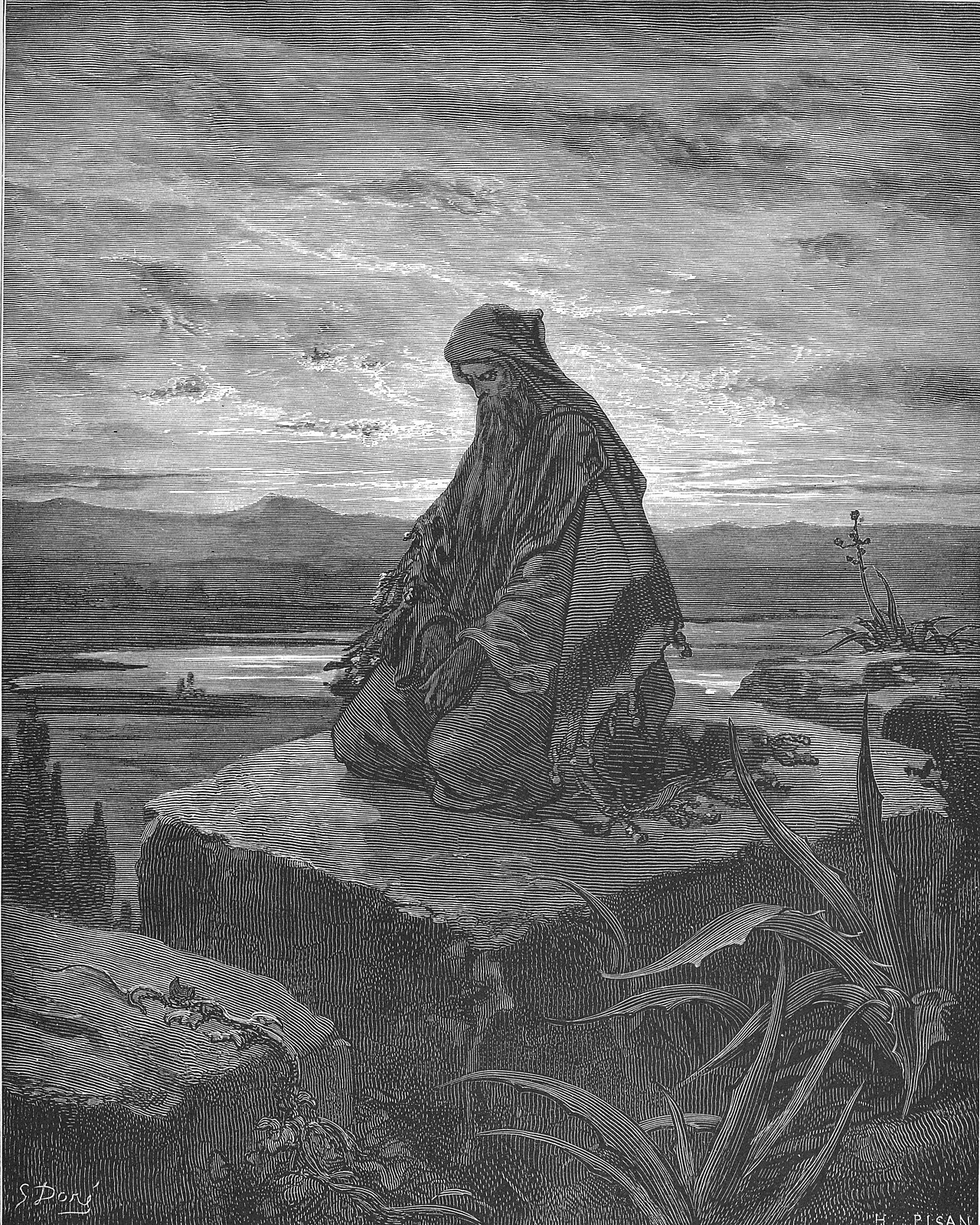
Isaiahchapter 20
6 verses · Isaiah · 8th century BC · The Prophets
Those who made Cush their hope and Egypt their boast will be dismayed and ashamed.
Introduction
Isaiah, The Prophets, Isaiah Overview.
This is the shortest chapter in the oracles against the nations, and it is dated by a campaign of Sargon king of Assyria. It is prose, the account of a sign the prophet acted out in the streets. Isaiah was a well known figure in Jerusalem, and the whole city watched him for three years. It was aimed at leaders who wanted to join a revolt with Egyptian backing. Listen for the one sentence that explains the sign, and for the question the people ask at the end.
Context
- Who
- Judeans who were being urged to join the Ashdod revolt
- What
- The account of a sign Isaiah acted out for three years, showing that Egypt and Cush would be led away as captives.
- Where
- Jerusalem, where Isaiah walked, with the Philistine city of Ashdod on the coast as the occasion.
- When
- Dated to 711 BC, the year Sargon's commander took Ashdod, and the sign ran for three years.
- Why
- To keep Judah out of the revolt against Assyria by showing what trust in Egypt and Cush would bring.
Historical context
This chapter names Sargon king of Assyria, and it is the only place in the Bible he appears. For a long time no other record of him was known and his existence was doubted. Then in 1843 his palace was uncovered at Khorsabad, with room after room of his annals carved on the walls, including his account of the Ashdod campaign. The chapter also names the officer who led it by his Assyrian title, the tartan, the commander-in-chief.
Show the rest of the historical context, 3 more paragraphs
Ashdod was a Philistine city on the coastal plain that revolted against Assyria and tried to recruit Judah, Edom, and Moab into the rebellion, with Egyptian backing promised. Sargon's own inscriptions describe crushing it. Judah stayed out, and this chapter is part of the reason.
The sign Isaiah performs is a prisoner-of-war display. Assyrian palace reliefs show captives stripped, barefoot, and driven along in columns; that was the standard way of moving a defeated population, and it was designed to humiliate. Isaiah walked around Jerusalem that way for three years so that everyone could see in advance what an Egyptian alliance bought.
What he took off is worth noting. Sackcloth was the coarse dark cloth of goat hair worn by mourners and by prophets, the plainest garment there was. Even that comes off.
Significance
The point is stated in one sentence at the end: so shall the king of Assyria lead away the Egyptians and the Cushites, naked and barefoot, and then, they shall be afraid and ashamed of Cush their expectation and Egypt their glory.
Show the rest of the significance, 1 more paragraph
Judah's political class had a hope, and the hope had a name. Isaiah spent three years walking through the city being what that hope would look like.
This chapter in Jewish lifeWhat this chapter is in Jewish life and reading.
What is done
No part of this chapter is read in the synagogue. Probed for this lane, the site's own table in src/lib/hebraic/readings.ts printed parashot 0 and haftarah uses 0 for Isaiah 20, and no festival reading for the book. Across chapters 1 to 22 of Isaiah the same probe found a Haftarah only in chapters 1, 6, 7 and 9.
How it is read
The corpus keeps more of Ibn Ezra on this chapter than of Rashi. Ibn Ezra is quoted from the Commentary of Ibn Ezra on Isaiah, translated by M. Friedlander in 1873, which Sefaria reports as Public Domain. Rashi is quoted here from The Judaica Press complete Tanach with Rashi, translated by A. J. Rosenberg, which Sefaria reports as CC-BY.
The prophet's walking naked and barefoot is read by both with care. Ibn Ezra writes that the command "shows that the prophet wore sackcloth", and doubts that he went naked (Ibn Ezra on Isaiah 20:2:1). Rashi gives the Targum of Jonathan: "with torn and worn out clothing, but not actually naked" (Rashi on Isaiah 20:2:3).
The three years are read by Rashi as a sign that at their end the king of Assyria will lead the captives of Egypt and Cush (Rashi on Isaiah 20:3:1). Ibn Ezra allows two readings of the same words, either three years from that day or three years of misfortune for Egypt (Ibn Ezra on Isaiah 20:3:2).
The inhabitants of the coast in the sixth verse are read by Rashi as "The land of Israel, who relied on Pharoah for aid" (Rashi on Isaiah 20:6:1). Ibn Ezra reads them as the Israelites who live in the islands near Egypt (Ibn Ezra on Isaiah 20:6:1). The corpus also carries three notes with no English text, listed below.
The corpus carries three notes on this chapter without an English text, marked linked. The note of Metzudat David at 20:1:1 stands cited and unquoted because Sefaria holds no English version of the ref. The notes of Radak at 20:1:1 and 20:3:1 stand cited and unquoted because Sefaria holds no English version of the ref.
What the rabbis say
The corpus carries 15 rabbinic locators on the verses of this chapter, 4 in the Talmud and 11 in the Midrash. It carries the text of none, so each is cited by ref here and never quoted or paraphrased. The verse numbers are the Hebrew ones the corpus prints.
On verse 1 it holds Ein Yaakov (Glick Edition), Sanhedrin 11:25, Ein Yaakov, Sanhedrin 11:24 and Sanhedrin 94a:12. It also holds Seder Olam Rabbah 23:1. On verse 2 it holds Yoma 77a:12. On verse 3 it holds Avot DeRabbi Natan, Recension B 43:18, Ein Yaakov (Glick Edition), Shabbat 15:3 and Ein Yaakov, Shabbat 15:3. It also holds Midrash Lekach Tov, Deuteronomy 3:24:1, Midrash Tanchuma, Noach 15:4 and Shabbat 114a:4. It also holds Sifrei Devarim 27:3. On verse 4 it holds Bereshit Rabbah 36:6, Midrash Lekach Tov, Genesis 9:23:3 and Midrash Tanchuma Buber, Noach 21:4.
The corpus file also carries one locator anchored to a verse this chapter does not have, and it is left out of the list above. Mekhilta DeRabbi Yishmael, Tractate Shirah 2:1 is anchored at Isaiah 20:29. The chapter has 6 verses in the Berean Standard Bible as the store holds it.
What each of them teaches is a saying of the rabbis, and is reported as theirs wherever this site quotes one. The quotations wait on a fetch that carries the text.
Sources: Ibn Ezra, Ibn Ezra on Isaiah 20:1:1 to 20:6:2, Commentary of Ibn Ezra on Isaiah - trans. by M. Friedlander, 1873, reported Public Domain; Rashi, Rashi on Isaiah 20:2:1 to 20:6:2, The Judaica Press complete Tanach with Rashi, translated by A. J. Rosenberg, reported CC-BY; Metzudat David, Metzudat David on Isaiah 20:1:1, cited by ref because the corpus carries no English text; Radak, Radak on Isaiah 20:1:1 and 20:3:1, cited by ref because the corpus carries no English text; The Sefaria corpus, scripts/data/sources/sefaria/isaiah/20.json, the 15 Talmud and Midrash locators on the verses of this chapter; The site's own files, src/lib/hebraic/readings.ts, probed for Isaiah 20: parashot 0, haftarah uses 0, and no festival reading for the book.
The heads below are this chapter's scenes. The numbered points under each are its verses.
Isaiah Walks Naked and Barefoot
Isaiah 20:1-3
came to Ashdod and attacked and captured it: The chapter is dated to the year "the chief commander, sent by Sargon king of Assyria, came to Ashdod". The LORD tells Isaiah to "remove the sackcloth", and he goes "naked and barefoot". Clarke and Barnes take naked as stripped of the outer garment, the dress of a captive.
Isaiah 20:1
“In the year that Tartan came unto Ashdod,.... Or Azotus, as the Septuagint here call it; and which is its name in the New Testament; see Gill on Act 8:40. This Tartan, or whom the Septuagint names Tanathan, and the Arabic version Tathan, was one of Sennacherib's generals, 2Ki 18:17, (when Sargon the king of Assyria sent him); to the above place to besiege it. This Sargon is generally thought to be the same with Sennacherib, since Tartan was one of his generals, who might have more names than one.”
2 more voices on this verseWhat preachers and commentators have said about this verse, in their own words.
Isaiah 20:1
“In the year that Tartan came unto Ashdod - Tartan was one of the generals of Sennacherib. Ashdod, called by the Greeks Azotus, was a seaport on the Mediterranean, between Askelon and Ekron, and not far from Gaza (Reland’s “Palestine,” iii.) It was one of the five cities of the Philistines, assigned to the tribe of Judah, but never conquered by them Jos 13:8; Jos 15:46-47. The temple of Dagon stood here; and here the ark of God was brought after the fatal battle of Eben-ezer (1Sa 5:1, following.)”
Isaiah 20:1
“GESENIUS takes "Tartan" as a title. Ashdod--called by the Greeks Azotus (Ac 8:40); on the Mediterranean, one of the "five" cities of the Philistines. The taking of it was a necessary preliminary to the invasion of Egypt, to which it was the key in that quarter, the Philistines being allies of Egypt.”
Jamieson, Fausset & Brown · Commentary Critical and Explanatory on the Whole Bible (1871)reformed
remove the sackcloth from your waist: Wesley takes the sackcloth as the standing sign of Isaiah's grief over what had come on Israel and was coming on Judah. Now he removes even the mourner's sackcloth and his sandals. The sign moves from sorrow to the shame of captivity.
Isaiah 20:2
“Walking naked and barefoot - It is not probable that the prophet walked uncovered and barefoot for three years; his appearing in that manner was a sign that within three years the Egyptians and Cushites should be in the same condition, being conquered and made captives by the king of Assyria. The time was denoted as well as the event; but his appearing in that manner for three whole years could give no premonition of the time at all.”
Adam Clarke · Commentary on the Bible (1810-1826)evangelical
1 more voice on this verse
Isaiah 20:2
“Sackcloth - Which he wore in token of his grief for the calamities that were already come upon Israel, and were coming upon Judah. Naked - Not wholly naked, but without his upper garment, as slaves and prisoners used to do, whose posture he was to represent.”
John Wesley · Explanatory Notes upon the Old Testament (1765)evangelical
A Three-Year Sign Against Egypt and Ethiopia
as a sign and omen against Egypt and Cush: The three years belong to the sign itself, a sign of three years of disaster coming on Egypt and Cush. It is the only strictly symbolic act Isaiah performed. Henry takes the title servant as the LORD honouring an obedience others mocked.
Isaiah 20:3
“Rather, join "three years" with "sign," a three years' sign, that is, a sign that a three years' calamity would come on Egypt and Ethiopia [BARNES], (Isa 8:18). This is the only instance of a strictly symbolical act performed by Isaiah.”
Jamieson, Fausset & Brown · Commentary Critical and Explanatory on the Whole Bible (1871)reformed
1 more voice on this verse
Isaiah 20:3
“Like as - That is, as Isaiah has gone stripped of his special garment as a prophet, so shall the Egyptians and Ethiopians be stripped of all that they value, and be carried captive into Assyria.’ Hath walked ... three years - A great deal of difficulty has been felt in the interpretation of this place, from the strong improbability that Isaiah should have gone in this manner for a space of time so long as our translation expresses.”
Isaiah 20:4-6
The three years become a forecast: "the captives of Egypt and the exiles of Cush, young and old alike, naked and barefoot". Isaiah had already worn that shame. Verse 6 lands the sign on "the dwellers of this coastland", who had made "Cush their hope and Egypt their boast".
Isaiah 20:4
“So shall the king of Assyria - The emphasis here is on the word “so.” As Isaiah has walked naked, that is, stripped off his usual clothing, “so” shall the Egyptians and Ethiopians be led away “stripped” of all their possessions. The Egyptians prisoners, and the Ethiopians captives - The Egyptians and Ethiopians, or Cushites, were often united in an alliance, and appear to have been when this prophecy was delivered. Thus Nah 3:8: Ethiopia and Egypt were her strength, and it was infinite; Put and Lubim were thy helpers.”
Those who made Cush their hope: Barnes applies the warning to the party in Judah that made Egypt its hope against the king of Assyria. Isaiah presses the same charge at 30:7 and 31:1. The chief commander of Assyria mocks that hope at 36:6, calling Egypt a splintered reed.
Isaiah 20:5
“And they shall be afraid - The Jews, or the party or faction among the Jews, that were expecting aid from allied Ethiopia and Egypt. When they shall see them vanquished, they shall apprehend a similar danger to themselves; and they shall be ashamed that they ever confided in a people so little able to aid them, instead of trusting in the arm of God. Egypt their glory - Their boast, as if Egypt was able to save them.”
1 more voice on this verse
Isaiah 20:5
“A warning to the party among the Jews, who, though Judah was then the subordinate ally of Assyria, were looking to Egypt as a preferable ally (Isa 30:7). Ethiopia was their "expectation"; for Palestine had not yet obtained, but hoped for alliance with it. Egypt was their "glory," that is, boast (Isa 13:19); for the alliance with it was completed.”
Jamieson, Fausset & Brown · Commentary Critical and Explanatory on the Whole Bible (1871)reformed
the dwellers of this coastland: The word for coastland is often rendered isle. Gill follows Jarchi and Kimchi in taking it as the land of Israel, and others take it as the Philistine coast, where Ashdod was captured. The dwellers who fled to Egypt for help see their own shame coming.
Isaiah 20:6
“And the inhabitant - The dwellers generally. Of this isle - The word אי 'iy “isle” is used here in the sense of “coast, or maritime” country, and is evidently applied to Palestine, or the land of Canaan, which is a narrow coast lying on the Mediterranean. That the word is often used in this sense, and may be applied to a maritime country, see the notes at Isa 13:22; Isa 41:1. The connection here requires us to understand it of Palestine. Shall say ... - Shall condemn their own folly in trusting in Egypt, and seeking deliverance there.”
1 more voice on this verse
Isaiah 20:6
“The date of this prophecy. It was in the year that Ashdod, a strong city of the Philistines (but which some think was lately recovered from them by Hezekiah, when he smote the Philistines even unto Gaza, 2 Kings xviii. 8 ), was besieged and taken by an army of the Assyrians.”
Matthew Henry · Commentary on the Whole Bible (1707-1721)puritan
Keep studying
Sources for this chapter
The summary
Jamieson, Fausset & Brown, Commentary Critical and Explanatory; John Calvin, Commentaries; John Wesley, Notes on the Old Testament and Matthew Henry, Complete Commentary.
The exposition
Adam Clarke, Commentary on the Bible; Albert Barnes; Jamieson, Fausset & Brown, Commentary Critical and Explanatory on the Whole Bible; John Gill; John Wesley, Explanatory Notes upon the Old Testament and Matthew Henry, Commentary on the Whole Bible.