
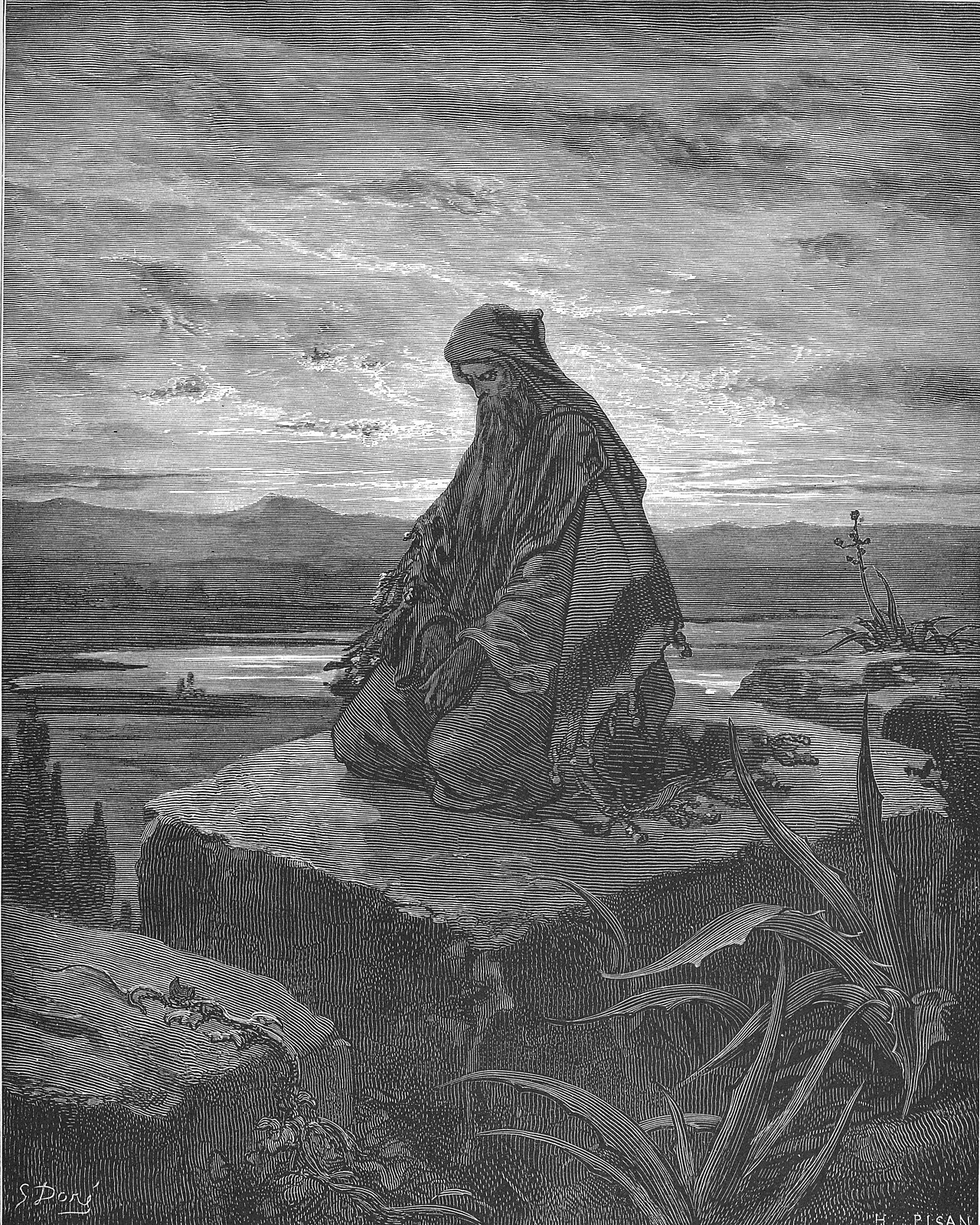
Isaiahchapter 16
14 verses · Isaiah · 8th century BC · The Prophets
in loving devotion a throne will be established in the tent of David. A judge seeking justice and hastening righteousness will sit on it in faithfulness.
Introduction
Isaiah, The Prophets, Isaiah Overview.
Isaiah continues his word against Moab, and this half turns from lament to a plea for help. It was spoken to a small kingdom that had to decide how to treat a proud and troublesome neighbor in its hour of need. The chapter moves between Moab's voice, Judah's answer and the prophet's own grief. Listen for the promise of a throne set in the middle of the pleading, and for the prophet's tears over the vineyards. The oracle closes with a deadline counted as strictly as a hired worker counts his days.
Context
- Who
- Judeans being asked to take in the neighbors who had always troubled them
- What
- The second half of the oracle against Moab, in which Moab asks Judah for shelter and the prophet mourns its vineyards.
- Where
- The fords of the Arnon, the road from Sela to Mount Zion, and the vineyards of Sibmah, Heshbon and Jazer.
- When
- Most likely between about 715 and 701 BC, with a final word that sets the fall of Moab's glory within three years.
- Why
- To call Judah to shelter the refugee because of the kind of king David's throne was meant to hold, and to show that Moab's pride would bring it down.
Historical context
The chapter opens with tribute. Send the lamb to the ruler of the land, from Sela, in the rocky south, across the wilderness to Zion. Moab had paid Israel in livestock before: the Bible records Mesha of Moab delivering a hundred thousand lambs and the wool of a hundred thousand rams as annual tribute. Sending the lambs again is Moab asking for protection by paying the old price.
Show the rest of the historical context, 3 more paragraphs
Then comes the asylum request, and it is put in the language of shade. Make your shadow at noonday like the night; hide the outcasts; do not betray the fugitive. In that climate, shade at midday is survival, and Israel's law had specific rules protecting the runaway and the resident foreigner. Moab is quoting the Law back to Judah.
The vineyards of Sibmah were famous. Isaiah says their branches once reached the sea and their shoots crossed the wilderness, the standard way of describing an export trade so large the vines seem to travel. He grieves for them with the tears of Jazer, and says the shouting has stopped: the treaders tread no wine in the presses, and the harvest shout has been silenced. That shout was a real sound. Treading was done to a rhythmic cry, and its absence is how a farmer knows the year has failed.
The oracle ends with a stopwatch. Within three years, counted the way a hired laborer counts his contract, strictly, to the day, because his pay depends on it, Moab's glory will be brought into contempt. A hired man's year is the ancient way of saying: no rounding, no grace period.
Significance
The reason Judah is told to shelter Moab is planted in the middle of the chapter: a throne will be established in mercy, and one will sit on it in the tent of David judging and seeking justice. Shelter the refugee because of the kind of king your throne is supposed to have.
Show the rest of the significance, 1 more paragraph
And the diagnosis of Moab is one the first hearers were meant to feel: we have heard of the pride of Moab, very proud. The same book has already said it of them.
This chapter in Jewish lifeWhat this chapter is in Jewish life and reading.
What is done
No part of this chapter is read in the synagogue. Probed for this lane, the site's own table in src/lib/hebraic/readings.ts printed parashot 0 and haftarah uses 0 for Isaiah 16, and no festival reading for the book. Across chapters 1 to 22 of Isaiah the same probe found a Haftarah only in chapters 1, 6, 7 and 9.
How it is read
Rashi is the main commentator on this chapter in the corpus, quoted here from The Judaica Press complete Tanach with Rashi, translated by A. J. Rosenberg, which Sefaria reports as CC-BY. Ibn Ezra is quoted from the Commentary of Ibn Ezra on Isaiah, translated by M. Friedlander in 1873, which Sefaria reports as Public Domain.
Rashi reads the lambs sent to Zion as a lesson in humility for Moab. "Be not proud", he writes, for Mesha king of Moab was a sheepman (Rashi on Isaiah 16:1:1). Ibn Ezra reads the same word as a swift dromedary (Ibn Ezra on Isaiah 16:1:1), and so the two commentators part on the first word.
The outcasts Moab is asked to hide are "The fleeing children of Israel" (Rashi on Isaiah 16:4:1). Moab is told to shelter them "for you too shall know the soul of the wanderers" (Rashi on Isaiah 16:4:2). When the destruction comes, "the throne of David shall be established and magnified" (Rashi on Isaiah 16:5:1).
Rashi reads the vine of Sibmah and the fields of Heshbon as a map of the land, one a place of fields and the other of vineyards (Rashi on Isaiah 16:8:2). The chapter's last words bring the end near. The word of the thirteenth verse is "the end of Moab’s destruction at the hands of Nebuchadnezzar" (Rashi on Isaiah 16:13:1).
What the rabbis say
The corpus carries 24 rabbinic locators on the verses of this chapter, 2 in the Talmud and 22 in the Midrash. It carries the text of none, so each is cited by ref here and never quoted or paraphrased. The verse numbers are the Hebrew ones the corpus prints.
On verse 1 it holds Ein Yaakov (Glick Edition), Sanhedrin 11:40, Ein Yaakov, Niddah 3:10 and Midrash Tanchuma Buber, Vaera 18:1. It also holds Niddah 31b:5 and Sanhedrin 96b:14. On verse 2 it holds Midrash Tanchuma Buber, Ki Teitzei 3:1 and Midrash Tanchuma, Ki Teitzei 2:1. On verse 3 it holds Midrash Sekhel Tov, Bereshit 30:40:4, Midrash Sekhel Tov, Bereshit 48:11:2 and Midrash Sekhel Tov, Shemot 10:1:5. On verse 4 it holds Midrash Sekhel Tov, Bereshit 47:15:5 and Otzar Midrashim, Chapter of Rabbi Yoshiahu 1:6. On verse 5 it holds Midrash Tehillim 110:1, Midrash Tehillim 89:1 and Otzar Midrashim, Hekhalot, Tractate Hekhalot 3. It also holds Otzar Midrashim, Midrashim of Rabbi Akiba, Aleph Bet of Rabbi Akiba (Version 2) 25 and Yalkut Shimoni on Torah 161:1.
On verse 9 it holds Otzar Midrashim, The Ten Exiles 2:5. On verse 11 it holds Bamidbar Rabbah 20:1, Midrash Tanchuma Buber, Balak 1:1 and Midrash Tanchuma, Balak 1:1. It also holds Yalkut Shimoni on Torah 765:9. On verse 12 it holds Bereshit Rabbah 50:8. On verse 14 it holds Seder Olam Rabbah 23:1.
The corpus file also carries two locators anchored to verses this chapter does not have, and they are left out of the list above. Jerusalem Talmud Yoma 6:3:7 is anchored at Isaiah 16:16. Midrash Tanchuma, Tetzaveh 4:4 is anchored at Isaiah 16:19. The chapter has 14 verses in the Berean Standard Bible as the store holds it.
What each of them teaches is a saying of the rabbis, and is reported as theirs wherever this site quotes one. The quotations wait on a fetch that carries the text.
Sources: Ibn Ezra, Ibn Ezra on Isaiah 16:1:1, Commentary of Ibn Ezra on Isaiah - trans. by M. Friedlander, 1873, reported Public Domain; Rashi, Rashi on Isaiah 16:1:1 to 16:14:1, The Judaica Press complete Tanach with Rashi, translated by A. J. Rosenberg, reported CC-BY; The Sefaria corpus, scripts/data/sources/sefaria/isaiah/16.json, the 24 Talmud and Midrash locators on the verses of this chapter; The site's own files, src/lib/hebraic/readings.ts, probed for Isaiah 16: parashot 0, haftarah uses 0, and no festival reading for the book.
The heads below are this chapter's scenes. The numbered points under each are its verses.
Send the Lamb: Shelter My Outcasts, O Moab
Isaiah 16:1-2
Send the tribute lambs: The appeal "Send the tribute lambs to the ruler of the land" continues the burden of Moab. The toll of lambs is the kind recorded at 2 Kings 3:4, here sent from Sela to the mount of Daughter Zion. Moab's daughters wait like birds pushed out of the nest.
Isaiah 16:1
“Send ye the lamb to the ruler of the land,.... Or tribute, as the Targum rightly interprets it.”
2 more voices on this verseWhat preachers and commentators have said about this verse, in their own words.
Isaiah 16:1
“Send ye the lamb - Lowth renders this, ‘I will send forth the son from the ruler of the land;’ meaning, as he supposes, that under the Assyrian invasion, even the young prince of Moab would be obliged to flee for his life through the desert, that he might escape to Judea; and “that” thus God says that “he” would send him.”
Isaiah 16:1
“Type of the need of submitting to Messiah (Ps 2:10-12; Ro 12:1). from Sela to--rather, "from Petra through (literally, 'towards') the wilderness" [MAURER]. "Sela" means "a rock," Petra in Greek; the capital of Idumea and Arabia-Petræa; the dwellings are mostly hewn out of the rock.”
Jamieson, Fausset & Brown · Commentary Critical and Explanatory on the Whole Bible (1871)reformed
Like fluttering birds pushed out of the nest: Barnes sets the picture beside Proverbs 27:8, where a man far from home is a bird strayed from its nest. The daughters of Moab are its people. Jamieson, Fausset and Brown picture a brood just fledged and driven out of the nest where it was hatched.
Isaiah 16:2
“For it shall be - It shall happen in the time of the calamity that shall come upon Moab. As a wandering bird - (See Isa 10:14.) The same idea is presented in Pro 27:8: As a bird that wanders from her nest, So is a man that wandereth from his place. The idea here is that of a bird driven away from her nest, where the nest is destroyed, and the young fly about without any home or place of rest. So would Moab be when the inhabitants were driven from their dwellings.”
Isaiah 16:3-5
Verse 5 answers with a throne "established in the tent of David," where a "judge seeking justice and hastening righteousness" sits in faithfulness. Because the throne is David's, the text allows both a king of Judah in the prophet's day and the Messiah, David's greater son.
Isaiah 16:3
“Take counsel - Hebrew, ‘Bring counsel;’ or cause it to come (הבאו hâbı̂'ı̂û, or as it is in the keri הביאי). The Vulgate, renders this in the singular number, and so is the keri, and so many manuscripts J. D.”
1 more voice on this verse
Isaiah 16:3
“Let them not discover those that absconded among them, nor deliver them up to the pursuers that made search for them: " Betray not him that wandereth, nor deliver him up" (as the Edomites did, Obad. 13, 14 ), "but hide the outcasts. " This was that good work by which Rahab's faith was justified, and proved to be sincere, Heb. xi.”
Matthew Henry · Commentary on the Whole Bible (1707-1721)puritan
Let my fugitives stay with you: The fugitives are read two ways. Barnes takes them as Judah's exiles, sheltered by Moab, and Clarke, reading the Hebrew without its vowel points, as Moab's outcasts asking Zion for refuge. Jamieson, Fausset and Brown add that the oppressor's end leaves Judah able to give it.
Isaiah 16:4
“Let mine outcasts dwell with thee, Moab “Let the outcasts of Moab sojourn with thee, O Zion” - Setting the points aside, this is by much the most obvious construction of the Hebrew, as well as most agreeable to the context, and the design of the prophet. And it is confirmed by the Septuagint οἱ φυγαδες Μωαβ, and Syriac. The oppressors “The oppressor” - Perhaps the Israelites, who in the time of Ahab invaded Judah, defeated his army, slaying one hundred and twenty thousand men, and brought the kingdom to the brink of destruction.”
Adam Clarke · Commentary on the Bible (1810-1826)evangelical
1 more voice on this verse
Isaiah 16:4
Rather, "Let the outcasts of Moab dwell with thee" (Judah) [HORSLEY]. for the extortioner, &c.--The Assyrian oppressor probably. is at an end--By the time that Moab begs Judah for shelter, Judah shall be in a condition to afford it, for the Assyrian oppressor shall have been "consumed out of the land."
Jamieson, Fausset & Brown · Commentary Critical and Explanatory on the Whole Bible (1871)reformed
a throne will be established in the tent of David: Jerome reports the Jewish teachers of his day read the throne as Hezekiah's, established after the Assyrian oppressor was gone, and Gill held the same. Loving devotion is the Hebrew hesed, covenant love. Wesley reads faithfulness as a throne that stands firm.
Isaiah 16:5
“I am now punishing their sins, yet I will deliver them for my own mercy's sake. The throne - The kingdom of Judah. In truth - That is, firmly and constantly; for truth is often put for the stability and certainty of a thing, as 2 Chron. xxxii, 1 Prov. xi, 18.”
John Wesley · Explanatory Notes upon the Old Testament (1765)evangelical
The Pride of Moab and the Withered Vine of Sibmah
Isaiah 16:6-9
We have heard of Moab’s pomposity: The oracle turns from appeal to a report, "We have heard of Moab’s pomposity," and that pride draws the mourning that follows. The trampled vines of Sibmah become the prophet's image of grief. Gill and Barnes note the turn from Moab's boast to Moab's weeping as the oracle's whole argument.
Therefore let Moab wail: Barnes hears Moab wail in alternate responses, one part of the nation answering another. The raisin cakes stand where the King James has foundations. Clarke corrected the word from Jeremiah 48:31, which laments the men of Kir-heres.
Isaiah 16:7
“Therefore shall Moab howl for Moab - One part of the nation shall mourn for another; they shall howl, or lament, in alternate responses. Jerome renders it, ‘the people (shall howl) to the city; the city to the provinces.’ The general idea is, that there would be an universal lamentation throughout the land. This would be the punishment which would result from their pride in neglecting to send the tribute and seeking the favor of the Jews; or they would lament because the expectation of finding a refuge among the Israelites was taken away.”
1 more voice on this verse
Isaiah 16:7
“Therefore--all hope of being allowed shelter by the Jews being cut off. foundations--that is, "ruins"; because, when houses are pulled down, the "foundations" alone are left (Isa 58:12).”
Jamieson, Fausset & Brown · Commentary Critical and Explanatory on the Whole Bible (1871)reformed
For the fields of Heshbon have withered: Barnes takes the fields of Heshbon as vineyards, which the parallel line requires, and cites the fields of Gomorrah in Deuteronomy 32:32. Jerome puts the two towns barely five hundred paces apart. Jamieson, Fausset and Brown name the Assyrians among the rulers who trampled the vines.
Isaiah 16:8
“Languish “Are put to shame” - Here the text of Jeremiah leaves us much at a loss, in a place that seems to be greatly corrupted. The Septuagint join the two last words of this verse with the beginning of the following. Their rendering is: και ουκ εντραπησῃ, τα πεδια Εσεβων. For אך ach they must have read אל al; otherwise, how came they by the negative, which seems not to belong to this place? Neither is it easy to make sense of the rest without a small alteration, by reading, instead of εντραπησῃ τα, εντραπησεται.”
Adam Clarke · Commentary on the Bible (1810-1826)evangelical
So I weep with Jazer: The triumphant shouts over the summer fruit are the vintage cry, and Jamieson, Fausset and Brown read the shout of battle in its place. Jeremiah 48:33 plays on the same Hebrew word, hedad. Barnes notes that the prophet weeps over a nation other than his own.
Isaiah 16:9
“Therefore, I will bewail - So great is the desolation that I, the prophet, will lament it, though it belongs to another nation than mine own. The expression indicates that the calamity will be great (see the note at Isa 15:5). With the weeping of Jazer - That is, I will pour out the same lamentation for the vine of Sibmah which I do for Jazer; implying that it would be deep and bitter sorrow (see Jer 48:32).”
Isaiah 16:10-12
Joy and gladness are removed: The prophet's grief sounds again, "my heart laments for Moab like a harp," mourning without holding himself apart from the nation under judgment. When Moab enters his sanctuary to pray, "it will do him no good," a sanctuary Adam Clarke takes as the shrine of Chemosh.
Isaiah 16:10
“Neither shall there be shouting “An end is put to the shouting” - The Septuagint read השבת hishbeth, passive, and in the third person; rightly, for God is not the speaker in this place. The rendering of the Septuagint is πεπαυται γαρ κελευσμα, “the cry ceaseth;” which last word, necessary to the rendering of the Hebrew and to the sense, is supplied by MSS. Pachom. and 1. D. II., having been lost out of the other copies.”
Adam Clarke · Commentary on the Bible (1810-1826)evangelical
Therefore my heart laments for Moab like a harp: The Hebrew behind heart here is the inward parts, which Barnes calls the seat of compassion. Henry pictures an inward trembling, like the strings of a harp as it is played. Kir-heres is the Kir-hareseth of verse 7.
Isaiah 16:11
“Wherefore my bowels shall sound like a harp for Moab,.... Making a noise as the harp does, and a mournful one as that, when used at funerals; which it makes when it is stricken or played on with the hand, as these were, through the afflictive and punitive hand of God; and which, when stricken, causes a quavering of the strings, to which the inward trembling of the bowels is compared, and is very expressive of the prophet's sympathy, or those he personates; for, when one string of the harp is touched, the rest sound.”
When Moab appears on the high place: Appears is the word used for coming before God at the feasts in Exodus 23:15, here turned to Moab's high place. Moab wearies himself with rites in his sanctuary. Henry notes that men seldom leave their idols until those idols have worn them out.
Isaiah 16:12
“When - When it shall appear that all their other devotions are vain. His sanctuary - To the temple of his great God Chemosh. But - His God can neither hear nor help him.”
John Wesley · Explanatory Notes upon the Old Testament (1765)evangelical
1 more voice on this verse
Isaiah 16:12
“When it is seen that Moab, etc. “When Moab shall see,” etc. - For נראה nirah, a MS. reads ראה raah, and so the Syriac and Chaldee. “Perhaps כי נראה ki nirah is only a various reading of כי נלאה ki nilah.” Secker. A very probable conjecture.”
Adam Clarke · Commentary on the Bible (1810-1826)evangelical
Isaiah 16:13-14
the message that the LORD spoke: A fresh word sets a limit, "In three years, as a hired worker counts the years," the reckoning of a hired servant's contract. Moab's survivors will be "few and feeble" once her splendor becomes an object of contempt. Barnes and Delitzsch connect the three-year term to the Assyrian campaigns.
Isaiah 16:13
In the mystery of prophetical revelation, Christ is symbolized by word, which people heard while they could see no one, as they said: "This is the word that the Lord spoke to Moab."
Bonaventure · written before 1257 · Collations on the Hexaemeron, Collation 14patristic
3 more voices on this verse
Isaiah 16:13
“Since - Since the beginning of God's Revelation to me concerning Moab, hitherto.”
John Wesley · Explanatory Notes upon the Old Testament (1765)evangelical
Isaiah 16:13
“This is the word - This is the substance of the “former” predictions respecting Moab. This has been the “general course” or sense of the prophecies respecting Moab, during all its history. Since that time - Formerly; from former times. There had been a course of predictions declaring in general that Moab should be destroyed, and the prophet says here that he had expressed their general sense; or that “his” predictions accorded with them all - for they all predicted the complete overthrow of Moab.”
Isaiah 16:13
“Here is the epilogue. From that time, from the death of the king Achaz.”
Thomas Aquinas · written before 1274 · Commentary on Isaiahpatristic
Jamieson, Fausset and Brown date the fulfilment to the years when Assyria carried the northern kingdom into exile. Wesley adds that a hired worker counts his years exactly. Henry places Moab's glory in its many people.
Isaiah 16:14
“Hireling - Within three years precisely counted; for hirelings are very punctual in observing the time for which they are hired. The glory - Their strength, and wealth, and other things in which they glory, shall be made contemptible to those who formerly admired them.”
John Wesley · Explanatory Notes upon the Old Testament (1765)evangelical
2 more voices on this verse
Isaiah 16:14
“Within three years - בשלש beshalish כשלש keshalish, according, or in or about three years, is the reading of nine of Kennicott’s and De Rossi’s MSS., and two ancient editions.”
Adam Clarke · Commentary on the Bible (1810-1826)evangelical
Isaiah 16:14
“Fulfilled about the time when the Assyrians led Israel into captivity. The ruins of Elealeh, Heshbon, Medeba, Dibon, &c., still exist to confirm the inspiration of Scripture. The accurate particularity of specification of the places three thousand years ago, confirmed by modern research, is a strong testimony to the truth of prophecy.”
Jamieson, Fausset & Brown · Commentary Critical and Explanatory on the Whole Bible (1871)reformed
Keep studying
Sources for this chapter
The summary
Jamieson, Fausset & Brown, Commentary Critical and Explanatory; John Calvin, Commentaries; John Wesley, Notes on the Old Testament and Matthew Henry, Complete Commentary.
The exposition
Adam Clarke, Commentary on the Bible; Albert Barnes; Franz Delitzsch, Biblical Commentary on the Prophecies of Isaiah; Jamieson, Fausset & Brown, Commentary Critical and Explanatory on the Whole Bible; Jerome; John Gill; John Wesley, Explanatory Notes upon the Old Testament and Matthew Henry, Commentary on the Whole Bible.