
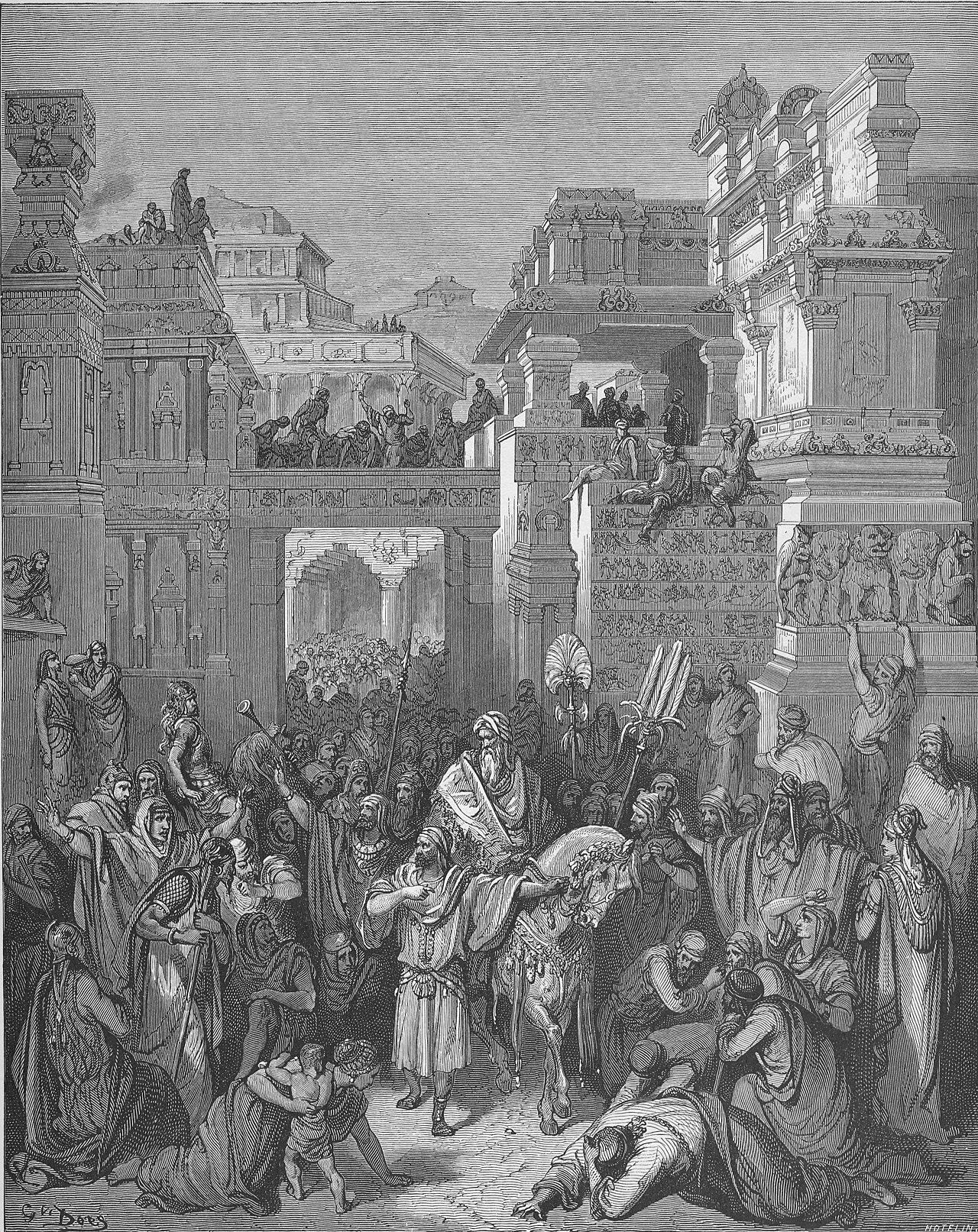
Estherchapter 6
14 verses · unknown · 5th century BC · History
That night sleep escaped the king; so he ordered the Book of Records, the Chronicles, to be brought in and read to him.
Introduction
unknown, History, Esther Overview.
This chapter was written for Jews who had waited long years for a wrong done to them to be noticed. It stands at the centre of the book, and everything before it is turned around after it. Nothing in it would look remarkable in a court record. A king cannot sleep, a servant reads aloud, and a man arrives early with a request. Listen for the question the king asks and for how Haman hears it. Notice what Haman's own household says at the close, because even they can see which way events are moving.
Context
- Who
- Jews who had waited years for a wrong to be noticed
- What
- The sleepless king learns that Mordecai was never rewarded for saving his life, and Haman is made to lead Mordecai through the city in royal honour.
- Where
- The king's bedchamber and the outer court of the palace at Susa, and the city square.
- When
- The night between Esther's two banquets and the morning after, about 474 BC.
- Why
- To show the turning of events at the point where the enemy seemed closest to his goal.
Historical context
Persian kings kept a daily written record of court business, and reading from it aloud was a normal way to pass a sleepless night, dry official prose, read by a servant, in a room where the lamps were still lit. The record also served a specific purpose: the Persians made a formal practice of registering men who had done the king a service, so the debt could be paid later. Mordecai's name was in the book, and the payment had never been made.
Show the rest of the historical context, 3 more paragraphs
The honour the king proposes is Persian to the core. The gift of a robe the king himself had worn was one of the highest marks of favour in that court, and Herodotus describes Xerxes handing out royal garments as a reward. Adding the king's own horse with a royal ornament on its head, and a nobleman to lead it through the city square proclaiming the reason, turned a private thank-you into a public event.
The staging depends on the layout of the palace. Haman arrives at dawn in the outer court, waiting for the doors to open so he can be first with his request; the king, awake all night, asks who is outside and summons him before he can speak. Two men are in the same room asking about the same person, each certain he knows who is meant.
Zeresh's reaction at the end is worth noticing. She and Haman's advisers read the reversal as an omen, once he has begun to fall before a Jew, he will not stand. Reading events for signs was ordinary in that world, and even Haman's own household could see which way the wind had turned.
Significance
The whole book turns on a king who cannot sleep. No angel appears, no prophet speaks, nothing happens that a court chronicler would have called miraculous, and by breakfast the man building a stake for Mordecai is leading Mordecai's horse through the street.
Show the rest of the significance, 1 more paragraph
For Jews living far from the temple, with no prophet and no king of their own, that was the encouragement: the God who is never named in this book is not absent from it. He works through insomnia and filing systems.
This chapter in Jewish lifeWhat this chapter is in Jewish life and reading.
What is done
This chapter is heard inside the whole scroll at Purim. The site's own table in src/lib/hebraic/readings.ts records that the scroll is read twice, in the evening and again the next morning, from a handwritten roll, and that the congregation is expected to hear every word. The table cites Mishnah Megillah 2 and Babylonian Talmud Megillah 18a. The book has no weekly portion and no Haftarah in the same table.
How it is read
Rashi is the one commentator on this chapter whose English the corpus carries, quoted here from The Metsudah Five Megillot, Lakewood, N.J., 2001, which Sefaria reports as CC-BY. The edition prints its own numbered notes inside his words, and a note is named here as the edition's. The sleepless night is the hinge of the book, and Rashi names it in four words. "It was a miracle" (Rashi on Esther 6:1:1). The edition's note gives the dream from Esther Rabbah 10:1, in which the king saw Haman take a sword to kill him. Rashi himself reports some of the Rabbis saying the king brooded over Esther's invitation to Haman and feared a plot.
The reading of the archives is explained two ways. It was the custom of kings to have tales told to them until sleep returned. The Rabbis, Rashi says, explained it by the king's worry. He reasoned that a friend would have warned him of a plot. So perhaps someone had done him a favour that he never repaid, and no one cared for him any longer (Rashi on Esther 6:1:2).
Haman's advice about the honour is read through what he left out. He did not mention the crown, because he saw the king grow jealous at the thought of a crown on another man's head (Rashi on Esther 6:9:1). After the parade Mordechai returned to his sackcloth and his fasting (Rashi on Esther 6:12:1). The edition's note adds that this was the last day of the three days of fasting.
Haman's shame is filled in by the Rabbis, and Rashi points to Maseches Megillah for it (Rashi on Esther 6:12:2). The edition's note tells the story. Haman's daughter, from a roof, took the rider for her father and the man leading the horse for Mordechai. She threw the contents of a chamber pot on the man leading, saw that it was her father, and fell and died. The chapter closes on the word of Zeresh and the wise men. Rashi gives her words as a saying about the people. "This nation has been compared to the stars and to the dust" (Rashi on Esther 6:13:1).
The corpus carries eighteen further notes on this chapter without an English text, each marked linked because Sefaria holds no English version of the ref. Six stand cited and unquoted at Ibn Ezra on Esther 6:1:1, 6:3:1, 6:6:1, 6:8:1, 6:12:1 and 6:13:1. Twelve stand at Malbim on Esther 6:1:1, 6:2:1, 6:3:1, 6:4:1, 6:6:1, 6:7:1, 6:8:1, 6:9:1, 6:10:1, 6:12:1, 6:13:1 and 6:14:1.
What the rabbis say
The corpus carries forty rabbinic locators on this chapter and the text of none, so each is cited and linked here rather than quoted. Thirty-one are Midrash and nine are Talmud. On the first verse, the sleepless night, it holds Bereshit Rabbah 70:15, Esther Rabbah 10:1 and 9:4, and Jerusalem Talmud Megillah 2:4:2. On the second it holds Esther Rabbah 1:15. On the third it holds Megillah 16a:2 and Sifrei Aggadah on Esther, Midrash Abba Guryon 6:3. On the fourth it holds Esther Rabbah 10:2, Kohelet Rabbah 5:2:1 and Megillah 16a:3, and on the fifth Midrash Abba Guryon at 6:4 and 6:5.
Haman's counsel draws the next run. On the sixth verse the corpus holds Aggadat Bereshit 2:2 and Bereshit Rabbah at 34:10, 67:8 and 75:9. On the seventh it holds Midrash Mishlei 26:4. On the eighth it holds Megillah 7a:15 and Midrash Abba Guryon at 6:6 and 6:7. On the ninth it holds Esther Rabbah 7:7 and Midrash Abba Guryon 3:5.
The parade and its end carry the rest. On the tenth verse the corpus holds Bereshit Rabbati, Parashat Vayera 36, Esther Rabbah 10:4, and Megillah 16a:4 and 16a:5. On the eleventh it holds Bereshit Rabbah 87:6, Bereshit Rabbati, Parashat Vayechi 32, Esther Rabbah 10:5 and Jerusalem Talmud Berakhot 1:1:21. On the twelfth it holds Esther Rabbah 10:6 and 10:7, Kohelet Rabbah 10:4:1 and Megillah 16a:12. On the thirteenth, the word of Zeresh, it holds Esther Rabbah 10:8 and 9:2 with Megillah 16a:13. On the fourteenth it holds Bereshit Rabbah 2:4, Eikhah Rabbah 2:1 and Ein Yaakov (Glick Edition), Megillah 1:37. What each of them teaches is a saying of the rabbis, and is reported as theirs wherever this site quotes one.
Sources: Rashi, Rashi on Esther 6:1:1 to 6:13:1, The Metsudah Five Megillot, Lakewood, N.J., 2001, reported CC-BY; Ibn Ezra, Ibn Ezra on Esther 6:1:1, 6:3:1, 6:6:1, 6:8:1, 6:12:1 and 6:13:1, cited by ref because the corpus carries no English text; Malbim, Malbim on Esther 6:1:1, 6:2:1, 6:3:1, 6:4:1, 6:6:1, 6:7:1, 6:8:1, 6:9:1, 6:10:1, 6:12:1, 6:13:1 and 6:14:1, cited by ref because the corpus carries no English text; The Sefaria corpus, scripts/data/sources/sefaria/esther/6.json, the 40 Talmud and Midrash locators of this chapter; The site's own files, src/lib/hebraic/readings.ts, the FESTIVAL_READINGS entry for esther at Purim citing Mishnah Megillah 2, Babylonian Talmud Megillah 18a and the Rema's gloss to Shulchan Aruch, Orach Chayim 690:17, and no portion or Haftarah for this book.
The heads below are this chapter's scenes. The numbered points under each are its verses.
The king cannot sleep, and the chronicles are read to him
That night sleep escaped the king: g," and the narrator lets an ordinary sleepless night carry the plot forward. No reason is given and no hand is named. The king has "the Book of Records, the Chronicles" read to him, and the reversal opens from a night the text never explains.
Esther 6:1
“On that night could not the king sleep - The Targum says the king had a dream, which was as follows: - “And the king saw one in the similitude of a man who spoke these words to him: Haman desireth to slay thee, and to make himself king in thy stead. Behold, he will come unto thee early in the morning, to ask from thee the man who rescued thee from death, that he may slay him: but say thou unto Haman, What shall be done for the man whose honor the king studieth?”
Adam Clarke · Commentary on the Bible (1810-1826)evangelical
3 more voices on this verseWhat preachers and commentators have said about this verse, in their own words.
Esther 6:1
“Commentary on Chapter VI 1. Sleep - How vain are all the contrivances of foolish man against the wise and omnipotent God, who hath the hearts and hands of kings and all men perfectly at his disposal, and can by such trivial accidents (as they are accounted) change their minds, and produce such terrible effects.”
John Wesley · Explanatory Notes upon the Old Testament (1765)evangelical
Esther 6:1
“Sleep was removed from the eyes of Ahasuerus, whom the Seventy call Artaxerxes, that he might turn over the memoirs of his faithful ministers and come on Mordecai, by whose evidence he was delivered from a conspiracy; and that thus Esther might be more acceptable and the whole people of the Jews escape imminent death.”
Jerome · written before 420 · Against the Pelagians 3.10patristic
Esther 6:1
“But God put it into his heart to call for it, rather than for music or songs, which the Persian kings used to be attended with ( Dan. vi. 18 ) and which would have been more likely to compose him to rest. When men do that which is unaccountable we know not what God intends by it.”
Matthew Henry · Commentary on the Whole Bible (1707-1721)puritan
Esther 6:2-3
Bigthana and Teresh: The reading turns up the deed of 2:21-23, Mordecai's warning against the plot of Bigthana and Teresh, filed away five years earlier and never repaid. "Nothing has been done for him": an act of loyalty sat unrewarded, waiting for the one night someone would ask the record to speak.
Esther 6:2
“Good services are sometimes so far from being a man's preferment that they will not be his protection. Mordecai is at this time, by the king's edict, doomed to destruction, with all the Jews, though it is owned that he deserved dignity. Those that faithfully serve God need not fear being thus ill paid.”
Matthew Henry · Commentary on the Whole Bible (1707-1721)puritan
The king inquired, “What honor or dignity: Persian kings kept a roll of Royal Benefactors, and Barnes notes that men on it were owed a fitting reward. Clarke notes that the record read to the king would have shown any honor bestowed on Mordecai. The king’s question held the court to that rule.
Esther 6:3
“It was a settled principle of the Persian government that “Royal Benefactors” were to receive an adequate reward. The names of such persons were placed on a special roll, and care was taken that they should be properly recompensed, though they sometimes waited for months or years before they were rewarded.”
Esther 6:4-5
Haman is already in the outer court at dawn, come to ask the king's leave to hang Mordecai on the gallows built the night before. The chapter's irony sits in the timing: the man come to destroy Mordecai walks in just as the king is deciding how to reward him.
Esther 6:4
“Now Haman was come into the outward court--This was early in the morning. It is the invariable custom for kings in Eastern countries to transact business before the sun is hot, often in the open air, and so Haman was in all probability come officially to attend on his master.”
Jamieson, Fausset & Brown · Commentary Critical and Explanatory on the Whole Bible (1871)reformed
1 more voice on this verse
Esther 6:4
“Mordecai was also persecuted as Jesus was persecuted. Mordecai was persecuted by the wicked Haman; and Jesus was persecuted by the rebellious people. Mordecai by his prayer delivered his people from the hands of Haman; and Jesus by his prayer delivered his people from the hands of Satan. Mordecai was delivered from the hands of his persecutor; and Jesus was rescued from the hands of his persecutors.”
Aphrahat the Persian Sage · written before 345 · DEMONSTRATIONS 21.20patristic
So the king’s attendants answered him: Haman stood in the outer court because even he could not enter the inner court uncalled, as John Gill notes. The law that threatened Esther in 4:11 bound him too. Matthew Henry pictures him brought into the king’s bedchamber, proud of the honor.
Esther 6:5
“And the king's servants said unto him, behold, Haman standeth in the court,.... In the outward court; for into the inward court none might enter without being called, for which he was waiting: and the king said, let him come in; into his bedchamber; and it was of God, no doubt, that Haman should be on the spot at this very time, when the king was in the humour to do honour to Mordecai, and by him.”
Haman leads the horse he thought would carry himself
Haman entered, and the king asked: Haman thought to himself, "Whom would the king be delighted to honor more than me?" The question named no one, and his own vanity supplies the only candidate he can imagine. The narrator lets Haman answer for himself before he learns whom he has actually described.
Esther 6:6
“He had a better opinion of his interest than there was reason for. He thought the king loved and valued no one but himself, but he was deceived. We should suspect that the esteem which others profess for us is not so great as it seems to be or as we are sometimes willing to believe it is, that we may not think too well of ourselves nor place too much confidence in others.”
Matthew Henry · Commentary on the Whole Bible (1707-1721)puritan
1 more voice on this verse
Esther 6:6
“The king said unto him - He did not give him time to make his request; and put a question to him which, at the first view, promised him all that his heart could wish.”
Adam Clarke · Commentary on the Bible (1810-1826)evangelical
Esther 6:7-9
And Haman told the king: Haman answers with the full ceremony of a Persian triumph. The man is to wear the royal robe and ride the king's horse, led through the city square by one of the king's noble princes. Every detail he names for his glory is handed to his enemy within the hour.
Esther 6:7
“And Haman answered the king,.... At once, being very prompt to suggest the honours he hoped to have done to himself: for the man whom the king delighteth to honour; let the following things be done.”
have them bring a royal robe: Albert Barnes notes that each of these honors would have been a capital offence without the king’s permission. Adam Clarke adds that even a robe the king had laid aside was death to put on. Haman asked to wear the king’s own dignity.
Esther 6:8
“Let the royal apparel be brought - Pride and folly ever go hand in hand. What he asked would have been in any ordinary case against his own life: but he wished to reach the pinnacle of honor: never reflecting that the higher he rose, the more terrible would be his fall. The royal apparel was never worn but by the king: even when the king had lain them aside, it was death to put them on. The Targum has purple robes.”
Adam Clarke · Commentary on the Bible (1810-1826)evangelical
Let the robe and the horse: Jamieson, Fausset and Brown describe the custom: on great occasions the highest subject led the royal horse, a parade that could last hours. Haman made a noble prince the servant of the man honored. Clarke likens him to the dog of the fable who lost the substance for its shadow.
Esther 6:9
“One of the king’s most noble princes - Alas, Poor Haman! Never was the fable of the dog and shadow more literally fulfilled. Thou didst gape at the shadow, and didst lose the substance.”
Adam Clarke · Commentary on the Bible (1810-1826)evangelical
Esther 6:10-11
said the king to Haman: The king names Haman's enemy and sends him to "do just as you proposed" for "Mordecai the Jew," and Haman must lead the horse himself. He performs the ceremony he designed for his own glory as Mordecai's servant, arraying and proclaiming the man he came that morning to have hanged.
Esther 6:10
“Make haste, and take the apparel - and do even so to Mordecai - O mortifying reverse of human fortune! How could Haman bear this? The Targumist might speak according to nature when he said that “Haman besought the king to kill him rather than degrade him so.” How astonishing is the conduct of Divine providence in all this business! From it we plainly see that there is neither counsel nor wisdom against the Lord; and that he who digs a pit for his neighbor, is sure to fall into it himself.”
Adam Clarke · Commentary on the Bible (1810-1826)evangelical
1 more voice on this verse
Esther 6:10
“But how is he thunderstruck when the king bids him not to order all this to be done, but to do it himself to Mordecai the Jew, the very man he hated above all men and whose ruin he was now designing! Now, it is to no purpose to think of moving any thing to the king against Mordecai when he is the man whom the king delights to honour.”
Matthew Henry · Commentary on the Whole Bible (1707-1721)puritan
So Haman took the robe and the horse: Henry reads the honor as welcome to Mordecai for what it signalled: the king’s favor, and hope Esther would win the reversal of the edict. Aphrahat the Persian Sage set Mordecai beside Jesus, each persecuted and each delivered. Haman’s decree against the Jews still stood.
Esther 6:11
“Upon this account it was agreeable to Mordecai as it was an indication of the king's favour, and gave hope that Esther would prevail for the reversing of the edict against the Jews.”
Matthew Henry · Commentary on the Whole Bible (1707-1721)puritan
Mourning at home while the eunuchs hurry him to the banquet
Mordecai returned to the king’s gate: Mordecai returns to the king's gate, unmoved by the honor as he was unmoved by the insult that started chapter five. Haman hastens home mourning, his head covered, the sign of a man already in disgrace. The two men end the scene in the postures each began it, reversed.
Esther 6:12
“Mordecai came again to the king’s gate - He resumed his former humble state; while Haman, ashamed to look up, covered his face, and ran home to hide himself in his own house. Covering the head and face was a sign of shame and confusion, as well as of grief, among most people of the earth.”
Adam Clarke · Commentary on the Bible (1810-1826)evangelical
1 more voice on this verse
Esther 6:12
“Gate - To his former place; shewing that as he was not overwhelmed by Haman's threats, so he was not puffed up with this honour. Cover'd - In token of his shame and grief for his unexpected disappointment, and for the great honour done to his abhorred adversary, by his own hands, and with his own public disgrace.”
John Wesley · Explanatory Notes upon the Old Testament (1765)evangelical
Esther 6:13-14
Haman told his wife Zeresh: Zeresh and his advisers read an omen: "Since Mordecai, before whom your downfall has begun, is Jewish, you will not prevail against him". Pagan counselors state the book's hidden conviction more plainly than the narrator ever does. The Hebrew behind "is Jewish" speaks of descent.
Esther 6:13
“But shalt surely fall before him - The Septuagint adds, ὁτι ὁ Θεος ὁ ζων μετ’ αυτου, for the living God is with him. But this is a sentiment that could scarcely be expected to proceed from the mouth of heathens, such as these were.”
Adam Clarke · Commentary on the Bible (1810-1826)evangelical
1 more voice on this verse
Esther 6:13
“Two things they grounded their prognostications upon:-- (1.) This Mordecai was of the seed of the Jews; feeble Jews their enemies sometimes called them, but formidable Jews they sometimes found them. They are a holy seed, a praying seed, in covenant with God, and a seed that the Lord hath all along blessed, and therefore let not their enemies expect to triumph over them.”
Matthew Henry · Commentary on the Whole Bible (1707-1721)puritan
While they were still speaking with Haman: The eunuchs arrived at the hour set, and Jamieson, Fausset and Brown note that custom sent guests a second summons when a banquet was prepared. Gill reads the rush as a sign that Haman was slow to go. Henry notes that Haman came to Esther’s banquet already broken.
Esther 6:14
“Hasted to bring Haman - There was a dreadful banquet before him, of which he knew nothing: and he could have little appetite to enjoy that which he knew was prepared at the palace of Esther.”
Adam Clarke · Commentary on the Bible (1810-1826)evangelical
1 more voice on this verse
Esther 6:14
“He thought it seasonable, in hopes it would revive his drooping spirits and save his sinking honour. But really it was seasonable because, his spirits being broken by this sore disappointment, he might the more easily be run down by Esther's complaint against him. The wisdom of God is seen in timing the means of his church's deliverance so as to manifest his own glory.”
Matthew Henry · Commentary on the Whole Bible (1707-1721)puritan
Keep studying
Studies3
Sources for this chapter
The summary
Jamieson, Fausset & Brown, Commentary Critical and Explanatory; John Wesley, Notes on the Old Testament and Matthew Henry, Complete Commentary.
The context
Matthew Henry, Commentary on the Whole Bible and W. F. Adeney, Ezra, Nehemiah and Esther (Expositor's Bible).
The exposition
Adam Clarke, Commentary on the Bible; Albert Barnes, Notes, Explanatory and Practical, on the Old and New Testaments (1832-1869); Aphrahat the Persian Sage, DEMONSTRATIONS 21.20; Jamieson Fausset and Brown, Commentary Critical and Explanatory on the Whole Bible; Jamieson, Fausset & Brown, Commentary Critical and Explanatory on the Whole Bible; John Gill; John Wesley, Explanatory Notes upon the Old Testament; Keil, The Books of Ezra, Nehemiah, and Esther; Matthew Henry, Commentary on the Whole Bible and W. F. Adeney, Ezra, Nehemiah and Esther (Expositor's Bible).