
A tale of faith · written c. 225-175 BC
Tobit
A blind old man and a desperate young woman pray on the same day, and God sends one angel to answer both.
- 14Chapters
- 244Verses
- c. 225-175 BCEWritten
Original language: Aramaic (with Hebrew variants; Aramaic and Hebrew fragments found at Qumran)
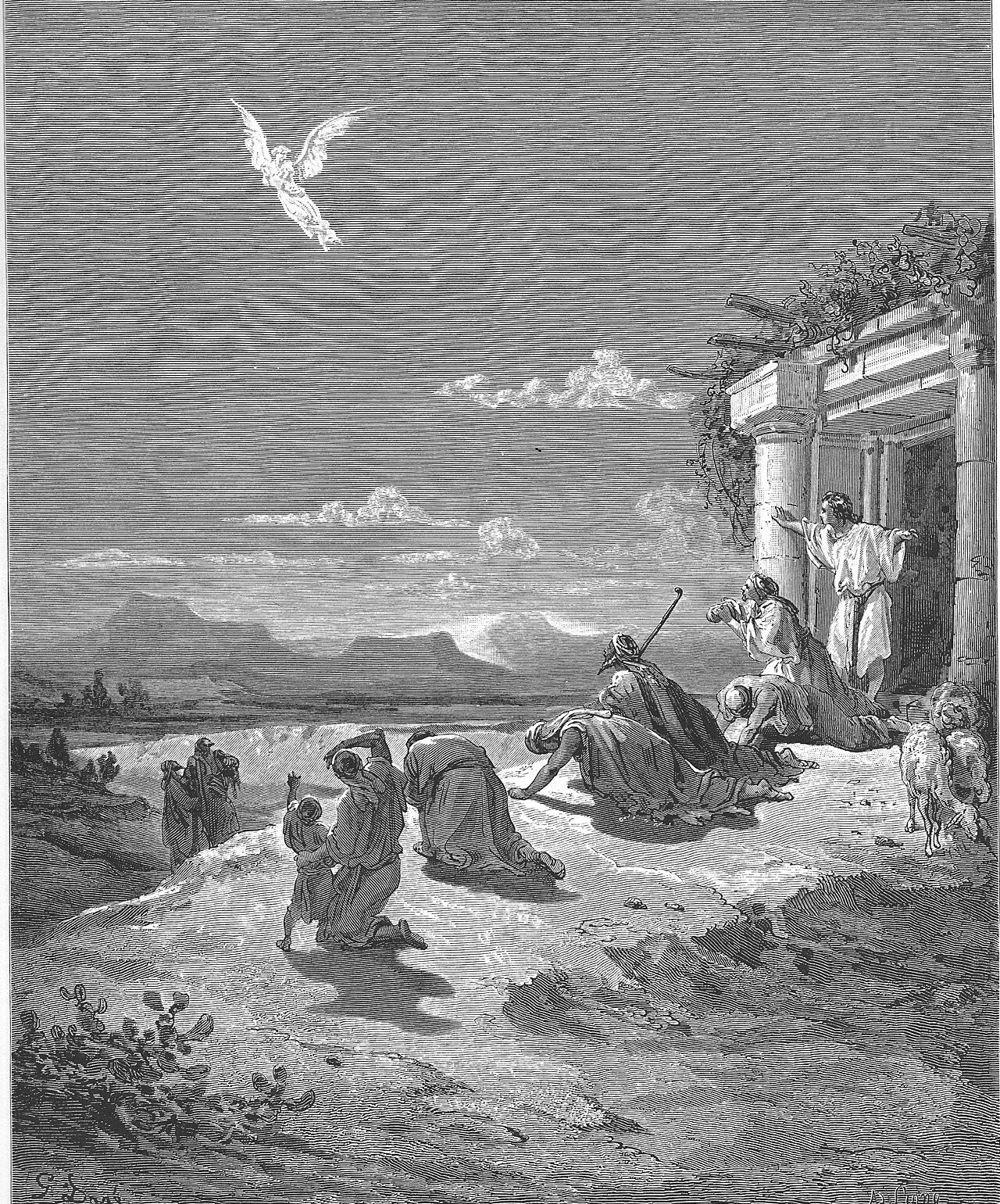
King James Version Apocrypha (1769 standardized text) · public domain
Read Tobit
King James Version + Apocrypha (standardized 1769 text), eBible.org USFX edition of the Crosswire/eBible KJV — Public Domain
Featured studies on this book
— the deep dives, each its own page
Asmodeus and the Unseen War
Circle of Rembrandt, Tobias Catching the Fish (17th century) — Public domain, via Wikimedia Commons

Raphael, the Angel on the Road
Filippino Lippi, Tobias and the Angel (c. 1475-1480) — Public domain, via Wikimedia Commons

The Road to Ecbatana
Adam Elsheimer, Tobias and the Angel (landscape with the dog) (c. 1607-1608) — Public domain, via Wikimedia Commons
Plain answers first
What this book is
Tobit is a Jew of the tribe of Naphtali, carried off to Nineveh when Assyria took the northern kingdom. He keeps the law in a hostile city: he feeds the hungry, and he buries Jewish dead the king has left lying in the street, which is dangerous work. One night, sleeping in his own courtyard, sparrow droppings fall into his eyes and he goes blind. Poor, mocked by his wife, he prays to die.
The same day, far off in Ecbatana, a young Jewish woman named Sarah prays exactly the same prayer. She has been married seven times, and every husband died on the wedding night, killed by the demon Asmodeus. Her own maids taunt her with it. She wants to die too.
God answers both prayers with one messenger. The angel Raphael takes human form, calls himself Azarias, and hires on to walk with Tobit's son Tobias to collect a debt in Media. At the Tigris a great fish lunges at the boy; Raphael tells him to catch it and keep the heart, liver, and gall. Burning the heart and liver drives the demon away. The gall heals his father's eyes. Tobias marries Sarah, and they kneel and pray together before they touch each other, and he lives.
At the end the angel tells them who he is: "I am Raphael, one of the seven holy angels, which present the prayers of the saints" (12:15). He says he never really ate or drank; they were seeing a vision. Tobit answers with a hymn (chapter 13), then dies old, telling his son to get out of Nineveh because the city is coming down (chapter 14).
It was probably written in Aramaic or Hebrew, somewhere in the Jewish dispersion, most likely between about 225 and 175 BC. The original language was long disputed until copies turned up at Qumran, four fragmentary Aramaic manuscripts and one Hebrew, settling the question. The setting is eighth-century Assyria, but the distances and the royal names do not line up with the history we know, which is one reason most readers take it as a teaching story rather than a chronicle.
Why a student of the 66 should still open it
Why read it: and how
Its picture of the unseen world is remarkable: prayer carried upward and set before the Holy One (12:12), a named archangel walking beside a young man who never guesses, and seven angels standing in God's presence, the same seven who appear in Revelation 8:2. The rule Tobit gives his son, "do that to no man which thou hatest" (4:15), is the negative form of the Golden Rule that Jesus states positively in Matthew 7:12; both were current Jewish teaching, and hearing it here helps a reader feel what Jesus was turning around. Tobit's insistence that alms deliver from death (4:10, 12:9) is the background against which Cornelius's alms come up "for a memorial before God" in Acts 10:4. No New Testament writer quotes Tobit, but the world of Tobit is the world the New Testament walks into.
Read it in one sitting. It is short, it moves like a folk tale, and there is a dog that follows the boy all the way home. Watch the two prayers in chapter 3 and how heaven answers them together: that is the point the book is making about God. Take the fish's organs as ancient storytelling rather than medicine, and take the angel's speech in chapter 12 seriously.
The canon question, honestly
Why it stands outside the 66
Tobit was not in the Hebrew Bible, even though it was written in a Semitic language and Jews plainly read it. Jerome translated it into Latin quickly and said openly that the Hebrews counted it among the apocrypha; he kept it in his Bible but marked books like it as good for building up the people, not for proving doctrine. The Reformers took Jerome's line and gathered it with the rest into a separate section, and that is where the King James of 1611 printed it: between the Testaments, with the note that such books are read for example of life and instruction of manners but not to establish any doctrine. Trent answered in 1546 by declaring it canonical for Roman Catholics. The disagreement is old and real, and it is about the book's rank, not about whether it is worth opening.
Doors into the text
Key moments
Tobit risks his life burying the dead, then loses his sight to sparrow droppings.
Tobit in Nineveh and Sarah in Ecbatana ask to die, and heaven hears both at once.
Raphael's strange instructions: keep the heart, the liver, and the gall.
They pray before they touch, the demon flees, and the grave dug outside is not needed.
"I am Raphael" — the traveling companion says whose errand he has been running.
God scatters and God gathers; Jerusalem will be rebuilt with sapphire and emerald.
Plainly told
The story it tells
Two prayers, the same day
Tobit, an Israelite deported to Nineveh, goes blind after sparrow droppings fall in his eyes, the last straw in a life spent keeping the Law under threat, feeding the hungry and burying the Jewish dead the king leaves in the street. Mocked by his own wife, he prays to die. Far off in Ecbatana, a young woman named Sarah prays the identical prayer the same day: seven bridegrooms, seven wedding nights, and a demon that has killed every one of them.
One angel, sent to answer both
God sends the angel Raphael, disguised as a traveling kinsman named Azarias, to walk with Tobit's son Tobias on a journey to collect a family debt. At the Tigris a great fish lunges at the boy; Raphael tells him to keep its heart, liver, and gall.
The wedding night that doesn't end in a grave
Tobias marries Sarah. The burning heart and liver of the fish drive the demon off; the two pray together before they touch each other, and Tobias lives to see morning, while outside, a grave dug in advance goes unused.
The angel unmasked
Back home, the fish's gall heals Tobit's eyes. Only then does the traveling companion reveal himself: "I am Raphael, one of the seven holy angels, which present the prayers of the saints." He says he never truly ate or drank with them: they had been seeing a vision the whole journey.
An old man's last word
Tobit sings a hymn of praise (chapter 13) and, dying, tells his son to leave Nineveh: the city's judgment is coming.
Dates hedged where scholarship hedges
Where it sits in history
- c. 225–175 BC (scholarly range)
Composed after the Assyrian setting it depicts but before the Maccabean crisis of 167 BC, which the book shows no awareness of.
- Long disputed, settled by Qumran
Whether the original was Hebrew, Aramaic, or a lost Semitic text behind the Greek was argued for centuries until fragments of Tobit turned up among the Dead Sea Scrolls.
- 1947–1956 (Qumran Cave 4 discoveries, published later)
Four fragmentary Aramaic manuscripts and one Hebrew manuscript of Tobit (4Q196–200) confirm a Semitic original, not a Greek composition.
- c. AD 390s
Jerome translates Tobit into Latin in a single day's dictated labor, at the request of bishops Chromatius and Heliodorus, while noting plainly that the Hebrews exclude it from their Scriptures.
- 1546
The Council of Trent declares Tobit canonical for Roman Catholics.
The disagreement is old: here it is plainly
Where the traditions stand
Tobit was never received into the Hebrew Bible, even though it was written in a Semitic language and clearly read among Jews of its time. Jerome said so directly in his preface, translating the book quickly at the request of two bishops while noting that the Hebrews counted it among what they called the Hagiographa in the non-canonical sense, outside the settled catalogue of Divine Scripture.
The Reformers followed Jerome's own distinction between books worth reading and books that settle doctrine, which is why the King James of 1611 places Tobit in the Apocrypha, between the Testaments; the Church of England's Article VI names books "read for example of life and instruction of manners" but not for establishing doctrine, and Tobit is exactly the kind of book that article has in mind.
Trent answered in 1546 by declaring Tobit canonical for Roman Catholics, and Eastern Orthodoxy receives it as well. The disagreement is old, and it is about the book's rank, not about whether the story is worth reading, which every tradition here agrees it is.
| Tradition | Where this book stands |
|---|---|
| jewish | not canonical; never included in the Tanakh, but the Qumran finds show it was read by some Jewish communities |
| anglican | apocryphal — read for example of life and instruction of manners |
| catholic | canonical (deuterocanonical) |
| protestant | non-canonical; Luther grouped it with the Apocrypha in his 1534 Bible as 'good and useful for reading' |
| eastern orthodox | canonical (anagignoskomena) |
| oriental orthodox | canonical |
Real echoes only: each one attested, none invented
What the New Testament has made of it
Tobit gives the negative form of the Golden Rule (the same maxim later attributed to the rabbi Hillel), and Jesus turns it to its positive form in the Sermon on the Mount. Not a quotation; a recognized parallel in the shared Jewish wisdom tradition Jesus was teaching within.
Robert J. Littman, Tobit: The Book of Tobit in Codex Sinaiticus (Brill, Septuagint Commentary Series, 2008), p. 93
1 threads into the 66
Its connections into Scripture
Tobit teaches that 'almsgiving delivers from death and keeps you from going into the Darkness... almsgiving from such a one will be a fine offering in the presence of the Most High' (4:10; 12:9). When Cornelius the centurion encounters the angel in Acts 10:4, he is told 'your prayers and your alms have ascended as a memorial before God' — using closely parallel cultic-memorial vocabulary. Luke is writing within an established Second Temple framework that Tobit articulates clearly.
Reception history, never our confession
What the church has made of it
Tobit's angel-and-fish story became a fixture of Christian art: "Tobias and the Angel" was painted by Rembrandt, Titian, and dozens of other Renaissance and Baroque artists, usually showing the boy walking beside Raphael with the dog that trails him the whole way home.
Its picture of seven angels who "present the prayers of the saints" before God (12:15) sits alongside the seven angels who stand before God in Revelation 8:2, a thematic resonance readers have long noticed, though it is presented here as resonance, not as one text citing the other.
It was read widely through the medieval and Reformation-era church as moral and devotional literature, prized for its picture of ordinary faithfulness (almsgiving, burying the dead, honoring parents) even in traditions that never counted it as doctrine-settling Scripture.
The voices
What the teachers have said
“For you demand that I bring a book written in Chaldean words into Latin writing, indeed the book of Tobias, which the Hebrews exclude from the catalogue of Divine Scriptures, being mindful of those things which they have titled Hagiographa.”
Every claim above rests on these
Where this comes from
- Bruce M. Metzger, An Introduction to the Apocrypha (1957)
- Joseph A. Fitzmyer, Tobit (Commentaries on Early Jewish Literature, 2003)
- David A. deSilva, Introducing the Apocrypha (2nd ed., 2018)
- The Qumran Tobit manuscripts, 4Q196-200 (Discoveries in the Judaean Desert XIX)
- The book of Tobit itself (KJV Apocrypha)