
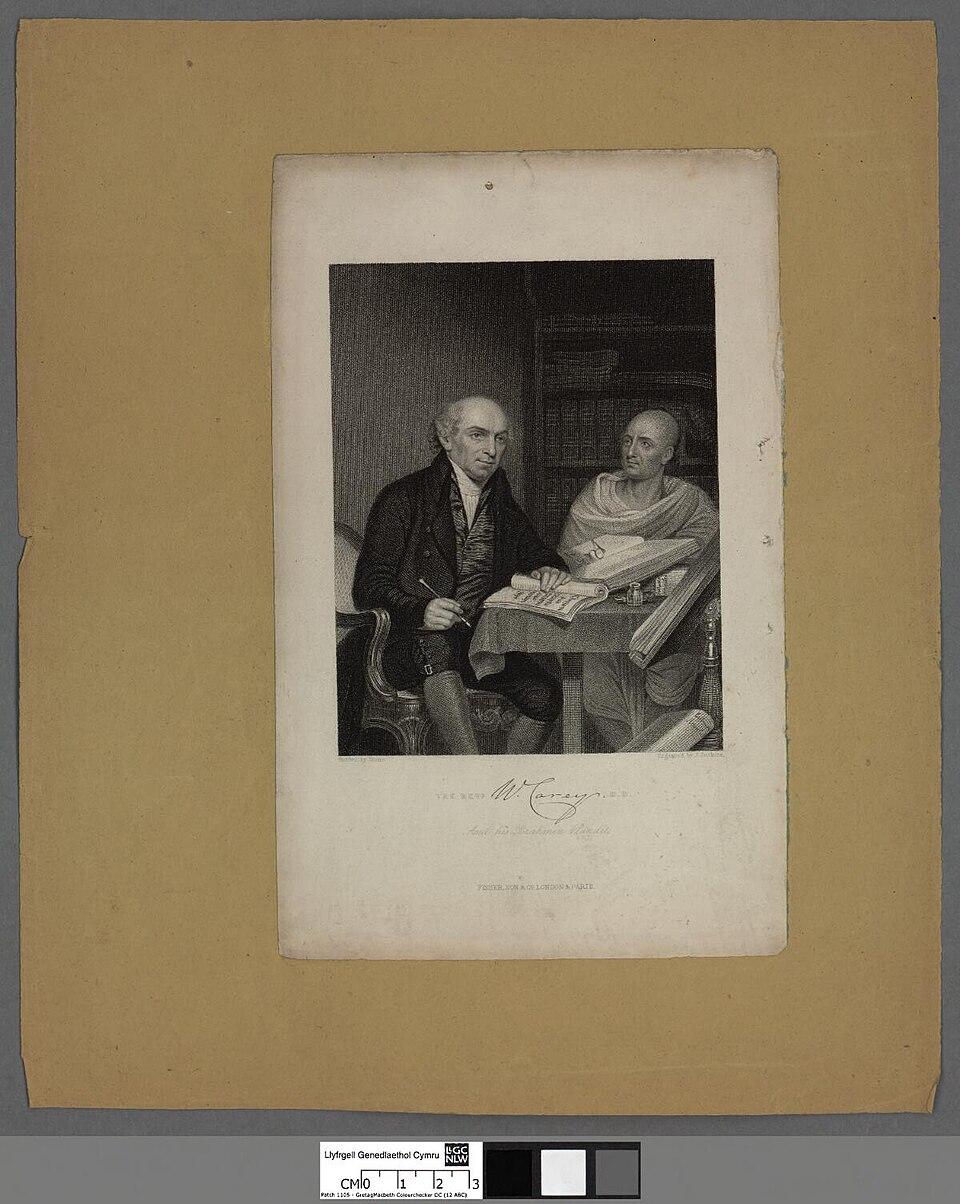
Joseph John Jenkins, The Rev.d W. Carey D.D. and his Brahmin Pundit, before 1885. Public domain.
1791 to 1792 · The churches · Featured Study
The Baptist Missionary Society
Founded at Kettering in 1792 by Particular Baptist ministers to carry the gospel overseas.
The Baptist Missionary Society began with thirteen pounds, two shillings and sixpence, given by twelve people at Kettering.
“Enlarge the site of your tent, stretch out the curtains of your dwellings, do not hold back. Lengthen your ropes and drive your stakes in deep.
- Began
- 2 October 1792, at Kettering
- Bodies
- The Particular Baptist Society for Propagating the Gospel amongst the Heathen, The auxiliary society at Birmingham
Summary
The Baptist Missionary Society came first among the mission societies that began in Britain and America over twenty years. William Carey's book gave it its plan. His friends, the pastors of the churches near him, gave money to it.
- William Carey put the question to the ministers at Clipstone and then wrote a book on it.
- His sermon at Nottingham on Isaiah 54:2 led to a plan for a society.
- The ministers met at Kettering, agreed six rules and pledged money.
- Within a month a church at Birmingham set up its own society to raise money for it.
- Its second resolution kept it to Particular Baptists. Each denomination was to work on its own.
The Texts Behind the Society
Carey's sermon text and the verses on his title page are the society's Scripture.
The society's own Narrative, printed in its Periodical Accounts, says Carey preached from Isaiah 54:2 at Nottingham. From that verse he pressed two things, that the ministers should expect great things and attempt great things.
How then can they call on the One in whom they have not believed? And how can they believe in the One of whom they have not heard? And how can they hear without someone to preach?The title page of Carey's Enquiry prints Paul's questions on how they shall hear without a preacher.
Therefore go and make disciples of all nations, baptizing them in the name of the Father, and of the Son, and of the Holy Spirit,Carey's first section argues that this commission still binds the church.
Where the Society Stands Among the Missions
The tree runs from the Moravian missions Carey praised to the American Board's first party.
The Baptist society followed the Moravians and came before the other voluntary societies.
1732
1791 to 1792
- Carey's Enquiry
- The society at Kettering
- The auxiliary society at Birmingham
1795 to 1799
1810 to 1812
Each date is read from the society's record or from the history of the body named.
The era page tells the century of missions in which these bodies were sent.
How the Society Began: Clipstone, Nottingham and Kettering
Three meetings of the association's ministers took the question from a debate to a society.
At a ministers' meeting at Clipstone in 1791, John Sutcliff and Andrew Fuller preached. Afterwards Carey asked whether it was not practicable and their bounden duty to attempt to spread the gospel in the heathen world. The ministers asked him to write his thoughts down and publish them.
Carey preached the Nottingham sermon on 31 May 1792. After it the association asked for a plan for a Baptist society, to be ready for the next ministers' meeting at Kettering. Carey offered the profits of his book to such a society.
On 2 October the same year the ministers at Kettering met apart after the public services. They agreed six resolutions, and no one voted against them. They named a committee of Ryland, Reynold Hogg, Carey, Sutcliff and Fuller, with Hogg as treasurer and Fuller as secretary.
The Duty They Pressed: Means for the Conversion of the Heathen
Carey's book argued that the command to teach all nations still binds the church and calls for means.
Carey's first section holds that the commission to teach all nations was laid on the church in every age. His second praises the Moravian Brethren above every other body of his time.
“This commission was as extensive as possible, and laid them under obligation to disperse themselves into every country of the habitable globe, and preach to all the inhabitants, without exception, or limitation.”
William Carey · An Enquiry, Section I (1792)Particular Baptist
“But none of the moderns have equalled the Moravian Brethren in this good work; they have sent missions to Greenland, Labrador, and several of the West-Indian Islands, which have been blessed for good.”
William Carey · An Enquiry into the Obligations of Christians to Use Means for the Conversion of the Heathens, section II, page 37Particular Baptist
Carey's Plan and the Kettering Resolutions
The book proposed the form, and the resolutions adopted it.
The resolutions at Kettering carried out the plan of Carey's fifth section.
| Question | Carey's plan | The resolutions |
|---|---|---|
| Who sends? | A society of serious Christians, ministers and private persons | The ministers whose names stand under the subscription |
| Which church? | The Particular Baptist denomination, each body working apart | A society of Particular Baptists, for the same reason |
| Who decides? | A committee to choose and supply the missionaries | A committee of five, three of whom may act |
| How is it paid for? | A penny a week from each congregation, or a tenth | Ten pounds at once, or ten shillings and sixpence a year, to be a member |
“I do not mean by this, in any wise to confine it to one denomination of Christians. I wish with all my heart, that every one who loves our Lord Jesus Christ in sincerity, would in some way or other engage in it. But in the present divided state of Christendom, it would be more likely for good to be done by each denomination engaging separately in the work, than if they were to embark in it conjointly.”
William Carey · An Enquiry into the Obligations of Christians, to Use Means for the Conversion of the Heathens (1792), section VParticular Baptist
The First Subscribers and Their Gifts
The society's own Narrative counts its first members and its first money.
The society began with twelve subscribers and grew by gifts at its second meeting.
| Meeting | The count | What it was |
|---|---|---|
| Kettering, 2 October | 12 names | The ministers and friends who signed the first subscription |
| Kettering, 2 October | £13 2s 6d | The sum of the first subscriptions |
| Northampton, 31 October | About £70 | The gift of the congregation in Cannon Street, Birmingham, brought by Samuel Pearce |
| Northampton, 31 October | 6½ guineas | The gifts of five more friends at the meeting |
From Clipstone to Birmingham
Each place stands with the meeting the Narrative records there.
The society took shape in four Midland towns over eighteen months.
| Date | Place | What happened there |
|---|---|---|
| 1791 | Clipstone | Carey put his question to the ministers after the two sermons. |
| 31 May 1792 | Nottingham | Carey preached on Isaiah 54:2 and a plan was ordered. |
| 2 October 1792 | Kettering | The ministers founded the society. |
| 31 October 1792 | Northampton | The second meeting welcomed an auxiliary society at Birmingham. |
In Their Own Words
Andrew Fuller was the society's secretary from 1792, and in 1793 William Carey went out as one of its first two missionaries.
Andrew Fuller (1754 to 1815)
The Instances, the Evil Nature, and the Dangerous Tendency of Delay, in the Concerns of Religion, a sermon preached at Clipstone Ministers' Meeting, 27 April 1791, in The Works of the Rev. Andrew Fuller, in Eight Volumes, volume VII (New Haven: S. Converse, 1824), Sermon III, page 62
Waiting for we know not what
“The truth is, if I am not mistaken, we wait for we know not what; we seem to think the time is not come, the time for the Spirit to be poured down from on high. We pray for the conversion and salvation of the world, and yet neglect the ordinary means by which those ends have been used to be accomplished.”
Particular Baptist
About this saying1 paragraph
Fuller preached on delay in religion at Clipstone on 27 April 1791. He asked why the churches still waited to send the gospel to the heathen.
Andrew Fuller
John Ryland, The Work of Faith, the Labour of Love, and the Patience of Hope, Illustrated; in the Life and Death of the Rev. Andrew Fuller, Late Pastor of the Baptist Church at Kettering, and Secretary to the Baptist Missionary Society from Its Commencement, in 1792 (Charlestown: Samuel Etheridge, 1818), page 144
Holding the rope
“Our undertaking to India really appeared to me, on its commencement, to be somewhat like a few men, who were deliberating about the importance of penetrating into a deep mine, which had never before been explored. We had no one to guide us, and while we were thus deliberating, Carey, as it were, said, 'Well, I will go down if you will hold the rope.'”
Particular Baptist
About this saying1 paragraph
Fuller served as secretary from 1792 until his death in 1815. He once told a friend on a journey how the mission to India had looked at its start, and John Ryland printed the words in his life of Fuller, in the Charlestown printing of 1818.
William Carey (1761 to 1834)
Letter to his sisters, Serampore, November 1801, in Eustace Carey, Memoir of William Carey, page 306
The Bible in Bengali
“Hitherto the Lord has helped me. I have lived to see the Bible translated into Bengali, and the whole New Testament printed.”
Particular Baptist
About this saying1 paragraph
Carey wrote to his sisters from Serampore in November 1801. In the same letter he told them that the missionaries lived as one public family and held no private property.
One Society for Each Church, or One for All
Carey's case for a Baptist society and the London directors' case for a united one stand side by side.
Carey held that mixed councils would let private quarrels damp the members' spirits. So each denomination should send its own missionaries and pray for the others.
Three years later the London society took the other side. Its directors called the union of God's people of various denominations a most desirable object. They left converts to choose their own church order.
Books to Read Next
An Enquiry into the Obligations of Christians, to Use Means for the Conversion of the Heathens
William Carey · 1792
Carey sets out the duty, the world's need and the plan of a society.
Free at Project GutenbergPeriodical Accounts Relative to the Baptist Missionary Society, volume I
The Baptist Missionary Society · 1800
Its Narrative records the meetings and prints the Kettering resolutions.
Free at the Internet ArchiveWhat the Society Handed On
The society handed on a form that later missions copied. Its members gave money of their own free will, and a committee chose, sent and supported the missionaries.
Sources
Scripture is the Berean Standard Bible.
- The Holy Bible, Berean Standard Bible (read 2026)
- William Carey, An Enquiry into the Obligations of Christians, to Use Means for the Conversion of the Heathens (Leicester: Ann Ireland, 1792), sections I, II and V.
- Periodical Accounts Relative to the Baptist Missionary Society, volume I (Clipstone: J. W. Morris, 1800), the Narrative, pages 1 to 6.
- Richard Lovett, The History of the London Missionary Society, 1795 to 1895, volume I (London: Henry Frowde, 1899), pages 49 to 50.
- Andrew Fuller, The Instances, the Evil Nature, and the Dangerous Tendency of Delay, in the Concerns of Religion, a sermon preached at Clipstone Ministers' Meeting, 27 April 1791, in The Works of the Rev. Andrew Fuller, in Eight Volumes, volume VII (New Haven: S. Converse, 1824), Sermon III, page 62.
- John Ryland, The Work of Faith, the Labour of Love, and the Patience of Hope, Illustrated; in the Life and Death of the Rev. Andrew Fuller, Late Pastor of the Baptist Church at Kettering, and Secretary to the Baptist Missionary Society from Its Commencement, in 1792 (Charlestown: Samuel Etheridge, 1818), page 144.
- Eustace Carey, Memoir of William Carey, D.D., Late Missionary to Bengal; Professor of Oriental Languages in the College of Fort William, Calcutta (Boston: Gould, Kendall and Lincoln, 1836), page 306, Carey's letter to his sisters, Serampore, November 1801.
Keep Studying
Read it1
Studies1
People and groups5