
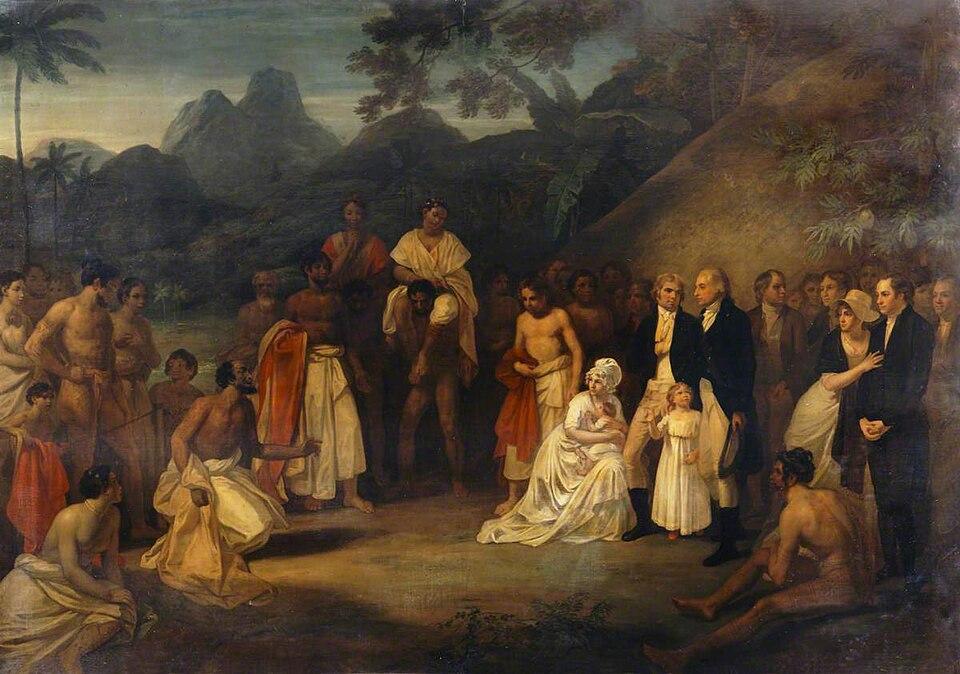
Robert Smirke, The Cession of Matavai to Captain James Wilson, before 1845. Public domain.
1795 to 1843 · The churches · Featured Study
The London and Church Missionary Societies
Two evangelical societies founded in one London inn, the first open to every church and the second within the Church of England.
that agrees with the glorious gospel of the blessed God, with which I have been entrusted.
- Began
- 21 September 1795 and 12 April 1799, at the Castle and Falcon, London
- Bodies
- The Missionary Society, later the London Missionary Society, The Church Missionary Society
Both societies were founded in the same first-floor room of an inn in Aldersgate Street, the Castle and Falcon, four years apart.
Summary
The London Missionary Society began in 1795. Its members came from several churches. The Church society began in 1799, within the Church of England. Between them they sent Robert Moffat and David Livingstone to southern Africa.
- The London society chose to send no form of church order, only the gospel.
- Its ship, the Duff, landed its first group on Tahiti.
- The Church society was formed by Anglicans who wanted a mission run on Church lines.
- Moffat put the New Testament into Sechwana at Kuruman.
- Crowther, once a slave boy, was the first African the Church society ordained.
The Text of the Fundamental Principle
The London directors took their phrase for the gospel from Paul's letter to Timothy.
The directors' minute of May 1796 says the society sends the gospel of the blessed God, in Paul's words to Timothy.
The Two Societies Among the Missions
The tree runs from the Baptist society to the American Board, with the two London societies between.
The London and Church societies followed the Baptist society within seven years.
1792
1795 to 1799
- The Missionary Society in London
- The Church Missionary Society
1797
- The Duff's company on Tahiti
1810 to 1816
- The American Board
- Moffat sent to South Africa
1841 to 1843
- Livingstone at Kuruman
- Crowther ordained
Each date is read from the society's own history or record.
The Anglican Communion is the family of churches the Church society served.
Livingstone was a member of the Congregational church at Hamilton before the London society accepted him.
How the Societies Began: Two Meetings at the Castle and Falcon
Richard Lovett and Eugene Stock, each writing his society's centenary history, tell the two founding meetings.
A general meeting was called for 22 to 24 September 1795. Lovett writes that the society was founded at the meeting meant only to prepare for it, on the evening of 21 September, with Sir Egerton Leigh in the chair.
On Friday 12 April 1799 sixteen clergymen and nine laymen met in the same room, with John Venn, rector of Clapham, in the chair. They adopted four resolutions.
The Truth They Pressed: The Gospel Sent, Church Order Left to the Converts
The London directors' minute of 9 May 1796 is still called the society's fundamental principle.
Lovett notes that the minute book first read Presbytery and Prelacy, and that those words were scored through and the others written above.
“As the union of God's People of various Denominations, in carrying on this great Work, is a most desirable Object, so, to prevent, if possible, any cause of future dissention, it is declared to be a fundamental principle of the Missionary Society, that our design is not to send Presbyterianism, Independency, Episcopacy, or any other form of Church Order and Government (about which there may be differences of opinion among serious Persons), but the Glorious Gospel of the blessed God to the Heathen”
The Directors of the Missionary Society · The minute of 9 May 1796, in Richard Lovett, The History of the London Missionary Society, 1795 to 1895, volume I, pages 49 to 50Evangelical
Their Founding Words Side by Side
Each society set down why it existed in its first year.
The London society joined churches, and the Church society kept to one.
| Question | The Missionary Society, 1796 | The Church Missionary Society, 1799 |
|---|---|---|
| Who belongs? | God's people of various denominations | Evangelical clergy and laymen of the Church of England |
| What is sent? | The gospel, with no form of church order | The gospel, by a society within the Church |
| Who chooses the converts' church order? | The converts themselves, by the Word of God | The Church of England's order |
| On whom is the duty laid? | The union of God's people | Every Christian |
The First Companies and Their Counts
The histories count the men sent and the men who met to found.
Each count is read from Lovett or Stock.
| Body | The count | What it was |
|---|---|---|
| The Church Missionary Society | 16 clergymen and 9 laymen | Those who met to found it, by Stock's count |
| The Missionary Society | 30 missionaries | The company on the Duff's second voyage, of whom ten took wives |
| The Missionary Society | 9 men | Those ordained at Surrey Chapel on 30 September 1816, Moffat and John Williams among them |
Where the Two Societies Went
Each place stands with the year its history gives.
The societies reached Tahiti, southern Africa and Sierra Leone within fifty years.
| Year | Place | What happened there |
|---|---|---|
| 1797 | Matavai Bay, Tahiti | The Duff's first company met the Tahitians on Sunday 5 March. |
| 1825 | Sierra Leone | Samuel Crowther, a freed slave boy, was baptized on 11 December. |
| 1827 | Fourah Bay College, Sierra Leone | Crowther was the first name on the roll of students. |
| 1839 | London | Moffat came to see his Sechwana New Testament through the press, and added the Psalms. |
| 1841 | Kuruman | David Livingstone reached Moffat's station in July. |
| 1843 | Sierra Leone | Crowther landed on 2 December, ordained in London on Trinity Sunday, 11 June. |
In Their Own Words
The Directors of the Missionary Society
The first Report of the Missionary Society (5 October 1795), in Richard Lovett, The History of the London Missionary Society, 1795 to 1895, volume I, page 40
Rejoice with trembling
“Let not, however, the appearance of success and prosperity in this arduous undertaking seduce our vain hearts into carnal confidence, security, and presumption.”
Evangelical
About this saying1 paragraph
The directors' first Report, dated 5 October 1795, warned the new society against pride in its early success.
The founders of the Church Missionary Society
The first resolution of the Church Missionary Society, at the Castle and Falcon on 12 April 1799, in Eugene Stock, The History of the Church Missionary Society, volume I, chapter VII, page 68
Every Christian
“That it is a duty highly incumbent upon every Christian to endeavour to propagate the knowledge of the Gospel among the Heathen.”
Anglican, evangelical
About this saying1 paragraph
Stock prints the first of the society's four resolutions of 1799 and notes that it lays the duty on every Christian.
Charles James Blomfield
The Annual Sermon of the Church Missionary Society, in Eugene Stock, The History of the Church Missionary Society, volume I, page 457
A minister from among them
“What cause for thanksgiving to Him who hath made of one blood all nations of men, is to be found in the thought that He has not only blessed the labours of this Society by bringing many of those neglected and persecuted people to the knowledge of a Saviour, but, from among a race despised as incapable of intellectual exertion and acquirement, He has raised up men well qualified, even in point of knowledge, to communicate to others the saving truths which they have themselves embraced, and to become preachers of the Gospel to their brethren according to the flesh!”
Anglican
About this saying1 paragraph
At the Church society's next anniversary after Crowther was ordained in 1843, Bishop Blomfield of London preached the annual sermon and said this.
Union Across the Churches, or a Society of One Church
The London directors and the Anglican founders answered one question in two ways, and Carey had answered it a third way.
The London directors held that one work shared by the churches would prevent future dissension, and they left church order to the converts.
Stock gives John Venn's rule that the missions must be based on the Church principle. He argues that churches divided on church order can preach together, but cannot order the communities their converts form.
Carey's Enquiry gave the Baptist answer, that each denomination should send its own, since mixed councils breed discords.
Books to Read Next
The History of the London Missionary Society, 1795 to 1895
Richard Lovett · 1899
Lovett prints the founding minutes and follows each mission field.
Free at the Internet ArchiveThe History of the Church Missionary Society
Eugene Stock · 1899
Stock tells the founding meeting and the life of Crowther.
Free at the Internet ArchiveWhat the Two Societies Handed On
They handed on two answers to the question of church order in missions, and a clergyman ordained from among the people the missions had reached.
Sources
Scripture is the Berean Standard Bible.
- The Holy Bible, Berean Standard Bible (read 2026)
- Richard Lovett, The History of the London Missionary Society, 1795 to 1895, volume I (London: Henry Frowde, 1899), pages 24 to 25, 49 to 50, 64, 133 to 134, 240 to 241 and 592.
- Eugene Stock, The History of the Church Missionary Society, volume I (London: Church Missionary Society, 1899), pages 65, 68, 451 and 457.
- William Carey, An Enquiry into the Obligations of Christians, to Use Means for the Conversion of the Heathens (Leicester: Ann Ireland, 1792), section V.
Keep Studying
Read it1
People and groups5