
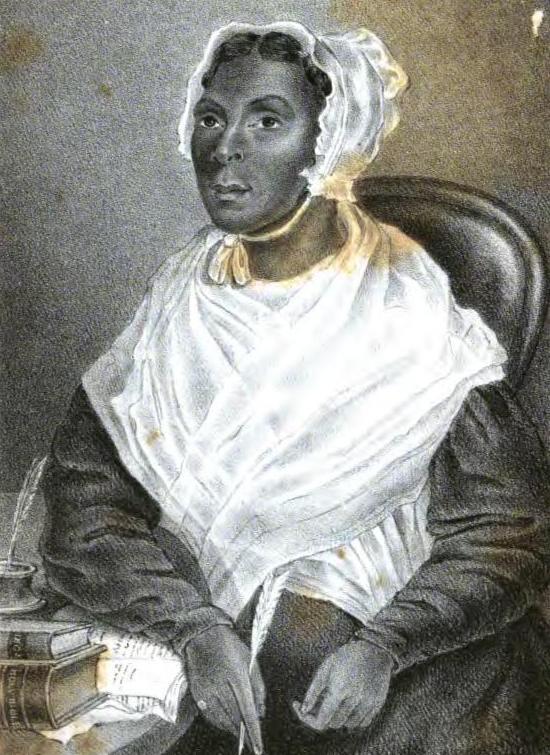
P. S. Duval after A. Hoffy, Mrs. Jarena Lee, 1844. Public domain.
Cape May to Philadelphia, 1783 to 1849 · Person · Featured Study
Jarena Lee
She was a travelling preacher of Richard Allen's church who argued in print for a woman's call.
When the preacher at Bethel Church lost his thread, a woman in the congregation stood up and exhorted on his text.
And afterward, I will pour out My Spirit on all people. Your sons and daughters will prophesy, your old men will dream dreams, your young men will see visions.
And afterward, I will pour out My Spirit on all people. Your sons and daughters will prophesy, your old men will dream dreams, your young men will see visions.
- Born
- 11 February 1783, at Cape May, New Jersey, by her own book (probable)
- Died
- not recorded in her book, which was printed in 1849 (proposed)
- Family
- husband: Joseph Lee
- Places
- Cape May, Philadelphia, Snow Hill
Summary
Jarena Lee was born at Cape May, New Jersey, in 1783. At seven she went into service. In Philadelphia she joined Richard Allen's society. She came to believe that God called her to preach. Allen said the Discipline did not call for women preachers. About eight years later he heard her speak and said he believed she was called.
- She travelled on foot, by stage and by steamboat, and in one year she counted 2,325 miles and 178 sermons.
- She argued that the Saviour died for the woman as well as the man, and that Mary first preached the risen Lord.
- She printed her own account in 1836 and again, enlarged, thirteen years later.
Your Daughters Will Prophesy
Joel 2 stands on her title page, and Jonah 2 was the text of the day she spoke at Bethel.
No verse of Scripture names Jarena Lee. She set Joel's promise, that sons and daughters would prophesy, at the head of her book. The preacher at Bethel on the day she first spoke there took his text from Jonah, and she told the people she was like Jonah, who had delayed to go.
The question of this life is how a woman with no licence came to preach across several states, and on what ground she argued that she should. Her own book answers both.
But I, with the voice of thanksgiving, will sacrifice to You. I will fulfill what I have vowed. Salvation is from the LORD!”Richard Williams took this verse as his text the day she stood up at Bethel.
The Life in Order
Every date comes from her own book, which gives years for some events and none for others.
She waited about eight years between her call and Allen's word for her.
- 1783BirthHer book
- At sevenInto serviceHer book
- 1804A sermon that troubled herHer book
- After 1804ConversionHer book
- 1807Freedom from doubtHer book
- Before her marriage, by the order of her bookThe call to preachHer book
- 1811MarriageHer book
- About eight years after her callThe day at BethelHer book
- 1823The New York conferenceHer journal
- After April 1827, by the order of her journalThe year of her longest travelsHer journal
- 1849The revised editionHer book
Each step of the life stands with the place in her book that gives it.
1811, About eight years after her call, 1823, After April 1827, by the order of her journal, 1849
From Cape May to Bethel Church
She waited years for leave to preach and then travelled for many years.
Her book gives her birthday as 11 February and her birthplace as Cape May. At seven she was sent to work as a servant about sixty miles from home. She wrote that her parents were wholly ignorant of the knowledge of God.
In Philadelphia she went to hear Richard Allen preach and decided that the Methodists were the people her heart joined. Three weeks later she was converted under the preaching, as soon as the text was read.
Four or five years after she believed herself sanctified, she heard a voice that seemed to tell her to preach the gospel. She went to Allen, who told her of a Mrs Cook allowed to exhort and hold prayer meetings. As to women preaching, he said, the Discipline knew nothing about it.
In 1811 she married Joseph Lee, pastor of a society at Snow Hill, six miles from Philadelphia. Within about six years five of her family died, her husband among them. She was left with two infant children.
Allen, now bishop of the African Methodist Episcopal Church, let her hold prayer meetings in her hired house and exhort. One Sunday at Bethel Church the preacher Richard Williams seemed to lose the spirit of his sermon. She sprang to her feet and exhorted on his text, and Allen rose to speak for her.
From then on she preached wherever a door opened, in churches, houses, schoolhouses and a courthouse, in New Jersey, Pennsylvania, New York and Ohio. Elders who were averse to a woman's preaching sometimes refused her their pulpits. She came home in March 1842 after two years of almost constant travel.
The Book She Printed
She paid for the printing herself and sold it as she travelled.
She entered her account for copyright in 1836. The revised edition calls itself "Revised and corrected from the Original Manuscript, written by herself" and was "Printed and Published for the Author".
On a tour in the West her pamphlets "went off as by a wind", and an elder urged her to print a second edition. She paid $38 to print a thousand copies, which left her short of money for the road.
In Their Own Words
Four passages of her book, from her call to her stand against slavery.
Jarena Lee (born 1783)
Religious Experience and Journal of Mrs. Jarena Lee, My Call to Preach the Gospel
Go preach the Gospel
“But to my utter surprise there seemed to sound a voice which I thought I distinctly heard, and most certainly understand, which said to me, ‘Go preach the Gospel!’ I immediately replied aloud, ‘No one will believe me.’”
African Methodist Episcopal
About this saying1 paragraph
She told of her call, which came before her marriage, in the chapter she headed My Call to Preach the Gospel.
Jarena Lee
Religious Experience and Journal of Mrs. Jarena Lee, My Call to Preach the Gospel
A whole Saviour
“If the man may preach, because the Saviour died for him, why not the woman? seeing he died for her also. Is he not a whole Saviour, instead of a half one? as those who hold it wrong for a woman to preach, would seem to make it appear.”
African Methodist Episcopal
About this saying1 paragraph
She set out her case for a woman's preaching in the same chapter, first printed in 1836.
Jarena Lee
Religious Experience and Journal of Mrs. Jarena Lee, My Call to Preach the Gospel
Did not Mary first preach
“Did not Mary first preach the risen Saviour, and is not the doctrine of the resurrection the very climax of Christianity—hangs not all our hope on this, as argued by St. Paul? Then did not Mary, a woman, preach the gospel? for she preached the resurrection of the crucified Son of God.”
African Methodist Episcopal
About this saying1 paragraph
In the same chapter of 1836 she argued from the women at the empty tomb.
Jarena Lee
Religious Experience and Journal of Mrs. Jarena Lee, the journal, after September 1839
Children of one parent
“as we are all children of one parent, no one is justified in holding slaves. I felt that the spirit of God was in the work, and also felt it my duty to unite with this Society.”
African Methodist Episcopal
About this saying1 paragraph
She wrote this after she attended a convention of the American Anti-Slavery Society in New York, some months after September 1839.
The People Around Her
Her book names the bishop who held her back and then spoke for her, and the people she worked beside.
Richard Allen stands at both ends of her waiting.
| Person | Tie to Jarena Lee | The witness |
|---|---|---|
| Richard Allen | The preacher who drew her in, and the bishop who later owned her call. | Her book |
| Mrs Cook | An earlier woman exhorter whom Allen named. | Her book |
| Joseph Lee | Her husband, who died within a few years of their marriage. | Her book |
| Richard Williams | The preacher whose text she took up. | Her book |
| Jane Hutt | An elderly woman of the society, a mother in Israel, who prayed with her at a deathbed. | Her book |
| Bishop Brown | A bishop of her church, named in her journal of 1823. | Her journal |
| Mrs H. Lane | Her companion at the anti-slavery convention. | Her journal |
Allen's church came out of the Methodists.
The Places of Her Life
Her life centred on Philadelphia, and her travels ran west to Ohio and north to Buffalo.
She preached in several states and returned each time to Philadelphia.
| Place | What her book says | The witness |
|---|---|---|
| Cape May, New Jersey | She was born there and went back to preach after a long absence. | Her book |
| Philadelphia | She heard Allen there, exhorted at Bethel, and made it her home. | Her book |
| Snow Hill, New Jersey | Her husband's charge, which she later visited as a preacher. | Her journal |
| New York | She spoke at two of its churches. | Her journal |
| Buffalo | She kept an appointment there on a northern tour. | Her journal |
| Dayton and Cincinnati, Ohio | She preached there and sold her pamphlets. | Her journal |
Why Not the Woman
She answered the case against a woman preacher from Scripture and from the fruit of her work.
She took up the objection that Mary did not expound the Scripture and so did not preach. She answered that preaching may have been a simpler thing in the first days, or the unlearned fishermen could not have preached at all. If preaching comes by the gift of heaven, she asked, must God take the man alone?
She pointed last to what followed her preaching. She wrote of families who had not been to a meeting for years and listened with tears. She was "fully persuaded that the Lord called me", and she asked how else He could bear testimony to her labours in converting sinners.
To one elder she gave an old answer: if an ass reproved Balaam, why should a woman not reprove sin?
Mary Magdalene went and announced to the disciples, “I have seen the Lord!” And she told them what He had said to her.Lee argued from the first witness of the resurrection.
‘In the last days, God says, I will pour out My Spirit on all people. Your sons and daughters will prophesy, your young men will see visions, your old men will dream dreams.Peter cited Joel's promise of daughters who prophesy on the day of Pentecost.
How the Key Verse Was Taught
Chrysostom, Matthew Henry and John Gill read the promise of the Spirit poured out.
John Chrysostom (died 407)
Homily on the Acts of the Apostles 5
Chrysostom read the promise as Peter used it at Pentecost.
“Hence we learn that on unessential points one must not spend many words. And besides, the sequel is enough to bear him out on this point: so now the discourse is for all in common. ‘But this is that which was spoken by the prophet Joel, And it shall come to pass in the last days, saith the Lord God.’ Nowhere as yet the name of Christ, nor His promises but the promise is that of the Father.... ‘And I will pour out of My Spirit upon all flesh.’ He offers even to them excellent hopes, if they would have them. And so far, he does not leave it to be regarded as the exclusive advantage of himself and his company; which would have made them be looked upon with an evil eye; thus cutting off all envious feeling. ‘And your sons shall prophesy.’ And yet, he says, not yours this achievement, this distinction; the gift has passed over to your children. Himself and his company he calls their sons, and those whom he is addressing he calls his and their fathers. ‘And your young men shall see visions, and your old men shall dream dreams; and on My servants and on My handmaidens I will pour out in those days of My Spirit; and they shall prophesy.’ To some the grace was imparted through dreams, to others it was openly poured forth. For indeed by dreams the prophets saw, and received revelations.”
on Joel 2:28 to 29Patristic
Matthew Henry (1662 to 1714)
Commentary on the Whole Bible
Matthew Henry read the promise as the gift of the Spirit that was to come.
“That was the gift of the Spirit, which, according to this prediction, was to come, and we are not to look for any other, any more than for another accomplishment of the promise of the Messiah. The blessing itself here promised is the pouring out of the Spirit of God, his gifts, graces, and comforts, which the blessed Spirit is the author of.”
on Joel 2:28Puritan
John Gill (1697 to 1771)
Exposition of the Old Testament (1748-1763)
John Gill placed the promise after the ministry of Christ and His apostles.
“And it shall come to pass afterward,.... After the teacher of righteousness has been sent, and a plentiful rain of the Gospel has been let down in the land of Judea, in the ministry of John the Baptist, Christ and his apostles, and such a comfortable enjoyment of the blessings of grace in it, and the knowledge of God by it; and after the wonderful work of redemption wrought by Christ. R.”
on Joel 2:28Reformed
What the Witnesses Leave Open
Her book leaves open her standing, the years of her call, and the end of her life.
Whether she was licensedJarena Lee; Richard Allen, as she reports him
Her book gives Allen's words at Bethel as she heard them, that he "now as much believed that I was called to that work, as any of the preachers present". It records no written licence. The Mrs Cook whom Allen named had exhorted by the verbal licence of an earlier preacher in charge.
The years of her callJarena Lee
She dates her freedom from doubt to 1807 and her marriage to 1811. She gives no year for her call or for the day at Bethel, only that about eight years lay between them.
The end of her lifeJarena Lee
Her journal ends after March 1842, and the book was printed seven years later. It records nothing of her death.
Books to Read Next
Religious Experience and Journal of Mrs. Jarena Lee
Jarena Lee · 1849
Her own account of her conversion, her call and her travels, in the revised edition.
Read her book free at Project GutenbergReligious Experience and Journal of Mrs. Jarena Lee, the printed scan
Jarena Lee · 1849
The printed pages, with the frontispiece, as the Internet Archive holds them.
See the printed book at the Internet ArchiveWhat Jarena Lee Left
Jarena Lee left a book she paid to print and sold on the road, the account in her own words of a woman preaching in Allen's church. She closed her journal resolved to wear out rather than rust out.
Sources
Scripture is the Berean Standard Bible.
- The Holy Bible, Berean Standard Bible (read 2026)
- Jarena Lee, Religious Experience and Journal of Mrs. Jarena Lee, Giving an Account of Her Call to Preach the Gospel, revised and corrected from the original manuscript (Philadelphia: printed and published for the author, 1849; entered 1836)
- Matthew Henry, Commentary on the Whole Bible, on Joel 2:28.
- John Gill, Exposition of the Old Testament (1748 to 1763), on Joel 2:28.
- John Chrysostom, Homily 5 on the Acts of the Apostles, on Joel 2:28 to 29.