
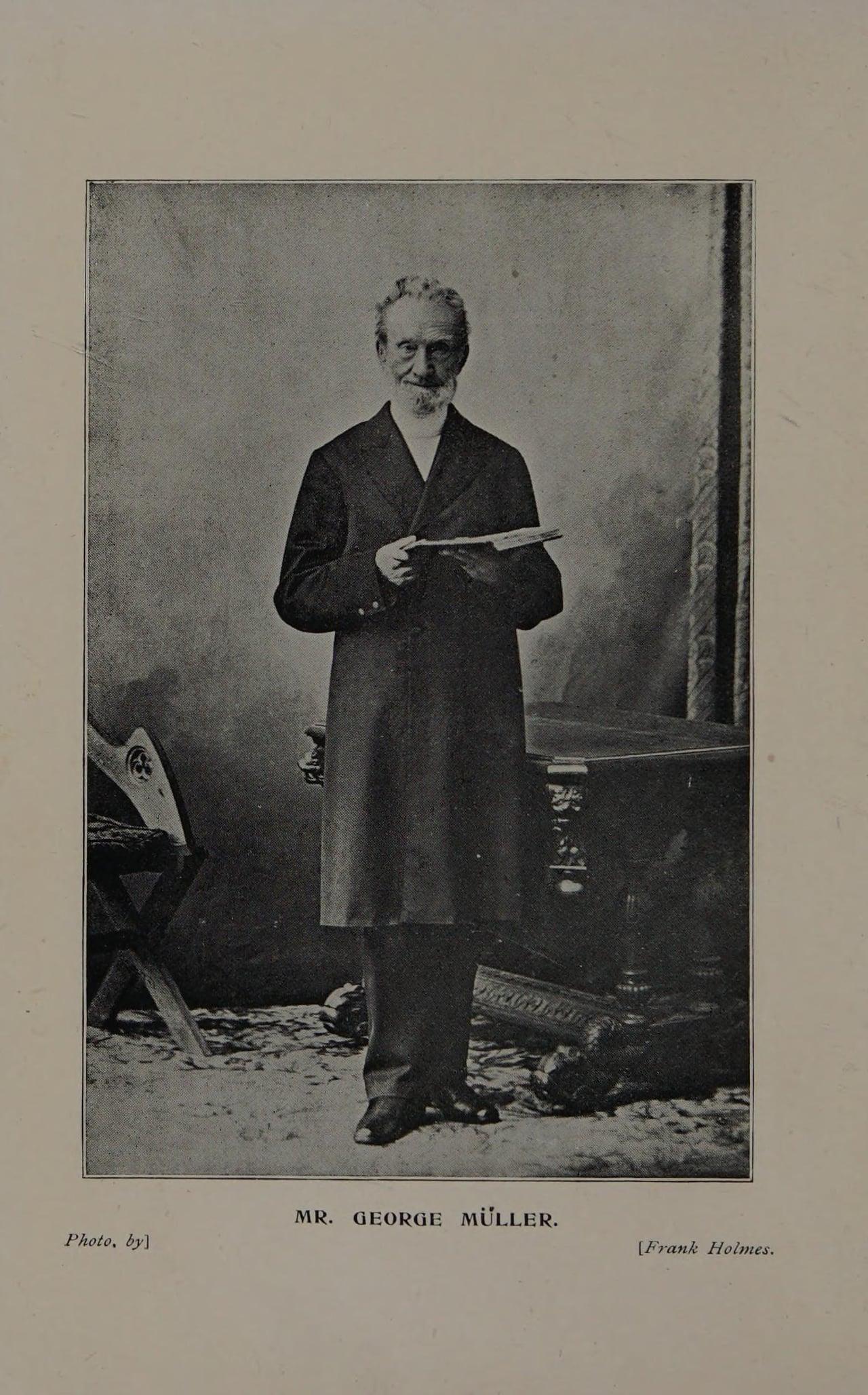
Mr. George Müller, Frank Holmes, 1898. Public domain.
Prussia and Bristol, 1805 to 1898 · Person · Featured Study
George Müller
He was a Prussian-born pastor who served in Bristol from 1832 until his death.
He resolved in 1830 to ask no one but God for money, and he kept the rule until his death in 1898.
But seek first the kingdom of God and His righteousness, and all these things will be added unto you.
But seek first the kingdom of God and His righteousness, and all these things will be added unto you.
- Born
- 27 September 1805
- Died
- 10 March 1898
- Family
- wife: Mary Groves; wife: Susannah Grace Sangar
- Places
- Kroppenstaedt, Halle, Teignmouth, Bristol
Summary
George Müller was born at Kroppenstaedt in Prussia in 1805. He was converted as a student at Halle in 1825. He came to England to prepare for mission work and preached in Devon. Then he moved to Bristol with his friend Henry Craik.
- Pierson counts a hundred servants of Christ helped by the Institution by 1860.
- From 1869 he sent gifts to every worker of the China Inland Mission.
- Arthur Pierson and Hudson Taylor's son and daughter-in-law give two dates for his influence on Taylor.
The Texts He Leaned On
His rule of asking no one stands under Matthew 6, and his first prayer for the orphan house under Psalm 81.
The question here is what Müller did beyond the orphan houses. The answer lies in the pastorate he took without salary, the Institution he began with Henry Craik, and the money he sent abroad. His own Narrative, Arthur Pierson's life of 1899 and the history of the China Inland Mission by Howard and Geraldine Taylor are the witnesses.
I am the LORD your God, who brought you up out of Egypt. Open wide your mouth, and I will fill it.He read this verse on 5 December 1835 and applied it that day to the orphan house he planned.
The Life in Order
The early years stand on his Narrative, and the later ones on Pierson and the Taylors.
The Institution came two years before the first orphan house.
- 27 September 1805Birth at KroppenstaedtPierson, page 9
- About the middle of November 1825Conversion at HalleThe Narrative, part 1
- Autumn 1830No fixed salary from then onPierson
- 7 October 1830Marriage to Mary GrovesPierson
- 23 May 1832From Teignmouth to Bristol, with Craik a day behindPierson
- 5 March 1834The Scriptural Knowledge Institution begun with CraikThe Narrative, part 1
- 5 December 1835Psalm 81:10 taken as a promise for the orphan workThe Narrative, part 1
- October 1869A letter and a gift for each of its workersHoward and Geraldine Taylor
- 6 February 1870Mary Müller diedPierson
- 10 March 1898Death at BristolPierson
Each step of the life stands with its witness.
5 December 1835, October 1869, 6 February 1870, 10 March 1898
From Halle to Bristol
A divinity student without faith became a pastor who would take no fixed pay.
Pierson gives his birthplace as Kroppenstaedt, near Halberstadt, and his father's post as a collector of the excise at Heimersleben. As a student at Halle he went one Saturday with his friend Beta to a meeting. There they read the Bible, sang and prayed, and Müller dates his conversion from that day.
He was preaching at Teignmouth when, in the autumn of 1830, he resolved to take no fixed salary for any service to God's people. That October he married Mary Groves, sister of Anthony Norris Groves, whose surrender of his goods for the mission field had moved him years before.
His friend Henry Craik left Shaldon for Bristol in March 1832 and invited him to follow. Müller left Teignmouth on 23 May, and the two men began at Gideon Chapel on their own terms. Pew-rents were to be done away with, and they would look to the Lord for their needs through free offerings. They also took Bethesda Chapel, and Müller was at its prayer service in the last week of his life.
On 5 March 1834 the two men stated at a public meeting the principles of the Scriptural Knowledge Institution for Home and Abroad. Its objects were schools, the circulation of the Scriptures and the aid of missionary work. It would neither ask unbelievers for money nor enlarge its work by debt. The first orphan house opened in Wilson Street in April 1836.
Mary Müller died early in 1870. Fourteen days after his daughter's marriage to James Wright, Müller married Susannah Grace Sangar, whom he had known for more than twenty-five years. On Sunday 6 March 1898 he preached at Alma Road Chapel, and on the Thursday morning that followed he was found dead beside his bed.
In Their Own Words
Two lines from his Narrative on the rule of his life, his prayer for the orphan house, and his letter to the China missionaries.
George Müller (1805 to 1898)
Narrative, First Part (ninth edition, 1865), Teignmouth, 1829
The word of God alone
“That the word of God alone is our standard of judgment in spiritual things; that it can be explained only by the Holy Spirit; and that in our day, as well as in former times, He is the teacher of His people.”
Plymouth Brethren
About this saying1 paragraph
He set down at Teignmouth in 1829 what he had learned of the Bible and the Holy Spirit.
George Müller
A Narrative of Some of the Lord's Dealings, first part, ninth edition (1865)
Ask no man
“At the same time it appeared to me right, that henceforth I should ask no man, not even my beloved brethren and sisters, to help me […]”
Plymouth Brethren
About this saying1 paragraph
He wrote this in the first part of his Narrative, of the autumn of 1830, when he gave up his salary.
George Müller
A Narrative of Some of the Lord's Dealings with George Müller, part 1, entry of 5 December 1835, part 1, December 1835
Premises, a thousand pounds and helpers
“This evening I was struck, in reading the Scriptures, with these words: ‘Open thy mouth wide, and I will fill it.’ Ps. lxxxi. 10. Up to this day I had not prayed at all concerning the means or individuals needed for the Orphan-House. I was now led to apply this scripture to the Orphan-House, and asked the Lord for premises, 1000l., and suitable individuals to take care of the children.”
Plymouth Brethren
About this saying1 paragraph
His diary for 5 December 1835 records the first prayer he made for the means of the orphan house.
George Müller
Letter to the members of the China Inland Mission, October 1869, in Howard and Geraldine Taylor, Hudson Taylor and the China Inland Mission, chapter The Exchanged Life, page 183
I love you in the Lord
“My chief object […] is to tell you that I love you in the Lord; that I feel deeply interested about the Lord's work in China, and that I pray daily for you.”
Plymouth Brethren
About this saying1 paragraph
He wrote this letter in October 1869 to be read aloud to the workers at their stations.
The People Around Him
The witnesses name his two wives, his fellow pastor, his successor and the missionaries he helped.
Craik shared his pastorate and his Institution from 1832.
| Person | Tie to Müller | The witness |
|---|---|---|
| Mary Groves | His wife from 7 October 1830 until her death in 1870 | Pierson |
| Anthony Norris Groves | Mary's brother, a dentist who gave up his goods for the mission field | Pierson |
| Henry Craik | His friend from Teignmouth and fellow pastor in Bristol | Pierson; the Narrative, part 1 |
| Susannah Grace Sangar | His second wife, who joined him in prayer and giving | Pierson |
| James Wright | His son-in-law and successor, who issued the report of 1898 | Pierson |
| Hudson Taylor | He began the China Inland Mission, visited Müller and took his counsel | Howard and Geraldine Taylor |
| William Berger | The mission's home director, who passed on his gifts and letter | Howard and Geraldine Taylor |
| August Hermann Francke | The Halle pastor whose orphan house Pierson names as Müller's pattern | Pierson |
William Berger, August Hermann Francke
The Places of His Life
His life runs from Prussia to Devon and then to Bristol, and his gifts reached China.
His work spread from one Bristol chapel to missions in China.
| Place | What the witnesses say | The witness |
|---|---|---|
| Kroppenstaedt | He was born there, near Halberstadt. | Pierson |
| Heimersleben | His father collected the excise there. | Pierson |
| Halle | He studied divinity there and was converted at a Bible meeting. | The Narrative, part 1 |
| Teignmouth | He preached there before he moved to Bristol. | Pierson |
| Bristol | He served Gideon and Bethesda chapels and ran the Institution and the orphan houses. | Pierson; the Narrative |
| China | The money he sent reached the mission's workers there. | Howard and Geraldine Taylor |
The Money That Went Abroad
The Institution carried missionaries as well as orphans, and Müller gave from his own purse.
Before the riot at Yangzhou, Müller was already sending to several members of the mission, sometimes twenty-five pounds a quarter. Within a day or two of the riot, long before he heard of it, he asked William Berger for more names. He was sent six and took them all. The Taylors write that his gifts for the next few years came to nearly two thousand pounds a year. In 1870 he sent Taylor 1,940 pounds.
After his death James Wright made known that the giver entered for over sixty years as "a servant of the Lord Jesus" was Müller himself. Pierson gives the sum of those gifts and his other gifts, up to the month of his death, as 81,490 pounds, 18 shillings and 8 pence.
How the Key Verse Was Taught
Tertullian, August Hermann Francke and the commentary of Jamieson, Fausset and Brown read the command to seek the kingdom first.
Tertullian (died 220)
On Prayer
Tertullian set the verse beside the order of the Lord's Prayer, which asks for bread after the kingdom.
“But how gracefully has the Divine Wisdom arranged the order of the prayer; so that after things heavenly-that is, after the ‘Name’ of God, the ‘Will’ of God, and the ‘Kingdom’ of God-it should give earthly necessities also room for a petition! For the Lord had withal issued His edict, ‘Seek ye first the kingdom, and then even these shall be added: ‘ albeit we may rather understand, ‘Give us this day our daily bread,’ spiritually.”
on Matthew 6:33Patristic
August Hermann Francke (1663 to 1727)
Pietas Hallensis (1705), printed at London by J. Downing, the third instance, page 37
Francke held to the verse while he fed the orphans of Halle, the work Müller later took as his pattern.
“I closely adhered in my Mind to that saying: Seek first the Kingdom of God and his Righteousness, and all these things shall be added unto you; ... And when I was now laying out the last of the Money, I said in my Thoughts, Domine respice ad indigentiam meam; Lord look upon my Necessity.”
Lutheran
Jamieson, Fausset & Brown (1802 to 1910)
Commentary Critical and Explanatory on the Whole Bible
Jamieson, Fausset and Brown weighed how far the command reaches beyond its own place in the sermon.
“This is the great summing up. Strictly speaking, it has to do only with the subject of the present section--the right state of the heart with reference to heavenly and earthly things; but being couched in the form of a brief general directory, it is so comprehensive in its grasp as to embrace the whole subject of this discourse.”
on Matthew 6:33Reformed
What the Witnesses Leave Open
Readers differ on the year his example first reached Taylor and on the report that was never issued for 1847.
When his example moved Hudson TaylorArthur Pierson; Howard and Geraldine Taylor
Pierson wrote in 1899 that Müller's witness encouraged Taylor "in 1863" to venture wholly on the Lord in founding the mission. Howard and Geraldine Taylor print Taylor's note in his Bible, which dates his prayer for twenty-four workers at Brighton to 25 June 1865.
The two dates may name two steps, the first trust and the founding, and neither book sets them side by side.
Whether a printed report was a way of askingMüller, as Pierson quotes him; James Wright, as Pierson reports him
Pierson quotes Müller's wish to cut off "even the shadow of ground" for saying that a new report was issued because money had run out. In 1844 he put off the public meeting and the report to show that no undue weight rested on indirect appeals.
Pierson adds that no report was issued for 1847, a year of great need, and that James Wright, Müller's successor, thought the need was the reason. Pierson's answer is that a trustee of other people's gifts owed them an account.
Books to Read Next
A Narrative of Some of the Lord's Dealings with George Müller, part 1
George Müller · 1837, ninth edition 1865
It is his own diary of his early years, with the founding of the Institution and the first orphan house.
Read the Narrative free at Project GutenbergGeorge Müller of Bristol
Arthur T. Pierson · 1899
Pierson wrote the life the year after his death, with the last report and his private giving.
Read Pierson free at the Internet ArchiveHudson Taylor and the China Inland Mission
Howard and Geraldine Taylor · 1918
It prints his letter to the mission and the sums he sent.
Read the Taylors free at the Internet ArchiveWhat Müller Left
Müller left the Institution, the orphan houses on Ashley Down and a printed record of every gift. Pierson wrote that he meant his life to be a proof that God hears prayer.
Sources
Scripture is the Berean Standard Bible.
- The Holy Bible, Berean Standard Bible (read 2026)
- George Müller, A Narrative of Some of the Lord's Dealings with George Müller, Written by Himself, part 1, ninth edition (1865)
- Arthur T. Pierson, George Müller of Bristol and His Witness to a Prayer-Hearing God (1899)
- Howard and Geraldine Taylor, Hudson Taylor and the China Inland Mission: The Growth of a Work of God (1918)
- Tertullian, On Prayer, on Matthew 6:33.
- August Hermann Francke, Pietas Hallensis (1705), London printing by J. Downing.
- Robert Jamieson, A. R. Fausset and David Brown, Commentary Critical and Explanatory on the Whole Bible (1871), on Matthew 6:33.