
Jonathan Edwards at Enfield · Story · Featured Study
Enfield and Sinners in the Hands
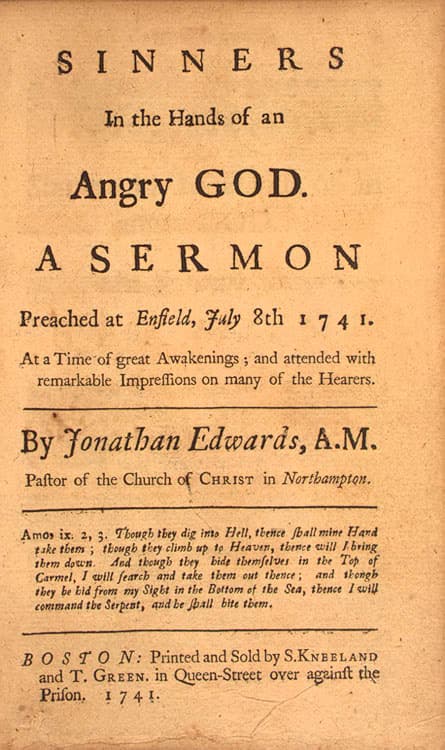
Jonathan Edwards's sermon at Enfield went into print at Boston the same year, under a title page that names the town and the day.
Its first title page told buyers the sermon had been “attended with remarkable Impressions on many of the Hearers.”
- When
- 8 July 1741
Jonathan Edwards, the title page of Sinners in the Hands of an Angry God, 1741. Public domain.
Vengeance is Mine; I will repay. In due time their foot will slip; for their day of disaster is near, and their doom is coming quickly.”
Summary
Jonathan Edwards preached at Enfield on 8 July 1741 from a text of Deuteronomy.
- The title page names him “Pastor of the Church of CHRIST in Northampton.”
- The Yale editors of 2003 call it “arguably America's greatest sermon.”
- The Yale editors judge the interruption possibly the only one Edwards had met, except the day the gallery of the old Northampton meeting-house fell.
The Verses of the Evening
Two passages beyond the sermon's text stand in its record.
One stands on the title page and one in the mouths of the hearers.
Though they dig down to Sheol, from there My hand will take them; and though they climb up to heaven, from there I will pull them down. Though they hide themselves atop Carmel, there I will track them and seize them; and though they hide from Me at the bottom of the sea, there I will command the serpent to bite them.The first printing and its reprints set these verses under the title, so a reader met God's reach before the first page.
Then he brought them out and asked, “Sirs, what must I do to be saved?”Williams heard the hearers cry, “what shall I do to be Saved,” the jailer's question at Philippi.
Who Recorded Enfield
Four records tell of the evening, each with its date and its side.
Every record of the evening comes from friends of the revival.
| Record | Written | Its side |
|---|---|---|
| Stephen Williams's diary, printed by the Yale editors from a typescript | 8 July 1741 | A minister of nearby Longmeadow who met Edwards at Enfield and spoke with the hearers after |
| The words of the first printing | The same year | The printers, who sold the sermon |
| The preface John Willison wrote for the Edinburgh reprint | 1745 | A minister of Dundee who defended the sermon |
| Benjamin Trumbull's History of Connecticut, which drew on Eleazar Wheelock's account | 1818 | A historian of the revival, from a minister who was there |
The Evening at Enfield
The record runs from Northampton to the hymn that ended the meeting.
The Yale editors write that Edwards first preached the sermon to his own congregation at Northampton, and that “It is not clear what effect this Sinners had on his own congregation.”
The next time he preached it was at Enfield. Trumbull, writing from Eleazar Wheelock's account, says that when the neighbouring ministers went into the meeting-house “the appearance of the assembly was thoughtless and vain.”
Stephen Williams, minister of nearby Longmeadow, wrote in his diary that Edwards preached “a most awakening Sermon from those words Deut - 32.35.”
Before the sermon was done, Williams wrote, there was “a great moaning” and crying out through the whole house, so that the minister was obliged to stop.
Trumbull tells it that “the preacher was obliged to speak to the people and desire silence, that he might be heard.”
When the congregation was still, Williams wrote, a prayer was made, and the ministers came down from the pulpit and spoke with the people, some in one place and some in another.
He wrote that several souls were hopefully wrought upon that night, and that the meeting sang a hymn, prayed and dispersed.
The Sermon's Argument
Edwards drew one doctrine from his text and pressed it on his hearers.
The printed sermon opens on the words of its text as the King James Bible gives them, “Their Foot shall slide in due Time.”
Its doctrine reads, “There is nothing that keeps wicked men, at any one moment, out of hell, but the meer Pleasure of GOD.”
Its sentence on the spider turns that doctrine on the hearer. “The God that holds you over the pit of hell, much as one holds a spider, or some loathsome insect, over the fire, abhors you.”
What the Record Leaves Unsaid
The witnesses left two questions open.
The Yale editors give no day for the sermon at Northampton, and neither Williams nor Trumbull counts the people at Enfield.
What Edwards Wrote of Outcries
Edwards held that cries and tears proved nothing either way about the Spirit's work.
Edwards set out his rule in The Distinguishing Marks of a Work of the Spirit of God, printed at Boston that year and reprinted at Edinburgh. “A Work is not to be judged of by any Effects on the Bodies of Men; such as Tears, Trembling, Grones, loud Outcries, Agonies of Body, or the failing of bodily Strength.”
In A Treatise Concerning Religious Affections of 1746 he held it no sign either way “that they have great Effects on the Body.”
By his own rule, then, the crying at Enfield settled nothing about the hearers' hearts.
How the Key Verse Was Taught
Three voices from the early church to the nineteenth century take up Deuteronomy 32:35.
Ambrose of Milan (died 397)
Epistle 63, section 84
A letter of the early church draws from the Lord's claim to repay a rule for His people.
“So far does He remove the desire of vengeance from the perfect that He commands charity towards those who injure them.”
Patristic
John Wesley (1703 to 1791)
Explanatory Notes upon the Old Testament
Wesley wrote this note in 1765 on the time the verse sets for judgment.
“So the scripture often speaks of those things which are at many hundred years distance, to signify, that though they may be afar off as to our measures of time, yet in God's account they are near”
Evangelical
Adam Clarke (1762 to 1832)
Commentary on the Bible
A nineteenth-century commentary records another scholar's reading of the verse.
“But Calmet thinks that this verse is spoken against the Canaanites, the enemies of the Jewish people.”
Methodist
In Their Own Words
Edwards's sermon, his letter, his treatise and his biographer speak of the Enfield preaching and its preacher.
Jonathan Edwards (1703 to 1758)
Sinners in the Hands of an Angry God, the application
The offer at the end
“And now you have an extraordinary opportunity, a day wherein CHRIST has flung the door of mercy wide open, and stands in the door calling and crying with a loud voice to poor sinners”
Congregationalist
About this saying1 paragraph
The sermon turns here from the danger to the offer, in the Boston edition of 1772.
Jonathan Edwards
Letter, as printed in Sereno E. Dwight, The Life of President Edwards, volume 1
A copy sent
“I have also sent one of those Sermons I preached at Enfield; as to the other, I have but one of them in the world.”
Congregationalist
About this saying1 paragraph
This letter, printed by Dwight in 1830, shows that Edwards kept more than one sermon from that town.
Jonathan Edwards
A Treatise Concerning Religious Affections, part 2, section 1
The height of feeling
“'Tis no Sign one Way or the other, that religious Affections are very great, or raised very high.”
Congregationalist
About this saying1 paragraph
Five years after Enfield, in 1746, he set this first among the signs that prove nothing.
Samuel Hopkins
The Life and Character of the Late Reverend Mr. Jonathan Edwards, on his preaching
The preacher in the pulpit
“His Appearance in the Desk was with a good Grace, and his delivery easy, natural and very solemn. He had not a strong, loud Voice”
Congregational
About this saying1 paragraph
His biographer described his preaching in 1765.
Jonathan Edwards, Samuel Hopkins
Where Historians Disagree
Readers since 1745 have asked whether the sermon shows Edwards's preaching or hides it.
Is the sermon typical of Edwards?2 paragraphs
John Willison answered in his preface of 1745, “If any alledge there is not much of Christ in the Sermon, I have it to say, that I have seen others of Mr. Edwards' Sermons and Discourses very full of Christ.” He held that Edwards spoke to a congregation he knew to be secure.
Joseph Tracy wrote in 1842 that “the most wonderful displays of his imagination were put forth in describing the imminent danger of the wicked,” and named two more sermons of the same kind.
Books to Read Next
Sinners in the Hands of an Angry God, third edition
Jonathan Edwards · 1772
The Boston reprint gives the whole sermon in its eighteenth-century type.
Free at the Internet ArchiveA Treatise Concerning Religious Affections
Jonathan Edwards · 1746
Edwards's own test of what the outcries of the revival did and did not show.
Free at the Internet ArchiveThe Great Awakening
Joseph Tracy · 1842
Tracy's history of the revival in the time of Edwards and Whitefield sets the sermon among his others.
Free at the Internet ArchiveWhat Enfield Left
Enfield left the town's name on the sermon's title page, where the later reprints kept it.
Sources
Scripture is the Berean Standard Bible.
- The Holy Bible, Berean Standard Bible (read 2026)
- Harry S. Stout and Nathan O. Hatch, eds., The Works of Jonathan Edwards, volume 22, Sermons and Discourses 1739 to 1742 (New Haven: Yale University Press, 2003), the editors' introduction, quoted at fifty words or fewer.
- Benjamin Trumbull, A Complete History of Connecticut, volume 2 (New Haven, 1818), page 145.
- Jonathan Edwards, The Distinguishing Marks of a Work of the Spirit of God (Boston, 1741; quoted from the reprint of Edinburgh: T. Lumisden and J. Robertson, 1742)
- Jonathan Edwards, A Treatise Concerning Religious Affections (Boston: S. Kneeland and T. Green, 1746), part 2, sections 1 and 2.
- [Samuel Hopkins], The Life and Character of the Late Reverend Mr. Jonathan Edwards (Boston: S. Kneeland, 1765)
- Sereno E. Dwight, The Life of President Edwards (New York, 1830)
- Joseph Tracy, The Great Awakening: A History of the Revival of Religion in the Time of Edwards and Whitefield (Boston, 1842)
- Ambrose of Milan, Epistle 63, section 84, in Nicene and Post-Nicene Fathers, second series, volume 10, Ambrose: Selected Works and Letters.
- John Wesley, Explanatory Notes upon the Old Testament (1765), on Deuteronomy 32:35.
- Adam Clarke, Commentary on the Bible, on Deuteronomy 32:35.