
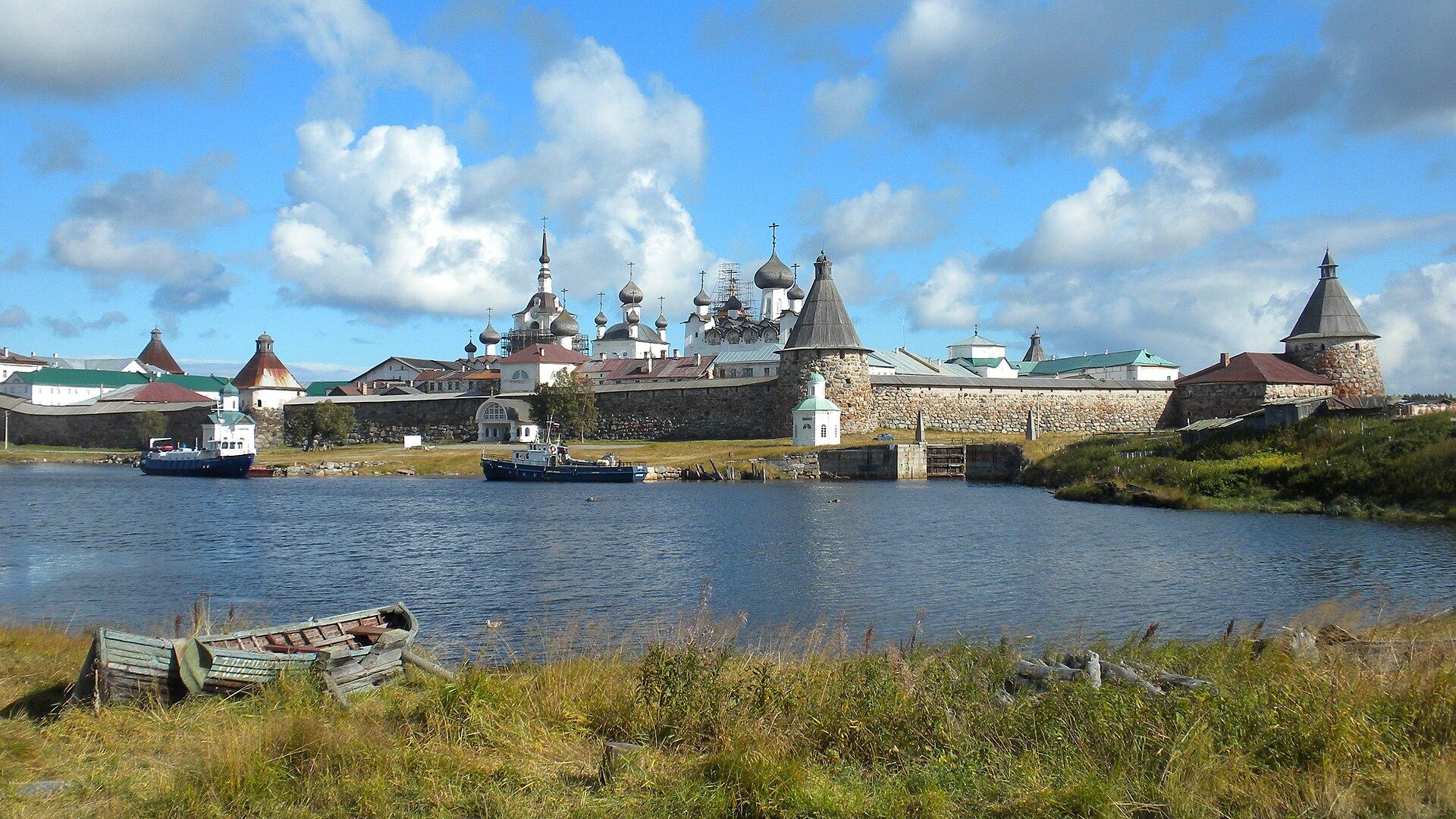
Claus Oreskov, the Solovetsky Monastery, 2010. Public domain.
Russia and the Soviet Union, from 1918 · Story · Featured Study
The Soviet Martyrs
The Soviet state jailed and shot bishops, priests, monks and lay believers, and the bishops divided over how the Church should answer.
- Where
- Petrograd, Solovki, Butovo, Moscow
- Who
- Patriarch Tikhon, Metropolitan Benjamin, Metropolitan Sergius, Georgi Vins
- When
- From the Revolution to 2000
The usual charge against the clergy on Solovki was Clause 72, which S. A. Malsagoff says reached as far as the religious education of children.
Who shall separate us from the love of Christ? Shall trouble or distress or persecution or famine or nakedness or danger or sword?
Summary
The Soviet state struck the Russian Church from its first months. In the late 1930s it shot hundreds of clergy at one range near Moscow. The range's own director gives that count. The state held bishops, priests and monks in a prison camp on the Solovki islands. Baptists and others paid as well.
- A law of 8 April 1929 asked for twenty adult believers to form a society. It barred meetings for children, young people or women.
- W. C. Emhardt, who wrote for the Episcopal Church, said exact figures cannot be had.
- Igor Garkavy, who runs the Butovo center, calls it the largest known site of its kind near Moscow.
The Texts of the Patriarch
Tikhon's message argued from Scripture, and two of its verses stand here.
This study asks how the Soviet state struck the churches, who counted the dead, and how the bishops disagreed. It gives each count with its counter, the story from the first decree to the range at Butovo, the Soviet Baptists and the Council of 2000. It also sets out whether those killed died for politics or for the faith, in the terms of those who argued it at the time.
And I tell you that you are Peter, and on this rock I will build My church, and the gates of Hades will not prevail against it.
Tikhon set this promise against the Soviet decrees, saying the persecutors would be scattered.
But those who persist in sin should be rebuked in front of everyone, so that the others will stand in fear of sin.
Tikhon gave this as his warrant for rebuking in public those who were shedding blood.
Who Counted the Dead and the Prisoners
Each count is a partial one, and every row names the person or body that made it.
The counts of the 1920s cover bishops and priests in those years, and the counts at Butovo cover one range in fifteen months.
| Counter | What is counted | The number |
|---|---|---|
| The London Times, as Emhardt cites it | Bishops, 1918 and 1919 | 28 |
| The Central Executive Committee, 1922, as Emhardt cites it | Bishops and priests | 20 and 1,414 |
| Bishop Nicolai Solovejtchik, 1926, as Emhardt cites him | Clergy and monks | 8,100 |
| The Solovki letter, end of 1926 | Bishops jailed, exiled or at hard labour | About 150, about half |
| S. A. Malsagoff, 1926 | Bishops, priests and monks on Solovki | Some 300 |
| Igor Garkavy, Butovo Memorial Center | Names shot at Butovo | 20,762 |
| Igor Garkavy | Shot there on church-related charges | 940 |
| Igor Garkavy | Of those, glorified as saints | 332 |
Igor Garkavy
The Butovo centre's own home page prints 20760, and The Moscow Times wrote about 20,760 and about 1,000 clergy in 2014. Garkavy says most of those shot there "were simple peasants and workers". The 940 include seven bishops, fifteen archimandrites and around six hundred priests.
On Solovki the church historian Mikhail Polsky listed 23 hierarchs in 1926 and 1927. The St Tikhon Institute's database records 195 held there at some time.
From the Decree to Butovo
The story runs from a decree through trials and a camp on the islands to a firing range near Moscow.
Emhardt dates the decree separating Church and state to 23 January 1918. Its articles took the school from the Church, denied religious bodies the right to own property, and declared their property the nation's wealth.
Patriarch Tikhon issued his message during the Christmas recess of the Sobor, the Russian Church's national council, and he anathematized those shedding blood. The Sobor then adopted as its official answer a report calling the decree a legalized open persecution.
In 1922 the state moved to seize church valuables, for the starving as it said. Metropolitan Benjamin of Petrograd asked for proof that other revenue was exhausted, a guarantee that the valuables would feed the hungry, and Tikhon's consent. Krasnitsky and Vvedensky, clergy he had removed, testified against him at his trial.
The tribunal announced ten death sentences in July 1922, and six were commuted. Benjamin, Novitsky, Shein and Kovsharov were executed, on 31 July by the Orthodox Church in America's life of him. Dr Spinka, whom Emhardt quotes, says the patriarchal party came to regard them as martyrs.
Malsagoff, who escaped from Solovki, says the Soviet authorities put the whole clergy in the "K.R." group, with no distinction of Church. He writes, on his word alone, that the Bolsheviks murdered half the monks of the monastery.
Secret Order 00447 opened the mass operations in early August 1937. Garkavy says "church people" stood among its categories, overwhelmingly clergy, monastics and active Orthodox lay people. The FSB concluded in 1993 that the executions at Butovo ran from 8 August 1937 to 19 October 1938.
The Soviet Baptists2 paragraphs
Peter Vins, a Baptist minister, was arrested for his religious work and died in a prison camp. His son Georgi was tied to the Council of Churches launched in 1965 and served three years at hard labour after his conviction of 1966.
Georgi Vins was arrested again in Novosibirsk on 31 March 1974, and he had finished a five-year term and begun Siberian exile when the exchange came. On 27 April 1979 the White House announced that the Soviet Government had released him and four others as two convicted Soviet spies went home. He reached Kennedy Airport that day, stripped of his citizenship.
The Council of 2000
The Church named its martyrs, and the list took in both sides of the quarrel of 1927.
The Jubilee Council glorified the New Martyrs and Confessors of Russia, those named and those "known to God". A newspaper printed its Act that September. The list included Metropolitan Kirill (Smirnov), whom Keston News Service calls the spiritual head of Sergius's opponents. Agafangel, Serafim (Samoilovich) and Viktor (Ostrovidov) stood with him.
Garkavy says more than one hundred saints of Butovo were glorified in that year. A wooden church stood at the range from 1996, and a larger one has been active since 2007.
How the Key Verse Was Taught
Two writers of the early church and one of the twentieth century on the verse Tikhon quoted.
Ambrosiaster (died 384)
COMMENTARY ON PAUL'S EPISTLES
Ambrosiaster took the love here to be Christ's gifts, which outweigh every torment.
“This means: ‘Who will turn us away from the love of Christ, who has given us such great and innumerable gifts?’ No torments will overcome the love of a mature Christian.”
on Romans 8:35Patristic
Augustine of Hippo (died 430)
AUGUSTINE ON ROMANS 57
Augustine heard Paul steadying people who might break under persecution.
“Paul is exhorting his hearers to not be broken by persecution, for perhaps they had been living according to the wisdom of the flesh.”
on Romans 8:35Patristic
R. C. Sproul (1939 to 2017)
The Inseparable Love of God
R. C. Sproul set the verse beside a marriage that no one can dissolve.
“But in the marriage of Christ and His bride, there is neither divorce nor separation.”
on Romans 8:35 to 39Reformed
In Their Own Words
These are the words of a patriarch, a council, the bishops on Solovki and a man who escaped the camp.
Tikhon (Bellavin) (1865 to 1925)
Tikhon's message, as Emhardt prints it
Recall yourselves
“Recall yourselves, ye senseless, and cease your bloody deeds. For what you are doing is not only a cruel deed; it is in truth a satanic act, for which you shall suffer the fire of Gehenna in the life to come”
Russian Orthodox
About this saying1 paragraph
Tikhon addressed this to those who were shedding blood, in his message of 1918 as Emhardt printed it.
The Sobor of the Russian Church
Official answer to the decree, as Emhardt prints it
All other religious communions
“The individuals wielding the governmental authority audaciously attempt to destroy the very existence of the Orthodox Church. In order to realize this satanic design, the Soviet of People's Commissioners published the decree concerning the separation of the Church from the State, which legalized an open persecution not only of the Orthodox Church, but of all other religious communions, Christian or non-Christian.”
Russian Orthodox
About this saying1 paragraph
In its answer of 1918 the council said the blow struck more than the Orthodox.
The bishops held on Solovki
Epistle to the Government, in a note in Emhardt
From Solovki
“A great number of Orthodox bishops are imprisoned, because of their unsuccessful struggle against the Renovated heresy; which struggle is looked upon as a protest against the plans of the government”
Russian Orthodox
About this saying1 paragraph
The bishops held on the islands wrote this to the government, and Troitsky's note in Emhardt keeps the sentence from a Russian paper of 1927.
S. A. Malsagoff
An Island Hell
The old priest
“All kinds of religious services, of course, are forbidden. One of the priests in the camp on Popoff Island, a feeble old man, died. He begged the commandant with tears in his eyes to allow the Vladika Illarion to administer the Holy Sacrament to him. The commandant refused in abusive terms.”
Former prisoner of Solovki
About this saying1 paragraph
Malsagoff, a former prisoner, told this in 1926 of the camp on Popoff Island.
S. A. Malsagoff
An Island Hell
Submissiveness and stoicism
“The clergy at the Solovky, though more oppressed and humiliated by the camp authorities than any other category of prisoners, are remarkable for the submissiveness and stoicism with which they endure their moral and physical sufferings.”
Former prisoner of Solovki
About this saying1 paragraph
Malsagoff set down in 1926 how he saw the clergy bear it.
Where the Church Divided
The bishops argued over the declaration of 1927, and the two sides of the trials argued over what the charges meant.
Should the Church declare its loyalty?3 paragraphs
Metropolitan Sergius wrote in his declaration of 16 (29) July 1927 that the Church wished to be Orthodox and to hold the Soviet Union its civil homeland, whose joys and successes were its own. He required the clergy abroad to give a written pledge of loyalty.
The bishops on Solovki had written in 1926 of a gulf that "precludes any intrinsic approximation or reconciliation between the Church and state", and that the Church "is ready to go on suffering". On 14 September 1927 they answered that the Church could not count the state's joys and successes as its own.
The Council of Russian Bishops Abroad replied in 1933 that Sergius made union with the Church depend on accepting an atheist regime. Emhardt had written in 1929 that the same synod's earlier call to arm Russia's sons had done harm inside Russia.
Politics or the faith?2 paragraphs
The state tried the clergy for counter-revolution and for resisting its decrees, and Tikhon's letter to the Supreme Court in 1923 admitted past hostility to the Soviet authorities.
Malsagoff, writing after his escape, says Illarion never came into conflict with the Soviet power and was sent away for the defence of his faith.
Books to Read Next
Religion in Soviet Russia
William Chauncey Emhardt · 1929
An Episcopal Church secretary printed the decree, Tikhon's message and the Sobor's answer in English.
Read Emhardt free at the Internet ArchiveAn Island Hell
S. A. Malsagoff · 1926
A prisoner who got away from Solovki tells what he saw of the clergy there.
Read Malsagoff free at the Internet ArchiveThe Bolshevik Persecution of Christianity
Francis McCullagh · 1924
A journalist reporting from Moscow wired word of Benjamin's execution, and the censor stopped it.
Read McCullagh free at the Internet ArchiveWhat Solovki Left
Patriarch Alexy II set a feast of the Solovki martyrs in the Jubilee year. The Azbuka Very church calendar names that feast the Synaxis of the New Martyrs and Confessors of Solovki.
Sources
Scripture is the Berean Standard Bible.
- The Holy Bible, Berean Standard Bible (read 2026)
- W. C. Emhardt, Religion in Soviet Russia (Milwaukee: Morehouse; London: Mowbray, 1929), with Dr Spinka's account and M. Troitsky's notes.
- S. A. Malsagoff, An Island Hell: A Soviet Prison in the Far North (London: A. M. Philpot, 1926)
- Francis McCullagh, The Bolshevik Persecution of Christianity (London, 1924)
- Igor Garkavy, director of the Butovo Memorial Center, interview, OrthoChristian, May 2026.
- The Butovo Memorial Center, home page.
- Alexander Annin, "Mass Grave in Moscow Suburbs Is Among Russia's Holiest Sites", The Moscow Times, May 2014.
- Geraldine Fagan, Keston News Service, 6 November 2000, on the canonizations and the Solovki bishops.
- The Act of the Jubilee Council of 2000, as printed in Krasny Sever, 6 September 2000, page 3.
- Metropolitan Sergius, Declaration of 16 (29) July 1927, in Gubonin, Akty Sviateishego Tikhona (Moscow, 1994), page 509 onward, Russian.
- Encyclical Letter of the Council of Russian Bishops Abroad (8/21 July 1933)
- Azbuka Very church calendar, the Synaxis of the New Martyrs and Confessors of Solovki.
- The law of the Russian Republic on religious associations, 8 April 1929.
- Orthodox Church in America, the life of Hieromartyr Benjamin of Petrograd.
- White House statement of 27 April 1979 on the exchange of prisoners.
- Christianity Today, May 1979, on Georgi Vins.
Keep Studying
People and groups3
Go further2
Church history6
Trials of life1