
Psalm 7
17 verses · Psalm of lament
The LORD judges the peoples; vindicate me, O LORD, according to my righteousness and integrity.
Introduction
David, the Appeal to the Judge, Book 1: The book of David, Poetry, Psalms Overview.
David wrote this when a man named Cush, of Saul's tribe, spoke against him. The heading remembers words rather than a battle. The psalm is shaped like a hearing in a court, where an accused man who cannot clear his name takes his case to the judge above every judge. Listen for the oath he swears against himself if the charge is true, for the call on God to take His seat, and for the pictures of a trap that closes on the one who set it. It ends in thanks before the verdict is read.
Context
- Who
- Israelites who knew what it was to be accused with no way to clear their name
- Where
- A formal appeal to God as judge, framed as a hearing before a tribunal
- When
- The reign of David, out of a slander spoken by a Benjamite named Cush. c. 1010 to 970 BC on the superscription, which Young's Literal Translation renders The Erring One, by David, that he sung to Jehovah concerning the words of Cush a Benjamite; Cush is named nowhere else and was likely a partisan of Saul's tribe
Historical context
The occasion the heading names is words rather than weapons, since Cush is remembered for what he said. The psalm is built as a legal proceeding. Where a charge could not be settled by witnesses at the town gate, Israel's law sent the case before the LORD at the sanctuary. The oath of verses 3 to 5 is the standard form, in which the accused calls down on himself the exact ruin his accusers intend if the charge is true. The term in the heading, shiggaion in the Hebrew, is a musical or literary word whose precise sense has been lost. The pit of verse 15 is a hunting pit dug in a game trail and covered with brush. A man who forgot where he had put it broke his own leg in it, which is how the picture became a proverb for a scheme that turns.
Significance
For the first hearers the psalm handed the case up. A man who could not prove his innocence in front of his neighbours asked the God who searches hearts and minds to hold the hearing Himself. It asks God to arise, and then it waits for Him, which is the whole of the action it takes against the accuser.
This chapter in Jewish lifeWhat this chapter is in Jewish life and reading.
How it is read
The first word of the heading is obscure, and Rashi's note on it is one of the clearest windows in the corpus into how a Jewish commentator argues. He is quoted here from the Judaica Press Tanach with Rashi. He sets out Menachem's reading first, that the word names a melody after an instrument. He then reports the reading of the Sages, who took it as an expression of error, and had David confessing the error of singing a song over Saul's downfall. Rashi rejects that reading from the contents of the psalm, because the ninth verse speaks of the nations rather than of Saul. His own proposal is that David recited it concerning Ishbi in Nob, who came upon him as a punishment for Saul, and he names the Talmudic discussion he is drawing on at Sanhedrin 95a. He then offers a further reading, "the error of the skirt of Saul's coat, which he had severed" (Rashi on Psalms 7:1:1).
The name in the heading is read as Saul in disguise. Rashi puts it in one line: "Just as a Cushite has unusual skin, so did Saul have unusual deeds" (Rashi on Psalms 7:1:2). Radak, quoted from the Finch translation of 1919, which is public domain, reaches the same man by a different road. He holds that the lion of the third verse "could not be said of any other enemy of David except Saul, who was king". Only a king rends with none to deliver (Radak on Psalms 7:3:1). At the second verse he reads the trust of the psalm as exclusive, "in Thee do I put my trust and not in the help of man". He names the pursuers as those allied with Saul (Radak on Psalms 7:2:1). Ibn Ezra comments on the same verse, and the corpus carries his ref without an English text, so he stands here cited and unquoted at Ibn Ezra on Psalms 7:2:1.
The oath of the fourth and fifth verses is where the commentators recover a scene from the record. Radak reads the charge David denies as requiting evil to a man at peace with him (Radak on Psalms 7:4:1). Rashi ties the stripping of the fifth verse to the night in the cave, when David cut the skirt of Saul's coat. He gives David's defence in David's own mouth. The cutting was done "only to let him know that he was delivered into my hand to kill him, and I did not kill him" (Rashi on Psalms 7:5:2). Radak reads the pursuit of the sixth verse out of the grammar. The verb carries two forms at once, so that Saul both chased David himself and set Israel to chase him (Radak on Psalms 7:6:1).
From the seventh verse the psalm turns outward to the nations, and the commentators turn with it. Rashi names Ishbi, his brothers and the Philistines as the enemies of the seventh verse (Rashi on Psalms 7:7:1). At the eighth he reads the congregation of kingdoms as troops of nations following God to be saved, and hears David asking that their voice go unheard (Rashi on Psalms 7:8:1). The ninth verse he makes a plea to move a sentence: "Reverse the sentence from upon us and place it upon the nations" (Rashi on Psalms 7:9:1). A Christian reader should mark that request and hold it beside the psalm's own ground, which is the righteousness of the judge rather than the standing of the petitioner. Radak reads the shield of the eleventh verse out of a single preposition, and concludes that "my reliance and stay is God, who will be my shield" (Radak on Psalms 7:11:1). At the sixteenth verse he takes the pit as prophecy, and holds that David "prophesies that Saul shall die by the sword" (Radak on Psalms 7:16:1). Rashi ends the chapter on thanksgiving for strict justice executed with righteousness (Rashi on Psalms 7:18:1).
What the rabbis say
The corpus carries forty locators on this psalm and the text of none, so each is cited and linked here rather than quoted. Four are Talmudic. They stand at Avot DeRabbi Natan, Recension B 43:28 on the heading, Kiddushin 30b:1 on the third verse, and Avodah Zarah 4a:18 with Berakhot 7a:7 on the twelfth.
Midrash Tehillim carries eleven, following the psalm verse by verse. They stand at 7:3 on the second verse, 7:4 on the third, 7:5 on the fourth, and 7:8 on the eighth. They continue at 7:9 on the tenth verse, 7:11 on the fourteenth, 7:12 on the fifteenth, 7:13 on the sixteenth and 7:14 on the eighteenth. Two more reach in from other psalms, at 64:1 on the thirteenth verse and 119:24 on the sixteenth.
The rest are scattered across the chapter. On the heading the corpus carries Bereshit Rabbah 37:2 and Kohelet Rabbah 10:20:1, with Ein Yaakov, Moed Katan 3:2 in the Glick Edition and Moed Katan 3:7. On the seventh verse it carries Bereshit Rabbah 75:1, Devarim Rabbah 3:11, Kohelet Rabbah 4:3:1 and two entries of Midrash Tanchuma on Ki Tisa, at 20:2 and at 13:1 in the Buber recension. On the ninth it carries Aggadat Bereshit 6:1 and Shemot Rabbah 30:11. Two entries of Esther Rabbah stand on the thirteenth verse, at 10:2 and 10:3, and a locator of Sifrei Aggadah on Esther stands on the seventeenth. On the sixteenth verse the corpus carries two entries of the Mekhilta, at Mekhilta DeRabbi Shimon Ben Yochai 14:24 and Mekhilta DeRabbi Yishmael, Vayehi Beshalach 7:1. What each of them teaches is a saying of the rabbis, and is reported as theirs wherever this site quotes one. The quotations wait on a fetch that carries the text.
Sources: Rashi, Rashi on Psalms 7:1:1 to 7:18:1, the Judaica Press complete Tanach with Rashi, translated by A. J. Rosenberg; Radak, Radak on Psalms 7:2:1 to 7:17:1, R. David Kimhi on the first book of Psalms, translated by R. G. Finch, London, 1919; Ibn Ezra, Ibn Ezra on Psalms 7:2:1, cited by ref because the corpus carries no English text; The Sefaria corpus, scripts/data/sources/sefaria/psalms/7.json, the 4 Talmud and 36 Midrash locators of this chapter.
Psalms 7:1-2
I take refuge in You: David takes refuge in the LORD and asks to be saved from all his pursuers. The danger he pictures is a lion that shreds the soul and tears its prey to pieces, with no one to rescue him. He prays before he makes any defence.
Psalms 7:1
“David appears before God to plead with him against the Accuser, who had charged him with treason and treachery. The case is here opened with an avowal of confidence in God. Whatever may be the emergency of our condition we shall never find it amiss to retain our reliance upon our God. "O Lord my God, " mine by a special covenant, sealed by Jesus' blood, and ratified in my own soul by a sense of union to thee; "in thee, " and in thee only, "do I put my trust, "even now in my sore distress.”
Charles Spurgeon · The Treasury of David, Vol. 1 (1869)Particular Baptist
shred my soul like a lion: Verse 1 names all his pursuers, but the Hebrew verb for shred is singular, so one enemy stands out as the lion. Charles Spurgeon saw one foe mightier than the rest. 1 Peter 5:8 draws the devil as a lion.
Psalms 7:2
“Lest he tear my soul like a lion - These words seem to answer well to Saul. As the lion is king in the forest; so was Saul king over the land. As the lion, in his fierceness, seizes at once, and tears his prey in pieces; so David expected to be seized and suddenly destroyed by Saul. He had already, in his rage, thrown his javelin at him, intending to have pierced him to the wall with it.”
Adam Clarke · Commentary on the Bible (1810-1826)evangelical
2 more voices on this verse
Psalms 7:2
“'Lest at any time he seize my soul like a lion.' This fits Saul, it does not fit Absalom. For how could he call Absalom a lion, of whom he says, 'Spare my boy Absalom'? If there he calls him a boy, and as it were a little child and one that knows nothing, how here does he proclaim him a lion? This, so far, according to the history. And there are many things that might be said, and the whole psalm can be interpreted historically in the person of Saul.”
Jerome · written before 420 · Homily 3, on Psalm 7patristic
Psalms 7:2
"Lest he tear my soul." Here is the plea of fear co-working with the plea of faith. There was one among David's foes mightier that the rest, who had both dignity, strength, and ferocity, and was, therefore, "like a lion." From this foe he urgently seeks deliverance. Perhaps this was Saul, his royal enemy; but in our own case there is one who goes about like a lion, seeking whom he may devour, concerning whom we should ever cry, "Deliver us from the Evil One."
Charles Spurgeon · The Treasury of David, Vol. 1 (1869)Particular Baptist
Psalms 7:3-5
if I have done this: David swears that if he has repaid his ally with evil or plundered his foe without cause, his enemy may overtake him. The oath is a self-curse, asking for the very ruin his enemy intends. Selah marks the pause after it is sworn.
Psalms 7:3
“'O Lord my God, if I have done this.' 'Behold, the prince of this world comes, and finds nothing in me.' 'If there be iniquity in my hands.' 'Who did no sin, neither was guile found in his mouth.'”
Jerome · written before 420 · Homily 3, on Psalm 7patristic
1 more voice on this verse
Psalms 7:3
“O Lord my God - A solemn appeal to God as to the sincerity and truth of what he was about to say. If I have done this - This thing charged upon me, for it is evident that “Cush,” whoever he was, had accused him of some wrong thing - some wicked action. What that was can only be learned from what follows, and even this is not very specific.”
if I have plundered my foe without cause: Two charges are denied here, evil rewarded to an ally and a foe plundered without cause. The verb for plundered can also mean to rescue. Albert Barnes, reading it that way, tied the line to David sparing Saul at 1 Samuel 24 and 26.
Psalms 7:4
“If I have rewarded evil unto him that was at peace with me,.... That is, when Saul was at peace with him; when he lived at his court, and ate at his table his meaning is, that he did not conspire against him, nor form schemes to deprive him of his crown nor of his life: or, as it may be rendered, "if I have rewarded to him that rewarded me evil" (u); that is, as Jarchi explains it, if I rewarded him as he rewarded me, evil for evil.”
2 more voices on this verse
Psalms 7:4
“'If I have rendered evils to them that repaid me.' They say, 'Crucify, crucify such a one'; I say, 'Father, forgive them, for they know not what they do.'”
Jerome · written before 420 · Homily 3, on Psalm 7patristic
Psalms 7:4
“Yea, I have delivered him - When, in the course of thy providence, thou didst put his life in my hand in the cave, I contented myself with cutting off his skirt, merely to show him the danger he had been in, and the spirit of the man whom he accused of designs against his life; and yet even for this my heart smote me, because it appeared to be an indignity offered to him who was the Lord ‘s anointed.”
Adam Clarke · Commentary on the Bible (1810-1826)evangelical
leave my honor in the dust: The Hebrew lines up soul, life and honor, so the enemy would pursue the soul, trample the life and leave the honor in the dust. Franz Delitzsch read honor, kavod or glory, as the soul itself, as at Psalm 16:9.
Psalms 7:5
“'Let the enemy pursue my soul, and take it.' 'The last enemy, death, is destroyed.' 'And let him tread down my life into the earth.' Life cannot be trodden down. 'And let him bring down my glory into the dust.' 'If,' he says, 'I have rendered evils to my enemies for evils, may I not rise again.'”
Jerome · written before 420 · Homily 3, on Psalm 7patristic
1 more voice on this verse
Psalms 7:5
“Let the enemy persecute my soul - Persecute my “life,” for so the word rendered “soul,” נפשׁ nephesh, is evidently used here. He was willing, if he had been guilty of the thing charged upon him, that the enemy here referred to should “pursue” or persecute him until he should destroy his life. Compare with this the expression of Paul in Act 25:11. The meaning here is simply that if he were a guilty man, in the manner charged on him, he would be willing to be treated accordingly.”
Psalms 7:6-8
Arise, O LORD, in Your anger: Four commands call God to judge: arise, rise up, awake, and ordain judgment. The scene is a court, with the peoples assembled and God seated above them. David asks to be vindicated by the integrity he has just sworn to.
Psalms 7:6
“'Arise, O Lord, in thy wrath.' Since they did not perceive thee through kindnesses, let them perceive thee through anger. 'Be exalted in the borders of my enemies.' He prays for his enemies, that he may be exalted in the borders of his enemies. For when they have ceased to be enemies, then thou, O Lord, wilt be exalted in them.”
Jerome · written before 420 · Homily 3, on Psalm 7patristic
2 more voices on this verse
Psalms 7:6
“God is involved as if hitherto careless of him (Ps 3:7; 9:18). rage--the most violent, like a flood rising over a river's banks. the judgment . . . commanded--or, "ordained"; a just decision.”
Jamieson, Fausset & Brown · Commentary Critical and Explanatory on the Whole Bible (1871)reformed
Psalms 7:6
“Lift up - Glorify thyself, and shew thyself to be above them. Commanded - To execute that righteous sentence, which thou hast commanded, appointed, and declared by thy prophet Samuel.”
John Wesley · Explanatory Notes upon the Old Testament (1765)evangelical
take Your seat over them on high: The Hebrew behind take Your seat is the verb return, so the picture is God going back up to the judgment seat. Albert Barnes read it as God ascending again to His throne to judge. The peoples gather as the audience of David's case.
Psalms 7:7
"So shall the congregation of the people compass thee about." Thy saints shall crowd to thy tribunal with their complaints, or shall surround it with their solemn homage: "for their sakes therefore return thou on high." As when a judge travels at the assizes, all men take their cases to his court that they may be heard, so will the righteous gather to their Lord. Here he fortifies himself in prayer by pleading that if the Lord will mount the throne of judgment, multitudes of the saints would be blessed as well as himself.
Charles Spurgeon · The Treasury of David, Vol. 1 (1869)Particular Baptist
2 more voices on this verse
Psalms 7:7
“Compass - They will come from all parts to worship thee, and offer to thee praises and sacrifices. High - To thy tribunal, to sit there and judge my cause. An allusion to earthly tribunals, which generally are set up on high above the people.”
John Wesley · Explanatory Notes upon the Old Testament (1765)evangelical
Psalms 7:7
"And a congregation of people shall surround you." It is evident that if one unjust person is chastened, many will be converted. Punish, therefore, the wickedness of this person, in order that a great congregation of people may surround you.
Basil of Caesarea · written before 379 · Homilies on the Psalms 11:4 (Ps 7)patristic
according to my righteousness and integrity: David's appeal to his own righteousness sits beside Psalm 143:2, where no one living is righteous before God. John Calvin limited the claim to this one cause between David and his enemies. Integrity renders a Hebrew word for wholeness.
Psalms 7:8
These words seem to contain some boastfulness and to be very much like the prayer of the Pharisee who was exalting himself, but, if one considers them reasonably, the prophet will be seen to be far from such a disposition.… "According to my justice" [means] according to that attainable by people and possible for those living in the flesh. "And according to my innocence," [in this] he names his innocence as if it were simplicity and ignorance of things useful to know according to the saying in the Proverbs: "The innocent believes every word."
Basil of Caesarea · written before 379 · Homilies on the Psalms 11:6 (Ps 7)patristic
2 more voices on this verse
Psalms 7:8
“The Lord shall judge the people - He will execute justice and maintain truth among them. They shall not be as sheep without a shepherd. Judge me, O Lord - Let my innocence be brought to the light, and my just dealing made clear as the noonday.”
Adam Clarke · Commentary on the Bible (1810-1826)evangelical
Psalms 7:8
“Though not claiming innocence in general, he can confidently do so in this case, and in demanding from the Judge of all the earth a judgment, he virtually asks acquittal.”
Jamieson, Fausset & Brown · Commentary Critical and Explanatory on the Whole Bible (1871)reformed
Psalms 7:9-11
who searches hearts and minds: The prayer widens past David's own case, to end the evil of the wicked and establish the righteous. Hearts and minds renders two Hebrew words for the inward man, the heart and the kidneys, where desire sits. God shields the upright and feels indignation each day.
Psalms 7:9
“He sees a smile of complacency upon the face of the King, and in the name of all the assembled congregation he cries aloud, "Oh let the wickedness of the wicked come to an end; but establish the just." Is not this the universal longing of the whole company of the elect? When shall we be delivered from the filthy conversation of these men of Sodom? When shall we escape from the filthiness of Mesech and the blackness of the tents of Kedar? What a solemn and weighty truth is contained in the last sentence of the ninth verse!”
Charles Spurgeon · The Treasury of David, Vol. 1 (1869)Particular Baptist
1 more voice on this verse
Psalms 7:9
“David having lodged his appeal with God by prayer and a solemn profession of his integrity, in the former part of the psalm, in this latter part does, as it were, take out judgment upon the appeal, by faith in the word of God, and the assurance it gives of the happiness and safety of the righteous and the certain destruction of wicked people that continue impenitent.”
Matthew Henry · Commentary on the Whole Bible (1707-1721)puritan
My shield is with God: The Hebrew reads my shield is upon God, and Albert Barnes took it as God bearing the shield that covers David. Psalm 3:3 and 5:12 use the same picture. Upright in heart answers the God who searches hearts in verse 9.
Psalms 7:10
“The judge has heard the cause, has cleared the guiltless, and uttered his voice against the persecutors. Let us draw near, and learn the results of the great assize. Yonder is the slandered one with his harp in hand, hymning the justice of his Lord, and rejoicing aloud in his own deliverance. "My defense is of God, which saveth the upright in heart." Oh, how good to have a true and upright heart. Crooked sinners, with all their craftiness, are foiled by the upright in heart. God defends the right.”
Charles Spurgeon · The Treasury of David, Vol. 1 (1869)Particular Baptist
1 more voice on this verse
Psalms 7:10
My help is not from wealth or from corporal resources or from my own power and strength nor from human ties of kinship, but "my help is from God." What assistance the Lord sends to those who fear him, we have learned elsewhere in a psalm that says, "The angel of the Lord shall encamp round about them that fear him and shall deliver them." And in another place: "The angel who has delivered me."
Basil of Caesarea · written before 379 · Homilies on the Psalms 11:7 (Ps 7)patristic
a God who feels indignation each day: The righteous judge feels indignation each day, and the Hebrew names no one it falls on. The Greek Septuagint read it as God holding back His anger each day, and Augustine of Hippo drew from it the patience of the judge. Verse 12 joins both readings.
Psalms 7:11
"God judgeth the righteous, " he hath not given thee up to be condemned by the lips of persecutors. Thine enemies cannot sit on God's throne, nor blot thy name out of his book. Let them alone, then, for God will find time for his revenge. "God is angry with the wicked every day." He not only detests sin, but is angry with those who continue to indulge in it. We have no insensible and stolid God to deal with; he can be angry, nay, he is angry to-day and every day with you, ye ungodly and impenitent sinners.
Charles Spurgeon · The Treasury of David, Vol. 1 (1869)Particular Baptist
1 more voice on this verse
Psalms 7:11
Do not be so poorly disposed toward God as to think that he is too weak to avenge, for he is also strong. What reason is there, then, that swift vengeance is not inflicted on the sinner? Because he is patient, "he is not angry every day."
Basil of Caesarea · written before 379 · Homilies on the Psalms 11:7 (Ps 7)patristic
Psalms 7:12-14
God will sharpen His sword: The judgment waits on repentance. If the man does not repent, God sharpens His sword, bends and strings His bow, and ordains His arrows with fire. Verse 14 draws the wicked man's evil as a pregnancy, travailing with evil, conceiving trouble, and giving birth to falsehood.
Psalms 7:12
"If he turn not, he will whet his sword." What blows are those which will be dealt by that long uplifted arm! God's sword has been sharpening upon the revolving stone of our daily wickedness, and if we will not repent, it will speedily cut us in pieces. Turn or burn is the sinner's only alternative. "He hath bent his bow and made it ready."
Charles Spurgeon · The Treasury of David, Vol. 1 (1869)Particular Baptist
2 more voices on this verse
Psalms 7:12
“Just as men who are polishing up their arms indicate by this action the attack in war, so Scripture, wishing to bespeak a movement of God toward vengeance, says that he polishes his sword. "He has bent his bow." … There is no bowstring that stretches the bow of God, but a punitive power, now strained tight, again loosened. Scripture threatens the sinner that future punishments are prepared for him, if he remains in his sin.”
Basil of Caesarea · written before 379 · Homilies on the Psalms 11:7 (Ps 7)patristic
Psalms 7:12
“If he turn not - This clause the Syriac adds to the preceding verse. Most of the versions read, “If ye return not.” Some contend, and not without a great show of probability, that the two verses should be read in connection, thus: “God is a just Judge; a God who is provoked every day. If (the sinner) turn not, he will whet his sword; he hath bent his bow, and made it ready.” This, no doubt, gives the sense of both.”
Adam Clarke · Commentary on the Bible (1810-1826)evangelical
He ordains His arrows with fire: The word behind with fire can mean burning or hot in pursuit, so older versions read against the pursuers. Franz Delitzsch read it as arrows made into fire. Either way, the sword, the bow and the deadly weapons are prepared for the pursuers of verse 1.
Psalms 7:13
“Fifthly, The destruction of impenitent sinners, though it come slowly, yet comes surely; for it is ordained, they are of old ordained to it. Sixthly, Of all sinners persecutors are set up as the fairest marks of divine wrath; against them, more than any other, God has ordained his arrows. They set God at defiance, but cannot set themselves out of the reach of his judgments.”
Matthew Henry · Commentary on the Whole Bible (1707-1721)puritan
1 more voice on this verse
Psalms 7:13
Even now the thirsty arrow longs to wet itself with the blood of the persecutor. The bow is bent, the aim is taken, the arrow is fitted to the string, and what, O sinner, if the arrow should be let fly at thee even now! Remember, God's arrows never miss the mark, and are, every one of them, "instruments of death." Judgment may tarry, but it will not come too late. The Greek proverb saith, "The mill of God grinds late, but grinds to powder."
Charles Spurgeon · The Treasury of David, Vol. 1 (1869)Particular Baptist
he conceives trouble and births falsehood: The wicked man travails with evil, conceives trouble and births falsehood, and Job 15:35 and Isaiah 59:4 use the same figure. The birth is a falsehood that fails its maker, as the pit of his own making shows in verse 15. James 1:15 traces desire to death.
Psalms 7:14
“In three graphic pictures we see the slanderer's history. A woman in travail furnishes the first metaphor. "He travaileth with iniquity." He is full of it, pained until he can carry it out, he longs to work his will, he is full of pangs until his evil intent is executed. "He hath conceived mischief." This is the original of his base design. The devil has had doings with him, and the virus of evil is in him. And now behold the progeny of this unhallowed conception.”
Charles Spurgeon · The Treasury of David, Vol. 1 (1869)Particular Baptist
2 more voices on this verse
Psalms 7:14
“The sinner's head with its politics conceives mischief, contrives it with a great deal of art, lays the plot deep, and keeps it close; the sinner's heart with its passions travails with iniquity, and is in pain to be delivered of the malicious projects it is hatching against the people of God.”
Matthew Henry · Commentary on the Whole Bible (1707-1721)puritan
Psalms 7:14
“He travaileth with iniquity - All these terms show the pitch of envy, wrath, and malevolence, to which Saul had carried his opposition against David. He conceived mischief; he travailed with iniquity; he brought forth falsehood - all his expectations were blasted.”
Adam Clarke · Commentary on the Bible (1810-1826)evangelical
Psalms 7:15-17
He has dug a hole: The man digs a hole, hollows it out, and falls into the pit he made. His trouble comes back on himself and his violence lands on his own head. David closes in thanks and praise before any answer comes.
Psalms 7:15
“He made a pit and digged it,.... That is, he digged a pit, and made it very large and capacious, to answer his purposes; and is fallen into the ditch which he made; so it is said of the Heathen, Psa 9:15; and is exemplified in the case of Haman, who was hanged upon the gallows he had built for Mordecai.”
2 more voices on this verse
Psalms 7:15
“He made a pit - The allusion here is undoubtedly to a method of hunting wild beasts which was common in ancient times. It consists in digging a pit-fall, and covering it over with brush and grass so as to deceive the animals, and then enclosing them and driving them into it. See the notes at Isa 24:17. And digged it - And hollowed it out so as to be large enough to contain his prey, and so deep that he could not escape if he fell into it.”
Psalms 7:15
“We do not find the name of "pit" ever assigned in the divine Scriptures in the case of something good or a "well" of water in the case of something bad. As to the reason for the pits being assigned among the worse things and the wells among the better, we think it is this.”
Basil of Caesarea · written before 379 · Homilies on the Psalms 11:8 (Ps 7)patristic
his violence falls on his own head: The trouble that recoils is the trouble the wicked man conceived in verse 14, and his violence falls back on his own head. The word for head means the crown. Haman hung on the gallows he built for Mordecai at Esther 7:10.
Psalms 7:16
“His mischief shall return upon his own head,.... That which he conceived and devised in his mind, and attempted to bring upon others, shall fall upon himself, as a just judgment from heaven upon him; and his violent dealing shall come down upon his own pate; referring to the violence with which Saul pursued David, which would be requited to him, and of which he prophesied, 1Sa 26:10.”
2 more voices on this verse
Psalms 7:16
“Shall come down upon his own pate - Upon his scalp, קדקד kodkod, the top of the head. It may refer to knocking the criminal on the head, in order to deprive him of life. Had scalping been known in those days, I should have thought the reference might be to that barbarous custom.”
Adam Clarke · Commentary on the Bible (1810-1826)evangelical
Psalms 7:16
“The rod which he lifted on high, has smitten his own back. He shot an arrow upward, and it has "returned upon his own head." He hurled a stone at another and it has "come down upon his own pate." Curses are like young chickens, they always come home to roost. Ashes always fly back in the face of him that throws them. "As he loved cursing, so let it come unto him." (Psalm 109:17.) How often has this been the case in the histories of both ancient and modern times.”
Charles Spurgeon · The Treasury of David, Vol. 1 (1869)Particular Baptist
sing praise to the name of the LORD Most High: Albert Barnes took the thanks as praise of God's righteousness, the quality the plea has leaned on since verse 9. LORD Most High joins the covenant name with Elyon, the title of Genesis 14:18 to 22. The judge becomes the one praised.
Psalms 7:17
“We conclude with the joyful contrast. In this all these Psalms are agreed; they all exhibit the blessedness of the righteous, and make its colours the more glowing by contrast with the miseries of the wicked. The bright jewel sparkles in a black foil. Praise is the occupation of the godly, their eternal work, and their present pleasure. Singing is the fitting embodiment for praise, and therefore do the saints make melody before the Lord Most High.”
Charles Spurgeon · The Treasury of David, Vol. 1 (1869)Particular Baptist
1 more voice on this verse
Psalms 7:17
“In this David was a type of Christ, who was himself, and still is in his members, thus injured, but will certainly be righted at last. David Prays Against His Enemies; Prayer for Sinners and Saints.”
Matthew Henry · Commentary on the Whole Bible (1707-1721)puritan
How this psalm is built
The form: A case opened before God against an accuser who charged the psalmist with treason and treachery, as Spurgeon classes it.
The patterns in this chapter
| Device | What it does | Where to see it |
|---|---|---|
| The oath that curses the man who swears it | Verses 3 to 5 are one conditional sentence. If the charge is true, then let the enemy pursue him, overtake him, trample him and leave his honour in the dust, which is the exact ruin his accusers intend. Selah stands after it, at the pause where the oath has been sworn and nothing more can be added to it.Albert Barnes, Notes, Explanatory and Practical, on the Old and New Testaments, 1832 to 1869, on Psalm 7:5. | Psalm 7:3, Psalm 7:5 |
| Four commands that open the court | Verse 6 calls God to act four times over, arise, rise up, awake, and ordain judgment, and verse 7 sets the scene those commands ask for, the peoples assembled and God seated above them. John Wesley reads the lifting up as God showing Himself above the enemies and the command as the righteous sentence God has already given.John Wesley, Explanatory Notes upon the Old Testament, 1765, on Psalm 7:6. | Psalm 7:6, Psalm 7:7 |
| The weapons made ready | Verses 12 and 13 list the judgment as a soldier's preparation, the sword sharpened, the bow bent and strung, the deadly weapons prepared, the arrows ordained with fire, and all of it waits on the words if one does not repent. Basil of Caesarea reads the picture as Scripture bespeaking a movement of God in the way that men polishing their arms indicate an attack.Basil of Caesarea, Homilies on the Psalms 11.7, on Psalm 7, 379. | Psalm 7:12, Psalm 7:13 |
| Three pictures of what the wicked man makes | Charles Spurgeon counts three of them in verses 14 to 16. The first is a woman in travail, conceiving trouble and giving birth to falsehood. The second is a hunter's pit, dug and hollowed out and fallen into. The third is a weapon that turns, since the trouble recoils on the man himself and the violence lands on his own head.Charles Spurgeon, The Treasury of David, Vol. 1, 1869, on Psalm 7:14. | Psalm 7:14, Psalm 7:15, Psalm 7:16 |
The oath of verses 3 to 5
9 more paragraphs on the patterns
The oath of verses 3 to 5 belongs with the other self-imprecations of the Old Testament, where a man calls down on himself the penalty he denies deserving. Adam Clarke reads verse 4 against the cave, where David had Saul's life in his hand and took only a piece of his robe, and Jerome hears in it the words of Christ, who did no sin, over against those who said crucify him.
Where it sits in the Psalter
The trap that springs on its maker is a pattern the Psalter uses more than once. Psalm 7:15 digs the pit and falls into it, Psalm 9:15 has the nations fall into the pit of their making with their feet caught in their own net, and Psalm 10:2 asks that the wicked be caught in the schemes they devise. The three psalms stand next to one another and say the same thing three ways.
The name it ends on
The title God is given at verse 17, the LORD Most High, is the name the psalm ends on after calling Him judge through the middle. Matthew Henry reads David here as a type of Christ, injured in Himself and in His members and certainly righted at the last.
The debated concept: the prayer that God rise and judge
The psalm asks God to awake, to judge the peoples and to end the evil of the wicked, and readers differ over how such a prayer is offered rightly. Basil of Caesarea handles the hardest part, the appeal to be judged according to the psalmist's own righteousness and integrity, and grants that the words seem to carry boastfulness until they are considered in their place (Homilies on the Psalms 11.4 to 11.8, on Psalm 7, 379). He also reads the sharpened sword of verse 12 as Scripture's way of speaking a movement of God toward vengeance, in the manner of men who polish their arms before a war. Adam Clarke reports that most of the versions read the clause as if ye return not, and that some join verses 11 and 12 so that the sentence turns on repentance rather than on the psalmist's wish (Commentary on the Bible, 1832). Charles Spurgeon reads the same verse as a warning held open, since the sword is sharpened on our daily wickedness and falls on the man who refuses to repent (The Treasury of David, Vol. 1, 1869).
Where the New Testament stands beside it
Albert Barnes reads verse 5 as the psalmist's willingness to be pursued to the death if he were guilty of the thing charged against him, and compares the words of Paul at Acts 25:11 (Notes, Explanatory and Practical, on the Old and New Testaments, 1832 to 1869). The comparison is worth making slowly, since both men answer a charge by offering their own lives on the terms of the charge itself. Basil of Caesarea reads the help of verse 10 in the same direction, that the psalmist's help comes from God rather than from wealth, bodily strength or ties of kinship (Homilies on the Psalms 11.7, on Psalm 7, 379).
Keep studying
Sources for this chapter
The summary
Jamieson, Fausset & Brown, Commentary Critical and Explanatory; John Calvin, Commentaries; John Wesley, Notes on the Old Testament and Matthew Henry, Complete Commentary.
The form and classifications
Charles Spurgeon, The Treasury of David, Vol. 1, 1869, on Psalm 7:1; Jerome, Homily 3, on Psalm 7, 420 and Matthew Henry, Commentary on the Whole Bible, 1710, on Psalm 7:9.
The exposition
Adam Clarke, Commentary on the Bible; Albert Barnes, Notes on the Book of Psalms; Augustine of Hippo, Expositions on the Psalms; Charles Spurgeon, The Treasury of David; Franz Delitzsch, Biblical Commentary on the Psalms; Jamieson Fausset and Brown, Commentary Critical and Explanatory on the Whole Bible; John Calvin, Commentary on the Book of Psalms; John Gill, Exposition of the Old Testament and Matthew Henry, Commentary on the Whole Bible.
The painting
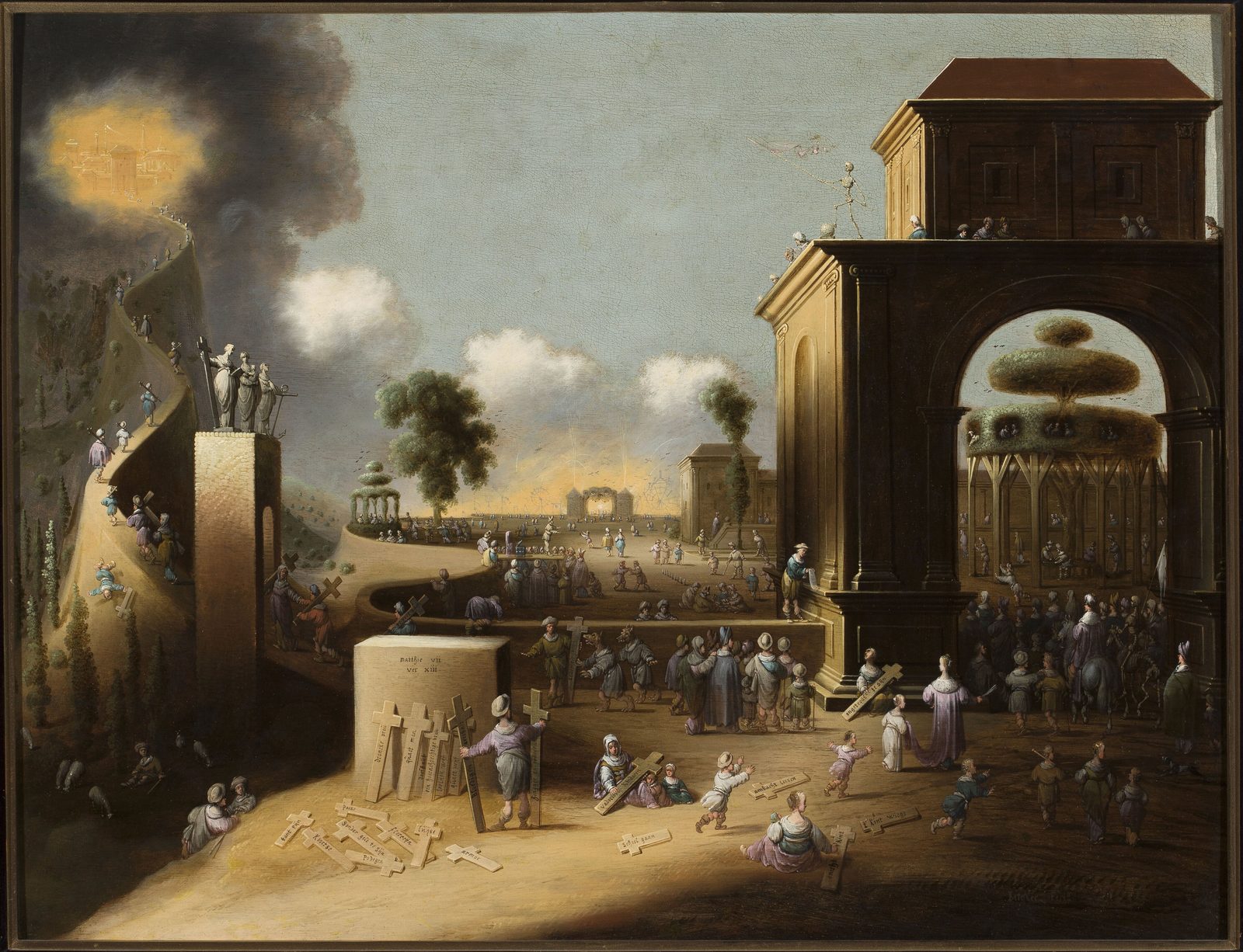
Narrow Road of Virtue and Wide Road of Sin. Jan Micker, not stated on the file page. National Museum in Warsaw. Public domain.