
Psalm 76
12 verses · Song of Zion
His tent is in Salem, His dwelling place in Zion.
Introduction
Asaph, the Broken Weapons, Book 3: The crisis of the throne, Poetry, Psalms Overview.
Headed for Asaph, this psalm is a song of Zion sung after an invading army broke apart outside Jerusalem. It calls the city by its oldest name and reports a battlefield strewn with broken weapons, with no account of Israel fighting at all. Many readers have tied it to the night the Assyrian army left Jerusalem in 701 BC, and the psalm itself names no enemy. Listen for the place named again and again before the battle is described, and for the call to the nations around to bring their gifts to the God who is feared.
Context
- Who
- A city that had watched an empire camp against its wall and then leave without taking it
- What
- A song of Zion celebrating an enemy army broken outside Jerusalem.
- Where
- Jerusalem, called by its old name Salem, with a broken army in the open ground outside.
- When
- Traditionally the night the Assyrian army left Jerusalem in 701 BC; the psalm itself names no enemy and no year.
- Why
- To declare God the one to be feared, who breaks the power of kings from His dwelling in Zion.
Historical context
The heading names Asaph, one of the men David set over the music of the sanctuary, and covers both the man and the guild of singers that kept his name. The occasion long attached to it is the night in 701 BC when Sennacherib of Assyria broke off from Jerusalem, and the Greek translation adds a heading naming the Assyrian. Sennacherib's own prism boasts that he shut Hezekiah up like a caged bird and never claims to have taken the city. Salem is the ancient short name of Jerusalem, used of Melchizedek in Genesis. A first hearer knew what a siege normally ended in, so a report of enemy dead with no account of the fighting was the point of the song.
Significance
A city that had heard a besieging army in the night sang about the God who breaks the arrows on this hill. That made Zion a fact of foreign policy as well as a place of worship, since the neighbouring kingdoms were told to bring their tribute to the one who cuts off the spirit of princes.
This chapter in Jewish lifeWhat this chapter is in Jewish life and reading.
How it is read
This is one of the few psalms where the corpus carries English from three commentators at once, so three medieval voices can be set side by side. On the tabernacle in Salem in verse 3, Ibn Ezra takes Salem for Jerusalem. He offers reasons for the name, that the city stands opposite the gate of heaven or is fit to be at peace (Ibn Ezra on Psalms 76:3:1). Radak gives the same verse a story the rabbis tell. Shem the son of Noah called the place Salem and Abraham called it Yireh, and God, unwilling to cancel either man's name, joined them, so the city is Jerusalem (Radak on Psalms 76:3:1). Rashi reads the whole psalm of one event. The broken arrows of verse 4 are the arrows of Sennacherib and his hosts, and he gives his reason, that no enemy is found falling in Jerusalem but Sennacherib (Rashi on Psalms 76:4:1 and 76:4:2). The judgment heard from heaven in verse 9 is then Isaiah's prophecy fulfilled, and the rising of God in verse 10 is the saving of Hezekiah and his company (Rashi on Psalms 76:9:1 and 76:10:1). On verse 11 Rashi reads the anger of men as ending in thanks to God. His example is Nebuchadnezzar at Daniel 3:28, blessing the God of Shadrach after the furnace (Rashi on Psalms 76:11:1). Rashi is quoted here from the Judaica Press complete Tanach with Rashi, translated by A. J. Rosenberg, under CC-BY. Ibn Ezra and Radak are quoted from Rabbi Mike Feuer's Jerusalem Anthology under CC-BY.
What the rabbis say
The corpus records forty places where the Midrash and the Talmud draw on this psalm, cited here by reference. Midrash Tehillim treats it at 76:1 and cites its verses again at 116:7. Verse 3, on Salem, draws the midrashim to the Melchizedek passage, at Bereshit Rabbah 43:6 and 56:10, Midrash Aggadah, Genesis 14:18:1 and Midrash Lekach Tov, Genesis 33:18:1. Verse 9 is carried into the Babylonian Talmud at Avodah Zarah 3a:7 and into the Jerusalem Talmud at Sanhedrin 10:2:20. Verse 12, on vowing and paying, stands in the Jerusalem Talmud at Nedarim 1:1:13 and in Vayikra Rabbah 37:1, beside Midrash Lekach Tov, Deuteronomy 23:23:1. Verse 6 is read at Shemot Rabbah 33:5, Bamidbar Rabbah 16:2 and Midrash Tanchuma, Sh'lach 2:1.
Sources: Rashi, Rashi on Psalms 76:4 to 76:13, the Judaica Press complete Tanach with Rashi, translated by A. J. Rosenberg, CC-BY, 1040 to 1105; Ibn Ezra, Ibn Ezra on Psalms 76:3:1, Rabbi Mike Feuer, Jerusalem Anthology, CC-BY, 1089 to 1167; Radak, Radak on Psalms 76:3:1, Rabbi Mike Feuer, Jerusalem Anthology, CC-BY, 1160 to 1236; Babylonian Talmud, Avodah Zarah 3a:7, cited by reference; Bereshit Rabbah, 43:6 and 56:10, cited by reference; The Sefaria corpus, scripts/data/sources/sefaria/psalms/76.json, fetched 2026-09-19, 2026.
Psalms 76:1-3
God is known in Judah: , and His tent is in Salem, the older name of Jerusalem where Melchizedek was king and priest at Genesis 14:18. In that same city He shattered the flaming arrows and broke the shield and sword. The weapons of war break at Zion.
Psalms 76:1
“In Judah is God known. If unknown in all the world beside, he has so revealed himself to his people by his deeds of grace, that he is no unknown God to them. His name is great in Israel. To be known, in the Lord's case, is to be honoured: those who know his name admire the greatness of it.”
Charles Spurgeon · The Treasury of David, Vol. 3 (1872)Particular Baptist
2 more voices on this verseWhat preachers and commentators have said about this verse, in their own words.
Psalms 76:1
“Before the cross gave light to the world, before the Lord was seen upon the earth, God was known in Judaea, and his name was great in Israel; but when the Savior came, his sound went out into all the earth, and his words unto the ends of the world.”
Jerome · written before 420 · Homily 9, on Psalm 75patristic
Psalms 76:1
“With what pleasure may we Christians apply all this to the advantages we enjoy by the Redeemer! It is through him that God is known; it is in him that God's name is great; to him it is owing that God has a tabernacle and a dwelling-place in his church.”
Matthew Henry · Commentary on the Whole Bible (1707-1721)puritan
His dwelling place in Zion: Albert Barnes noted that Salem means peace, and the Greek translators rendered the line his place is in peace. The name suits a city where God had just restored peace. Charles Spurgeon added that whoever attacks Zion attacks the Lord who lives there.
Psalms 76:2
“In Salem also is his tabernacle. In the peaceful city he dwells, and the peace is perpetuated, because there his sacred tent is pitched. The church of God is the place where the Lord abides and he is to her the Lord and giver of peace. And his dwelling place in Zion. Upon the chosen hill was the palace of Israel's Lord. It is the glory of the church that the Redeemer inhabits her by his Holy Spirit. Vain are the assaults of the enemy, for they attack not us alone, but the Lord himself.”
Charles Spurgeon · The Treasury of David, Vol. 3 (1872)Particular Baptist
1 more voice on this verse
Psalms 76:2
“And his place was made in peace: which in Hebrew is said "in Salem." So it seems, according to the letter, to speak of Jerusalem, that is, Salem, which formerly was called Salem, and afterward Jebus, and then was called Jerusalem. This is that Salem in which Melchizedek was king. We read, "Thou art a priest for ever after the order of Melchizedek." He did not say, after the order of Aaron, but of Melchizedek. What did he mean to say, Thou art a priest for ever after the order of Melchizedek?”
Jerome · written before 420 · Homily 9, on Psalm 75patristic
the flaming arrows: Clarke took the flaming arrows as fiery darts, wrapped in burning matter and shot into a town to set it alight. Spurgeon said God shattered them from His dwelling in Zion before they could be fired. Shield, sword and every weapon of war fail.
Psalms 76:3
“There brake he the arrows of the bow. Without leaving his tranquil abode, he sent forth his word and snapped the arrows of his enemies before they could shoot them. The idea is sublime, and marks the ease, completeness, and rapidity of the divine action. The shield, and the sword, and the battle. Every weapon, offensive and defensive, the Lord dashed in pieces; death bearing bolts and life preserving armour were alike of no avail when the Breaker sent forth his word of power.”
Charles Spurgeon · The Treasury of David, Vol. 3 (1872)Particular Baptist
1 more voice on this verse
Psalms 76:3
“There he broke the strength of bows. There. Where? In Jerusalem and Zion. Jerusalem is interpreted "peace," Zion "watchtower": let us see, then, what is peace, and what is the watchtower. Let us interpret it in two ways: either the human soul, in which is the peace of God and contemplation; or else the Church, or else the holy Scripture. For there is peace, and there is the dwelling and the watchtower of God. There he broke the strength of bows: those burning arrows which the devil used to shoot. The shield, and the sword, and the battle.”
Jerome · written before 420 · Homily 9, on Psalm 75patristic
Psalms 76:4-6
more majestic than mountains: God is resplendent with light, more majestic than the mountains where the game is thick. The valiant lie plundered, and their sleep is the last. At His rebuke, horse and rider lie stunned, and no man of might can lift a hand.
Psalms 76:4
“Thou dost give light wondrously from the everlasting mountains. We interpret the mountains in two ways: in the Old Testament, the prophets; in the New Testament, the apostles. Of these mountains he says: "I have lifted up mine eyes unto the mountains, whence shall come my help." Upon these mountains also is the city of God set, "A city set upon a mountain cannot be hid." We were all sitting in darkness and in the shadow of death; and the Lord gave light to us from the everlasting mountains, that is, from the prophets and apostles.”
Jerome · written before 420 · Homily 9, on Psalm 75patristic
2 more voices on this verse
Psalms 76:4
“Thou art more glorious and excellent than the mountains of prey. Far more is Jehovah to be extolled than all the invading powers which sought to oppress his people, though they were for power and greatness comparable to mountains. Assyria had pillaged the nations till it had become rich with mountains of spoil, this was talked of among men as glory, but the psalmist despised such renown, and declares that the Lord was far more illustrious. What are the honours of war but brags of murder? What the fame of conquerors but the reek of manslaughter?”
Charles Spurgeon · The Treasury of David, Vol. 3 (1872)Particular Baptist
Psalms 76:4
“Than - The greatest kings and empires of the earth, which in prophetic writings are often compared to mountains. And they are called mountains of prey, because they generally were established by tyranny, and maintained by preying upon their own subjects, or other kingdoms.”
John Wesley · Explanatory Notes upon the Old Testament (1765)evangelical
they sleep their last sleep: Spurgeon saw a reversal: the valiant who came to plunder lie plundered themselves. He read the scene as the army of Sennacherib, struck down in a single night. These men of might could not lift a hand.
Psalms 76:5
“The stouthearted are spoiled. They came to spoil, and lo! they are spoiled themselves. Their stout hearts are cold in death, the angel of the pestilence has dried up their life blood, their very heart is taken from them. They have slept their sleep. Their last sleep—the sleep of death. And none of the men of might have found their hands. Their arms are palsied, they cannot lift a finger, for the rigour of death has stiffened them. What a scene was that when Sennacherib's host was utterly destroyed in one night.”
Charles Spurgeon · The Treasury of David, Vol. 3 (1872)Particular Baptist
1 more voice on this verse
Psalms 76:5
“The stout hearted are spoiled,.... The Assyrian army, its officers and generals, that came up against Jerusalem, with great resolution and courage, and with daring impiety and blasphemy against the God of heaven, as Rabshakeh and others; these were spoiled, and their armour and riches became a prey to those they thought to have made a prey of.”
At Your rebuke, O God of Jacob: Spurgeon said a single rebuke did the work. He heard in the God of Jacob the God of a wrestling people and of the covenant. Barnes noted that the Hebrew word can mean riders as well as chariots, so horse and rider both lie stunned.
Psalms 76:6
“At thy rebuke, O God of Jacob,.... The God of Jacob personally, and of his posterity, the children of Israel, and of the church, often so called who rebukes his people in love, but his enemies with furious rebukes, with rebukes in flames of fire; with such he rebukes the Heathen, destroys the wicked, and puts out their name for ever: both the chariot and horse are cast into a dead sleep; that is, the riders in chariots and on horses; such there were doubtless in the Assyrian army, it being usual to have such in great armies.”
1 more voice on this verse
Psalms 76:6
“They slumbered who mounted horses. Let us speak according to the tropology. Indeed Pharaoh mounted horses, and slumbered, and perished. And the Egyptians had horses, but they perished. Hence too it was commanded in the Law that a Hebrew should not have a horse. Indeed Solomon too did not have a horse from Jerusalem or from Judaea, but bought them for himself from Egypt. Horses are always sold in Egypt. "These in chariots, and these in horses: but we will call upon the name of the Lord our God." Those, then, who mounted horses, slumbered and perished.”
Jerome · written before 420 · Homily 9, on Psalm 75patristic
Psalms 76:7-9
You alone are to be feared: Judgment came from heaven, and the earth feared and was still as God rose to judge and to save the lowly. Calvin and Henry read it beside the night the angel of the LORD struck the Assyrian camp at 2 Kings 19:35. No one stands before Him in His anger.
Psalms 76:7
“Thou, even thou, art to be feared. Not Sennacherib, nor Nisroch his god, but Jehovah alone, who with a silent rebuke had withered all the monarch's host. The fear of man is a snare, but the fear of God is a great virtue, and has great power for good over the human mind. God is to be feared profoundly, continually, and alone. Let all worship be to him only. And who may stand in thy sight when once thou art angry? Who indeed?”
Charles Spurgeon · The Treasury of David, Vol. 3 (1872)Particular Baptist
1 more voice on this verse
Psalms 76:7
“From then thy wrath. From what time is the wrath of God? When the people cried out to Aaron in the wilderness, saying: "Make us gods whom we may follow: for this Moses, who brought us out of the land of Egypt, we know not what has become of him." Thou didst bring them out of the land of Egypt, and immediately they denied thee.”
Jerome · written before 420 · Homily 9, on Psalm 75patristic
the earth feared and was still: Barnes pictured the whole earth listening, as if it heard God pronounce judgment from heaven and feared. Spurgeon added that lands which never saw the overthrow still heard the report. The earth was still.
Psalms 76:8
“From heaven thou didst make judgment to be heard. Thou didst speak from heaven, all the people heard and trembled: and yet they did not believe in thee. The earth feared and was still. But Israel neither feared nor was still.”
Jerome · written before 420 · Homily 9, on Psalm 75patristic
2 more voices on this verse
Psalms 76:8
“Thou didst cause judgment to be heard from heaven. So complete an overthrow was evidently a judgment from heaven; those who saw it not, yet heard the report of it, and said, "This is the finger of God." Man will not hear God's voice if he can help it, but God takes care to cause it to be heard. The echoes of that judgment executed on the haughty Assyrian are heard still, and will ring on down all the ages, to the praise of divine justice. The earth feared and was still.”
Charles Spurgeon · The Treasury of David, Vol. 3 (1872)Particular Baptist
Psalms 76:8
“Thou - Didst execute judgment upon thine enemies, by an angel from heaven: which is said to be heard, either because it was accompanied with thunders and earthquakes, or because the fame of it was quickly spread abroad.”
John Wesley · Explanatory Notes upon the Old Testament (1765)evangelical
to save all the lowly of the earth: The earth fell still in verse 8 because God rose to take the judgment seat. Matthew Henry likened it to the hush when a court sits. Albert Barnes took the lowly as the afflicted and the oppressed, whom this judgment came to save.
Psalms 76:9
“When God arose to judgment. Men were hushed when he ascended the judgment seat and actively carried out the decrees of justice. When God is still the people are in tumult; when he arises they are still as a stone. To save all the meek of the earth. The Ruler of men has a special eye towards the poor and despised; he makes it his first point to right all their wrongs. "Blessed are the meek, for they shall inherit the earth." They have little enough of it now, but their avenger is strong and he will surely save them.”
Charles Spurgeon · The Treasury of David, Vol. 3 (1872)Particular Baptist
Psalms 76:10-12
Even the wrath of man: will end in praise to God, and the survivors of that wrath He puts on like a garment. The call that follows is to make vows to the LORD and keep them, and bring tribute from the lands around. He breaks the spirits of princes.
Psalms 76:10
“Surely the wrath of man shall praise thee. It shall not only be overcome but rendered subservient to thy glory. Man with his breath of threatening is but blowing the trumpet of the Lord's eternal fame. Furious winds often drive vessels the more swiftly into port. The devil blows the fire and melts the iron, and then the Lord fashions it for his own purposes. Let men and devils rage as they may, they cannot do otherwise than subserve the divine purposes. The remainder of wrath shalt thou restrain. Malice is tethered and cannot break its bounds.”
Charles Spurgeon · The Treasury of David, Vol. 3 (1872)Particular Baptist
2 more voices on this verse
Psalms 76:10
“The hardships which God's people suffer by the wrath of their enemies are made to redound to the glory of God and his grace; and the more the heathen rage and plot against the Lord and his anointed the more will God be praised for setting his King upon his holy hill of Zion in spite of them, Ps. ii.”
Matthew Henry · Commentary on the Whole Bible (1707-1721)puritan
Psalms 76:10
“Man's wrath praises God by its futility before His power. restrain--or, "gird"; that is, Thyself, as with a sword, with which to destroy, or as an ornament to Thy praise.”
Jamieson, Fausset & Brown · Commentary Critical and Explanatory on the Whole Bible (1871)reformed
Make and fulfill your vows: Spurgeon noted that to make a vow is left to choice, but to fulfill it is a duty. Clarke read the One to be feared as the Terrible One. The neighboring lands had watched the Assyrians fall and had reason to bring tribute.
Psalms 76:11
“Vow, and pay unto the Lord your God. Well may we do so in memory of such mercies and judgments. To vow or not is a matter of choice, but to discharge our vows is our bounden duty. He who would defraud God, his own God, is a wretch indeed. He keeps his promises, let not his people fail in theirs. He is their faithful God and deserves to have a faithful people. Let all that be round about him bring presents unto him that ought to be feared.”
Charles Spurgeon · The Treasury of David, Vol. 3 (1872)Particular Baptist
1 more voice on this verse
Psalms 76:11
“Not that God needs any present we can bring, or can be benefited by it; but thus we must give him honour and own that we have our all from him. Our prayers and praises, and especially our hearts, are the presents we should bring to the Lord our God. The reasons to enforce this duty: Render to all their due, fear to whom fear is due; and is it not due to God?”
Matthew Henry · Commentary on the Whole Bible (1707-1721)puritan
He breaks the spirits of princes: Wesley said the verb for breaks pictures a vintage, with grapes cut from the vine. Spurgeon added that the kings of the earth, feared by others, are themselves in fear of God. The spirits of princes are brought low.
Psalms 76:12
“He shall cut off the spirit of princes. Their courage, skill, and life are in his hands, and he can remove them as a gardener cuts off a slip from a plant. None are great in his hand. Caesars and Napoleons fall under his power as the boughs of the tree beneath the woodman's axe. He is terrible to the kings of the earth. While they are terrible to others, he is terrible to them.”
Charles Spurgeon · The Treasury of David, Vol. 3 (1872)Particular Baptist
2 more voices on this verse
Psalms 76:12
“To the terrible one. To whom? To God. And to him who takes away the spirit of princes. When we see certain powerful men, for example, emperors, prefects, and men exceedingly powerful in this world, let us too say to God: Who takes away the spirit of princes. By "spirit" we can speak both of the soul, and we can speak also of pride. Let us understand it also in another way. Who takes away the spirit of princes. Let us here understand "princes" as the saints.”
Jerome · written before 420 · Homily 9, on Psalm 75patristic
Psalms 76:12
“Cut off - As men do their grapes in time of vintage; so the Hebrew verb implies.”
John Wesley · Explanatory Notes upon the Old Testament (1765)evangelical
How this psalm is built
The form: A song of Zion that reports a victory God won without an army of His own, as Spurgeon classes it.
The patterns in this chapter
| Device | What it does | Where to see it |
|---|---|---|
| The place named four times before the fighting is named once | Verses 1 and 2 set Judah beside Israel and Salem beside Zion, so that the same place is said twice in two pairs. The psalm establishes where God is known before it says what He did there, and verse 3 opens with the word There. | Psalm 76:1, Psalm 76:2, Psalm 76:3 |
| The two Selahs that divide the psalm in three | Selah stands at verse 3 and again at verse 9. The first closes the account of the broken weapons, the second closes the account of the judgment given from heaven, and the last three verses stand outside both as the charge to the hearer. | Psalm 76:3, Psalm 76:9 |
| The weapons counted one by one | Verse 3 lists the flaming arrows, the shield, the sword and the weapons of war rather than saying that the army was destroyed. Augustine reads the naming of each piece as the point, since a weapon broken in the place where God dwells is a weapon that never reached the wall.Augustine of Hippo, Exposition on Psalm 76, 430. | Psalm 76:3 |
| The turn to the second person at the end | Verses 1 to 10 speak to God or about Him. Verse 11 turns to the hearer and gives two commands, to make and fulfill vows and to bring tribute, and verse 12 returns to God as the reason the commands are given. | Psalm 76:11, Psalm 76:12 |
The psalm belongs with the group of songs that take Zion as their subject and God's defence of it as their event. Psalm 46, Psalm 48 and Psalm 87 stand in the same company, and Psalm 75, which immediately precedes this one, ends with the horns of the wicked cut off and the horns of the righteous lifted up. Psalm 76 opens as though it were the report of that judgment carried out.
8 more paragraphs on the patterns
Inside the psalm the pattern is a steady narrowing of who is able to act. In verse 3 the weapons break. In verse 5 the valiant sleep and no man of might can lift a hand. In verse 6 the horse and rider lie stunned together. In verse 12 the spirits of princes are broken and the kings of the earth are afraid. Every rank that might have resisted is named and then removed, and the only one still standing at the end of the list is God.
The question at verse 7 is the hinge. It asks who can stand before God when He is angry, and every verse before it has already answered by showing someone who could not.
The New Testament's use
No verse of Psalm 76 is quoted in the New Testament. Its language of the God who breaks the spirits of princes runs alongside the Magnificat's putting down of the mighty from their thrones, and the church has read the two together, but a quotation is a different thing from an echo and this psalm has none.
The debated point
Where the psalm belongs in Israel's history is contested and the text settles nothing. Adam Clarke reads verses 5 and 6 of Sennacherib's army destroyed outside Jerusalem and offers the occasion as the language's best fit. Augustine reads Salem and Zion as the church and the broken weapons as what happens to every power raised against it, and treats the psalm as a rule rather than as a report (Exposition on Psalm 76, 430). Both readings are held by teachers the site cites, and the psalm names no king and no year, so neither is more than a reading.
Where to go deeper
The city and its name are set out at Zion and Jerusalem. The fear that verse 7 asks about is set out at the fear of the LORD.
Keep studying
Sources for this chapter
The summary
Jamieson, Fausset & Brown, Commentary Critical and Explanatory; John Calvin, Commentaries; John Wesley, Notes on the Old Testament and Matthew Henry, Complete Commentary.
The form and classifications
Adam Clarke, Commentary on the Bible, 1832, on Psalm 76; Augustine of Hippo, Exposition on Psalm 76, 430 and Charles Spurgeon, The Treasury of David, Vol. 3, 1872, on Psalm 76.
The exposition
Adam Clarke, Commentary on the Bible; Albert Barnes; Charles Spurgeon; Franz Delitzsch, Biblical Commentary on the Psalms; John Calvin, Commentary on the Book of Psalms; John Gill, Exposition of the Old Testament; John Wesley, Explanatory Notes upon the Old Testament and Matthew Henry, Commentary on the Whole Bible.
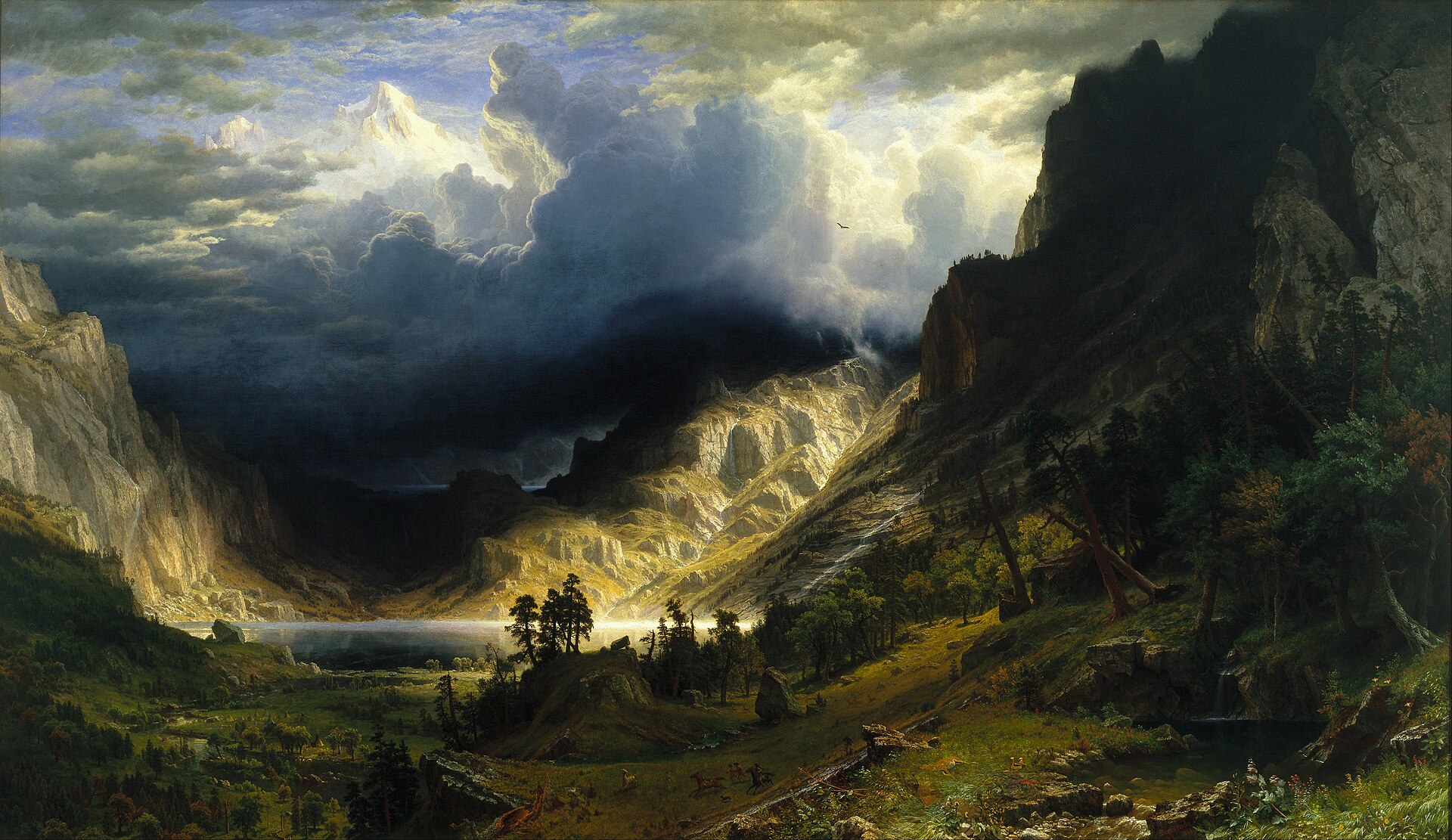
The painting
A Storm in the Rocky Mountains, Mt. Rosalie. Albert Bierstadt, 1866. Wikimedia Commons. Public domain.