
Psalm 74
23 verses · Communal lament
Yet God is my King from ancient times, working salvation on the earth.
Introduction
Asaph, the Burned Sanctuary, Book 3: The crisis of the throne, Poetry, Psalms Overview.
This psalm is headed for Asaph and speaks for a people standing in front of their burned sanctuary. An enemy army has wrecked the house of God on Mount Zion, and no prophet is left to say how long the silence will last. The prayer does two things. It lays the damage before God in plain detail, and then it reminds Him of what He did at the creation and at the sea. Listen for the two questions that carry the prayer, why and how long, and for the argument that the insult falls on God's own name.
Context
- Who
- A congregation with no sanctuary, no sign and no prophet to tell them how long it would last
- What
- A communal lament made in front of a sanctuary burned by an enemy army.
- Where
- The ruins of the sanctuary on Mount Zion in Jerusalem.
- When
- After an enemy burned the sanctuary, most often set after the Babylonian destruction of 586 BC; the psalm names no king and no year.
- Why
- To plead with God to act again as Creator and Redeemer for the sake of His own name.
Historical context
The heading reads a maskil of Asaph, and the psalm stands second among the psalms of Asaph at the head of Book III. The place is named, Mount Zion, where God is said to dwell, and the date is read off the description, since the psalm names no king and carries no year. Most readers set it after the Babylonian destruction of 586 BC, and some also read it of later persecutions. A first hearer knew what the carved work had cost, because the house was built by men honoured for felling and preparing the cedars, and the same kind of axe now broke what they had made. With the house went the sacrifices, the feasts and every prophet who could say how long the silence would run.
Significance
The psalm gave a people with no sanctuary a way to pray in public and to say what had been done to them without softening it. It then argued, rehearsing what God had already done at the sea and in the sky, and asked Him to plead His own cause, since the taunting was aimed at Him.
This chapter in Jewish lifeWhat this chapter is in Jewish life and reading.
How it is read
This is the psalm of a burnt sanctuary, and Rashi reads it as a prophecy of every burning. On verse 8 he names three in one line: the Philistines destroyed Shiloh, Nebuchadnezzar the First Temple, and Titus the Second (Rashi on Psalms 74:8:1). On verse 9, where the signs are gone, he says that Asaph prophesied concerning the days of the last exile. The psalm is then read as the voice of a people still waiting (Rashi on Psalms 74:9:1). The axes in the thicket of verse 5 carry a saying of the rabbis that Rashi passes on. The enemy knew his blows reached as high as the sky, because he saw the trees entangle and swallow the hatchets. One gate of Jerusalem swallowed them all up, at Sanhedrin 96b (Rashi on Psalms 74:5:1). The meeting place of verse 4 is the Temple, named from the appointed meeting of Exodus 25:22 (Rashi on Psalms 74:4:1). The sea monsters of verse 13 are the Egyptians, and the heads of Leviathan in verse 14 are Pharaoh, read with Ezekiel 29:3 and Isaiah 27:1 (Rashi on Psalms 74:13:1 and 74:14:1). Ibn Ezra stands in the corpus on this psalm four times, cited by reference alone. Rashi is quoted here from the Judaica Press complete Tanach with Rashi, translated by A. J. Rosenberg, under CC-BY.
What the rabbis say
The corpus records forty places where the Midrash and the Talmud draw on this psalm, cited here by reference. Midrash Tehillim treats it at 74:1, 74:2 and 74:4, and cites its verses again at 18:1, 64:1 and 121:1. Verse 11, on the hand withdrawn from the bosom, is drawn into the Babylonian Talmud at Menachot 36b:11 and into Sifrei Devarim 35:8. Verse 13, on the waters divided, stands in Avot DeRabbi Natan at 33:2 and in its Recension B at 38:2. Verse 2, on the congregation acquired long ago, is read at Bereshit Rabbah 1:4 and Midrash Tanchuma Buber, Nasso 19:1. Verse 5 is carried into Midrash Tanchuma, Pekudei 4:1 and Midrash Tanchuma Buber, Pekudei 3:1.
Sources: Rashi, Rashi on Psalms 74:1 to 74:22, the Judaica Press complete Tanach with Rashi, translated by A. J. Rosenberg, CC-BY, 1040 to 1105; Babylonian Talmud, Sanhedrin 96b and Menachot 36b:11, cited by reference; Midrash Tehillim, 74:1, 74:2, 74:4 and 121:1, cited by reference; Avot DeRabbi Natan, 33:2 and Recension B 38:2, cited by reference; The Sefaria corpus, scripts/data/sources/sefaria/psalms/74.json, fetched 2026-09-19, 2026.
Psalms 74:1-3
the sheep of Your pasture?: The psalm opens by asking why God has rejected his own and why his anger smolders against the sheep of his pasture. The plea rests on what God did, purchasing this congregation and redeeming it as the tribe of his inheritance, with Mount Zion as his dwelling.
Psalms 74:1
“O God, why hast thou cast us off for ever? To cast us off at all were hard, but when thou dost for so long a time desert they people it is an evil beyond all endurance—the very chief of woes and abyss of misery. It is our wisdom when under chastisement to enquire, "Show me wherefore thou contendest with me?" and if the affliction be a protracted one, we should more eagerly enquire the purport of it.”
Charles Spurgeon · The Treasury of David, Vol. 3 (1872)Particular Baptist
1 more voice on this verseWhat preachers and commentators have said about this verse, in their own words.
Psalms 74:1
“This psalm is entitled Maschil--a psalm to give instruction, for it was penned in a day of affliction, which is intended for instruction; and this instruction in general it gives us, That when we are, upon any account, in distress, it is our wisdom and duty to apply to God by faithful and fervent prayer, and we shall not find it in vain to do so.”
Matthew Henry · Commentary on the Whole Bible (1707-1721)puritan
the tribe of Your inheritance—: Wesley took the tribe of Your inheritance as Judah, chosen for the birth of the Messiah and hardest hit by this ruin. Henry heard the plea beneath it. Would God reject a congregation He had purchased so dearly?
Psalms 74:2
“Remember thy congregation, which thou hast purchased of old. What a mighty plea is redemption. O God, canst thou see the blood mark on thine own sheep, and yet allow grievous wolves to devour them? The church is no new purchase of the Lord; from before the world's foundation the chosen were regarded as redeemed by the Lamb slain; shall ancient love die out, and the eternal purpose become frustrate? The Lord would have his people remember the paschal Lamb, the bloodstained lintel, and the overthrow of Egypt; and will he forget all this himself?”
Charles Spurgeon · The Treasury of David, Vol. 3 (1872)Particular Baptist
1 more voice on this verse
Psalms 74:2
“Thy congregation - Thy people. Thine inheritance - The tribe of Judah, which thou hast in a special manner chosen for thine inheritance, and for the birth of the Messiah. Nor is it strange that he mentions this tribe particularly, because the calamity here remembered, did principally befall this tribe, and Benjamin, which was united with it.”
John Wesley · Explanatory Notes upon the Old Testament (1765)evangelical
the everlasting ruins: Barnes gave the everlasting ruins as ruins so long standing they seemed to last forever. He took the first line as a call for God to turn His steps and see the sanctuary. Gill asked whether the enemy was Nebuchadnezzar or Titus.
Psalms 74:3
“Lift up thy feet unto the perpetual desolations,.... That is, arise, hasten, move swiftly, and in the greatness of strength, and come and see the desolations made by the enemy, which look as if they would remain for ever; meaning either the desolations made in the city and temple of Jerusalem, either by Nebuchadnezzar, or by Titus; or the havocs and devastations made in the church of God by the tyranny and persecutions of antichrist; which have continued so long, that an end of them has been almost despaired of.”
2 more voices on this verse
Psalms 74:3
“Lift up thy feet unto the perpetual desolations. The ruin made had already long been an eyesore to the suppliant, and there seemed no hope of restoration. Havoc lorded it not only for a day or a year, but with perpetual power. This is another argument with God. Would Jehovah sit still and see his own land made a wilderness, his own palace a desolation? Until he should arise, and draw near, the desolation would remain; only his presence could cure the evil, therefore is he entreated to hasten with uplifted feet for the deliverance of his people.”
Charles Spurgeon · The Treasury of David, Vol. 3 (1872)Particular Baptist
Psalms 74:3
“The concerns of religion should lie nearer our hearts and affect us more than any worldly concern whatsoever. The desolation of God's house should grieve us more than the desolation of our own houses; for the matter is not great what becomes of us and our families in this world provided God's name may be sanctified, his kingdom may come, and his will be done.”
Matthew Henry · Commentary on the Whole Bible (1707-1721)puritan
Psalms 74:4-6
unfurled their banners as signs: The foes roar inside the meeting place and raise their own banners there as signs. The wreckage is put in the words of woodcutting: axes swung in a thicket, and the carvings smashed with hatchets and picks. The temple is cut down like timber.
Psalms 74:4
“Thine enemies roar in the midst of thy congregations. Where thy people sang like angels, these barbarians roar like beasts. When thy saints come together for worship, these cruel men attack them with all the fury of lions. They have no respect for the most solemn gatherings, but intrude themselves and their blasphemies into our most hallowed meetings. How often in times of persecution or prevalent heresy has the church learned the meaning of such language. May the Lord spare us such misery.”
Charles Spurgeon · The Treasury of David, Vol. 3 (1872)Particular Baptist
like men wielding axes in a thicket of trees: Spurgeon heard an old memory here: men were once praised for wielding axes on the cedars to build the sanctuary. Now the axes are raised with the same pride to destroy it. Wesley called that felling of trees an honor.
Psalms 74:5
“A man was famous according as he had lifted up axes upon the thick trees. Once men were renowned for felling the cedars and preparing them for building the temple, but now the axe finds other work, and men are as proud of destroying as their fathers were of erecting. Thus in the olden times our sires dealt sturdy blows against the forests of error, and laboured hard to lay the axe at the root of the trees; but, alas!”
Charles Spurgeon · The Treasury of David, Vol. 3 (1872)Particular Baptist
1 more voice on this verse
Psalms 74:5
“Famous - The temple was so noble a structure, that it was a great honour to any man to be employed in the meanest part of the work, though it were but in cutting down the trees of Lebanon.”
John Wesley · Explanatory Notes upon the Old Testament (1765)evangelical
hatchets and picks: Barnes noted that the word for carvings is the one 1 Kings 6:29 uses for the carvings of Solomon's sanctuary. Wesley held that the words for hatchets and picks came from the enemy's own speech. The carvings fall to foreign hands.
Psalms 74:6
“But now they break down the carved work thereof at once with axes and hammers. The invaders were as industrious to destroy as the ancient builders had been to construct. Such fair carving it was barbarous to hew in pieces, but the Vandals had no mercy and broke down all, with any weapon which came to hand. In these days men are using axes and sledgehammers against the gospel and the church. Glorious truths, far more exquisite than the goodliest carving, are cavilled over and smashed by the blows of modern criticism.”
Charles Spurgeon · The Treasury of David, Vol. 3 (1872)Particular Baptist
1 more voice on this verse
Psalms 74:6
“Axes and hammers - These words are not Hebrew, but Chaldee or Syriack, to point out the time when this was done, even when the Chaldeans brought in their language, together with their arms, among the Israelites.”
John Wesley · Explanatory Notes upon the Old Testament (1765)evangelical
Psalms 74:7-8
burned Your sanctuary to the ground: The sanctuary is burned and the dwelling place of God's Name is defiled. The enemy says in his heart that he will crush them completely, and the burning reaches every place where God met the people. The Hebrew calls those the appointed places of God.
Psalms 74:7
“They have cast fire into thy sanctuary. Axes and hammers were not sufficient for the purpose of the destroyers, they must needs try fire. Malice knows no bounds. Those who hate God are never sparing of the most cruel weapons. To this day the enmity of the human heart is quite as great as ever; and, if providence did not restrain, the saints would still be as fuel for the flames. They have defiled by casting down the dwelling place of thy name to the ground. They made a heap of the temple, and left not one stone upon another.”
Charles Spurgeon · The Treasury of David, Vol. 3 (1872)Particular Baptist
1 more voice on this verse
Psalms 74:7
“He complains of the desolations of the synagogues, or schools of the prophets, which, before the captivity, were in use, though much more afterwards. There God's word was read and expounded, and his name praised and called upon, without altars or sacrifices.”
Matthew Henry · Commentary on the Whole Bible (1707-1721)puritan
Wesley took the boast as a plan to crush the people at once, which the enemy later changed by carrying some away. So a remnant survived. Clarke noted that every place where God met the people may mean any place of worship in the land.
Psalms 74:8
“They said in their hearts, Let us destroy them together. It was no idle wish, their cruelty was sincere, deep seated, a matter of their inmost heart. Extirpation was the desire of Haman, and the aim of many another tyrant; not a remnant of the people of God would have been left if oppressors could have had their way. Pharaoh's policy to stamp out the nation has been a precedent for others, yet the Jews survive, and will: the bush though burning has not been consumed.”
Charles Spurgeon · The Treasury of David, Vol. 3 (1872)Particular Baptist
2 more voices on this verse
Psalms 74:8
“They said in their hearts, let us destroy them together,.... The Targum is, "their children, are together;'' or "their kindred", as the Septuagint Vulgate Latin, Ethiopic, and Arabic versions, taking the word to be of נין, which signifies a "son"; and the sense to be, that seeing they were all together, as the Jews were at the taking of Jerusalem, they might be cut off at once.”
Psalms 74:8
“Destroy them - All at once. So they intended, although afterwards they changed their council, and carried some away captive. Burnt up - All the public places wherein the Jews used to meet together to worship God every sabbath-day.”
John Wesley · Explanatory Notes upon the Old Testament (1765)evangelical
There is no longer any prophet: Three things are gone at once: the signs, the prophet, and anyone who can say how long this lasts. A people who had heard God speak now hear nothing, and the psalm counts that as part of the ruin. The psalm moves straight to How long at verse 10.
Psalms 74:9
“We see not our signs. Alas, poor Israel! No Urim and Thummim blazed on the High Priest's bosom, and no Shechaniah shone from between the cherubim. The smoke of sacrifice and cloud of incense no more arose from the holy hill; solemn feasts were suspended, and even circumcision, the covenant sign, was forbidden by the tyrant. We, too, as believers, know what it is to lose our evidences and grope in darkness; and too often do our churches also miss the tokens of the Redeemer's presence, and their lamps remain untrimmed. Sad complaint of a people under a cloud!”
Charles Spurgeon · The Treasury of David, Vol. 3 (1872)Particular Baptist
1 more voice on this verse
Psalms 74:9
“The temple and ark, and sacrifices, and solemn feasts, were signs between God and his people. Prophet - Who can foretell things to come. Probably Ezekiel and Jeremiah were dead when this psalm was composed; and David was involved in civil affairs, and did not teach the people as a prophet.”
John Wesley · Explanatory Notes upon the Old Testament (1765)evangelical
Psalms 74:10-11
will the enemy taunt You?: The taunt is aimed at God, and the question is how long he will let it stand. Then the harder question: why the right hand is drawn back. The Hebrew says where it goes, into the bosom of his garment, and the psalm asks for it to come back out.
Psalms 74:10
“O God, how long shall the adversary reproach? Though we know not how long yet thou dost. The times and seasons are with thee. When God is reproached, there is hope for us, for it may be he will hearken and avenge his dishonoured name. Wickedness has great license allowed it, and justice lingers on the road; God has his reasons for delay, and his seasons for action, and in the end it shall be seen that he is not slack concerning his promise as some men count slackness. Shall the enemy blaspheme thy name for ever?”
Charles Spurgeon · The Treasury of David, Vol. 3 (1872)Particular Baptist
1 more voice on this verse
Psalms 74:10
“In the desolations of the sanctuary our chief concern should be for the glory of God, that it may not be injured by the blasphemies of those who persecute his people for his sake, because they are his; and therefore our enquiry should be, not "How long shall we be troubled?" but "How long shall God be blasphemed?" 2.”
Matthew Henry · Commentary on the Whole Bible (1707-1721)puritan
Stretch it out to destroy them!: Why withdraw Your strong right hand, the psalmist asks God. Clarke drew the picture from eastern dress, where a hand kept in the robe must stretch out to destroy. Spurgeon counted such a bold prayer right, and a cold prayer wrong.
Psalms 74:11
“Why withdrawest thou thy hand, even thy right hand? Wherefore this inaction, this indifference for thine own honour and thy people's safety? How bold is the suppliant! Does he err? Nay, verily, we who are so chill, and distant, and listless in prayer are the erring ones. The kingdom of heaven suffereth violence, and he who learns the art shall surely prevail with God by its means.”
Charles Spurgeon · The Treasury of David, Vol. 3 (1872)Particular Baptist
Psalms 74:12-15
God is my King from ancient times: The psalm turns to what God has already done: the sea divided, the heads of the dragons smashed, Leviathan crushed. Isaiah 51:9 and 10 use the same pictures of Rahab and the dragon for Egypt at the Red Sea. The fountain and the flood belong there too.
Psalms 74:12
“For God is my King of old. How consoling is this avowal! Israel in holy loyalty acknowledges her King, and claims to have been his possession from of old, and thence she derives a plea for defence and deliverance. If the Lord be indeed the sole monarch of our bosoms, he will in his love put forth his strength on our behalf; if from eternity he has claimed us as his own, he will preserve us from the insulting foe. Working salvation in the midst of the earth.”
Charles Spurgeon · The Treasury of David, Vol. 3 (1872)Particular Baptist
1 more voice on this verse
Psalms 74:12
“This is Pharaoh and all his multitude, Ezek. xxxi. It was the Lord's doing; none besides could do it, and he did it with a strong hand and an outstretched arm. This was typical of Christ's victory over Satan and his kingdom, pursuant to the first promise, that the seed of the woman should break the serpent's head.”
Matthew Henry · Commentary on the Whole Bible (1707-1721)puritan
You divided the sea by Your strength: Albert Barnes gave divided as literally broke, as if God shattered the strength of the sea itself. John Gill counted this and the verses after it as proofs of the salvation named in verse 12. The Red Sea comes first.
Psalms 74:13
“Thou didst divide the sea by thy strength,.... This and the following instances from hence to Psa 74:18 are proofs of God's working salvation in the midst of the earth; some of them seem peculiar to the people of Israel, and others are benefits common to mankind in general; which the church makes use of to encourage her faith and hope, in expectation of salvation, and deliverance out of her present distressed and melancholy circumstances.”
ConnectionsRevelation 21:1
You fed him to the creatures of the desert: The Hebrew calls the desert creatures a people, and John Wesley said they earn the name as the only people living there. Adam Clarke read Leviathan as Egypt's government, its heads as Pharaoh and his captains. The desert beasts fed on the bodies the tide cast ashore.
Psalms 74:14
“Thou breakest the heads of leviathan in pieces,.... A large fish, generally thought to be the whale, by some the crocodile, described in Job 41:1 to which the king of Egypt or Babylon is compared, Isa 27:1 and so the Romish antichrist in one of his characters is represented as a sea beast with many heads, which will all be broken in pieces in due time, Rev 13:1, as here is one "leviathan" with heads in the plural number.”
1 more voice on this verse
Psalms 74:14
“The people - To the ravenous birds and beasts of the desert. These creatures are significantly called the people of the wilderness, because they are the only people that inhabit it.”
John Wesley · Explanatory Notes upon the Old Testament (1765)evangelical
You broke open the fountain and the flood: Water breaks open in the desert and the rivers dry up, both for the same people. Jamieson, Fausset and Brown placed the fountain at the rocks of Horeb and Kadesh and the dried rivers at the Jordan. Henry added that the rock was Christ.
Psalms 74:15
“The flood - Thou didst by cleaving the rock, make a fountain and a stream to flow from it, for the refreshment of thy people in those dry deserts. Driedst - Jordan and the Red Sea; for the sea itself; yea, a greater sea than that, is called a river, Jonah ii, 3, where the Hebrew word is the same which is here used.”
John Wesley · Explanatory Notes upon the Old Testament (1765)evangelical
Psalms 74:16-17
You established the moon and the sun: From what God did in history the psalm moves to what he made: day and night, the moon and the sun, summer and winter. The Hebrew word at moon is ma'or, a light-giver, and the Berean reads it of the moon. The appeal rests on the maker.
Psalms 74:16
“The day is thine, the night also is thine - Thou art the Author of light, and of the sun, which is the means of dispensing it.”
Adam Clarke · Commentary on the Bible (1810-1826)evangelical
1 more voice on this verse
Psalms 74:16
“The day is thine, the night also is thine - Thou hast universal dominion. All things are under thy control. Thou hast power, therefore, to grant what we desire of thee. Thou hast prepared the light and the sun - He who has made the sun - that greatest and noblest object of creation to the view of man - must have almighty power, and must be able to give what we need.”
You made the summer and winter: Henry heard in the summer and winter God's covenant with Noah. A God who keeps His covenant with the day and the night, he argued, will keep His promise to Abraham's seed. The order of the earth becomes a plea.
Psalms 74:17
“Thou hast set all the borders of the earth - Thou hast established all the boundaries of the world; that is, the boundaries of the earth itself; or the natural bonndaries of nations and people, made by seas, mountains, rivers, and deserts.”
2 more voices on this verse
Psalms 74:17
"Thou hast made all the ends of the earth" (ver. 17). ...Behold in what manner He hath made the ends of the earth, that hath wrought Salvation in the midst of the earth. "Thou hast made all the ends of the earth. Summer and spring Thou hast made them." Men fervent in the Spirit are the summer. Thou, I say, hast made men fervent in the Spirit: Thou hast made also the novices in the Faith, they are the "spring." "Summer and Spring Thou hast made them."
Augustine of Hippo · written before 430 · Exposition on Psalm 74patristic
Psalms 74:17
“Thou hast set all the borders of the earth - Thou alone art the Author of all its grand geographical divisions. Thou hast made summer and winter - Thou hast appointed that peculiarity in the poise and rotation of the earth, by which the seasons are produced.”
Adam Clarke · Commentary on the Bible (1810-1826)evangelical
Psalms 74:18-21
how the enemy has mocked You: The requests gather: remember the mocking, and do not hand the soul of your dove over to beasts. The ground of the asking is the covenant, with haunts of violence filling the dark places of the land. The last request is that the poor praise his name.
Psalms 74:18
“This was that which they roared in the sanctuary; they triumphed as if they had now got the mastery of the God is Israel, of whom they had heard such great things.”
Matthew Henry · Commentary on the Whole Bible (1707-1721)puritan
the soul of Your dove: Albert Barnes took the dove as a name of endearment, as in the Song of Songs, for a people gentle, timid and dear to God. Jamieson, Fausset and Brown noted that the Hebrew for beasts is singular and can name a company of men. Gentleness is set against savagery.
Psalms 74:19
“How are those increased that trouble them! There is no standing before an enraged multitude, especially like these, armed with power; and, as they are numerous, so they are barbarous: The dark places of the earth are full of the habitations of cruelty.”
Matthew Henry · Commentary on the Whole Bible (1707-1721)puritan
Consider Your covenant: Adam Clarke tied the covenant to Genesis 15, where God and Abram passed between the divided pieces of the sacrifice. John Wesley named what that covenant gave: the land of Canaan, to Abraham and his seed forever. Now violence fills that land.
Psalms 74:20
“The covenant - Made with Abraham, whereby thou didst give the land of Canaan to him, and to his seed forever. Dark places - This dark and dismal land in which we live.”
John Wesley · Explanatory Notes upon the Old Testament (1765)evangelical
Do not let the oppressed retreat in shame: Albert Barnes took retreat as coming back from the throne of mercy, and shame as the disgrace of a disappointed hope. The oppressed are trodden down, crushed. Matthew Henry turned the second line into a plea: deliver them, and they will praise your name.
Psalms 74:21
“O let not the oppressed return ashamed,.... From the throne of grace, not having an answer of their prayer, but still continuing under the oppressions of their enemies: let the poor and needy praise thy name; let them have occasion for it, by the destruction of their enemies, and their deliverance from them, as they will have ere long; see Rev 19:1.”
1 more voice on this verse
Psalms 74:21
“O let not the oppressed return ashamed. Though broken and crushed they come to thee with confidence; suffer them not to be disappointed, for then they will be ashamed of their hope. Let the poor and needy praise thy name. By thy speedy answer to their cries make their hearts glad, and they will render to thee their gladdest songs.”
Charles Spurgeon · The Treasury of David, Vol. 3 (1872)Particular Baptist
Psalms 74:22-23
defend Your cause!: The closing appeal hands the case to God as his own, with the fool mocking him all day long. The last picture is noise, the clamor of the adversaries and the uproar of the enemies going up without stopping. The psalm ends there, with the noise still rising.
Psalms 74:22
“Arise, O God, plead thine own cause. Answer thou the taunts of the profane by arguments which shall annihilate both the blasphemy and the blasphemer. God's judgments are awful replies to the defiance of his foes. When he makes empires crumble, and smites persecutors to the heart, his cause is pleaded by himself as none other could have advocated it. O that the Lord himself would come into the battle field.”
Charles Spurgeon · The Treasury of David, Vol. 3 (1872)Particular Baptist
the uproar of Your enemies that ascends continually: Charles Spurgeon heard a bold turn: if the cries of God's children are too faint, let the loud voices of his foes reach him. Augustine said God remembers their pride, and either punishes it or amends it. The noise rises to him.
Psalms 74:23
“Forget not the voice of thine enemies. Great warrior let the enemy's taunt provoke thee to the fray. They challenge thee; accept thou the gage of battle, and smite them with thy terrible hand. If the cries of thy children are too feeble to be heard, be pleased to note the loud voices of thy foes and silence their profanities for ever. The tumult of those that rise up against thee increaseth continually.”
Charles Spurgeon · The Treasury of David, Vol. 3 (1872)Particular Baptist
How this psalm is built
The form: A lament, prayer out of trouble spoken to God by a people who expect an answer, as Gunkel classes it.
The patterns in this chapter
| Device | What it does | Where to see it |
|---|---|---|
| Why and how long, the two questions that carry the prayer | The psalm asks why at verse 1 and why again at verse 11, and it asks how long at verses 9 and 10. Spurgeon holds that the times and seasons are with God, who has His reasons for delay and His seasons for action. Every question is put to God directly and none of them is answered inside the psalm.Charles Spurgeon, The Treasury of David, Vol. 3, 1872, on Psalm 74:10. | Psalm 74:1, Psalm 74:9, Psalm 74:10, Psalm 74:11 |
| The axes that built the house and the axes that broke it | Verses 5 and 6 put the wreckage in the words of woodcutting, axes swung in a thicket and carvings smashed with hatchets and picks. Spurgeon reads the reversal, that men were once renowned for felling the cedars and preparing them for building the temple, and now the axe finds other work. Wesley holds that the words at verse 6 are Chaldee or Syriac in origin, which he takes as a mark of when the wreckage was done.Charles Spurgeon, The Treasury of David, Vol. 3, 1872, on Psalm 74:5. | Psalm 74:5, Psalm 74:6 |
| The list of what God did before this | From verse 13 to verse 17 the psalm counts up the ancient works. The sea is divided, the heads of the dragons are smashed and Leviathan is crushed. The fountain and the flood are broken open, the rivers are dried, the moon and the sun are set in place, and the boundaries and the seasons are fixed. Gill holds that these are the proofs of God working salvation in the midst of the earth, some peculiar to Israel and others common to all mankind.John Gill, Exposition of the Old Testament, 1748 to 1763, on Psalm 74:13. | Psalm 74:13, Psalm 74:14, Psalm 74:15, Psalm 74:16, Psalm 74:17 |
| Remember, said three times | The word remember opens the plea at verse 2 and returns at verses 18 and 22. The first asks God to remember His congregation, and the last two ask Him to remember the mocking of the enemy. Spurgeon reads verse 2 as the plea of redemption itself, asking whether the Lord who bids His people remember the paschal lamb will forget it Himself.Charles Spurgeon, The Treasury of David, Vol. 3, 1872, on Psalm 74:2. | Psalm 74:2, Psalm 74:18, Psalm 74:22 |
In the New Testament
5 more paragraphs on the patterns
This lane's material carries no New Testament quotation of Psalm 74. Gill sets the many heads of Leviathan at verse 14 beside the sea beast with many heads at Revelation 13:1. Cassiodorus reads verse 12 as Asaph foretelling in the spirit of prophecy that the Saviour would come. Spurgeon applies the roaring in the congregations at verse 4 to the church under persecution and prevalent heresy.
Inside the psalm
The fire of verse 7 stands against the making of verse 16, since the house burned by men was built for the God who established the moon and the sun. The noise runs from one end of the psalm to the other, with the foes roaring in the meeting place at verse 4 and the uproar of the enemies ascending continually at verse 23. The psalm ends with that noise still rising.
Where it stands in the Psalter
Psalm 73 found its answer in the sanctuary at verse 17, and Psalm 74 finds that sanctuary burned. Spurgeon reads the singing of Psalm 75 against the roaring of Psalm 74, since both happen in the place where the chosen praised the Lord. The three psalms stand together at the head of the eleven psalms of Asaph.
Keep studying
Studies1
Places1
Sources for this chapter
The summary
Jamieson, Fausset & Brown, Commentary Critical and Explanatory; John Calvin, Commentaries; John Wesley, Notes on the Old Testament and Matthew Henry, Complete Commentary.
The form and classifications
Hermann Gunkel, Einleitung in die Psalmen, 1933, as set out for students in C. Hassell Bullock, Encountering the Book of Psalms, 2001; the type this site publishes for Psalm 74; John Gill, Exposition of the Old Testament, 1748 to 1763, on Psalm 74:3 and Matthew Henry, Commentary on the Whole Bible, 1710, on Psalm 74:1.
The exposition
Adam Clarke, Commentary on the Bible; Albert Barnes; Augustine of Hippo, Exposition on Psalm 74; Charles Spurgeon; Franz Delitzsch, Biblical Commentary on the Psalms; Jamieson, Fausset & Brown, Commentary Critical and Explanatory on the Whole Bible; John Gill; John Wesley, Explanatory Notes upon the Old Testament and Matthew Henry, Commentary on the Whole Bible.
The painting
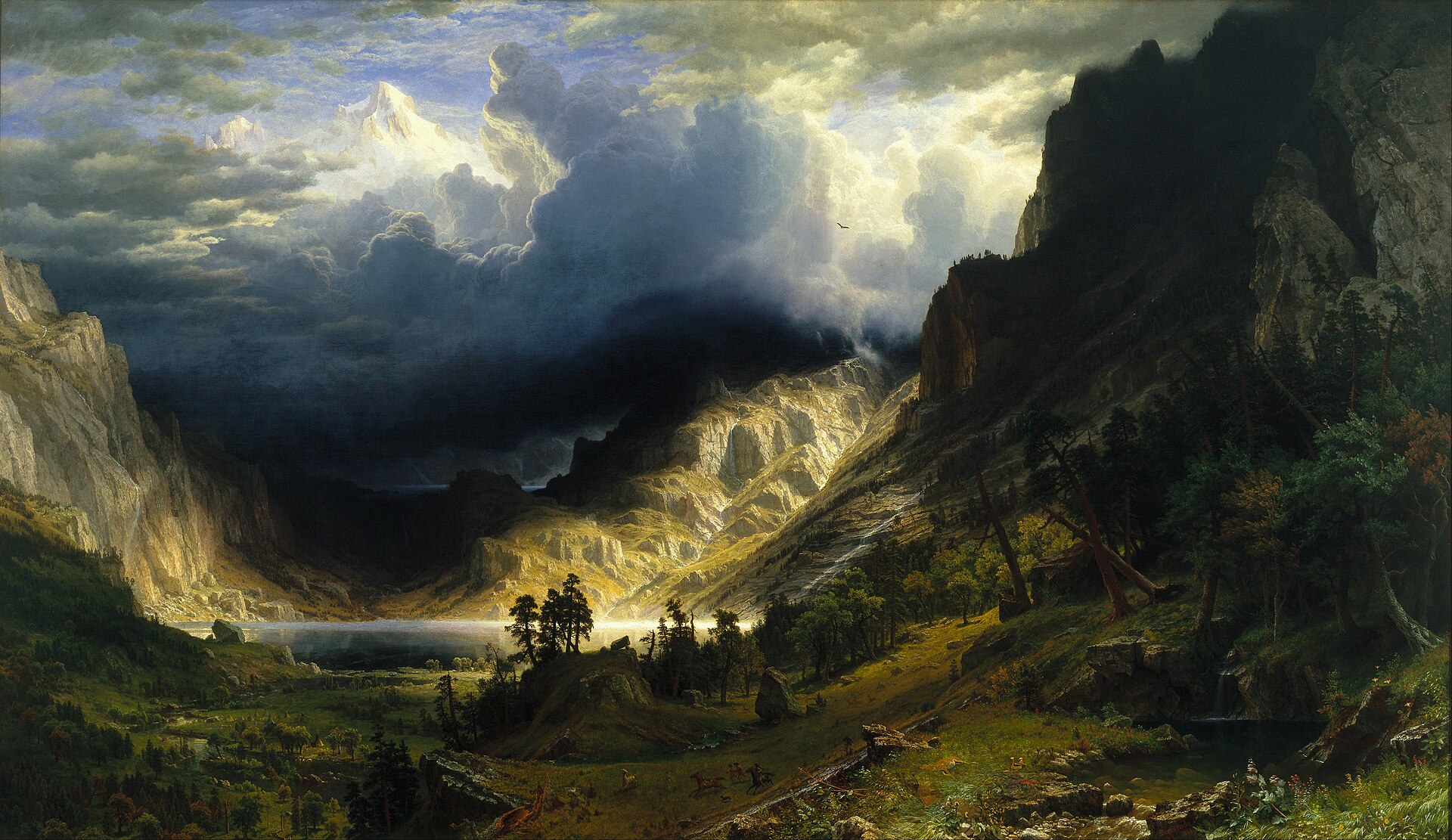
A Storm in the Rocky Mountains, Mt. Rosalie. Albert Bierstadt, 1866. Wikimedia Commons. Public domain.